

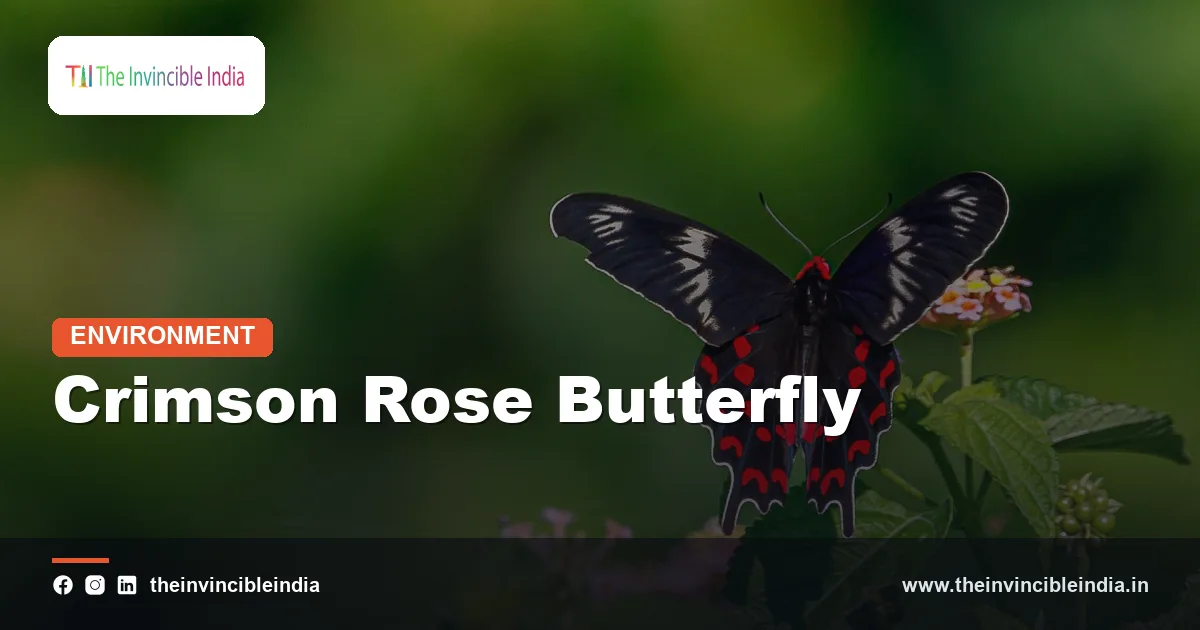
The crimson rose butterfly (Pachliopta hector) is a black, long-tailed swallowtail of the family Papilionidae, easily recognised by its crimson body and the white patch on its hindwings, and it is found mainly in peninsular India and Sri Lanka. The crimson rose butterfly is toxic to predators because its caterpillars feed on Aristolochia plants, and that chemical protection makes it one of the best-known “models” in Indian butterfly mimicry.
This explainer covers how to identify the crimson rose butterfly, where it lives, what its caterpillars eat, why birds avoid it, which other butterflies imitate it, how it moves with the seasons, and how gardeners can support it. Information was last reviewed on 23 October 2026.
| Quick Fact | Detail |
|---|---|
| Common name | Crimson rose |
| Scientific name | Pachliopta hector (Linnaeus, 1758) |
| Family | Papilionidae (swallowtails), tribe Troidini (the “roses” and birdwings) |
| Wingspan | Roughly 90 to 110 mm in adults |
| Range | Peninsular India, with records in parts of the east and north-west, and Sri Lanka |
| Caterpillar host plant | Aristolochia indica (Indian birthwort or Ishwarmul) and related Aristolochia species |
| Defence | Aristolochic acids taken in by the caterpillar, plus bright warning colours |
| Role in mimicry | Model for Batesian mimics such as the female common mormon, form romulus |
| Conservation note | Widely cited among butterflies protected under India’s Wildlife (Protection) Act, 1972; locally common in suitable habitat |
Key Takeaways
- The crimson rose butterfly (Pachliopta hector) is a black swallowtail with a crimson body and a white patch on the hindwing, native to peninsular India and Sri Lanka.
- Caterpillars of the crimson rose butterfly feed on Aristolochia plants such as Aristolochia indica and store their poisonous aristolochic acids in their bodies.
- Predators such as birds learn to avoid the crimson rose butterfly because of its bitter taste and conspicuous colours, a strategy called aposematism.
- The female common mormon (form romulus) imitates the crimson rose butterfly, an example of Batesian mimicry in Indian butterflies.
- The crimson rose butterfly is a strong, slow flier that visits flowers such as lantana and ixora, and it can be attracted to gardens that grow its host vine.
- The crimson rose butterfly is not a mass long-distance migrant like the tiger and crow butterflies, but it shows seasonal movements and sometimes gathers in numbers during the monsoon months.
What Is the Crimson Rose Butterfly?
The crimson rose butterfly is a medium-to-large swallowtail butterfly, scientifically named Pachliopta hector, that belongs to the “roses”, a group of unpalatable, slow-flying swallowtails in Asia. The word “rose” in its name does not refer to a flower; it describes the crimson-red markings on the body and wings.
Carl Linnaeus described the species in 1758 as Papilio hector, using the name of the Trojan prince in Homer’s Iliad, a naming habit he applied to many swallowtails. The species was later moved to the genus Pachliopta. In older field guides, the crimson rose appears under the name Atrophaneura hector, and some books still use that spelling.
The crimson rose butterfly shares its genus with the common rose (Pachliopta aristolochiae), another black-and-red Indian swallowtail. Both species depend on Aristolochia vines and both advertise their toxicity through colour, which is why beginners often confuse them.
How Do You Identify a Crimson Rose Butterfly?
A crimson rose butterfly is identified by its velvety black wings, a clear white patch on each hindwing, a row of red spots near the hindwing margin, and a bright crimson body, especially on the head, thorax and the sides of the abdomen. The hindwing outline is slightly scalloped and carries a short tail, so the species looks more compact than the large, long-tailed black swallowtails of the genus Papilio.
Key field marks
- Forewings: elongated, velvety black with pale streaks along the veins that look greyish in good light.
- Hindwings: a large whitish or cream patch in the middle, bordered by black, with crimson spots along the outer edge.
- Body: crimson-red on the head and thorax, with red markings along the abdomen.
- Flight: slow, floating and deliberate, which is itself a signal of toxicity, since a palatable butterfly would usually fly in a quicker, more erratic manner.
Males and females
Males and females look broadly alike, and the sexes are most easily separated by size and by close examination of the abdomen tip. Females are typically slightly larger and rounder-winged, but field distinctions are subtle, so most observers record the species without sexing it.
Where Does the Crimson Rose Butterfly Live in India?
The crimson rose butterfly lives mainly in peninsular India and Sri Lanka, in scrub, deciduous woodland, plantations, village edges and gardens where its Aristolochia host plants grow. It is commonly reported from the Western Ghats, the Deccan plateau and the Eastern Ghats, and it has also been recorded in parts of Gujarat, Odisha and West Bengal.
The butterfly prefers warm, moderately humid habitats from sea level to the foothills of hill ranges. Where the host vine has been cleared for agriculture, the crimson rose often disappears locally, so its presence is a modest sign that wild birthwort still grows in the area.
Because records come from citizen-science platforms and regional checklists, exact distribution maps change as more observations are uploaded. Readers should treat range boundaries, especially in the north and east, as approximate rather than fixed.
What Does the Crimson Rose Butterfly Caterpillar Eat?
The crimson rose butterfly caterpillar eats the leaves of Aristolochia plants, mainly Aristolochia indica, a slender climber known in English as Indian birthwort and in Hindi and other languages as Ishwarmul. These plants are the only reliable food source for the larvae, so the butterfly’s life cycle is tied directly to them.
The four stages of the life cycle
- Egg: the female lays small round eggs, usually singly or in small groups, on the young leaves and tender shoots of the host vine.
- Larva: the caterpillar is dark reddish-brown with fleshy projections along its body, often with pale bands, a shape that warns of toxicity and resembles a thorny object to a predator.
- Pupa: the chrysalis is attached to a stem or leaf by a silk girdle and tail pad and is held upright or at an angle against the plant, where its colour helps it blend with the surroundings.
- Adult: the butterfly emerges after about one to two weeks in the pupal stage in warm weather, dries its wings, and begins feeding on nectar.
Development from egg to adult usually takes about a month in warm conditions, although timing varies with temperature and food supply. In some regions, several generations can occur in one year, especially during and after the monsoon, when fresh leaves are plentiful.
Why Is the Crimson Rose Butterfly Toxic?
The crimson rose butterfly is toxic because its caterpillars absorb aristolochic acids from Aristolochia leaves and keep them in their tissues through metamorphosis into the adult. This process is called sequestration, and it gives the butterfly a built-in chemical defence that many predators find bitter or sickening.
Aristolochic acids are plant chemicals that discourage grazing insects and mammals. The caterpillar is not harmed by the compounds in the quantities it eats, but a bird that bites the caterpillar or butterfly tastes them and learns to avoid similar prey in future. This learning is the foundation of aposematism, where bright or distinctive colours serve as an honest signal of unpleasantness.
Not every predator is deterred, and a small number of specialised insects, spiders or birds may still attack the crimson rose. However, in general terms, a naive bird that has once tasted a crimson rose is far less likely to attack a black-and-red swallowtail again. This is the same logic seen in the monarch and its relatives in other parts of the world.
It is worth noting that aristolochic acids are harmful to humans in large quantities, which is why the plant is regulated in medicine in many countries. Handling the butterfly is not dangerous, but eating the plant or its extracts is not safe.
How Does the Crimson Rose Butterfly Act as a Mimicry Model?
The crimson rose butterfly acts as a model in Batesian mimicry, meaning that other, harmless butterflies imitate its warning pattern to gain protection from predators that have learned to avoid it. The best-known Indian example is the female common mormon (Papilio polytes), one of whose forms, called romulus, closely resembles the crimson rose and its relatives.
In Batesian mimicry, the mimic is palatable, the model is toxic, and the mimic benefits only when it is rarer than the model. If mimics became more common than models, predators would learn that the pattern is not reliable. The crimson rose butterfly’s frequent presence across peninsular India therefore helps keep the system working.
The mimicry in the common mormon is also an example of polymorphism, because females occur in several forms. One form resembles the male in appearance, while others copy distasteful roses. Geneticists have studied the control of this pattern, and it is regarded as a classic case study in evolutionary biology.
| Butterfly | Role | How it relates to the crimson rose |
|---|---|---|
| Crimson rose (Pachliopta hector) | Toxic model | Defends itself through aristolochic acids and warning colours |
| Common rose (Pachliopta aristolochiae) | Toxic relative | Shares the host plants and warning pattern; part of a Mullerian-style ring of toxic species |
| Common mormon, form romulus (Papilio polytes) | Batesian mimic | Palatable female form that copies the red-and-black pattern |
| Other mimetic swallowtails | Possible mimics | Some regional forms imitate Aristolochia-feeding swallowtails to a lesser degree |
Does the Crimson Rose Butterfly Migrate?
The crimson rose butterfly is not a true long-distance migrant, but it makes local and seasonal movements that follow rainfall, flowering and the growth of its host plants. Observers in southern and western India have reported larger numbers in the post-monsoon months, with butterflies drifting through valleys and along forest edges.
These movements are less dramatic than the mass migrations of the common crow, blue tiger and dark blue tiger, which stream through the Western Ghats before and after the monsoon. For the crimson rose, the pattern is better described as seasonal dispersal and local concentration than as a defined migratory route.
Because butterfly movement is difficult to track, scientific detail on crimson rose movement is limited compared with better-studied species. Counts by citizen scientists, especially during organised butterfly walks and annual counts, are gradually adding to what is known.
Behaviour linked to the seasons
- Mud-puddling: males often gather at damp soil or riverbanks to take up minerals and salts.
- Nectar feeding: adults visit lantana, ixora, jatropha and other bright flowers, often fluttering their wings while feeding.
- Roosting: butterflies commonly rest in shaded foliage at night and in the heat of the day.
How Can You Attract Crimson Rose Butterflies to a Garden?
You can attract crimson rose butterflies to a garden by growing the caterpillar host plant, Aristolochia indica, together with nectar flowers such as lantana, ixora and pentas, and by avoiding pesticides. The caterpillar host plant matters most, because adults will only breed where the vine is present.
- Plant Aristolochia indica or another locally appropriate native Aristolochia on a trellis or fence in partial sun.
- Add nectar sources such as ixora, lantana, pentas and jatropha near the vine.
- Avoid chemical sprays, because caterpillars are small and sensitive to insecticides.
- Accept some leaf damage; chewed leaves are a sign that the plant is working as a nursery.
- Offer a shallow, damp patch of soil or sand for mud-puddling in dry months.
Gardeners should avoid planting Aristolochia species that are not native to the region, since some introduced varieties can be invasive or can attract caterpillars of species that cannot digest them. Local nurseries and butterfly societies can advise on suitable plants.
Is the Crimson Rose Butterfly Protected in India?
The crimson rose butterfly is widely cited as a protected butterfly under India’s Wildlife (Protection) Act, 1972, and collecting or trading it is regulated. Readers should check the current schedules of the Act, since the lists have been updated over time, and rules vary for research, education and trade.
In practice, the crimson rose is locally common wherever Aristolochia grows, and global assessments do not treat it as a threatened species. The main long-term risks are habitat clearing, loss of host vines, pesticide use and pressure from illegal collection for the specimen trade.
Citizen-science efforts, butterfly parks and school gardens have helped bring public attention to swallowtails like the crimson rose. Planting native host vines is one of the simplest and most effective conservation actions an ordinary household can take.
How Is the Crimson Rose Different From the Common Rose?
The crimson rose differs from the common rose mainly in its larger white hindwing patch, its more strongly crimson-red head and body, and its slightly larger size. The common rose (Pachliopta aristolochiae) typically shows a smaller whitish patch, more extensive red on the abdomen tip, and a broader band of red spots on the hindwing.
| Feature | Crimson rose | Common rose |
|---|---|---|
| Scientific name | Pachliopta hector | Pachliopta aristolochiae |
| Hindwing patch | Prominent white or cream patch | Smaller, narrower pale patch |
| Body colour | Crimson on head and thorax | Red on abdomen and head |
| Range | Mostly peninsular India and Sri Lanka | Very widespread across India and South and Southeast Asia |
| Host plant | Aristolochia indica and relatives | Aristolochia species |
| Rarity | Locally common | Often more abundant and widespread |
Because the two species fly together in many places, careful photographs of the hindwing and abdomen are the best way to record them correctly. Beginners often start by calling both “rose” and refining the identification later.
Why Does the Crimson Rose Butterfly Matter to India?
The crimson rose butterfly matters to India because it is a clear example of chemical defence, mimicry and plant-insect partnerships that can be seen in ordinary gardens and village edges. It also acts as an indicator of healthy native vegetation and as an easy species for beginners to learn.
The butterfly also ties together several ecological stories: pollination while feeding on nectar, food-web roles as prey, and evolutionary lessons through its mimics. Teachers use the crimson rose and the common mormon to explain natural selection in a way that students can observe directly.
Bottom Line
The crimson rose butterfly is a toxic black-and-crimson swallowtail whose survival depends on Aristolochia vines, and whose warning colours are copied by harmless butterflies such as the female common mormon. Planting native host vines and avoiding pesticides are the simplest ways to keep it in Indian gardens and village landscapes.
Frequently Asked Questions
What is a crimson rose butterfly?
The crimson rose butterfly (Pachliopta hector) is a black swallowtail with a crimson body and a white patch on each hindwing, native to peninsular India and Sri Lanka. It belongs to the family Papilionidae. Its caterpillars feed on Aristolochia plants, which makes the adults toxic to many predators.
Why is the crimson rose butterfly poisonous?
The crimson rose butterfly is poisonous because its caterpillars absorb aristolochic acids from Aristolochia leaves and keep them in their bodies as adults. Birds that taste these chemicals learn to avoid the butterfly. The bright colours act as a warning signal that predators remember.
What does the crimson rose butterfly caterpillar eat?
The caterpillar of the crimson rose butterfly eats the leaves of Aristolochia plants, mainly Aristolochia indica, known as Indian birthwort or Ishwarmul. The female lays eggs on the young leaves of this vine. Without the host plant, the butterfly cannot complete its life cycle.
Which butterfly mimics the crimson rose?
The female common mormon (Papilio polytes), in its form romulus, is the best-known mimic of the crimson rose butterfly. This is Batesian mimicry, because the mormon is harmless and copies the pattern of a toxic species. Predators that avoid the crimson rose also tend to avoid the mimic.
Does the crimson rose butterfly migrate?
The crimson rose butterfly is not a true long-distance migrant, but it makes local and seasonal movements linked to the monsoon and flowering. Larger numbers are often seen in the months after the rains. Its movements are less dramatic than the mass migrations of crows and tigers in the Western Ghats.
How can I attract crimson rose butterflies to my garden?
Grow the host vine Aristolochia indica along with nectar flowers such as lantana, ixora and pentas, and avoid pesticides. The host plant is essential, since the female lays eggs only on it. A damp patch of soil for mud-puddling can also help in dry months.
{“@context”:”https://schema.org”,”@graph”:[{“@type”:”FAQPage”,”mainEntity”:[{“@type”:”Question”,”name”:”What is a crimson rose butterfly?”,”acceptedAnswer”:{“@type”:”Answer”,”text”:”The crimson rose butterfly (Pachliopta hector) is a black swallowtail with a crimson body and a white patch on each hindwing, native to peninsular India and Sri Lanka. It belongs to the family Papilionidae. Its caterpillars feed on Aristolochia plants, which makes the adults toxic to many predators.”}},{“@type”:”Question”,”name”:”Why is the crimson rose butterfly poisonous?”,”acceptedAnswer”:{“@type”:”Answer”,”text”:”The crimson rose butterfly is poisonous because its caterpillars absorb aristolochic acids from Aristolochia leaves and keep them in their bodies as adults. Birds that taste these chemicals learn to avoid the butterfly. The bright colours act as a warning signal that predators remember.”}},{“@type”:”Question”,”name”:”What does the crimson rose butterfly caterpillar eat?”,”acceptedAnswer”:{“@type”:”Answer”,”text”:”The caterpillar of the crimson rose butterfly eats the leaves of Aristolochia plants, mainly Aristolochia indica, known as Indian birthwort or Ishwarmul. The female lays eggs on the young leaves of this vine. Without the host plant, the butterfly cannot complete its life cycle.”}},{“@type”:”Question”,”name”:”Which butterfly mimics the crimson rose?”,”acceptedAnswer”:{“@type”:”Answer”,”text”:”The female common mormon (Papilio polytes), in its form romulus, is the best-known mimic of the crimson rose butterfly. This is Batesian mimicry, because the mormon is harmless and copies the pattern of a toxic species. Predators that avoid the crimson rose also tend to avoid the mimic.”}},{“@type”:”Question”,”name”:”Does the crimson rose butterfly migrate?”,”acceptedAnswer”:{“@type”:”Answer”,”text”:”The crimson rose butterfly is not a true long-distance migrant, but it makes local and seasonal movements linked to the monsoon and flowering. Larger numbers are often seen in the months after the rains. Its movements are less dramatic than the mass migrations of crows and tigers in the Western Ghats.”}},{“@type”:”Question”,”name”:”How can I attract crimson rose butterflies to my garden?”,”acceptedAnswer”:{“@type”:”Answer”,”text”:”Grow the host vine Aristolochia indica along with nectar flowers such as lantana, ixora and pentas, and avoid pesticides. The host plant is essential, since the female lays eggs only on it. A damp patch of soil for mud-puddling can also help in dry months.”}}]}]}


