

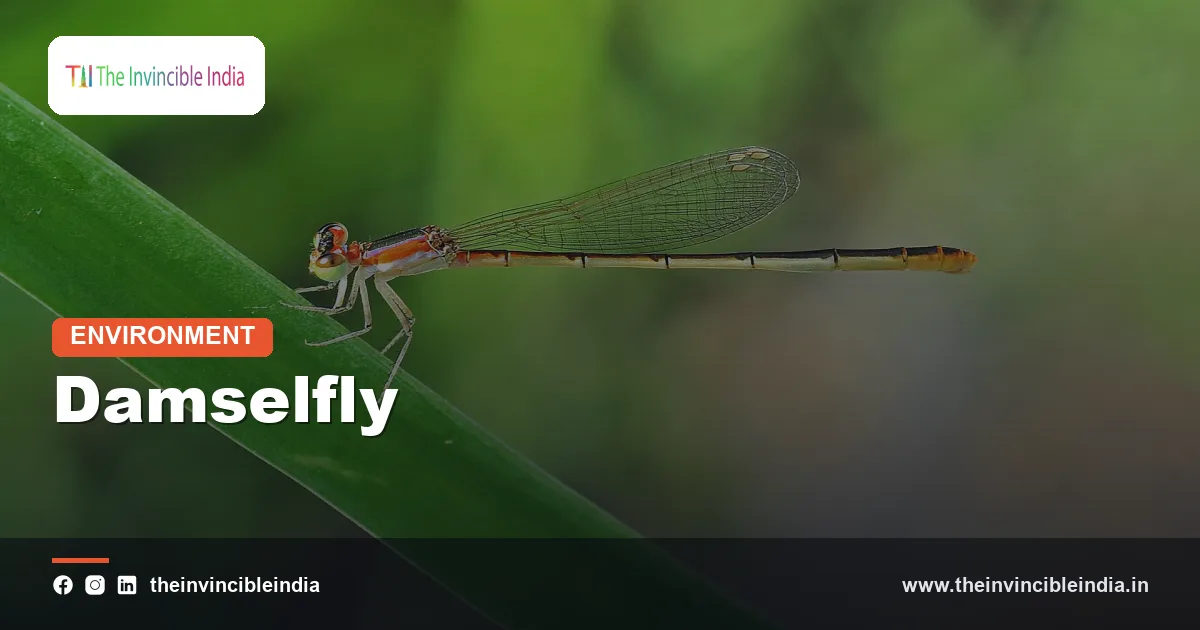
A damselfly is a slender, predatory flying insect of the suborder Zygoptera in the order Odonata, the same order as dragonflies, recognised by its thin body, widely separated eyes and wings that are usually held folded together along the abdomen at rest. Damselflies are found beside ponds, paddy fields, streams, marshes and lakes across India, where the adults hunt small flying insects and the young live underwater as aquatic larvae.
Because damselflies spend part of their lives in water and part in the air, they are closely tied to the health of freshwater habitats and are valued as natural controllers of mosquitoes and midges. This explainer covers what a damselfly is, how it differs from a dragonfly, the main damselfly families in India, how the insect hunts and breeds, and why it matters.
Quick Facts
| Order | Odonata (damselflies and dragonflies) |
|---|---|
| Suborder | Zygoptera (damselflies); dragonflies belong to the suborder Anisoptera |
| Typical families in India | Coenagrionidae, Platycnemididae, Lestidae, Calopterygidae, Chlorocyphidae, Euphaeidae and Platystictidae |
| Size | Body length mostly about 2 to 6 cm, depending on species |
| Wings | Two pairs of similar, narrow, transparent wings, usually folded along the body at rest |
| Habitat | Ponds, paddy fields, marshes, slow rivers, hill streams and lake margins |
| Diet | Adults eat small flying insects such as midges and mosquitoes; larvae eat small aquatic animals |
| Life cycle stages | Egg, aquatic larva (nymph), then emergence as a winged adult; no pupal stage |
Key Takeaways
- A damselfly is an insect of the suborder Zygoptera in the order Odonata and is a close relative of the dragonfly.
- Damselflies typically hold their wings folded along the body at rest, while most dragonflies hold their wings open and flat.
- Damselfly larvae live underwater and breathe through three leaf-like gills at the tip of the abdomen.
- Both adult and larval damselflies are predators, feeding on small insects, and so help to limit mosquito and midge populations.
- Damselflies pass through incomplete metamorphosis, with egg, larva and adult stages but no pupa.
- The presence of damselflies at a pond or stream is generally taken as a sign of reasonably clean, unpolluted fresh water.
What is a damselfly?
A damselfly is a predatory flying insect with a long, thin abdomen, two pairs of narrow wings and large compound eyes, belonging to the suborder Zygoptera of the order Odonata. The name Odonata comes from a Greek word for “toothed”, which refers to the toothed jaws of these insects.
Damselflies are among the oldest groups of winged insects. Their ancestors flew in the Carboniferous period, around 300 million years ago, long before birds and flowering plants appeared. Modern damselflies have a body plan that has changed little over a very long time.
In India, damselflies are found from the plains to the high hills, and from the Western Ghats and the north-east to the Himalaya. India has well over 400 recorded species of Odonata, and damselflies make up a substantial share of them, with new records still being made by field naturalists.
How is a damselfly different from a dragonfly?
A damselfly differs from a dragonfly mainly in body build and wing posture: damselflies are slimmer, have eyes set wide apart on the sides of the head, and usually fold their wings along the body, while dragonflies are stouter, have large eyes that nearly meet and hold their wings flat and open. Both belong to the order Odonata.
| Feature | Damselfly (Zygoptera) | Dragonfly (Anisoptera) |
|---|---|---|
| Body | Slender and delicate | Stout and strong |
| Eyes | Widely separated, set on the sides of the head | Large, usually touching or very close on top of the head |
| Wing shape | Fore and hind wings similar in shape and size | Hind wings broader at the base than the fore wings |
| Wings at rest | Usually folded along the body (spreadwings partly open) | Held open and flat to the sides |
| Flight | Weak, fluttering and low | Strong, fast and often high |
| Larva | Slender, with three external caudal gills | Stout, with internal gills in the rectum |
A quick field rule is to look at the wings. If the insect settles on a reed and closes its wings over its back like a slim stick, it is almost certainly a damselfly. If it perches with wings spread wide, it is almost certainly a dragonfly.
What are the main types of damselflies in India?
The main types of damselflies in India are grouped into families such as Coenagrionidae (pond damselflies), Platycnemididae (featherlegs), Lestidae (spreadwings), Calopterygidae (demoiselles), Chlorocyphidae (jewels), Euphaeidae (gossamerwings) and Platystictidae (shadowdamsels). Each family has its own look and habitat.
| Family | Common name | Typical habitat and features |
|---|---|---|
| Coenagrionidae | Pond damselflies, bluets, dartlets | Ponds, paddy fields and marshes; small, often blue, green, red or yellow |
| Platycnemididae | Featherlegs, bush darts | Streams and shaded water; some males have flattened, feathery legs |
| Lestidae | Spreadwings | Still, weedy water; hold wings partly open at rest |
| Calopterygidae | Demoiselles, glories | Forest streams; broad, often metallic wings |
| Chlorocyphidae | Jewels | Hill streams; brilliantly coloured, often with metallic bodies |
| Euphaeidae | Gossamerwings | Fast, rocky streams; delicate wings, often with dark tips |
| Platystictidae | Shadowdamsels | Shaded forest streams; very slim, often found in dim light |
Familiar Indian examples include the Coromandel marsh dart (Ceriagrion coromandelianum), a yellow-and-green damselfly of ponds and gardens, and the pygmy dartlet (Agriocnemis pygmaea), among the smallest damselflies in the country. The stream glory (Neurobasis chinensis) is a showy metallic-green species of hill streams.
Where do damselflies live?
Damselflies live near fresh water, because their larvae develop underwater and the adults need nearby vegetation to perch, hunt and lay eggs. They are found around ponds, paddy fields, marshes, ditches, slow rivers, hill streams and the weedy edges of lakes.
Different groups prefer different waters. Pond damselflies of the family Coenagrionidae are the ones most likely to be seen in gardens, village tanks and paddy fields. Jewels, glories and gossamerwings are typical of clean hill and forest streams, particularly in the Western Ghats, the Himalayan foothills and the north-east. Spreadwings favour still, weedy pools that dry out at some seasons.
Habitat quality matters a great deal. Many stream-dwelling species need shade, clean flowing water and intact bankside vegetation, and they disappear when streams are polluted, silted up or stripped of trees.
What do damselflies eat?
Damselflies eat other small animals: adults catch small flying insects such as mosquitoes, midges, small flies and tiny moths, while larvae eat aquatic invertebrates including mosquito larvae, water fleas, small crustaceans and tadpoles. The insect is a predator at every stage of life.
Adults hunt by sight. Many species do not chase prey over open air, as dragonflies do, but pick insects from leaves and stems or snatch them in short sorties from a perch. Their legs are held in a basket-like cage that scoops prey and passes it to the mouthparts.
Larvae lie in wait among water plants and use a hinged, extendable lower lip, called the labium, which shoots out to seize prey. Because mosquito larvae are a regular part of their diet, damselfly larvae make a small but real contribution to keeping mosquito numbers down in ponds and ditches.
What is the life cycle of a damselfly?
A damselfly’s life cycle has three stages: egg, aquatic larva (also called a nymph) and winged adult, and the insect develops by incomplete metamorphosis, so there is no pupal stage. Most of its life is spent as a larva underwater, and the adult stage is comparatively short.
Egg
The female lays eggs in or on water plants, often slitting open a stem or leaf with a blade-like egg-laying organ called an ovipositor and placing the eggs inside. Some species descend below the surface to lay eggs, while others lay them just above the water line.
Larva
The larva hatches and lives underwater. It is slender and has three leaf-like gills at the end of its abdomen. It moults many times as it grows, gradually developing wing buds on its back. This stage can last from a few weeks to many months, depending on species, water temperature and food.
Emergence and adult
When ready, the larva climbs a reed or stem out of the water, its skin splits, and the adult pulls itself out. The wings expand and harden over a few hours. A newly emerged adult is pale and soft, and it flies away from the water to feed and mature before returning to breed.
How do damselflies mate and lay eggs?
Damselflies mate in a distinctive position called the wheel or heart shape, in which the male grips the female behind the head with claspers at the end of his abdomen, and she curves her abdomen up to meet his secondary genitals near the base of his abdomen. The pair is often seen flying in tandem over the water.
After mating, many males continue to hold the female while she lays eggs, a form of mate guarding that prevents other males from mating with her. This guarded egg-laying can be seen on floating leaves and reed stems in ponds. In some species the pair may even submerge together.
Males of many species defend small territories along the water’s edge. Metallic-winged species of hill streams perform courtship displays, flashing their coloured wings to attract females and to ward off rivals.
Why are damselflies important?
Damselflies are important because they control insect populations, serve as food for other animals and act as indicators of freshwater quality. As both larval and adult predators, they take large numbers of mosquitoes and midges, and they in turn are eaten by fish, frogs, birds, spiders and larger dragonflies.
Because many species are sensitive to pollution and loss of bankside vegetation, scientists and nature groups use damselfly surveys to judge the health of streams, ponds and wetlands. A pond with many different damselfly species is usually clean and well vegetated, while a polluted one will hold only a few hardy species.
Damselflies also have a cultural and educational value. Citizen-science surveys of dragonflies and damselflies in parts of India involve students and nature groups and add to knowledge of where species occur.
Are damselflies harmful to humans?
No, damselflies are not harmful to humans: they do not bite or sting, and they carry no known diseases that affect people. They are beneficial insects that are best left undisturbed.
A damselfly may land on a hand or a hat, but this is a harmless act of perching. Its jaws are small and its prey consists of tiny insects, so there is nothing to fear. The only real concern is for the damselflies themselves, since their fragile wings are easily damaged by handling.
How can you watch damselflies?
You can watch damselflies by visiting a pond, paddy field edge or stream on a warm, sunny morning and scanning perches such as reeds, grass stems and floating leaves. Damselflies are most active in bright weather, when they hunt and mate.
- Go slowly and keep your shadow off the water, since damselflies are sensitive to movement.
- Carry binoculars with close focus or a camera with a macro lens to see colour and markings.
- Note the wing posture, the colour of the eyes and the pattern on the tail end, as these help in identification.
- Visit during and after the monsoon, when many species are breeding and numbers peak.
- Avoid catching or squeezing the insects, and do not trample bankside plants.
Bottom Line
The damselfly is a delicate but efficient predator that links water and air, feeding on mosquitoes and midges while serving as an indicator of clean fresh water. Learning to tell damselflies from dragonflies, and to know their main families, opens up a rewarding corner of Indian nature watching that needs only a pond and some patience.
Frequently Asked Questions
What is a damselfly?
A damselfly is a slender predatory insect of the suborder Zygoptera in the order Odonata, closely related to the dragonfly. It has a thin body, widely separated eyes and wings that are usually folded along the abdomen at rest. Damselflies live near fresh water, where their larvae develop.
What is the difference between a damselfly and a dragonfly?
A damselfly is slimmer than a dragonfly, has eyes set far apart and usually folds its wings along its body, whereas a dragonfly is stouter, has large eyes that nearly touch and holds its wings open and flat. Damselfly flight is weaker and more fluttering. Both belong to the order Odonata.
What do damselflies eat?
Adult damselflies eat small flying insects such as mosquitoes, midges and tiny flies, and their larvae eat small aquatic animals such as mosquito larvae and water fleas. They hunt by sight and seize prey with their legs or mouthparts. This makes them natural controllers of small pest insects.
How long do damselflies live?
Adult damselflies usually live for only a few weeks, while the larval stage underwater can last from several weeks to many months. The exact period depends on species, temperature and food supply. Most of the life of a damselfly is spent as a larva before it emerges as a winged adult.
Do damselflies bite or sting?
No, damselflies do not sting, and they are not known to bite people in any harmful way. Their jaws are meant for catching tiny insects. They are harmless and beneficial, and they should be watched rather than handled.
Why are damselflies a sign of clean water?
Damselflies are considered a sign of clean water because many species need unpolluted water and healthy bankside plants to breed. Their larvae are sensitive to pollution, silt and loss of vegetation. A pond or stream with many damselfly species generally has good water quality.
{“@context”:”https://schema.org”,”@graph”:[{“@type”:”FAQPage”,”mainEntity”:[{“@type”:”Question”,”name”:”What is a damselfly?”,”acceptedAnswer”:{“@type”:”Answer”,”text”:”A damselfly is a slender predatory insect of the suborder Zygoptera in the order Odonata, closely related to the dragonfly. It has a thin body, widely separated eyes and wings that are usually folded along the abdomen at rest. Damselflies live near fresh water, where their larvae develop.”}},{“@type”:”Question”,”name”:”What is the difference between a damselfly and a dragonfly?”,”acceptedAnswer”:{“@type”:”Answer”,”text”:”A damselfly is slimmer than a dragonfly, has eyes set far apart and usually folds its wings along its body, whereas a dragonfly is stouter, has large eyes that nearly touch and holds its wings open and flat. Damselfly flight is weaker and more fluttering. Both belong to the order Odonata.”}},{“@type”:”Question”,”name”:”What do damselflies eat?”,”acceptedAnswer”:{“@type”:”Answer”,”text”:”Adult damselflies eat small flying insects such as mosquitoes, midges and tiny flies, and their larvae eat small aquatic animals such as mosquito larvae and water fleas. They hunt by sight and seize prey with their legs or mouthparts. This makes them natural controllers of small pest insects.”}},{“@type”:”Question”,”name”:”How long do damselflies live?”,”acceptedAnswer”:{“@type”:”Answer”,”text”:”Adult damselflies usually live for only a few weeks, while the larval stage underwater can last from several weeks to many months. The exact period depends on species, temperature and food supply. Most of the life of a damselfly is spent as a larva before it emerges as a winged adult.”}},{“@type”:”Question”,”name”:”Do damselflies bite or sting?”,”acceptedAnswer”:{“@type”:”Answer”,”text”:”No, damselflies do not sting, and they are not known to bite people in any harmful way. Their jaws are meant for catching tiny insects. They are harmless and beneficial, and they should be watched rather than handled.”}},{“@type”:”Question”,”name”:”Why are damselflies a sign of clean water?”,”acceptedAnswer”:{“@type”:”Answer”,”text”:”Damselflies are considered a sign of clean water because many species need unpolluted water and healthy bankside plants to breed. Their larvae are sensitive to pollution, silt and loss of vegetation. A pond or stream with many damselfly species generally has good water quality.”}}]}]}


