

The dark grass blue (Zizeeria karsandra) is a tiny dusky-blue butterfly of the family Lycaenidae that lives on lawns, road verges, wasteland and other grassy open ground across India, and it is among the smallest butterflies a person is likely to see in a city. Its wings span only about two to three centimetres, so it is easily mistaken for a moth or overlooked altogether as it flutters a few centimetres above the ground.
Despite its size, the dark grass blue is one of the most widespread and adaptable butterflies in the country. Its caterpillars feed on common low-growing weeds, which means the species thrives wherever grass and weedy herbs are allowed to grow, from village paths to school playgrounds. This article explains how to recognise it, what it eats, how it breeds and why such an ordinary little insect matters.
| Quick Facts | Details |
|---|---|
| Common name | Dark grass blue |
| Scientific name | Zizeeria karsandra (Moore, 1865) |
| Family and subfamily | Lycaenidae (gossamer-winged butterflies), subfamily Polyommatinae (the blues) |
| Wingspan | Roughly 20 to 30 mm |
| Larval host plants | Creeping woodsorrel (Oxalis corniculata) and a few other low weedy herbs |
| Range and habitat in India | Found across most of the country in lawns, gardens, roadsides, fallow land and grassy clearings, mostly at low and middle elevations |
| Broods | Several overlapping generations a year, most abundant in and after the monsoon |
| Flight | Low, short, jerky flights close to the ground; settles often |
Key Takeaways
- The dark grass blue (Zizeeria karsandra) is a small lycaenid butterfly with a wingspan of roughly 20 to 30 millimetres, which makes it one of the smallest butterflies in India.
- Caterpillars of the dark grass blue feed mainly on creeping woodsorrel (Oxalis corniculata), a common weed of lawns and damp ground.
- Males of the dark grass blue show a dusky violet-blue upperside with dark margins, while females are usually browner and duller.
- The dark grass blue breeds in several overlapping broods a year and is most numerous during and just after the monsoon.
- The dark grass blue is a lawn and wasteland butterfly, so it is often the first butterfly to colonise new, open, weedy patches in towns.
- Pesticide-free, unmown patches of weeds are the simplest way to support the dark grass blue in a garden or school ground.
What is the dark grass blue butterfly?
The dark grass blue butterfly is a small member of the “blues”, a large group of lycaenid butterflies that are typically tiny, delicate and often coloured blue on the upperside. The scientific name Zizeeria karsandra places it in the genus Zizeeria, a small group of grass blues that are found mainly in the warmer parts of Asia, Africa and Australasia.
Butterflies are classified in the insect order Lepidoptera, and the family Lycaenidae is the second-largest family of butterflies in the world by number of species. Many lycaenids are small, many have caterpillars that are short and slug-like, and many have unusual relationships with ants. The dark grass blue follows this general pattern, although it is a plain and unfussy member of the family.
The word “grass” in its name refers to the type of habitat where it is usually found rather than to its food. It is the weeds growing within the grass, particularly woodsorrel, that feed its caterpillars. The word “dark” distinguishes it from paler relatives such as the pale grass blue, with which it can be confused in the field.
How do you identify a dark grass blue?
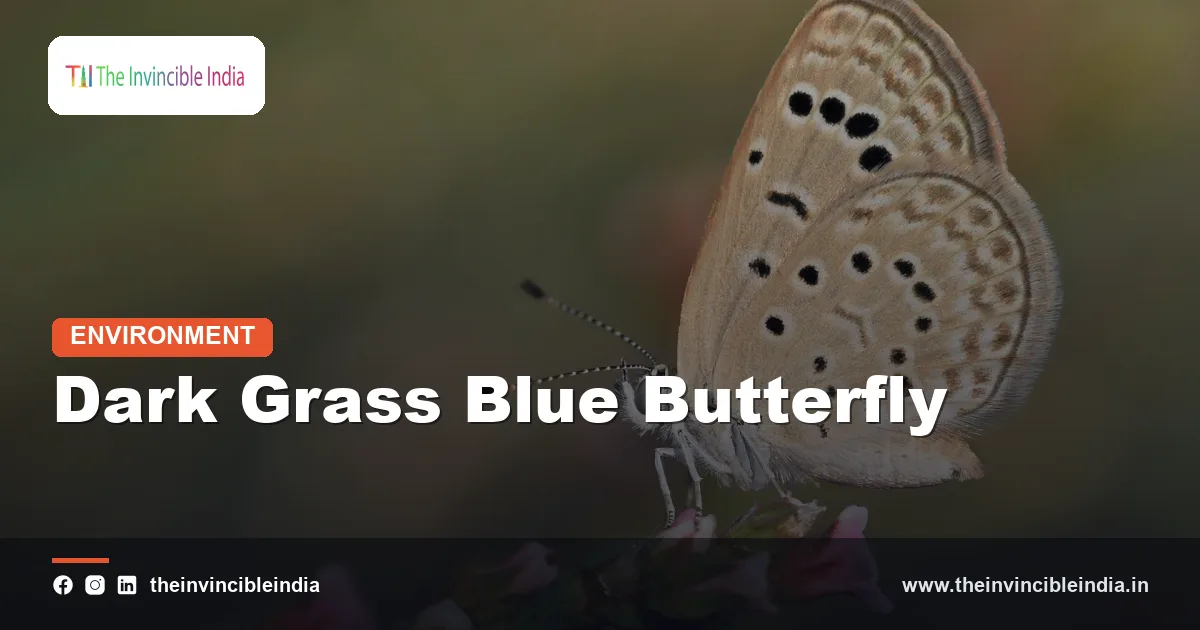
A dark grass blue is identified by its very small size, its dusky upperside with a violet-blue tinge in males, and a pale grey-brown underside patterned with small black spots ringed in white. Most people see the underside first, because the butterfly usually perches with its wings folded upright over its back.
Upperside
The male’s upperside is a dull violet-blue or blue-grey colour bordered by a dark brown edge that is broader than in many other blues. The female is usually brown, sometimes with a faint blue dusting near the wing bases. Both sexes look dark at a glance, which explains the common name.
Underside
The underside is a pale brownish-grey and carries a neat series of small dark spots, each ringed in white. There is typically a curved row of spots on the forewing and a scatter of spots on the hindwing, along with fine marginal markings. The exact tone and the size of the spots vary between individuals and between seasonal forms.
Seasonal variation
Many grass blues look different in the wet season and the dry season. Wet-season individuals tend to be darker and more heavily marked, while dry-season individuals can look paler and plainer. This variation is one reason why identification of small blues often depends on looking at several individuals rather than a single one.
Look-alikes
Several other tiny blues share the same habitat, and they are easily confused. The table below lists the ones most often mistaken for the dark grass blue.
| Butterfly | Scientific name | How it differs |
|---|---|---|
| Dark grass blue | Zizeeria karsandra | Dusky upperside, dark broad borders, small white-ringed spots below |
| Pale grass blue | Pseudozizeeria maha | Paler upperside and a generally lighter appearance |
| Lesser grass blue | Zizina otis | Slightly larger, clearer blue upperside and a plainer underside |
| Tiny grass blue | Zizula hylax | Even smaller, with banded markings on the underside |
| Grass jewel | Freyeria trochylus | Brown upperside and a bright orange-ringed black spot on the hindwing underside |
Where does the dark grass blue live in India?
The dark grass blue lives across most of India, wherever there are open, grassy or weedy places at low and middle elevations. It is common on lawns, in parks, along roadsides and canal banks, in fallow fields, around village edges and in the waste ground that develops on construction sites.
Outside India the species is found widely in tropical and subtropical Asia, and related populations extend to other warm regions. Within India, the dark grass blue is not restricted to one biome. It is recorded from the plains of the north to the peninsula and from the coastal belt to the foothills, wherever its host plants grow.
Because the butterfly prefers open and disturbed ground, it benefits from some of the changes humans make to the landscape. A cleared plot that sprouts weeds after the first rain will often attract dark grass blues within weeks. In dense forest, by contrast, the species is usually absent or confined to clearings and trail edges.
Moisture matters more than temperature. In dry regions the butterfly is most active after rain, when woodsorrel and grasses flush with new growth. In wetter regions it can be seen almost throughout the year, although numbers dip in the coldest weeks and in the driest months.
What do dark grass blue caterpillars eat?
Dark grass blue caterpillars eat the leaves and soft shoots of low-growing weedy herbs, and the best-known host plant is creeping woodsorrel, Oxalis corniculata. This is a small, clover-like plant with yellow flowers that grows on lawns, pavements, flower pots and damp ground throughout India.
Woodsorrel is generally regarded as a nuisance weed by gardeners, which makes the butterfly’s association with it a good example of how ordinary plants carry hidden ecological value. A patch of woodsorrel that is left to grow can support caterpillars through every stage of growth, and the plant regrows quickly after being nibbled.
Records suggest that the caterpillars may also use a small number of other low herbs. Observers should therefore be cautious about assuming that every grass blue caterpillar is on woodsorrel. As with many butterflies, the host plant list varies by region, and local observations are valuable.
The adult butterflies feed on nectar, usually from small, shallow flowers that suit their short mouthparts. Common choices include the flowers of low weeds and the tiny flowers of lawn herbs. Males also gather at damp patches of soil to drink moisture and dissolved minerals, a behaviour known as puddling.
What is the life cycle of the dark grass blue?
The life cycle of the dark grass blue has four stages, namely egg, caterpillar, pupa and adult, and in warm weather the whole cycle can be completed in roughly a month. Like all butterflies, the species undergoes complete metamorphosis, in which the body is rebuilt entirely during the pupal stage.
Egg
The female lays tiny pale eggs singly on the young leaves, buds or stems of the host plant. A single female may deposit many eggs over her short life, spreading them over several plants so that not all offspring are lost to a single predator.
Caterpillar
The caterpillar is short, flattened and slug-like, usually green or yellowish-green and covered in fine hairs. It grows through a number of moults, called instars, feeding on the host plant. Its small size and green colour make it very hard to find in the field.
Pupa
When it is fully grown, the caterpillar forms a small pupa, often on the host plant or in leaf litter nearby. The pupa is held by a fine silk girdle and is usually pale green or brownish, blending with its surroundings. In warm weather the adult emerges after several days.
Adult
The adult lives for a short time, usually one to a few weeks, during which it feeds, mates and, in the case of females, lays eggs. Because the generations overlap, all stages can often be found on the same patch of weeds in the same week.
| Stage | What happens | Approximate duration in warm weather |
|---|---|---|
| Egg | Laid singly on leaves, buds or stems | A few days |
| Caterpillar | Feeds and moults several times | About two weeks |
| Pupa | Body is reorganised inside the pupal case | About a week |
| Adult | Feeds on nectar, mates, lays eggs | One to a few weeks |
These durations are only approximate, because temperature strongly affects development. Cool weather slows every stage, while warm and humid conditions speed them up.
How do ants relate to the dark grass blue?
Ants are often associated with lycaenid caterpillars, and the dark grass blue belongs to a family in which many species are tended by ants that feed on sweet secretions produced by the caterpillar. Many lycaenid caterpillars have a special gland on the back that releases a sugary liquid, and ants that drink it may defend the caterpillar from small predators and parasites.
The strength of this partnership differs widely between species. Some lycaenids depend completely on ants, a few are even carried into ant nests, and others have only a casual relationship. Observers have recorded ants near grass blue caterpillars, but it would be wrong to assume that every caterpillar is guarded.
For a gardener, the lesson is that a patch of weeds is not a single organism but a small community. Caterpillars, ants, aphids, spiders and wasps interact there, and removing one part of the community can change the others.
Why is the dark grass blue ecologically important?
The dark grass blue is ecologically important because it is a pollinator of small flowers, a food source for insect-eating animals and a sensitive indicator of how a patch of ground is managed. It is not a rare or dramatic species, yet it plays several steady roles in the food web of lawns and grasslands.
- Food for predators: Eggs, caterpillars and adults are eaten by spiders, ants, wasps, small lizards, birds and dragonflies.
- Pollination: By visiting tiny flowers close to the ground, the butterfly moves pollen between plants that larger pollinators often ignore.
- Recycling: Caterpillars convert leaf tissue into body mass, and their droppings return nutrients to the soil.
- Indicator value: Frequent mowing, herbicides and pesticides reduce its numbers quickly, so a healthy population suggests a more tolerant landscape.
Because the dark grass blue tolerates disturbance, it is not threatened in the way that forest-dependent butterflies are. Its presence is nonetheless a pleasant sign that some weedy corner of a town has been left alone long enough for the food chain to function.
When and where can you see the dark grass blue?
The dark grass blue can be seen on warm, sunny days, usually from mid-morning to late afternoon, in places where its weedy host plants grow. It is most numerous during and after the monsoon, when new growth appears on lawns and wasteland.
The best approach is to walk slowly along the edge of a lawn or weedy path and watch the ground. The butterfly rises in short, hopping flights and settles again within a few metres, often on a flower head or a blade of grass. It tends to close its wings immediately on landing, so the underside is the view most observers get.
A few practical tips can help. Early morning and overcast weather make the butterflies less active, so they can be approached more easily. Photographing from a low angle shows the underside spots clearly, which helps with identification. A small hand lens or a close-focus camera is far more useful than binoculars for such a tiny insect.
How can you help the dark grass blue in your garden?
You can help the dark grass blue by letting a small patch of lawn or garden grow wild, avoiding pesticides, and tolerating woodsorrel and other low weeds that act as caterpillar food. Almost no special effort is required, because this butterfly tends to find suitable spots on its own.
- Leave a corner of the lawn unmown during the monsoon so that woodsorrel and flowering weeds can mature.
- Avoid weedkillers and insecticides, which kill caterpillars and eggs on contact.
- Keep a shallow dish of damp sand or soil to allow males to puddle.
- Plant or permit small nectar flowers that grow close to the ground.
- Record sightings with date and place so that the information can be shared with butterfly groups and citizen-science projects.
Schools and housing societies can turn such patches into small “butterfly corners” that teach children how food chains work. A plot of only a few square metres can support several species of tiny butterflies if it is left undisturbed.
Bottom Line
The dark grass blue is a small, plain, easily overlooked butterfly, but it is one of the best examples of how everyday weeds and lawns support wildlife. Its caterpillars depend on common plants such as creeping woodsorrel, and its adults thrive wherever the ground is left a little wild. Learning to recognise it is a good first step towards noticing the many tiny creatures that live beneath ordinary human attention.
Frequently Asked Questions
What is a dark grass blue butterfly?
A dark grass blue is a tiny lycaenid butterfly, scientifically named Zizeeria karsandra, found on grassy and weedy ground across India. It has a wingspan of only about 20 to 30 millimetres. Males show a dusky violet-blue upperside while females are browner.
What do dark grass blue caterpillars feed on?
Dark grass blue caterpillars feed mainly on creeping woodsorrel (Oxalis corniculata), a common weed of lawns and damp ground. A few other low weedy herbs may also be used in some places. The adults drink nectar from small, shallow flowers.
Is the dark grass blue found all over India?
The dark grass blue is found across most of India, mainly at low and middle elevations in open, grassy or weedy habitats. It is common in lawns, parks, roadsides and fallow land. It is usually absent from dense forest interiors.
How long does the dark grass blue live?
The adult dark grass blue usually lives for one to a few weeks. The full life cycle from egg to adult can take about a month in warm weather. Several generations overlap during the year, so butterflies can be seen for much of the year in warmer regions.
How can you tell a dark grass blue from other small blues?
A dark grass blue is told apart by its very small size, its dusky upperside with dark borders and the small white-ringed black spots on its pale grey-brown underside. Similar species such as the pale grass blue, lesser grass blue and tiny grass blue differ in shade, size and underside markings. Looking at several individuals and checking the underside pattern gives the most reliable identification.
Is the dark grass blue endangered?
The dark grass blue is not considered endangered, because it is widespread and tolerates disturbed, weedy habitats. Its numbers can still fall locally where lawns are heavily mown, sprayed with pesticides or paved over. Allowing small weedy patches to grow helps local populations.
{“@context”:”https://schema.org”,”@graph”:[{“@type”:”FAQPage”,”mainEntity”:[{“@type”:”Question”,”name”:”What is a dark grass blue butterfly?”,”acceptedAnswer”:{“@type”:”Answer”,”text”:”A dark grass blue is a tiny lycaenid butterfly, scientifically named Zizeeria karsandra, found on grassy and weedy ground across India. It has a wingspan of only about 20 to 30 millimetres. Males show a dusky violet-blue upperside while females are browner.”}},{“@type”:”Question”,”name”:”What do dark grass blue caterpillars feed on?”,”acceptedAnswer”:{“@type”:”Answer”,”text”:”Dark grass blue caterpillars feed mainly on creeping woodsorrel (Oxalis corniculata), a common weed of lawns and damp ground. A few other low weedy herbs may also be used in some places. The adults drink nectar from small, shallow flowers.”}},{“@type”:”Question”,”name”:”Is the dark grass blue found all over India?”,”acceptedAnswer”:{“@type”:”Answer”,”text”:”The dark grass blue is found across most of India, mainly at low and middle elevations in open, grassy or weedy habitats. It is common in lawns, parks, roadsides and fallow land. It is usually absent from dense forest interiors.”}},{“@type”:”Question”,”name”:”How long does the dark grass blue live?”,”acceptedAnswer”:{“@type”:”Answer”,”text”:”The adult dark grass blue usually lives for one to a few weeks. The full life cycle from egg to adult can take about a month in warm weather. Several generations overlap during the year, so butterflies can be seen for much of the year in warmer regions.”}},{“@type”:”Question”,”name”:”How can you tell a dark grass blue from other small blues?”,”acceptedAnswer”:{“@type”:”Answer”,”text”:”A dark grass blue is told apart by its very small size, its dusky upperside with dark borders and the small white-ringed black spots on its pale grey-brown underside. Similar species such as the pale grass blue, lesser grass blue and tiny grass blue differ in shade, size and underside markings. Looking at several individuals and checking the underside pattern gives the most reliable identification.”}},{“@type”:”Question”,”name”:”Is the dark grass blue endangered?”,”acceptedAnswer”:{“@type”:”Answer”,”text”:”The dark grass blue is not considered endangered, because it is widespread and tolerates disturbed, weedy habitats. Its numbers can still fall locally where lawns are heavily mown, sprayed with pesticides or paved over. Allowing small weedy patches to grow helps local populations.”}}]}]}


