

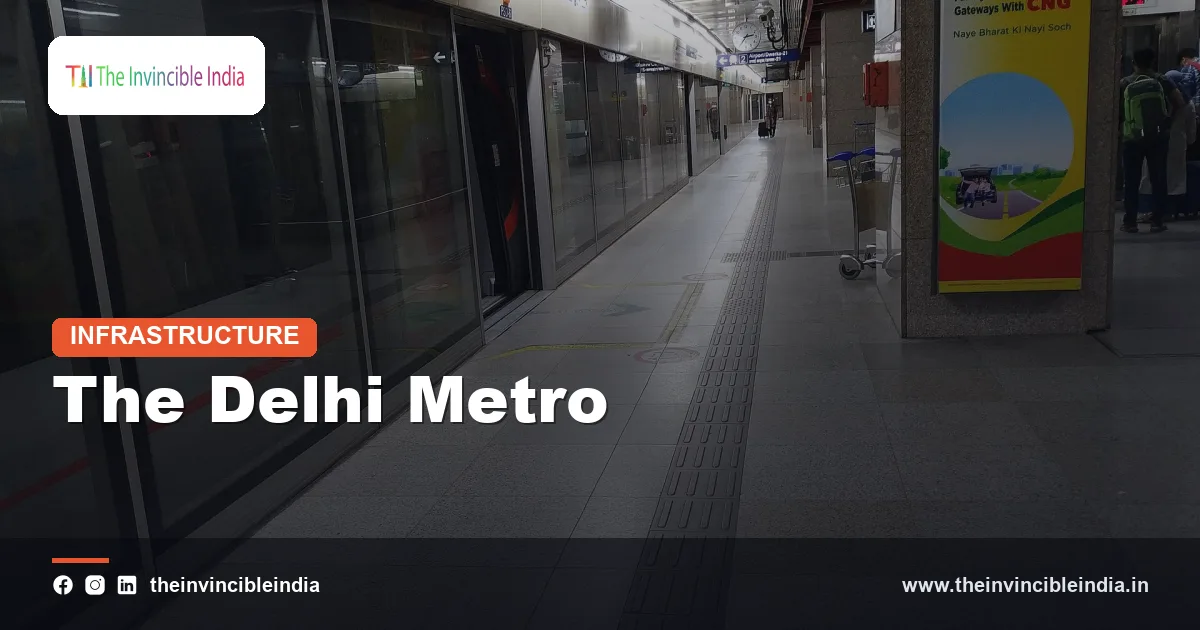
The Delhi Metro is a rapid transit system serving Delhi and the surrounding National Capital Region (NCR), built and operated by the Delhi Metro Rail Corporation (DMRC), whose first line opened in December 2002. It is one of the largest metro networks in the world and the first modern metro system in India to be built on time and on a national scale, and it links Delhi with the satellite cities of Gurugram, Noida, Ghaziabad, Faridabad and Bahadurgarh.
The Delhi Metro is identified by colour-coded lines, such as the Red, Yellow, Blue, Green, Violet, Pink, Magenta and Grey lines, together with the Airport Express line. Under the leadership of E. Sreedharan, DMRC became a benchmark for project discipline in the country, and the system also became the first railway project in the world to earn carbon credits under a United Nations mechanism. 15 October 2026
Quick Facts
| Attribute | Details |
|---|---|
| System | Delhi Metro, a rapid transit network for Delhi and the NCR |
| Operator and builder | Delhi Metro Rail Corporation (DMRC) |
| Ownership | Joint venture of the Government of India and the Government of the National Capital Territory of Delhi, in equal shares |
| Company incorporated | 1995 |
| First line opened | 24 December 2002 (Shahdara to Tis Hazari, now part of the Red Line) |
| Headquarters | Metro Bhawan, Barakhamba Road, New Delhi |
| Network | Well over 300 km of lines and over 250 stations across Delhi and the NCR |
| Construction phases | Phase I (2002-2006), Phase II (2006-2011), Phase III (2011-2019), Phase IV (under way) |
| Notable first | First railway project in the world to earn carbon credits under the UN Clean Development Mechanism (2007) |
Key Takeaways
- The Delhi Metro is built and run by the Delhi Metro Rail Corporation (DMRC), which was incorporated in 1995 as an equal joint venture of the Government of India and the Government of the National Capital Territory of Delhi.
- The Delhi Metro opened its first line on 24 December 2002 between Shahdara and Tis Hazari and has grown in phases to a network of several hundred kilometres across the National Capital Region.
- E. Sreedharan, popularly called the “Metro Man”, led the Delhi Metro Rail Corporation as managing director for roughly fourteen years and shaped its reputation for completing work on time.
- The Delhi Metro became the first railway project in the world to earn carbon credits under the United Nations Clean Development Mechanism, largely because of its regenerative braking systems.
- The Delhi Metro carries a very large number of passengers every day, ranking it among the busiest metro networks in the world.
- The Delhi Metro has introduced driverless train operation on its newer lines, and its success influenced metro projects in many other Indian cities.
What is the Delhi Metro?
The Delhi Metro is a mass rapid transit system that uses electric trains running on dedicated tracks, mostly elevated or underground, to move passengers across Delhi and the NCR. The Delhi Metro Rail Corporation (DMRC) plans, builds and operates the network, and it is a public sector company under the Ministry of Housing and Urban Affairs.
The system was created to relieve the strain on Delhi’s roads, which were overwhelmed by private vehicles and unreliable bus services by the late 1990s. Unlike the older suburban railway and the city’s bus network, the Delhi Metro offers fast, frequent and predictable service that is largely separated from road traffic.
It is also a financial and institutional model. The project was funded through equity from the central and Delhi governments, together with long-term, low-interest loans from the Japan International Cooperation Agency (JICA), and it has been cited as an example of how large urban projects can be delivered with discipline.
When did the Delhi Metro start, and how was it built in phases?
The Delhi Metro started operating on 24 December 2002 with its first stretch from Shahdara to Tis Hazari, and it has since expanded through successive construction phases. The idea of a metro for Delhi dates back to studies done in the 1960s and 1980s, but planning moved decisively in the 1990s, and DMRC was set up in 1995.
Construction of the first line began in 1998, and the legal framework was supported by the Delhi Metro Railway (Operation and Maintenance) Act, 2002, which complements the Metro Railways (Construction of Works) Act, 1978. Each phase has expanded the network outward from the city centre.
| Phase | Approximate period | What it added |
|---|---|---|
| Phase I | 2002-2006 | The first Red, Yellow and Blue line corridors, including the first underground sections |
| Phase II | 2006-2011 | Extensions to Gurugram, Noida and outer Delhi, the Violet Line and the Airport Express line |
| Phase III | 2011-2019 | The Magenta and Pink lines, many extensions and the beginning of driverless technology |
| Phase IV | From 2019 onward | New priority corridors and extensions that are being built in stages |
Phase I was completed ahead of schedule, and Phase II was timed to be ready for the 2010 Commonwealth Games, which is widely noted as an example of the corporation meeting a national deadline. Phase III added lines such as the Magenta Line and Pink Line, and the Phase IV works build further corridors to serve outlying areas.
Who runs the Delhi Metro?
The Delhi Metro is run by the Delhi Metro Rail Corporation (DMRC), which is headquartered at Metro Bhawan on Barakhamba Road in New Delhi. DMRC is an equal joint venture between the Government of India and the Government of the National Capital Territory of Delhi, and its board includes representatives of both.
DMRC handles planning, design, construction, operation and maintenance of the network. It also acts as a consultant for other metro and rapid transit projects in India and abroad, and its engineers and project managers have trained teams that later worked on metros in cities such as Jaipur, Kochi and Lucknow.
It is worth noting that not every metro line in the NCR is operated by DMRC. The Noida-Greater Noida Metro, known as the Aqua Line, is run by a separate company, the Noida Metro Rail Corporation (NMRC), and the Rapid Metro in Gurugram has been operated by a private company. These services connect with the DMRC network but are run independently.
What are the lines of the Delhi Metro?
The Delhi Metro has a set of colour-coded lines that cover the main corridors of Delhi and the NCR, and each line has a name and colour used on maps, trains and signage. The Red, Yellow, Blue, Green, Violet, Pink, Magenta and Grey lines are the main lines, and the Airport Express line serves the airport.
| Line | General role |
|---|---|
| Red Line | Runs across north and east Delhi, toward Ghaziabad, and was the first line to open |
| Yellow Line | Runs north to south through the heart of the city and on to Gurugram, with a long underground stretch |
| Blue Line | Runs east to west from Dwarka in west Delhi to Noida and Vaishali, with a branch |
| Green Line | Serves west Delhi and extends to Bahadurgarh in Haryana |
| Violet Line | Runs from central Delhi to the south and then toward Faridabad |
| Pink Line | A large orbital line that circles much of the city |
| Magenta Line | Runs from the west to the southwest and links Noida and the Botanical Garden area, with driverless trains |
| Grey Line | A short line serving Dwarka and Najafgarh |
| Airport Express line | A high-speed link between New Delhi, the airport and Dwarka |
Because the lines intersect at interchange stations, a passenger can move between corridors without leaving the system. Rajiv Chowk in central Delhi, for example, is the major interchange between the Yellow and Blue lines, and Kashmere Gate links the Red, Yellow and Violet lines.
How big is the Delhi Metro, and how many people use it?
The Delhi Metro is one of the largest metro networks in the world, with well over 300 kilometres of operating lines and more than 250 stations, and it carries several million passenger journeys on busy days. Exact figures change as new sections open, so the numbers are best understood as approximate.
In terms of scale, the network is the largest metro system in India, and it ranks among the top systems in the world by length and by the number of riders. Peak-hour trains are frequent and heavily used, which has led DMRC to add more coaches and to run longer trains on busy corridors.
Several features support the heavy ridership:
- Frequency: Trains run at intervals of a few minutes during peak hours.
- Integration: Interchange stations, feeder buses and last-mile services link the metro to other modes.
- Ticketing: Smart cards, tokens and the National Common Mobility Card allow tap-and-go travel.
- Accessibility: Lifts, tactile paths, women’s coaches and priority seats are standard.
Who was E. Sreedharan, and what was his role?
E. Sreedharan is an Indian civil engineer, widely known as the “Metro Man”, who served as the managing director of the Delhi Metro Rail Corporation and led the construction of the first three phases. He had earlier gained national attention for rebuilding the Pamban Bridge in 1964 after a cyclone, and for completing the Konkan Railway through very difficult terrain.
At DMRC, Sreedharan insisted on strict timelines, transparent contracts and a work culture that avoided delay and corruption. He set a rule that the corporation would use modern technology and professional project management, and the early success of Phase I helped win public trust and political support for the metro.
He received many honours, including the Padma Shri, the Padma Vibhushan and the Legion of Honour from France. After leaving DMRC, he continued to advise on metro and rail projects in India, and his methods are still cited as a template for public infrastructure delivery.
How is the Delhi Metro the first railway to earn UN carbon credits?
The Delhi Metro became the first railway project in the world to earn carbon credits under the United Nations Clean Development Mechanism (CDM) when its project was registered in 2007, because regenerative braking and the shift of passengers from road transport reduce greenhouse gas emissions. The mechanism is part of the Kyoto Protocol framework and allows emission-reducing projects in developing countries to earn tradable credits.
Regenerative braking works by converting the kinetic energy of a braking train into electricity that is fed back into the power system, instead of dissipating it as heat. This reduces the net electricity consumed from the grid. In addition, every passenger who travels by metro and not by car or two-wheeler reduces the fuel burned on the road.
DMRC has also adopted other environmental measures over the years, such as solar power installations on station roofs and depots, energy-efficient lighting and rainwater harvesting at selected stations. These steps are part of the corporation’s wider effort to cut its carbon footprint.
What technology does the Delhi Metro use?
The Delhi Metro uses electric multiple unit trains powered by overhead lines at 25 kV AC, and its newer lines use communication-based train control (CBTC) that allows driverless operation. The first lines were built on broad gauge, while later lines were built on standard gauge, which is the global norm for metros.
The Magenta Line saw the first driverless trains on the network, and the Pink Line also adopted the technology. Driverless operation allows trains to run closer together with fewer errors, and it makes it easier to adjust service to demand.
Key technology features
- Automatic train protection: Systems keep trains at safe speeds and distances.
- Platform screen doors: Doors at certain stations improve safety and cut the entry of dust and noise.
- Underground and elevated sections: The network combines tunnels, elevated viaducts and at-grade sections, depending on the terrain and available space.
- Centralised control: An operations control centre monitors traffic, power and safety across the network.
How has the Delhi Metro affected congestion and pollution?
The Delhi Metro has reduced road congestion and vehicular pollution by shifting many daily trips from cars, two-wheelers and buses to rail, though it has not removed traffic jams from the city entirely. Delhi continues to have a very large and growing number of private vehicles, and the metro has absorbed a large share of the demand rather than eliminating it.
Studies and DMRC’s own estimates suggest the system takes many thousands of vehicles off the road each day and cuts fuel use and emissions. The air quality of Delhi is influenced by many sources, including dust, crop burning, industry and weather, so the metro is one useful measure within a larger set of actions.
The benefits go beyond emissions. Metro travel is safer than road travel, it is predictable in time, and it is accessible to women, students, senior citizens and persons with disabilities. Real estate and commercial activity have also grown around stations, which supports transit-oriented development.
What is the legacy of the Delhi Metro for other Indian cities?
The Delhi Metro served as a template for metro systems in other Indian cities such as Kolkata’s later extensions, Bengaluru, Mumbai, Chennai, Kochi, Jaipur, Lucknow and Hyderabad, and it helped create a national policy framework for urban rail. The Metro Rail Policy of 2017 draws on lessons from the Delhi experience, including those on financing, standards and technology.
Kolkata had the earliest metro in India, which opened in 1984, but the Delhi system demonstrated that a modern metro could be delivered on schedule and operated efficiently. DMRC’s consultancy work and training programmes spread this knowledge, and a large share of India’s metro engineers have worked in Delhi at some point.
Bottom Line
The Delhi Metro is a large, well-run public transport network that changed how people move around the NCR and set standards for urban rail across India. Its success came from clear leadership, strict timelines, modern technology and sustained public support.
Frequently Asked Questions
What is the Delhi Metro?
The Delhi Metro is a rapid transit system serving Delhi and the National Capital Region, built and operated by the Delhi Metro Rail Corporation (DMRC). Its first line opened in December 2002 and it has expanded to several hundred kilometres of colour-coded lines. It links Delhi with Gurugram, Noida, Ghaziabad, Faridabad and Bahadurgarh.
Who built the Delhi Metro?
The Delhi Metro was built by the Delhi Metro Rail Corporation, a joint venture of the Government of India and the Government of the National Capital Territory of Delhi. E. Sreedharan, known as the Metro Man, led the corporation as managing director through its first three phases. Construction was supported by long-term loans from the Japan International Cooperation Agency.
When did the Delhi Metro open?
The Delhi Metro opened on 24 December 2002 with a short line between Shahdara and Tis Hazari. Construction had begun in 1998, and DMRC itself was incorporated in 1995. The network has grown in phases since then, with further sections still being added.
How many lines does the Delhi Metro have?
The Delhi Metro has a number of colour-coded lines, including the Red, Yellow, Blue, Green, Violet, Pink, Magenta and Grey lines, and the Airport Express line. The exact count of lines, stations and route kilometres changes as extensions open. Interchange stations such as Rajiv Chowk and Kashmere Gate connect the main corridors.
Why is the Delhi Metro called the first railway to earn carbon credits?
The Delhi Metro earned that distinction because the United Nations Clean Development Mechanism registered it in 2007 as the first railway project eligible for carbon credits. The credits arise from regenerative braking, which returns energy to the grid, and from reduced road traffic. This recognised the system’s contribution to cutting greenhouse gas emissions.
Is the Delhi Metro driverless?
Parts of the Delhi Metro are driverless, because the newer Magenta and Pink lines use communication-based train control that allows trains to run without a driver on board. Older lines still operate with train operators. DMRC has been gradually extending automation across the network.
{“@context”:”https://schema.org”,”@graph”:[{“@type”:”FAQPage”,”mainEntity”:[{“@type”:”Question”,”name”:”What is the Delhi Metro?”,”acceptedAnswer”:{“@type”:”Answer”,”text”:”The Delhi Metro is a rapid transit system serving Delhi and the National Capital Region, built and operated by the Delhi Metro Rail Corporation (DMRC). Its first line opened in December 2002 and it has expanded to several hundred kilometres of colour-coded lines. It links Delhi with Gurugram, Noida, Ghaziabad, Faridabad and Bahadurgarh.”}},{“@type”:”Question”,”name”:”Who built the Delhi Metro?”,”acceptedAnswer”:{“@type”:”Answer”,”text”:”The Delhi Metro was built by the Delhi Metro Rail Corporation, a joint venture of the Government of India and the Government of the National Capital Territory of Delhi. E. Sreedharan, known as the Metro Man, led the corporation as managing director through its first three phases. Construction was supported by long-term loans from the Japan International Cooperation Agency.”}},{“@type”:”Question”,”name”:”When did the Delhi Metro open?”,”acceptedAnswer”:{“@type”:”Answer”,”text”:”The Delhi Metro opened on 24 December 2002 with a short line between Shahdara and Tis Hazari. Construction had begun in 1998, and DMRC itself was incorporated in 1995. The network has grown in phases since then, with further sections still being added.”}},{“@type”:”Question”,”name”:”How many lines does the Delhi Metro have?”,”acceptedAnswer”:{“@type”:”Answer”,”text”:”The Delhi Metro has a number of colour-coded lines, including the Red, Yellow, Blue, Green, Violet, Pink, Magenta and Grey lines, and the Airport Express line. The exact count of lines, stations and route kilometres changes as extensions open. Interchange stations such as Rajiv Chowk and Kashmere Gate connect the main corridors.”}},{“@type”:”Question”,”name”:”Why is the Delhi Metro called the first railway to earn carbon credits?”,”acceptedAnswer”:{“@type”:”Answer”,”text”:”The Delhi Metro earned that distinction because the United Nations Clean Development Mechanism registered it in 2007 as the first railway project eligible for carbon credits. The credits arise from regenerative braking, which returns energy to the grid, and from reduced road traffic. This recognised the system’s contribution to cutting greenhouse gas emissions.”}},{“@type”:”Question”,”name”:”Is the Delhi Metro driverless?”,”acceptedAnswer”:{“@type”:”Answer”,”text”:”Parts of the Delhi Metro are driverless, because the newer Magenta and Pink lines use communication-based train control that allows trains to run without a driver on board. Older lines still operate with train operators. DMRC has been gradually extending automation across the network.”}}]}]}


