

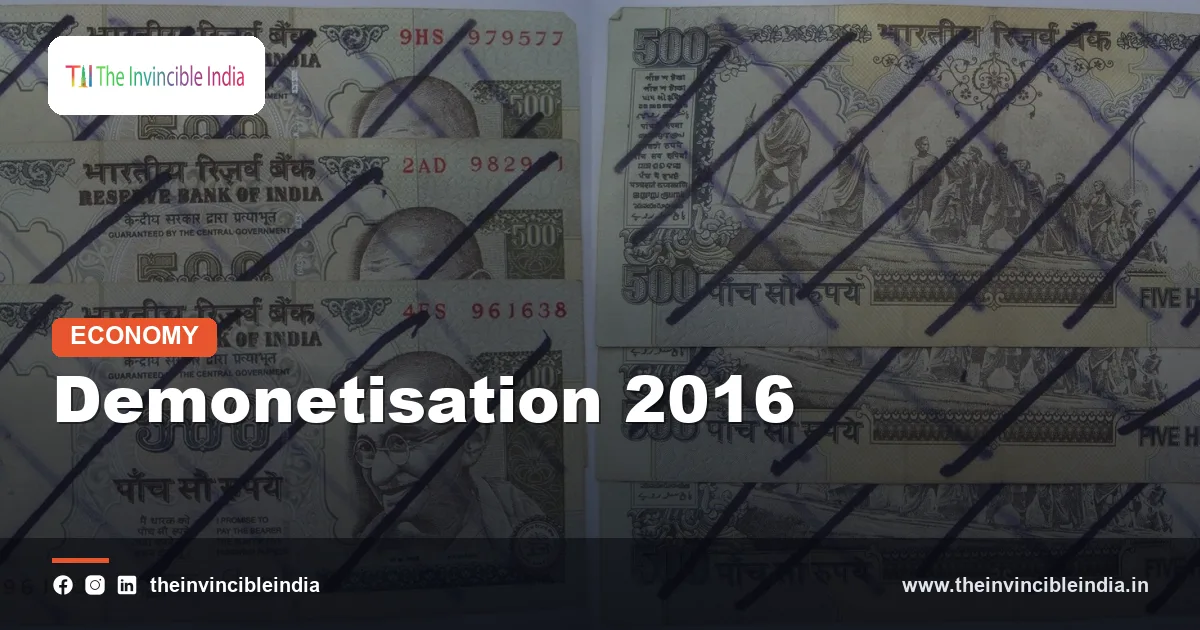
Demonetisation is the act of stripping a currency unit of its status as legal tender. In India, the term is most closely associated with the announcement made on the evening of 8 November 2016, when the Government declared that Rs 500 and Rs 1,000 banknotes would cease to be legal tender from midnight. The decision affected the bulk of the currency then in circulation by value and touched the daily life of almost every household and business in the country.
The move remains one of the most discussed economic decisions in modern Indian history. Supporters pointed to its stated objectives of tackling unaccounted wealth, counterfeit notes and the financing of illegal activity, while also encouraging digital payments. Critics questioned its costs, its execution and its measurable outcomes. This explainer sets out the facts, the sequence of events, the data released by the Reserve Bank of India (RBI) and the main strands of the continuing debate, without taking a side.
Quick Facts
| Item | Details |
|---|---|
| Date of announcement | 8 November 2016, in an address to the nation by the Prime Minister |
| Notes withdrawn | Rs 500 and Rs 1,000 banknotes of the Mahatma Gandhi Series |
| Share of cash by value | Roughly 86 per cent of currency in circulation |
| Legal route | Section 26(2) of the Reserve Bank of India Act, 1934, on the recommendation of the RBI Central Board |
| New notes introduced | New Rs 500 and Rs 2,000 notes of the Mahatma Gandhi (New) Series |
| Deposit window | Until 30 December 2016 at banks; later windows at the RBI for specified categories |
| Notes returned | RBI reported that roughly 99 per cent of the withdrawn notes came back into the banking system |
| Earlier demonetisations | 1946 and 1978 |
What Is Demonetisation and Why Do Governments Use It?
Demonetisation is a monetary measure in which a government or central bank declares that a particular denomination of currency can no longer be used for payments. Holders must exchange the notes for new ones or deposit them in bank accounts within a stated period. Because notes are not simply replaced one for one, the process forces large amounts of cash into the formal banking system, where it can be recorded.
Countries have used demonetisation for different reasons: replacing an old currency with a new one, curbing hyperinflation, defeating counterfeiting, or attacking the so-called parallel economy. The design choice that matters most is how much of the money supply is withdrawn and how quickly replacement notes can be supplied.
Earlier episodes in India
- 1946: shortly before Independence, the British Indian government demonetised Rs 500, Rs 1,000 and Rs 10,000 notes, mainly to deal with war-time profiteering and black money.
- 1978: the Janata Party government under Prime Minister Morarji Desai demonetised notes of Rs 1,000, Rs 5,000 and Rs 10,000. These notes were held by only a small section of the public, so the effect on ordinary people was limited.
- 2016: the most extensive of the three, because the withdrawn notes were the highest denominations in everyday use.
The Announcement of 8 November 2016
At around 8 pm on 8 November 2016, the Prime Minister announced in a televised address that Rs 500 and Rs 1,000 notes would stop being legal tender from midnight. The decision followed a meeting of the Union Cabinet and the recommendation of the RBI’s Central Board earlier the same day. Under the RBI Act, the Central Government can declare, on the recommendation of the Central Board, that specified series of banknotes shall cease to be legal tender.
The immediate rules
- The old notes could be deposited into bank accounts without a ceiling, though larger deposits attracted scrutiny under income tax rules.
- Exchange of old notes for new currency over the counter was permitted for a limited amount per person per day at first, and the limit was changed several times in the following weeks.
- Cash withdrawal limits were placed on bank accounts and ATMs, with higher limits for businesses holding current accounts.
- Certain essential services, such as government hospitals, pharmacies, railway and airline ticket counters and fuel stations, were permitted to accept the old notes for a limited period.
Banks were shut on 9 November 2016 and ATMs remained closed for a day or two so that they could be recalibrated for the new notes.
The Stated Objectives
The Government and the RBI described several goals, and these have been treated differently in later analysis. It is useful to separate the objectives that were stated at the time from those that were added or emphasised later.
Primary stated goals
- Black money: to disrupt hoards of unaccounted cash, or to bring such cash into the tax net if it was deposited.
- Counterfeit currency: to render fake high-value notes worthless, since counterfeit notes were seen as a security concern.
- Terror and illegal financing: to cut off money believed to be used for terrorism, insurgency and other illegal activity.
Goals that gained emphasis later
- Digital payments: to shift transactions from cash to digital channels such as cards, mobile wallets, the Unified Payments Interface (UPI) and net banking.
- Formalisation: to widen the base of taxpayers and bring more economic activity into formal, documented channels.
- Lower cash dependence: to reduce the overall ratio of cash in the economy.
The measure was also linked to other reforms of the period, including the Income Declaration Scheme of 2016 and the introduction of the Goods and Services Tax in 2017.
The New Notes and the Cash Crunch
To replace the withdrawn currency, the RBI introduced a new series. A redesigned Rs 500 note and an entirely new Rs 2,000 note, both in the Mahatma Gandhi (New) Series, began to be issued from 10 November 2016. The notes were smaller in size, had new colours and security features, and carried motifs such as the Mangalyaan on the Rs 2,000 note and the Red Fort on the Rs 500 note.
Why a shortage arose
The scale of the withdrawal created a mismatch between demand for cash and the supply of new notes. Printing presses needed time to produce the new denominations, and the Rs 2,000 note, being a large denomination, was difficult to use for small purchases without change. ATMs also had to be physically recalibrated, since the new notes had different dimensions.
Queues and daily life
For several weeks, long queues formed outside banks and ATMs. Sectors that relied heavily on cash, such as small retail, agriculture markets, construction, transport and informal labour, reported disruption. Weddings, medical expenses and daily wages posed particular difficulty for some households. Over the following months the supply of new notes gradually improved, and the withdrawal limits were progressively relaxed and then removed in early 2017.
Timeline of Key Events
| Date | Event |
|---|---|
| 8 November 2016 | Announcement: Rs 500 and Rs 1,000 notes cease to be legal tender at midnight |
| 10 November 2016 | New Rs 500 and Rs 2,000 notes begin to be issued; exchange counters open |
| December 2016 | BHIM app launched to promote UPI payments; digital incentives announced |
| 30 December 2016 | Last date for depositing the old notes at bank branches |
| Early 2017 | Withdrawal limits eased and then lifted in stages; Specified Bank Notes (Cessation of Liabilities) Act, 2017 enacted |
| 2018 | RBI annual report gives the figure of old notes returned to the system |
| 2 January 2023 | Supreme Court upholds the decision-making process by a 4:1 majority |
Measures to Handle Unaccounted Money
Alongside the note withdrawal, the Government introduced measures meant to deal with cash that had been kept outside the tax system. The Income Declaration Scheme, which ran for a limited window in 2016, gave persons a chance to disclose undeclared income by paying tax, a surcharge and a penalty. Following the withdrawal, the Taxation Laws (Second Amendment) Act, 2016 brought in the Pradhan Mantri Garib Kalyan Yojana, under which undisclosed income declared after the deposit of old notes was taxed at a higher rate and a portion was to be locked into a deposit scheme for a period.
Scrutiny of deposits
Large cash deposits made during the deposit window were examined by the Income Tax Department. Operation Clean Money, launched in early 2017, used data analytics to flag accounts whose deposits appeared inconsistent with their known income. The number of persons filing income tax returns rose in the following years, and the Government attributed this partly to the measure, while others attributed it to wider compliance reforms and technology.
Cooperative banks and the issue of old notes held by them drew special attention, since these institutions had a role in rural credit and some were initially restricted from exchanging notes.
Effect on Cash Use and Digital Payments
One of the more visible effects was a temporary surge in the use of digital payment tools. Prepaid wallets, card swipes at point-of-sale machines, and mobile banking all saw spikes in transaction volumes in the weeks after the announcement. The government supported this shift with incentives, including lower charges on certain digital transactions and consumer schemes such as the Lucky Grahak Yojana and the Digi Dhan Mela.
Long-run pattern
The National Payments Corporation of India had launched UPI in April 2016, a few months before demonetisation, and UPI went on to become the dominant retail digital payment system in India over the following years. Analysts differ on how much of this growth can be traced to demonetisation as against mobile phone penetration, low-cost data, bank account expansion through the Jan Dhan Yojana, and the design of UPI itself.
Cash did not disappear. The value of currency in circulation, which dropped sharply right after the withdrawal, rose again over the following years and eventually exceeded the pre-2016 level in nominal terms. Researchers have used this to argue both that cash remains deeply embedded in the economy and that digital payments have grown alongside it.
RBI Data on Notes Returned
The RBI’s annual report for 2017-18, published in August 2018, provided the most-cited figure on the outcome. It stated that of the old Rs 500 and Rs 1,000 notes in circulation on 8 November 2016, a very large proportion, roughly 99 per cent by value, had returned to the banking system. The remaining amount was small relative to the total.
How the figure was interpreted
- One reading held that such a high return rate suggested that most holders of unaccounted cash had found ways to deposit it, so the exercise did not eliminate black money held in cash.
- Another reading held that cash deposited does not mean the money has been legitimised, because the deposits could be traced and taxed, and that the key effect was the formal documentation of previously unrecorded money.
- Counterfeit detection figures reported by the RBI in subsequent years were also cited by both sides, with different conclusions drawn about whether fake notes had been substantially reduced.
The cost of printing the new notes and managing the exchange was also part of the accounting, and the RBI reported increased expenditure on printing in the period. The Rs 2,000 note, whose printing was reduced from 2018 and which was announced for withdrawal from circulation in May 2023, was itself a point of discussion.
The Economic Debate
Economists have not reached a single verdict on demonetisation, and the discussion has continued for years. Studies tend to differ on what is measured, over what period, and with which data, especially because a large share of Indian economic activity is informal and poorly captured by official statistics.
Arguments made in support
- It was a one-time shock that brought large volumes of cash into the formal system and gave tax authorities new data.
- It accelerated acceptance of digital payments and the use of bank accounts.
- It sent a signal against holding unaccounted wealth in cash and supported later formalisation measures.
Arguments made against
- The short-term disruption fell hardest on the informal sector, small traders, daily wage workers and farmers, whose transactions depend on cash.
- Official growth figures showed a slowdown in the quarters after the move, though economists disagree on how much was due to demonetisation and how much to other factors.
- The return of nearly all notes suggested that the black money objective was only partially met.
- Black money is held in many forms such as real estate, gold and overseas assets, not just currency.
The Legal Challenge and the Supreme Court Verdict
Numerous petitions challenged the decision in the Supreme Court, raising questions on whether the Government had the power to demonetise all series of notes under Section 26(2) of the RBI Act and whether the process was proportionate. On 2 January 2023, a five-judge Constitution Bench delivered its judgment in a 4:1 majority, holding that the decision-making process for the 2016 notification was valid. The majority found that the power under Section 26(2) was not limited to specific series of notes and that there had been consultation between the Government and the RBI.
The dissent
One judge, Justice B. V. Nagarathna, dissented, expressing the view that the power to withdraw an entire series of notes should be exercised through legislation rather than a notification, and that the RBI’s Central Board had not applied independent mind to the proposal as envisaged by the law. The court did not rule on the wisdom or the economic outcomes of the policy, observing that those lay in the domain of economic policy.
Legacy and What It Teaches
Demonetisation left lasting institutional traces. It made Indians more familiar with digital payments and e-wallets, led to the Specified Bank Notes Act, and placed cash and its tracking at the centre of policy debate. The experience also highlighted the importance of preparing adequate currency supply, communication, and rural access to banks before a large-scale monetary measure.
Students of public policy often use it as a case study in the trade-offs between short-term disruption and longer-term formalisation, and in how difficult it is to isolate the effect of a single policy in a large and complex economy.
Conclusion
The demonetisation of 2016 was a sweeping measure whose goals, execution and results continue to be debated. The facts that are widely agreed include the date and legal basis, the withdrawal of notes that formed most of the currency by value, the cash shortages in the following weeks, the near-complete return of old notes to banks and the rise of digital payments in the years that followed. How to weigh these outcomes against each other remains a matter on which informed observers differ.
Frequently Asked Questions
When did demonetisation happen in India?
The decision was announced on the evening of 8 November 2016, and the Rs 500 and Rs 1,000 notes ceased to be legal tender from midnight that night. Earlier demonetisations had taken place in 1946 and 1978, but the 2016 move covered notes that were widely used in everyday transactions.
What were the stated objectives of demonetisation?
The stated goals were to curb black money, eliminate counterfeit currency and cut off funding for terrorism and other illegal activities. Promoting digital payments and bringing more transactions into the formal economy were also highlighted as aims.
What new notes were introduced?
The RBI issued a new Rs 500 note and a new Rs 2,000 note in the Mahatma Gandhi (New) Series from 10 November 2016. Later it also issued new Rs 200, Rs 100, Rs 50, Rs 20 and Rs 10 notes in the same series. The Rs 2,000 note was announced for withdrawal from circulation in May 2023.
How many of the old notes came back to the banks?
According to the RBI’s annual report published in 2018, roughly 99 per cent of the withdrawn Rs 500 and Rs 1,000 notes by value returned to the banking system. Observers interpret this figure in different ways, as discussed in the debate over the policy’s effectiveness.
Did the Supreme Court uphold demonetisation?
On 2 January 2023, a Constitution Bench of the Supreme Court held by a 4:1 majority that the decision-making process behind the 2016 notification was valid. It did not examine the economic merits of the policy, and one judge delivered a dissenting opinion on the legal process.
Did demonetisation increase digital payments?
Digital payments through wallets, cards and mobile apps rose noticeably after the announcement, and the Government promoted UPI and the BHIM app. Analysts agree that digital payments have grown strongly since then, though they differ on how much of that growth was caused by demonetisation as opposed to other factors.


