

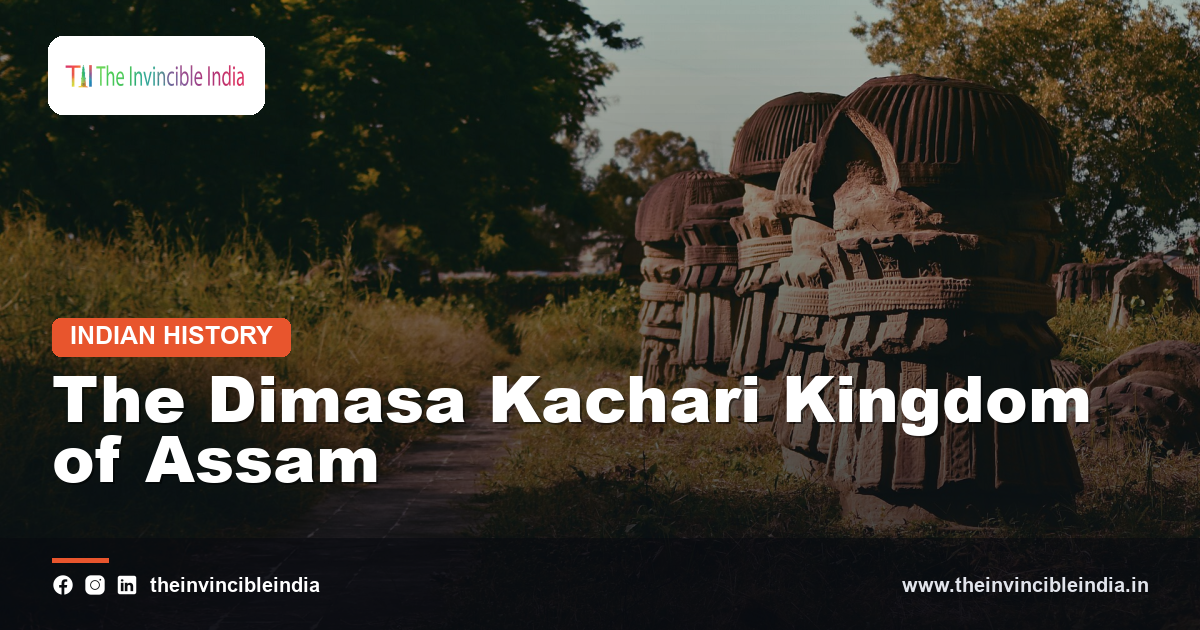
The Dimasa Kachari kingdom, also called the Kachari kingdom or the kingdom of the Dimasa people, was a kingdom of northeast India that ruled over parts of what is now Assam, including the hill district of Dima Hasao and the plains of Cachar. Ruled by the Dimasa, a people of the wider Kachari group whose kings in later times adopted Hindu titles and customs, the kingdom is especially remembered for its shifting capitals, which moved over time from Dimapur, in present-day Nagaland, to Maibang in the hills, and later to Khaspur in the plains of Cachar. It endured through the medieval and early modern periods before being absorbed by the British in the nineteenth century. The brick-and-stone ruins at Dimapur survive as striking relics of its history. The kingdom belongs to the rich history of northeast India, in the same broad span as the great empires described in our guide to the Mughal Empire. Because several dates and details rest on tradition, this account keeps to general terms where the record is uncertain.
Quick answer: The Dimasa Kachari kingdom was a kingdom of northeast India, ruled by the Dimasa people of the wider Kachari group, that governed parts of present-day Assam, including Dima Hasao and Cachar. It is especially remembered for its shifting capitals, which moved over time from Dimapur, now in Nagaland, to Maibang in the hills, and later to Khaspur in the plains of Cachar. Its kings later adopted Hindu titles and customs, and the kingdom was absorbed by the British in the nineteenth century; the brick-and-stone ruins at Dimapur survive.
Key Takeaways
- The Dimasa Kachari kingdom, also called the Kachari kingdom, was a kingdom of northeast India ruled by the Dimasa people.
- It governed parts of present-day Assam, including the hill district of Dima Hasao and the plains of Cachar.
- Its capitals shifted over time from Dimapur, now in Nagaland, to Maibang in the hills, and later to Khaspur in Cachar.
- The Dimasa belonged to the wider Kachari group, and their kings in later times adopted Hindu titles and customs.
- The kingdom was gradually absorbed by the British in the nineteenth century.
- The brick-and-stone ruins at Dimapur survive as notable relics of the kingdom.
Read on for the history, culture, and legacy in detail.
Quick Facts
| Detail | Information |
|---|---|
| Kingdom | Dimasa Kachari kingdom |
| Ruling People | The Dimasa (a Kachari people) |
| Period | Medieval to the nineteenth century; dates debated |
| Region | Parts of present Assam, Dima Hasao and Cachar |
| Capitals | Dimapur, then Maibang, then Khaspur |
| Later Customs | Kings adopted Hindu titles |
| Absorbed By | The British in the nineteenth century |
| Surviving Ruins | Brick-and-stone ruins at Dimapur |
Who Were the Dimasa Kachari?
The Dimasa Kachari were the people and ruling house behind the Dimasa Kachari kingdom of northeast India, remembered as one of the historic powers of the region. The Dimasa, whose name is often understood to relate to a great river, belonged to the wider group known as the Kacharis, a people long settled in the hills and plains of the northeast. From this community arose a line of kings who built a kingdom that endured through the medieval and early modern periods. The rulers, drawn from the Dimasa people, in later times adopted Hindu titles and customs while retaining their own distinctive identity and traditions. As a kingdom of the Dimasa, it held an important place among the states of the northeast, alongside neighbouring powers. The Dimasa Kachari thus represent both a people and a kingdom whose history is woven into the broader story of Assam and the surrounding lands.
Where Was the Dimasa Kingdom Located?
The Dimasa kingdom was located in northeast India, ruling over parts of what is now the state of Assam, including the hill district known today as Dima Hasao and the plains of the Cachar region. Its territory thus spanned both hill and plain, embracing the varied terrain of the northeast with its forests, rivers and valleys. Over the course of its history the centre of the kingdom shifted between these areas, reflected in the movement of its capitals from the plains near Dimapur into the hills and later back into the plains of Cachar. This position placed the kingdom among the powers of the Brahmaputra and Barak valleys and the surrounding hills. The region’s geography shaped the character and fortunes of the kingdom, offering both the defensibility of the hills and the resources of the plains. The Dimasa kingdom was thus firmly anchored in the historical landscape of northeast India.
Why Did the Dimasa Capital Shift Over Time?
The Dimasa capital shifted over time because the fortunes of the kingdom changed amid pressures from neighbouring powers and the movement of its centre between hill and plain. In its earlier history the kingdom was associated with Dimapur, a centre in the plains, whose remains survive to this day. As circumstances changed, the seat of the kingdom moved into the hills at Maibang, which became an important capital in a more defensible setting. Later still, the ruling house established itself at Khaspur in the plains of Cachar, which served as a capital in the later period of the kingdom. These shifts reflected the changing relations with powerful neighbours and the evolving geography of the kingdom’s power. The movement of the capital is one of the most distinctive features of Dimasa history. The sequence from Dimapur to Maibang and then Khaspur marks the stages of the kingdom’s long career.
What Was Dimapur?
Dimapur was an early centre associated with the Dimasa Kachari kingdom, a site in the plains that is especially famous today for its surviving ruins. In the earlier period of the kingdom, Dimapur served as a seat of Dimasa power before the centre of the kingdom moved into the hills. The site, which lies in present-day Nagaland, preserves notable brick-and-stone remains, including distinctive carved monoliths and structures that are counted among the most striking relics of the kingdom. These ruins bear witness to the building traditions and the material culture of the Dimasa in this phase of their history. Dimapur thus holds an important place in the memory of the kingdom as one of its principal early centres. The remains at the site continue to attract visitors and students of the region’s past. Dimapur stands as an enduring symbol of the early history of the Dimasa Kachari kingdom.
What Was Maibang?
Maibang was a capital of the Dimasa Kachari kingdom in its hill phase, an important centre set in the hill country of the region now known as Dima Hasao. After the earlier period associated with Dimapur, the ruling house established itself at Maibang, which became a seat of Dimasa power in a more defensible hill setting. The site is remembered for remains connected with the kingdom, including rock-cut and stone structures associated with the Dimasa rulers and their traditions. Maibang reflects the period when the centre of the kingdom lay in the hills, shaped by the terrain and the pressures of the age. As one of the historic capitals, it occupies an important place in the story of the kingdom’s shifting seats of power. Its remains add to the heritage of the region and its long history. Maibang thus marks the hill chapter in the long career of the Dimasa Kachari kingdom.
What Was Khaspur?
Khaspur was a later capital of the Dimasa Kachari kingdom, established in the plains of the Cachar region in the kingdom’s later history. After the hill period associated with Maibang, the ruling house moved its seat into the plains, where Khaspur became an important centre of Dimasa power. The site is remembered for structures and remains associated with the kingdom, including gateways and buildings that reflect the culture of the court in this period. The move to Khaspur reflected the evolving fortunes and geography of the kingdom as its history drew toward its close. By this stage the rulers had adopted Hindu titles and customs, and the court at Khaspur reflected this character. As one of the historic capitals, Khaspur marks the final chapter in the sequence of Dimasa seats of power. Its remains stand among the heritage of the Cachar region and the long history of the kingdom.
How Did the Dimasa Kings Adopt Hindu Customs?
The Dimasa kings in later times adopted Hindu titles and customs, a notable development in the cultural history of the kingdom. While the Dimasa people retained their own distinctive identity and traditions, their rulers over time embraced elements of Hindu practice, including royal titles, rituals and patronage of temples and Brahmins. This process reflected the wider pattern by which ruling houses across the region drew on Hindu kingship to express and legitimise their authority. The adoption of such customs did not erase the older traditions of the Dimasa, but added a new layer to the culture of the court. This blending of indigenous and Hindu elements became a feature of the kingdom in its later periods, especially at Khaspur. The details of this process are drawn from tradition and the records of the region and are treated with care. The cultural transformation of the Dimasa court forms an important part of the kingdom’s history.
What Was the Culture of the Dimasa?
The culture of the Dimasa combined the distinctive traditions of the Dimasa people with the influences absorbed by the ruling house over the course of its history. The Dimasa, as a people of the northeast, maintained their own language, customs, social organisation and religious practices, rooted in the traditions of the region. Their society was organised around clans and kinship, and their festivals, dress and crafts reflected the heritage of the hills and plains. Over time, as the kings adopted Hindu titles and customs, the court culture came to blend indigenous and Hindu elements. This synthesis gave the later kingdom a distinctive character, drawing on both sources. The arts, architecture and religious life of the kingdom reflected this meeting of traditions. The details of this culture are described in general terms, reflecting the broadly known heritage of the Dimasa. Through this culture the kingdom contributed to the rich and varied heritage of northeast India.
How Did the Dimasa Kingdom Relate to Its Neighbours?
The Dimasa kingdom related to its neighbours through the shifting patterns of rivalry, warfare and diplomacy that marked the politics of northeast India. The region was home to several powers, and the Dimasa engaged with neighbouring kingdoms and peoples through conflict, alliance and the contest for territory. Among the most significant of these neighbours were powerful states of the Brahmaputra valley, with which the Dimasa had a long and often difficult relationship. The pressures from such neighbours influenced the fortunes of the kingdom and contributed to the shifting of its capitals over time. The kingdom also had dealings with the powers of the plains of Bengal and, in later times, with the expanding authority of the British. These relations shaped the long history of the Dimasa. The details are drawn from tradition and the records of the period and are described in general terms. The kingdom thus navigated the complex political landscape of the northeast.
How Was the Dimasa Kingdom Governed?
The Dimasa kingdom was governed by its king, whose authority rested on control of the territory, its people and its resources, supported by a structure of officials and councils. The Dimasa had a distinctive system of social and political organisation, in which clans and their heads held an important place, and the kingdom drew on these traditions in its government. The ruler depended on the support of nobles, chiefs and officials who held responsibilities within the administration and the military. The kingdom managed the resources of its hill and plain territories, drawing revenue from agriculture and the lands of the region. In later times, as the kings adopted Hindu titles and customs, the forms of royal authority reflected this influence. The details of the administration are drawn from tradition and the records of the region. This system of governance enabled the Dimasa kingdom to hold its territory through the long and often turbulent history of the northeast.
What Role Did Religion Play in the Kingdom?
Religion played an important role in the Dimasa kingdom, reflecting both the indigenous traditions of the Dimasa people and the Hindu customs later adopted by the ruling house. The Dimasa maintained their own religious practices, centred on their traditional deities and observances rooted in the culture of the northeast. Over time, as the kings embraced Hindu titles and customs, the court came to patronise Hindu worship, temples and Brahmins, adding a new dimension to the religious life of the kingdom. This blending of traditions became a feature of the later kingdom, especially at its plains capital. Religion thus served both as a source of identity for the Dimasa people and as an expression of the authority and legitimacy of the kings. The coexistence of indigenous and Hindu practice reflects the cultural history of the kingdom. The details of this religious life are described in general terms, reflecting the broadly known heritage of the Dimasa.
How Was the Dimasa Kingdom Absorbed by the British?
The Dimasa kingdom was gradually absorbed by the British in the nineteenth century, as the expanding authority of the British in northeast India brought the region under its control. In the earlier part of that century, the British extended their power across Assam and the surrounding lands, and the territories of the Dimasa kingdom came within the sphere of their administration. Through the processes of annexation and the reorganisation of the region, the independent existence of the kingdom came to an end, and its lands were incorporated into British-administered territory. This transition was part of the wider extension of British rule across northeast India in the nineteenth century. The details of these events are drawn from the records of the period and are described in general terms. The absorption of the kingdom marked the close of the long career of the Dimasa Kachari state. The region thereafter formed part of the administrative framework of British Assam.
What Ruins and Heritage Survive?
The Dimasa Kachari kingdom left a rich heritage, seen above all in the ruins and remains at its historic capitals and in the living traditions of the Dimasa people. The most famous of these are the brick-and-stone ruins at Dimapur, including distinctive carved monoliths and structures that count among the most striking relics of the kingdom. The hill capital of Maibang and the later plains capital of Khaspur also preserve remains associated with the kingdom, reflecting its building traditions and the character of its courts. These sites bear witness to the material culture and history of the Dimasa across the different phases of their kingdom. The living heritage of the Dimasa people, in their language, customs and festivals, continues in the region today. As with other heritage, these monuments and traditions are studied through archaeology, tradition and local knowledge. The surviving ruins and heritage thus keep alive the memory of the Dimasa Kachari kingdom.
Why Is the Dimasa Kachari Kingdom Significant?
The Dimasa Kachari kingdom is significant as one of the historic powers of northeast India and as a kingdom of the Dimasa people with a long and distinctive history. Its sequence of shifting capitals, from Dimapur to Maibang and then Khaspur, illustrates the changing fortunes and geography of a kingdom that endured through the medieval and early modern periods. The adoption of Hindu titles and customs by its kings reflects the wider cultural processes of the region, in which ruling houses blended indigenous and Hindu traditions. Its history offers a window onto the politics of the northeast, with its contest among several powers. The kingdom’s surviving ruins, especially at Dimapur, stand among the notable monuments of the region. For students of Indian history, the Dimasa Kachari kingdom offers a vivid example of a northeastern state. Its significance rests on this blend of long continuity, distinctive culture and rich heritage.
The Dimasa Kachari Kingdom Today
The Dimasa Kachari kingdom is remembered today through the ruins and heritage of its historic capitals and through the living traditions of the Dimasa people in northeast India. The brick-and-stone ruins at Dimapur, together with the remains at Maibang and Khaspur, draw visitors and students of history, standing as enduring symbols of the long career of the kingdom. The Dimasa people continue to preserve their language, customs and festivals, keeping alive the heritage of their ancestors in present-day Assam and the surrounding region. The memory of the kingdom and its shifting capitals remains part of the historical identity of the northeast. Scholars continue to study the ruins, traditions and records of the kingdom to refine the understanding of its history. For readers of Indian history, the Dimasa Kachari kingdom offers a striking example of a northeastern power. Its legacy endures in the ruins, culture and traditions of the Dimasa.
Sources & Further Reading
- Archaeological Survey of India (asi.nic.in).
- Ministry of Culture, Government of India (indiaculture.gov.in).
- Directorate of Tourism, Government of Assam (assamtourism.gov.in).
Frequently Asked Questions
What was the Dimasa Kachari kingdom?
The Dimasa Kachari kingdom was a kingdom of northeast India, ruled by the Dimasa people of the wider Kachari group, that governed parts of present-day Assam, including Dima Hasao and Cachar. It is especially remembered for its shifting capitals and its long history through the medieval and early modern periods.
Where were the capitals of the Dimasa kingdom?
The capitals of the Dimasa kingdom shifted over time, from Dimapur, now in Nagaland, to Maibang in the hills, and later to Khaspur in the plains of Cachar. This movement reflected the changing fortunes and geography of the kingdom.
Who were the Dimasa people?
The Dimasa were a people of northeast India belonging to the wider group known as the Kacharis, long settled in the hills and plains of the region. From this community arose the kings who built the Dimasa Kachari kingdom, and the Dimasa continue to preserve their language and traditions today.
Did the Dimasa kings follow Hindu customs?
In later times the Dimasa kings adopted Hindu titles and customs, patronising temples and Brahmins, while the Dimasa people retained their own distinctive identity and traditions. This blending of indigenous and Hindu elements became a feature of the later kingdom.
What happened to the Dimasa kingdom?
The Dimasa Kachari kingdom was gradually absorbed by the British in the nineteenth century, as British authority expanded across northeast India. Its territories were incorporated into British-administered Assam, bringing the independent kingdom to an end.
What ruins of the Dimasa kingdom survive?
The most famous remains are the brick-and-stone ruins at Dimapur, including distinctive carved monoliths and structures. The historic capitals of Maibang and Khaspur also preserve remains associated with the kingdom and its courts.


