

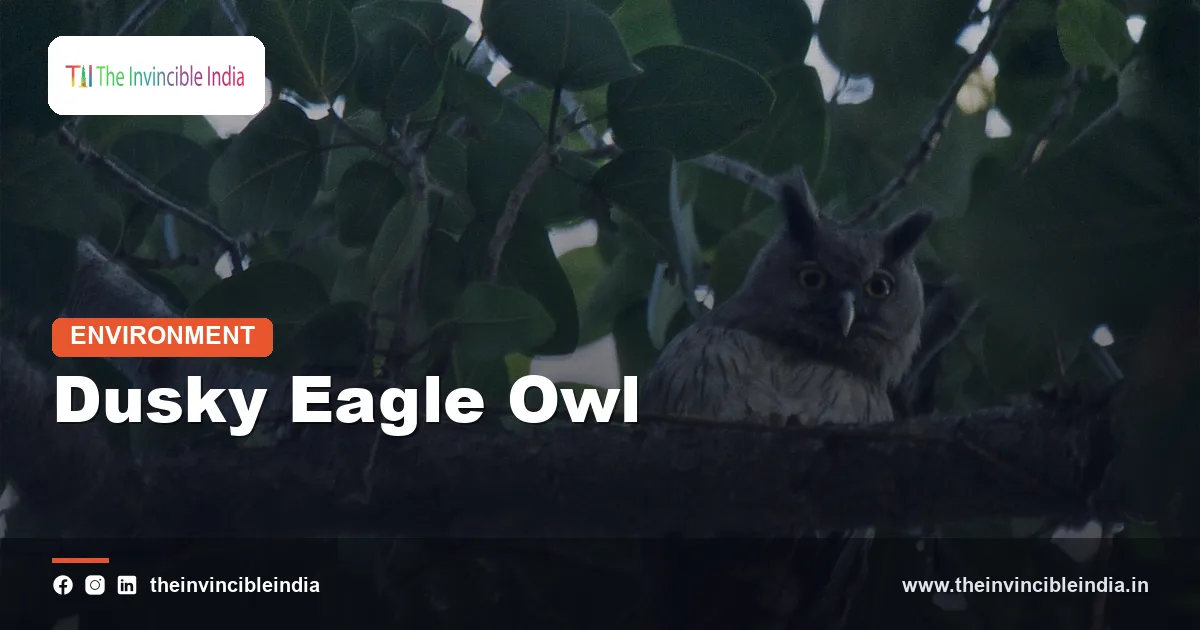
The dusky eagle owl (Bubo coromandus) is a large, grey-brown, ear-tufted owl with finely streaked plumage and yellow eyes, found in the plains of the Indian subcontinent where tall old trees grow near water. It roosts by day in the dense foliage of big trees such as banyan, mango and tamarind, hunts at dusk and through the night for rodents, birds, bats and other animals, and is known for a deep, booming call that carries across groves and riverbanks.
This explainer describes how to recognise the dusky eagle owl, where it lives in India, how it hunts and breeds, how it differs from other large Indian owls, and why old trees and quiet groves matter for its survival. The details are stable, well-documented natural history and are not tied to any particular year.
| Attribute | Detail |
|---|---|
| Common name | Dusky eagle owl (also called the dusky horned owl or Indian grey eagle owl) |
| Scientific name | Bubo coromandus |
| Family | Strigidae (typical owls), order Strigiformes |
| Size | About 50 to 58 cm long; one of the larger owls of the Indian plains |
| Range and habitat in India | Plains and lowlands, in groves of tall trees, riverine woods, village orchards and tree-lined water bodies |
| Diet | Rodents, birds, bats, reptiles, frogs, large insects and occasionally fish and crabs |
| Breeding and migration | Resident; breeds mainly in winter and early spring, usually in old stick nests of other large birds |
| Conservation status | Least Concern on the IUCN Red List; uncommon and local in many areas |
Key Takeaways
- The dusky eagle owl (Bubo coromandus) is a large resident owl of the Indian plains, about 50 to 58 cm long, with ear tufts and finely streaked grey-brown plumage.
- The dusky eagle owl has yellow eyes, which separates it from the orange-eyed rock eagle owl, Bubo bengalensis.
- The dusky eagle owl roosts by day in dense tall trees near water and hunts mainly at dusk and at night.
- The dusky eagle owl usually breeds in winter and early spring and often reuses large stick nests built by other birds, such as vultures, eagles and crows.
- The dusky eagle owl calls with a deep, resonant series of hoots that speeds up and ends in a sudden drop, often heard on quiet evenings.
- The dusky eagle owl is listed as Least Concern, but the loss of big old trees, groves and wetland edges makes it uncommon in many regions.
What is the dusky eagle owl?
The dusky eagle owl is a large owl of the genus Bubo, the group that includes the eagle owls and great horned owls, and it belongs to the typical owl family Strigidae. Bubo coromandus is native to South Asia and extends into mainland Southeast Asia, and its Latin species name refers to the Coromandel Coast of south-eastern India.
The bird is also known as the grey eagle owl, dusky horned owl or Indian dusky eagle owl. It is a lowland species that avoids dense hill forest and instead favours the open, cultivated plains where large trees survive. In its appearance it is somewhat plain compared with the well-known great horned owl of other continents, yet its size and presence are impressive.
Eagle owls are so named because of their large size and powerful build, which resemble those of small eagles. Like other owls, the dusky eagle owl has forward-facing eyes, a facial disc that helps channel sound, and soft-edged flight feathers that muffle noise in flight, allowing it to approach prey silently.
How do you identify a dusky eagle owl?
A dusky eagle owl is identified by its large size, grey-brown upperparts finely vermiculated and streaked, long prominent ear tufts, pale whitish throat patch, yellow eyes with dark eyelids and a pale, streaked underside. The overall impression is of a dusty, greyish owl, much paler and less rufous than many forest species.
Key field marks
- Large, upright owl with prominent ear tufts that are usually held erect.
- Bright yellow eyes with dark pink or blackish eyelids, giving a heavy-lidded look.
- A whitish throat and upper breast, with fine dark streaks on the underparts.
- Legs and feet feathered down to the toes, with strong dark talons.
- Greyish-brown back with fine cross-barring that breaks up its outline against bark.
Voice
The call is a deep, booming series of notes, often written as “wo-wo-wo-wo-wo-wo”, delivered in a rising rhythm and often ending in a sharp drop. The call is mostly heard at dusk, at night and just before dawn, especially in the breeding season. Pairs may duet, and the sound can travel for a long distance across still water.
Where does the dusky eagle owl live in India?
The dusky eagle owl lives in India chiefly across the northern and central plains and parts of the peninsula and east, in groves of tall trees, mango orchards, riverine forests and village woodlots, usually within reach of water. It is a bird of lowland, settled countryside rather than of deep forest or high mountains.
It is found in the Gangetic plains, the Indus-Ganga basin, central India, parts of Gujarat, Maharashtra, Odisha, Andhra Pradesh and West Bengal, and in Bangladesh. Its range extends east to Myanmar and mainland Southeast Asia. The species seems to avoid the driest deserts and the wettest evergreen forests, and it is generally absent from the higher Himalaya.
Choice of habitat is guided by two needs. The owl needs tall, leafy trees with dense crowns for daytime concealment, and it needs open ground and water margins with plenty of prey. Mango groves along canals, large banyans and peepals near ponds, tamarind trees in old temple compounds and tall trees along riverbanks are typical homes.
- Roosting habitat: dense-canopied old trees such as banyan, peepal, mango, tamarind and jamun.
- Hunting habitat: open fields, canal banks, marsh edges, river margins and village outskirts.
- Breeding habitat: tall trees holding old stick nests, or occasionally cavities and ledges.
What does the dusky eagle owl eat?
The dusky eagle owl eats a wide range of animals, with rodents, birds, bats and reptiles forming the main part of its diet, along with large insects, frogs and, near water, occasionally fish and crabs. It is an opportunistic hunter that takes whatever suitable prey is most available.
Hunting begins at dusk. The owl watches from a perch, then drops silently onto prey, or flies low over fields and water margins before striking with its talons. Its large eyes gather light, and its asymmetrical, sensitive ears can pinpoint rustling sounds even in the dark. Birds such as pigeons, doves, parakeets and herons may be taken at their night roosts, while bats are sometimes caught as they emerge from tree hollows or buildings at dusk.
After eating, owls cough up pellets of indigestible fur, bones and feathers. These pellets, found under roost trees, are useful to biologists, who study them to identify what the owl has been eating. Such studies repeatedly show that owls prey heavily on rats and mice that damage crops, a benefit that is not always recognised by farmers.
- Mammals: field rats, mice, shrews, squirrels and bats.
- Birds: pigeons, doves, small waterbirds and roosting songbirds.
- Other animals: lizards, snakes, frogs, crabs and large beetles.
How does the dusky eagle owl breed?
The dusky eagle owl breeds mainly in winter and early spring in India, usually from about December to April, and it typically lays two or three white eggs in an old stick nest built by another large bird. Owls do not build nests of their own, so they depend on structures made by other species.
Typical nests belong to vultures, eagles, kites, crows or herons, and the owl may take over a large stick platform high in a tree. Less often it uses a hollow or ledge. The female incubates the eggs for about a month while the male brings food. After hatching, the downy white chicks are brooded and fed by the female, and they may leave the nest and climb on nearby branches before they can fly, a stage known as branching.
Young owls remain dependent on their parents for several weeks. Pairs are strongly territorial, and a pair may use the same grove in successive years. Because the species nests in the cooler season, the owlets are often on branches in February and March, when many observers notice them and mistake them for a separate kind of owl.
How is the dusky eagle owl different from other eagle owls?
The dusky eagle owl differs from other Indian eagle owls in its yellow eyes, its grey, finely streaked plumage and its preference for tall trees in lowland groves. India has several large Bubo owls, and the main ones are compared below.
| Species | Scientific name | Eye colour | Habitat and notes |
|---|---|---|---|
| Dusky eagle owl | Bubo coromandus | Yellow | Groves of tall trees near water in the plains; greyish; finely streaked |
| Rock eagle owl (Indian eagle owl) | Bubo bengalensis | Orange | Rocky hills, ravines, quarries and scrub; more widespread; browner |
| Forest eagle owl (spot-bellied eagle owl) | Bubo nipalensis | Dark brown | Dense evergreen and moist forest; bold dark spots on underparts |
| Eurasian eagle owl | Bubo bubo | Orange | Northern and Himalayan regions; largest and heaviest of the group |
The simplest field rule is to look at the eye. A big, ear-tufted owl with yellow eyes in a mango grove or beside a river is very likely to be a dusky eagle owl, whereas an orange-eyed owl sitting on a rocky outcrop or ruined wall is usually a rock eagle owl. The dusky eagle owl is also generally paler, greyer and more finely marked, while the rock eagle owl looks warmer brown with bolder streaks.
Why do old trees and groves matter to the dusky eagle owl?
Old trees and groves matter to the dusky eagle owl because it relies on large, leafy crowns for daytime roosts and on big nests built by other birds for breeding. When tall trees are cut, the owl loses both its hiding places and its nesting platforms, and it moves away or fails to breed.
Traditional village groves, temple trees, canal-side plantations and old mango orchards have long provided such habitat in rural India. Today these are removed for roads, farmland, construction and wood. Large trees take decades to grow back, so the effects are slow to reverse. The loss of vultures also affects owls, because vulture nests were once available for reuse.
Protecting old trees helps many other species as well. Nest sites for raptors, roosting places for bats and parakeets, and feeding trees for fruit eaters often occur in the same groves. A single large banyan can therefore support an entire small community of wildlife.
Is the dusky eagle owl threatened?
The dusky eagle owl is not globally threatened and is listed as Least Concern on the IUCN Red List, but it is uncommon and patchily distributed across much of its range. Local populations can decline quickly where groves, wetlands and old trees disappear.
Habitat loss is the main concern. Other pressures include the use of rodenticides, which can poison owls that eat contaminated rats, collisions with vehicles and wires, and persecution driven by superstition. Owls have been feared or associated with omens in some traditions, and in some areas they are captured or killed, or trapped for illegal trade and ritual use. Owls are protected under the Wildlife (Protection) Act, 1972, and capturing, trading or killing them is an offence.
- Protect old banyan, peepal, mango and tamarind trees, especially those near water.
- Avoid cutting trees during the winter and early-spring nesting season.
- Reduce reliance on poison for rodent control and favour natural predators such as owls.
- Report any trapping or sale of owls to the forest department.
- Observe roosting owls from a distance and avoid flash photography at nests.
Bottom Line
The dusky eagle owl is a big, silent and often unseen hunter of Indian groves and riverbanks, easily recognised by its ear tufts, yellow eyes and booming call. It keeps rat and mouse numbers in check, and its survival depends on the old trees and quiet water margins that are steadily disappearing from the plains.
Frequently Asked Questions
What is a dusky eagle owl?
A dusky eagle owl is a large, grey-brown, ear-tufted owl, Bubo coromandus, of the family Strigidae. It is about 50 to 58 cm long, with finely streaked plumage and yellow eyes. It lives in groves of tall trees near water in the plains of the Indian subcontinent.
How can you tell a dusky eagle owl from a rock eagle owl?
The easiest way is the eye colour: the dusky eagle owl has yellow eyes, while the rock eagle owl has orange eyes. The dusky eagle owl is also greyer and more finely streaked, and it lives in tall groves near water. The rock eagle owl prefers rocky hills, ravines and scrub.
What does the dusky eagle owl eat?
The dusky eagle owl eats rodents, birds, bats, reptiles, frogs and large insects, and it occasionally takes fish and crabs. It hunts at dusk and during the night, dropping silently on prey from a perch. Its diet includes many crop-damaging rats and mice.
Where does the dusky eagle owl nest?
The dusky eagle owl usually nests in old stick nests built by other large birds such as vultures, eagles and crows. It occasionally uses tree hollows or ledges. Breeding mainly takes place in winter and early spring, with two or three white eggs.
What sound does the dusky eagle owl make?
The dusky eagle owl makes a deep, booming series of hoots, often written as wo-wo-wo-wo, that speeds up and ends with a sudden drop. The call is heard mainly at dusk, at night and before dawn. It is most frequent in the breeding season, and pairs may call together.
Is the dusky eagle owl endangered?
No, the dusky eagle owl is listed as Least Concern on the IUCN Red List, although it is uncommon and local in many areas. Its main problems are the loss of old trees and groves, rodenticide poisoning and persecution linked to superstition. Owls are protected in India under the Wildlife (Protection) Act, 1972.
{“@context”:”https://schema.org”,”@graph”:[{“@type”:”FAQPage”,”mainEntity”:[{“@type”:”Question”,”name”:”What is a dusky eagle owl?”,”acceptedAnswer”:{“@type”:”Answer”,”text”:”A dusky eagle owl is a large, grey-brown, ear-tufted owl, Bubo coromandus, of the family Strigidae. It is about 50 to 58 cm long, with finely streaked plumage and yellow eyes. It lives in groves of tall trees near water in the plains of the Indian subcontinent.”}},{“@type”:”Question”,”name”:”How can you tell a dusky eagle owl from a rock eagle owl?”,”acceptedAnswer”:{“@type”:”Answer”,”text”:”The easiest way is the eye colour: the dusky eagle owl has yellow eyes, while the rock eagle owl has orange eyes. The dusky eagle owl is also greyer and more finely streaked, and it lives in tall groves near water. The rock eagle owl prefers rocky hills, ravines and scrub.”}},{“@type”:”Question”,”name”:”What does the dusky eagle owl eat?”,”acceptedAnswer”:{“@type”:”Answer”,”text”:”The dusky eagle owl eats rodents, birds, bats, reptiles, frogs and large insects, and it occasionally takes fish and crabs. It hunts at dusk and during the night, dropping silently on prey from a perch. Its diet includes many crop-damaging rats and mice.”}},{“@type”:”Question”,”name”:”Where does the dusky eagle owl nest?”,”acceptedAnswer”:{“@type”:”Answer”,”text”:”The dusky eagle owl usually nests in old stick nests built by other large birds such as vultures, eagles and crows. It occasionally uses tree hollows or ledges. Breeding mainly takes place in winter and early spring, with two or three white eggs.”}},{“@type”:”Question”,”name”:”What sound does the dusky eagle owl make?”,”acceptedAnswer”:{“@type”:”Answer”,”text”:”The dusky eagle owl makes a deep, booming series of hoots, often written as wo-wo-wo-wo, that speeds up and ends with a sudden drop. The call is heard mainly at dusk, at night and before dawn. It is most frequent in the breeding season, and pairs may call together.”}},{“@type”:”Question”,”name”:”Is the dusky eagle owl endangered?”,”acceptedAnswer”:{“@type”:”Answer”,”text”:”No, the dusky eagle owl is listed as Least Concern on the IUCN Red List, although it is uncommon and local in many areas. Its main problems are the loss of old trees and groves, rodenticide poisoning and persecution linked to superstition. Owls are protected in India under the Wildlife (Protection) Act, 1972.”}}]}]}


