

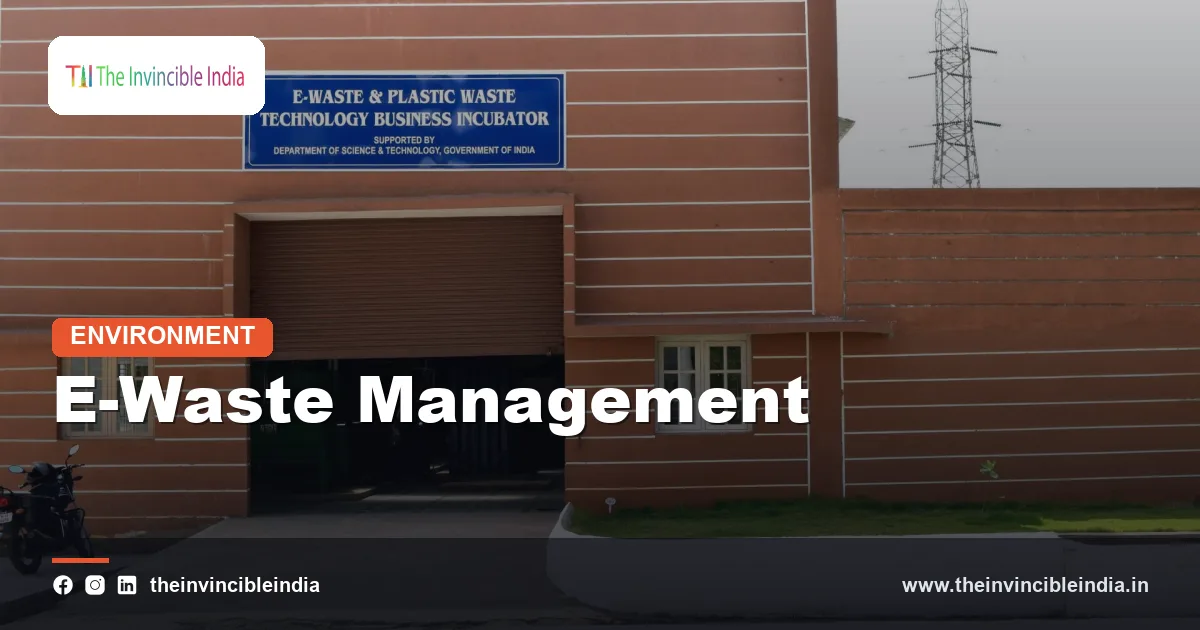
E-waste management in India is the system of laws, collection channels and recycling practices that deal with discarded electrical and electronic equipment, governed mainly by the E-Waste (Management) Rules and built on the principle of Extended Producer Responsibility. India is one of the world’s largest generators of e-waste, and most of it is still handled by an informal sector rather than by authorised recyclers.
This explainer describes what e-waste is, how much India generates, which toxic materials it contains, how informal recycling works and harms people, how the rules and the Central Pollution Control Board (CPCB) regulate producers and recyclers, and why the sector is seen as a circular-economy opportunity. Information on this page was last reviewed on 15 October 2026.
Quick Facts: E-Waste Management in India
| Attribute | Detail |
|---|---|
| Parent ministry | Ministry of Environment, Forest and Climate Change (MoEFCC) |
| Parent law | Environment (Protection) Act, 1986 |
| First dedicated rules | E-Waste (Management and Handling) Rules, 2011, in force from 2012 |
| Rules that introduced EPR | E-Waste (Management) Rules, 2016 |
| Current framework | E-Waste (Management) Rules, 2022, in force from 1 April 2023 |
| Central regulator | Central Pollution Control Board (CPCB), with State Pollution Control Boards (SPCBs) |
| Global ranking by volume | Among the top three e-waste generating countries, after China and the United States |
| Annual generation | More than three million tonnes in recent global assessments |
| Dominant handling channel | Informal sector, which processes the large majority of e-waste |
Key Takeaways
- E-waste management in India is regulated by the E-Waste (Management) Rules, 2022, which came into force on 1 April 2023 under the Environment (Protection) Act, 1986.
- India is among the top three generators of e-waste in the world, producing more than three million tonnes a year according to recent global monitoring reports.
- The informal sector handles the large majority of India’s e-waste, often using acid leaching and open burning that release lead, mercury and other toxins.
- Extended Producer Responsibility makes manufacturers and importers legally responsible for the collection and recycling of electronics they place on the Indian market.
- The 2022 rules created an online EPR certificate system on a CPCB portal, in which recyclers generate certificates that producers buy to meet their targets.
- E-waste is a form of urban mine because it contains recoverable gold, silver, copper and palladium, which makes formal recycling economically attractive.
What Is E-Waste?
E-waste is any electrical or electronic equipment, along with its components, consumables and parts, that has been discarded by its owner as waste. The category covers computers, mobile phones, televisions, refrigerators, air conditioners, washing machines, batteries in devices, LED lamps, medical equipment and many other products.
Indian rules define e-waste by listing the equipment that falls under them. The 2022 rules cover a long list of items, grouped broadly into information technology and telecommunication equipment and consumer electrical and electronic equipment. Equipment becomes e-waste when it is obsolete, broken, replaced or no longer wanted, even if parts of it still work.
E-waste is not ordinary trash. It combines valuable metals with hazardous substances in small, tightly bound assemblies. That combination is what makes both informal dismantling and careless landfilling risky, and proper recycling rewarding.
How Much E-Waste Does India Generate?
India generates more than three million tonnes of e-waste every year according to recent global assessments, which places it in the top three generating countries in the world alongside China and the United States. Volumes have grown steadily for more than a decade.
Why volumes keep rising
- Rapid growth in smartphone, laptop and appliance ownership as incomes rise.
- Shorter product lifespans and frequent upgrades, driven by new models and falling prices.
- Rising demand for cooling and white goods such as air conditioners and refrigerators.
- Expanding digital services, from online learning to electronic payments, which need more devices.
- Growing imports of used electronics and parts, mostly for refurbishing.
Where the waste comes from
Households, offices and government departments generate large volumes. Large cities such as Mumbai, Delhi, Bengaluru, Chennai, Kolkata, Hyderabad and Ahmedabad are leading sources, but the share from smaller cities is rising. India’s per-person e-waste generation is much lower than that of rich countries, so total volumes are large mainly because of population size.
Official data on generation and collection are uncertain, because estimates rely on sales data and product-lifespan models rather than direct counts. Reported collection by authorised channels is a small fraction of the estimated total.
What Is E-Waste Made Of and Why Is It Hazardous?
E-waste is made of metals, plastics and glass, and it contains toxic substances such as lead, mercury, cadmium, arsenic and brominated flame retardants that harm health and the environment when released. A single device can contain dozens of elements, some valuable and some dangerous.
| Material | Where it is found | Main hazard |
|---|---|---|
| Lead | Solder, cathode ray tube glass, batteries | Damages the nervous system and kidneys, especially in children |
| Mercury | Fluorescent lamps, switches, some displays | Harms the brain and nervous system, and contaminates water |
| Cadmium | Rechargeable batteries, some semiconductors | Causes kidney and bone damage and is a carcinogen |
| Hexavalent chromium | Metal coatings | Causes lung and skin problems |
| Brominated flame retardants | Plastic casings, circuit boards | Release toxic dioxins and furans when burned |
| Arsenic | Some semiconductors | Toxic and carcinogenic |
| Gold, silver, copper, palladium | Circuit boards, connectors | Valuable, recoverable resources |
Safe handling therefore needs controlled dismantling, closed processes and treatment of residues. Substances like lead and mercury do not break down, so they persist in soil, groundwater and food chains.
How Does the Informal Recycling Sector Work?
The informal recycling sector in India works through a chain of rag-pickers, itinerant collectors (kabadiwalas), scrap dealers and small dismantling units that buy, break up and sell e-waste components without environmental safeguards. The sector processes the large majority of India’s e-waste and supports a large number of livelihoods.
Stages in the informal chain
- Households and offices sell old devices to local collectors, who offer cash on the spot.
- Scrap dealers aggregate and sort items by type and value.
- Dismantlers manually break devices apart, removing batteries, wiring and boards.
- Valuable metals are recovered by crude methods such as acid baths and open burning of cables.
- Remaining plastics and residues are dumped, burned or sold.
Major informal hubs
Well-known clusters include Seelampur and Mandoli in Delhi, Moradabad and Meerut in Uttar Pradesh, parts of Mumbai and Bhiwandi, Bengaluru, Chennai and Kolkata. These hubs developed because collection, trading and dismantling are low-cost, and they offer higher prices to sellers than formal recyclers often do.
Why the informal sector persists
- It pays households more than formal collectors can usually afford.
- It is flexible, widespread and works on thin margins.
- Many workers depend on it for livelihood and have few alternatives.
- Enforcement against unregistered units is difficult.
What Harm Does Informal E-Waste Recycling Cause?
Informal e-waste recycling causes serious occupational illness and pollution because workers handle toxic materials without protective equipment and release residues directly into air, soil and water. The harm falls most heavily on poor workers and their families, often including children.
Health effects
- Respiratory problems from fumes produced by burning wires and plastics.
- Skin burns and poisoning from acid leaching.
- Lead exposure that can cause developmental and neurological harm.
- Higher long-term risks of cancer and kidney disease from metals such as cadmium.
Environmental effects
Acid residues from metal recovery are discharged into drains and open ground, contaminating groundwater. Burning of cables releases dioxins and furans into the air. Ash and dust settle on soil near settlements, and unrecoverable fractions of plastic and glass are dumped or landfilled. Environmental studies of e-waste hubs around the world have repeatedly found elevated heavy metal levels in soil and dust.
There is also a resource loss. Crude methods recover only a share of the precious metals present, which means a considerable amount of value goes to waste.
What Are the E-Waste (Management) Rules?
The E-Waste (Management) Rules are the rules framed by the Ministry of Environment, Forest and Climate Change under the Environment (Protection) Act, 1986, that regulate how electronics are produced, collected, refurbished and recycled in India. The framework has been revised three times, each time widening its reach.
Evolution of the rules
| Year | Rules | Key feature |
|---|---|---|
| 1989 to 2008 | Hazardous waste rules | E-waste dealt with under general hazardous waste provisions |
| 2011 (in force 2012) | E-Waste (Management and Handling) Rules | First dedicated rules; introduced the idea of producer responsibility |
| 2016 | E-Waste (Management) Rules | Mandatory Extended Producer Responsibility, collection targets, Producer Responsibility Organisations, deposit refund scheme |
| 2022 (in force 2023) | E-Waste (Management) Rules | EPR certificates, online portal, wider list of covered items, registration of refurbishers |
Features of the 2016 rules
- Introduced authorisation of producers under EPR and the role of Producer Responsibility Organisations (PROs).
- Brought in a Deposit Refund Scheme as an additional route.
- Extended coverage to compact fluorescent lamps and other mercury-containing lamps.
- Set limits on hazardous substances, including lead, mercury, cadmium, hexavalent chromium, polybrominated biphenyls and polybrominated diphenyl ethers, in new equipment.
Features of the 2022 rules
- Moved the system online, with registration of manufacturers, producers, refurbishers and recyclers on a central portal.
- Replaced earlier collection-based targets with EPR certificates linked to recycling.
- Extended the list of covered items, including a wider range of consumer and IT equipment.
- Required recyclers to meet standards and stored material accounting, and provided for environmental compensation for violations.
- Set a schedule of targets that grow over the first few years.
How Does Extended Producer Responsibility Apply to E-Waste?
Extended Producer Responsibility (EPR) applies to e-waste by requiring producers, which include manufacturers, importers and brand owners, to ensure that a specified share of the electronics they sell is collected and recycled in an environmentally sound way. EPR moves the cost and duty of end-of-life handling from municipalities and the public to the companies that profit from the products.
How the certificate system works
- Producers register on the CPCB portal and declare the equipment they place on the market.
- Authorised recyclers and refurbishers register as well and process e-waste under specified standards.
- Recyclers generate EPR certificates on the portal, based on the quantity actually recycled and verified.
- Producers buy certificates from recyclers to meet their annual EPR target.
- The CPCB audits records, and non-compliance can lead to environmental compensation.
The certificate approach is intended to reward real recycling rather than paper collection, because the certificate is created only after processing. It also builds a market in which formal recyclers earn additional income from the certificates, supporting investment in better plant.
Who Regulates E-Waste in India?
E-waste in India is regulated by the Central Pollution Control Board (CPCB), State Pollution Control Boards and Pollution Control Committees (SPCBs/PCCs), which operate under the Ministry of Environment, Forest and Climate Change. The CPCB acts as the central authority for registration, the EPR portal, target setting and audits.
- MoEFCC: frames the rules and policy.
- CPCB: runs the EPR portal, issues guidelines and monitors compliance.
- SPCBs: inspect facilities and authorise recyclers in their states.
- Customs and trade authorities: control the import of used electronics and hazardous waste.
- Local bodies: support collection and awareness.
India is also a party to the Basel Convention, which governs the transboundary movement of hazardous wastes, and domestic rules restrict import of e-waste for dumping.
What Are Formal Recyclers and What Challenges Do They Face?
Formal recyclers are registered companies that dismantle and process e-waste in authorised facilities using controlled methods, worker safety measures and pollution control equipment. India has a considerable number of authorised recyclers, with installed capacity that is much larger than what they actually process.
Challenges for formal recyclers
- Feedstock shortage: most e-waste flows to the informal sector, so authorised plants run below capacity.
- Cost disadvantage: compliance, labour and pollution control costs are higher than for informal units.
- Technology gaps: advanced recovery of precious metals from boards is limited, and some material is exported for final refining.
- Weak enforcement: unregistered operators continue to function with limited penalty.
- Consumer behaviour: households usually sell to the highest bidder rather than the safest channel.
Integrating the informal sector
Policy discussions increasingly focus on bringing informal collectors and dismantlers into the formal system by registering them, training them and linking them with authorised recyclers. A collection-and-aggregation role with safe dismantling could keep livelihoods intact while ensuring that hazardous fractions go to proper facilities.
Why Is E-Waste a Circular-Economy Opportunity?
E-waste is a circular-economy opportunity because it holds recoverable metals and components that can be returned to manufacturing, reducing mining, imports and emissions. Electronic scrap is often described as an urban mine, as its metal content per tonne can exceed that of many natural ores.
- Resource recovery: gold, silver, copper, aluminium, palladium and rare materials can be reclaimed.
- Import substitution: domestic recovery reduces dependence on imported critical minerals.
- Reuse and repair: refurbishing extends product life and creates skilled jobs.
- Lower emissions: recycling metals uses much less energy than primary mining.
- Green jobs: a formal recycling and refurbishing industry can employ large numbers of workers.
The shift from a linear model of make, use and dispose to a circular one also depends on design. Products that are easier to repair, upgrade and disassemble, and that avoid hazardous materials, produce less waste to begin with. The right-to-repair movement in India reflects this broader approach.
What Can Consumers Do About E-Waste?
Consumers can reduce e-waste by repairing and reusing devices, and by giving old electronics only to authorised recyclers or producer take-back schemes. Households play a decisive role because collection is the weakest link in the chain.
- Repair or upgrade a device instead of replacing it, where possible.
- Donate or sell working devices for reuse.
- Use manufacturer take-back or authorised collection points for dead devices.
- Remove personal data before disposal.
- Never throw batteries, lamps or devices into household waste.
Bottom Line
E-waste management in India is shifting from an informal, polluting system towards a regulated one built on producer responsibility and certified recycling. The decisive test is whether collection flows into authorised channels and whether the informal workforce is brought into the formal economy rather than displaced.
Frequently Asked Questions
What is e-waste management in India?
E-waste management in India is the system of rules, collection and recycling that handles discarded electronic products. It is governed by the E-Waste (Management) Rules, 2022, framed under the Environment (Protection) Act, 1986. The rules make producers responsible for ensuring that their products are collected and recycled by authorised recyclers.
How much e-waste does India generate?
India generates more than three million tonnes of e-waste per year, according to recent global monitoring reports. This places the country among the top three generators in the world after China and the United States. Exact figures vary because they are estimated from sales and lifespan data.
Why is e-waste dangerous?
E-waste is dangerous because it contains toxic substances such as lead, mercury, cadmium and brominated flame retardants. These can damage the nervous system, kidneys and lungs, and they contaminate soil and water when electronics are burned or dumped. Informal dismantling without protection greatly increases exposure.
What is the role of the informal sector in e-waste recycling?
The informal sector collects, dismantles and trades the large majority of India’s e-waste and supports many livelihoods. However, it often uses acid leaching and open burning, which cause pollution and health harm. Policy aims to integrate informal workers into the formal system through registration and training.
What is EPR for e-waste?
Extended Producer Responsibility for e-waste requires manufacturers, importers and brand owners to ensure that a set share of the electronics they sell is recycled properly. Under the 2022 rules, recyclers generate EPR certificates on a CPCB portal and producers buy them to meet their targets. This links producer obligations to verified recycling.
How can I dispose of old electronics safely in India?
You can dispose of old electronics safely by handing them to an authorised recycler, a registered collection centre or a manufacturer take-back programme. Working devices can be sold or donated for reuse after personal data is erased. Avoid giving dead devices to unregistered scrap buyers, as these may be dismantled unsafely.
{“@context”:”https://schema.org”,”@graph”:[{“@type”:”FAQPage”,”mainEntity”:[{“@type”:”Question”,”name”:”What is e-waste management in India?”,”acceptedAnswer”:{“@type”:”Answer”,”text”:”E-waste management in India is the system of rules, collection and recycling that handles discarded electronic products. It is governed by the E-Waste (Management) Rules, 2022, framed under the Environment (Protection) Act, 1986. The rules make producers responsible for ensuring that their products are collected and recycled by authorised recyclers.”}},{“@type”:”Question”,”name”:”How much e-waste does India generate?”,”acceptedAnswer”:{“@type”:”Answer”,”text”:”India generates more than three million tonnes of e-waste per year, according to recent global monitoring reports. This places the country among the top three generators in the world after China and the United States. Exact figures vary because they are estimated from sales and lifespan data.”}},{“@type”:”Question”,”name”:”Why is e-waste dangerous?”,”acceptedAnswer”:{“@type”:”Answer”,”text”:”E-waste is dangerous because it contains toxic substances such as lead, mercury, cadmium and brominated flame retardants. These can damage the nervous system, kidneys and lungs, and they contaminate soil and water when electronics are burned or dumped. Informal dismantling without protection greatly increases exposure.”}},{“@type”:”Question”,”name”:”What is the role of the informal sector in e-waste recycling?”,”acceptedAnswer”:{“@type”:”Answer”,”text”:”The informal sector collects, dismantles and trades the large majority of India’s e-waste and supports many livelihoods. However, it often uses acid leaching and open burning, which cause pollution and health harm. Policy aims to integrate informal workers into the formal system through registration and training.”}},{“@type”:”Question”,”name”:”What is EPR for e-waste?”,”acceptedAnswer”:{“@type”:”Answer”,”text”:”Extended Producer Responsibility for e-waste requires manufacturers, importers and brand owners to ensure that a set share of the electronics they sell is recycled properly. Under the 2022 rules, recyclers generate EPR certificates on a CPCB portal and producers buy them to meet their targets. This links producer obligations to verified recycling.”}},{“@type”:”Question”,”name”:”How can I dispose of old electronics safely in India?”,”acceptedAnswer”:{“@type”:”Answer”,”text”:”You can dispose of old electronics safely by handing them to an authorised recycler, a registered collection centre or a manufacturer take-back programme. Working devices can be sold or donated for reuse after personal data is erased. Avoid giving dead devices to unregistered scrap buyers, as these may be dismantled unsafely.”}}]}]}


