

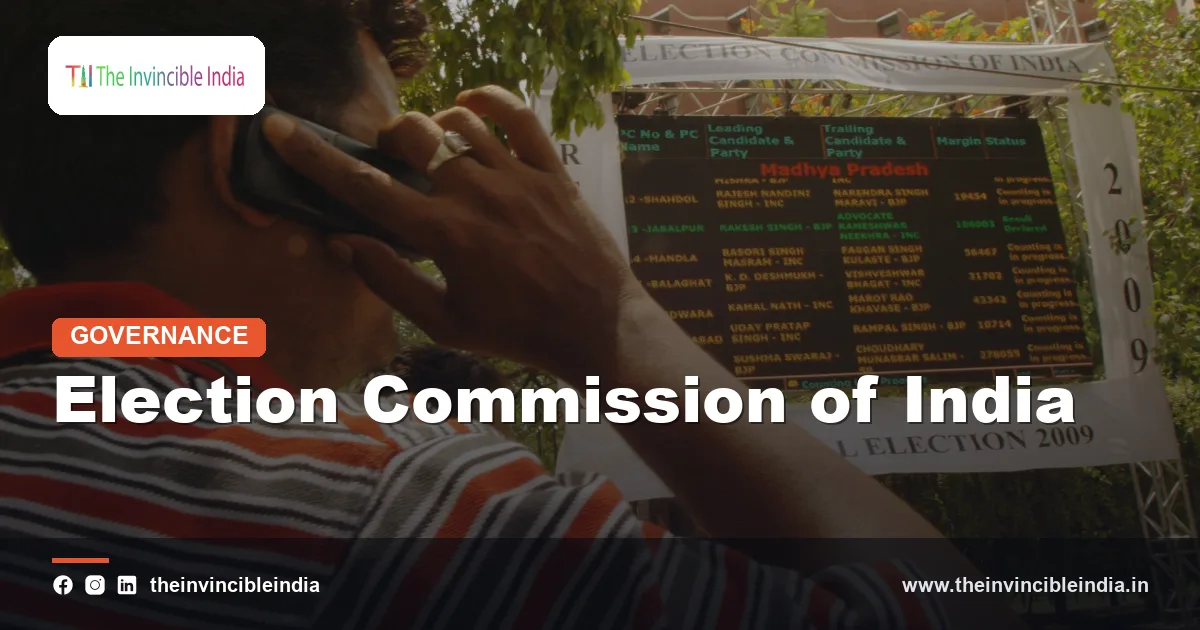
The Election Commission of India is the permanent constitutional body that organises and supervises the country’s elections, from the first draft of the electoral roll to the declaration of results. Created under Article 324 of the Constitution, it carries out the vast democratic exercise through which more than a billion citizens choose their representatives, and it does so on a scale that few other institutions in the world attempt.
Its work is easy to overlook between polls, yet it is continuous: updating voter lists, registering political parties, allotting symbols, framing rules of conduct and training an enormous temporary workforce of officials. This article explains how the Commission is constituted, what its powers are, how it uses tools such as the Model Code of Conduct and electronic voting machines, and why its independence is considered central to Indian democracy.
Quick Facts
| Feature | Details |
|---|---|
| Constitutional basis | Article 324 (Part XV of the Constitution) |
| Established | 25 January 1950, a day before India became a republic |
| Headquarters | Nirvachan Sadan, New Delhi |
| Composition | Chief Election Commissioner (CEC) and such other Election Commissioners as the President may fix |
| Tenure | Six years or until the age of 65, whichever is earlier |
| First Chief Election Commissioner | Sukumar Sen (1950 to 1958) |
| Elections conducted | Lok Sabha, Rajya Sabha, State Legislative Assemblies and Councils, offices of President and Vice-President |
| Not covered | Panchayat and municipal elections, which are run by State Election Commissions |
| National Voters’ Day | Observed every year on 25 January, since 2011 |
Origins and History of the Election Commission
The framers of the Constitution held a firm view that free and fair elections could not be left to the executive of the day. During the Constituent Assembly debates, members argued that the machinery for conducting elections should be placed under an independent authority, and this conviction produced Article 324. The Commission came into existence on 25 January 1950, and that date is now celebrated as National Voters’ Day to encourage enrolment, especially among young citizens.
The new republic’s first major test was the general election of 1951-52, held over several months because of the size of the country, the low literacy rate and the logistical difficulty of reaching remote areas. Voters who could not read were helped by the use of symbols and separate ballot boxes for each candidate. Sukumar Sen, the first CEC, oversaw this pioneering exercise, which is regarded as one of the largest peaceful exercises in adult franchise ever organised up to that time.
From one member to three
For its first four decades the Commission was a single-member body consisting only of the CEC. Two additional Election Commissioners were appointed for a brief period in October 1989 and removed in January 1990. In October 1993 the arrangement was made permanent through an amendment to the law, and the Commission has functioned as a three-member body since then, with decisions taken by majority if the members differ.
Constitutional Provisions Governing Elections
Article 324(1) vests the superintendence, direction and control of the preparation of electoral rolls and the conduct of elections in the Election Commission. This covers elections to Parliament, to the legislatures of the States, and to the offices of President and Vice-President. The words “superintendence, direction and control” have been interpreted broadly by the Supreme Court, and the provision is often described as a source of plenary power in areas where laws are silent.
Several neighbouring articles complete the electoral framework:
- Article 325 provides that there shall be one general electoral roll for every territorial constituency, with no one excluded on grounds of religion, race, caste or sex.
- Article 326 guarantees elections on the basis of adult suffrage, and the voting age was lowered from 21 to 18 years by the 61st Constitutional Amendment of 1988.
- Article 327 empowers Parliament to make laws on all matters relating to elections to Parliament and State legislatures.
- Article 328 allows State legislatures to make such laws where Parliament has not done so.
- Article 329 bars courts from interfering in electoral matters, such as the validity of delimitation or seat allotment, and states that election disputes can be raised only through an election petition.
Parliament has exercised its power mainly through the Representation of the People Act, 1950, which deals with the allocation of seats, delimitation and the electoral rolls, and the Representation of the People Act, 1951, which deals with the actual conduct of elections, qualifications, disqualifications, corrupt practices and election disputes.
Composition, Appointment and Tenure
The Commission consists of the Chief Election Commissioner and such number of other Election Commissioners as the President may determine from time to time. Article 324(2) leaves the numbers flexible, which is why the body could grow from one member to three by ordinary legislative and executive action rather than by constitutional amendment.
Appointment
Originally the President appointed the CEC and ECs on the advice of the government, subject to any law made by Parliament. Because Parliament had not framed a detailed law for many decades, the process attracted criticism. In March 2023, in the case of Anoop Baranwal v. Union of India, the Supreme Court directed that, until Parliament made a law, appointments should be made on the advice of a committee comprising the Prime Minister, the Leader of the Opposition in the Lok Sabha and the Chief Justice of India. Parliament subsequently enacted the Chief Election Commissioner and Other Election Commissioners (Appointment, Conditions of Service and Term of Office) Act, 2023, which provides for a selection committee consisting of the Prime Minister, a Union Cabinet Minister nominated by the Prime Minister and the Leader of the Opposition in the Lok Sabha, assisted by a search committee.
Tenure and service conditions
- The term is six years from the date of assuming office, or until the incumbent turns 65, whichever comes first.
- The CEC and ECs receive salary and allowances equal to those of a judge of the Supreme Court of India.
- The conditions of service of the CEC cannot be altered to his or her disadvantage after appointment.
- Regional Commissioners may be appointed by the President in consultation with the Commission, if required.
Removal and Safeguards for Independence
The Constitution tries to insulate the Commission from political pressure through the manner of removal. Under the proviso to Article 324(5), the Chief Election Commissioner cannot be removed from office except in the like manner and on the like grounds as a judge of the Supreme Court. This means that Parliament must pass a motion by a special majority, supported by a majority of the total membership of each House and at least two-thirds of those present and voting, on grounds of proved misbehaviour or incapacity.
Other Election Commissioners and Regional Commissioners cannot be removed except on the recommendation of the CEC. This protects them from arbitrary dismissal by the executive, although critics point out that their security is, in the text of the Constitution, less robust than that of the CEC, who is the only member entitled to the full judge-like procedure.
Other features that support independence
- A fixed tenure, so that members cannot be shifted at the pleasure of the government.
- Parity of pay and status with Supreme Court judges.
- A bar on further government appointments after retirement is not laid down in the Constitution, and this remains a matter of debate in reform discussions.
- Judicial review, since the Commission’s orders can be challenged in the High Courts and the Supreme Court.
The Commission does not operate in isolation. Because it depends on the government for staff and funds, it has often asked for greater financial and administrative autonomy, a theme that recurs in the reports of several expert committees.
Powers and Functions of the Election Commission of India
The functions of the Commission fall into administrative, advisory and quasi-judicial categories. Administratively, it prepares and periodically revises the electoral rolls, notifies the schedule of elections, supervises nominations and scrutiny, decides the number and location of polling stations, appoints observers and ensures that results are declared promptly.
Quasi-judicial powers
The Commission registers political parties under Section 29A of the Representation of the People Act, 1951, and grants recognition as a national or State party on the basis of electoral performance criteria. Under the Election Symbols (Reservation and Allotment) Order, 1968, it allots symbols and settles disputes between rival factions of a recognised party over the right to use a name and symbol. It also has the power to countermand or postpone a poll in case of violence, booth capturing or similar disturbances.
Advisory powers
- It advises the President on the disqualification of sitting Members of Parliament under Article 103, and the Governor on the disqualification of State legislators under Article 192, and these opinions are treated as binding in practice.
- It can recommend the disqualification of persons found guilty of corrupt practices, in cases referred to it.
- It makes suggestions to the government on electoral reforms, including changes in the law on candidates’ affidavits and expenditure.
A landmark Supreme Court decision, Mohinder Singh Gill v. Chief Election Commissioner (1978), held that Article 324 operates in areas not covered by legislation and fills the gaps, although it cannot be used to override express statutory provisions.
Electoral Rolls and the Voter ID Card
The foundation of every election is a correct list of voters. The Commission prepares a roll for every constituency, and a person who is an Indian citizen, aged 18 or above on the qualifying date and ordinarily resident in the constituency may apply for inclusion. Each roll is revised periodically, with special summary revisions held before major elections and continuous updating throughout the year.
The Elector’s Photo Identity Card, popularly called the voter ID card or EPIC, was introduced in the 1990s as a measure against impersonation. It helps polling officials verify identity, though voters are also permitted to use other prescribed documents at the polling station if their EPIC is not available.
The field machinery
Though the Commission itself is small, it relies on a hierarchy of officials who work under its superintendence during elections:
| Level | Official | Role |
|---|---|---|
| National | Commission and its Secretariat | Policy, scheduling, instructions and overall control |
| State or Union Territory | Chief Electoral Officer | Supervises election work in the State |
| District | District Election Officer | Usually the District Magistrate, coordinates district-level work |
| Constituency | Returning Officer and Electoral Registration Officer | Accept nominations, maintain rolls, declare results |
| Polling station | Presiding Officer and polling staff | Conduct the actual voting |
Government employees who are placed on election duty are, for the period of the election, considered to be on deputation to the Commission and are subject to its control and discipline.
The Model Code of Conduct
The Model Code of Conduct is a set of guidelines that political parties and candidates agree to follow from the announcement of the election schedule until the results are declared. It has no statutory force of its own, but it is enforced through the Commission’s wide powers under Article 324 and through the ordinary criminal and electoral laws that overlap with its provisions. Its origins are traced to the Kerala Assembly elections of 1960, when the administration prepared a voluntary code, and the Commission circulated a similar document to recognised parties during the 1962 general election. It was revised and strengthened over the following decades, and particularly came to public attention in the 1990s.
Main provisions
- Parties and candidates must avoid appeals to caste or communal feelings and must not use places of worship for campaigning.
- Criticism must be confined to policies and record, and not extend to private life.
- The party in power must not misuse official machinery, vehicles or funds for campaigning, and must not announce new schemes or make ad hoc appointments that could influence voters once the code is in force.
- Rallies and processions must have prior permission, and loudspeakers are restricted during specified hours.
- Bribery, intimidation of voters and distribution of liquor are prohibited.
- Observers may be appointed to monitor compliance.
The Commission can issue notices, censure leaders or restrict their campaigning for a period when it finds violations, and it can recommend registration of criminal cases where an offence under law has taken place.
Electronic Voting Machines and VVPAT
Electronic Voting Machines, or EVMs, replaced paper ballots in stages. They were first used on a trial basis in the Parur Assembly constituency of Kerala in 1982. After a legal amendment in 1989 allowed their use, they were tried in selected constituencies in the 1990s, and by the 2004 Lok Sabha election they were used across the whole country. Two public sector undertakings, Bharat Electronics Limited and the Electronics Corporation of India Limited, manufacture them.
How an EVM works
An EVM has two units: a ballot unit placed inside the voting compartment and a control unit kept with the presiding officer. The voter presses the button against the chosen candidate on the ballot unit, and the vote is recorded in the control unit. The machines are battery operated, do not require mains power and are not networked, which is the basis on which the Commission has defended their security.
VVPAT and NOTA
The Voter Verifiable Paper Audit Trail, or VVPAT, is a printer attached to the EVM that shows the voter a slip bearing the name and symbol of the selected candidate for about seven seconds before it drops into a sealed box. Following a Supreme Court direction in 2013, it was introduced in phases, first being used at a by-election in Noksen in Nagaland, and was deployed in all constituencies in the 2019 general election. The None of the Above (NOTA) option was added to EVMs after the Supreme Court’s 2013 judgment in PUCL v. Union of India, which held that voters have a right to reject all candidates, although NOTA votes do not alter the result.
Election Expenditure, Observers and Enforcement
Ensuring a level playing field is a major function. Candidates are subject to ceilings on expenditure, which the Government fixes in consultation with the Commission and which vary by State and by the type of election. Every candidate must file accounts within a fixed period after results, and failure to do so can lead to disqualification. Candidates also file affidavits disclosing criminal cases, assets and educational qualifications, a requirement that arose from Supreme Court rulings in the early 2000s.
Monitoring tools
- General observers, drawn from senior civil servants, who watch the overall conduct of the poll.
- Expenditure observers, usually from the revenue or accounts services, who track campaign spending.
- Police observers, who assess the law and order situation and deployment of forces.
- Flying squads and static surveillance teams, who check the movement of cash, liquor and gifts.
- Central armed police forces, deployed in sensitive areas to ensure that voters can cast their ballots without fear.
The Commission also runs the Systematic Voters’ Education and Electoral Participation programme, usually called SVEEP, to raise awareness and turnout, and it maintains the India International Institute of Democracy and Election Management in Delhi for training.
Limits of the Commission and Debates on Reform
The Commission’s jurisdiction has clear limits. It does not conduct elections to panchayats and municipalities; these are held by State Election Commissions created under Articles 243K and 243ZA following the 73rd and 74th Constitutional Amendments. It also does not hear election petitions, which must be filed in the High Court of the relevant State, and it does not decide delimitation, which is the work of a separate Delimitation Commission whose orders are not open to challenge in court.
Recurring reform proposals
- A collegium or similar broad-based process for appointing the CEC and ECs, a matter that has been addressed in part by the 2023 law and the Supreme Court’s earlier directions.
- Equal constitutional protection from removal for all Election Commissioners.
- Stronger powers to deregister parties that fail to contest elections or comply with filing requirements.
- Better regulation of party spending, which is not capped in the same way as that of candidates.
- Greater financial independence through a budget charged to the Consolidated Fund, as suggested by various committees.
- Simultaneous elections to the Lok Sabha and State Assemblies, a proposal that has been studied by committees and generates both support and concern on federal and logistical grounds.
These debates show that the Election Commission remains a living institution whose design continues to evolve with experience and judicial interpretation.
Conclusion
The Election Commission of India is best understood as a guardian of the process rather than of any particular outcome. Its authority rests on Article 324, its credibility on perceived neutrality and its effectiveness on a vast chain of field officials who work to a strict timetable. As technology, campaign methods and expectations change, the Commission continues to adapt its rules, and its reputation for fairness will remain central to public trust in the country’s elections.
Frequently Asked Questions
What is the Election Commission of India?
The Election Commission of India is an autonomous constitutional authority established under Article 324. It supervises the preparation of electoral rolls and the conduct of elections to Parliament, State legislatures and the offices of President and Vice-President. It was set up on 25 January 1950.
How is the Chief Election Commissioner removed?
The Chief Election Commissioner can be removed only in the same manner and on the same grounds as a judge of the Supreme Court, which requires a special majority in both Houses of Parliament on grounds of proved misbehaviour or incapacity. Other Election Commissioners can be removed only on the recommendation of the CEC.
What is the Model Code of Conduct?
It is a set of guidelines for parties and candidates that comes into force when the election schedule is announced and lasts until results are declared. It covers speeches, rallies, use of government resources and announcement of new schemes. It is not a law, but the Commission enforces it using its powers under Article 324.
Does the Election Commission conduct panchayat and municipal elections?
No. Local body elections are conducted by State Election Commissions established under Articles 243K and 243ZA of the Constitution. The Election Commission of India handles elections to Parliament, State Assemblies and Councils, and the offices of President and Vice-President.
What is the difference between an EVM and a VVPAT?
The EVM records and stores the votes electronically through a ballot unit and a control unit. The VVPAT is a printer connected to it that shows the voter a paper slip with the chosen candidate’s name and symbol for a few seconds, providing a physical record that can be used to verify the electronic count.
How long is the term of the Election Commissioners?
The Chief Election Commissioner and the other Election Commissioners hold office for six years or until they reach the age of 65, whichever is earlier. Their salary and allowances are equal to those of a Supreme Court judge.


