

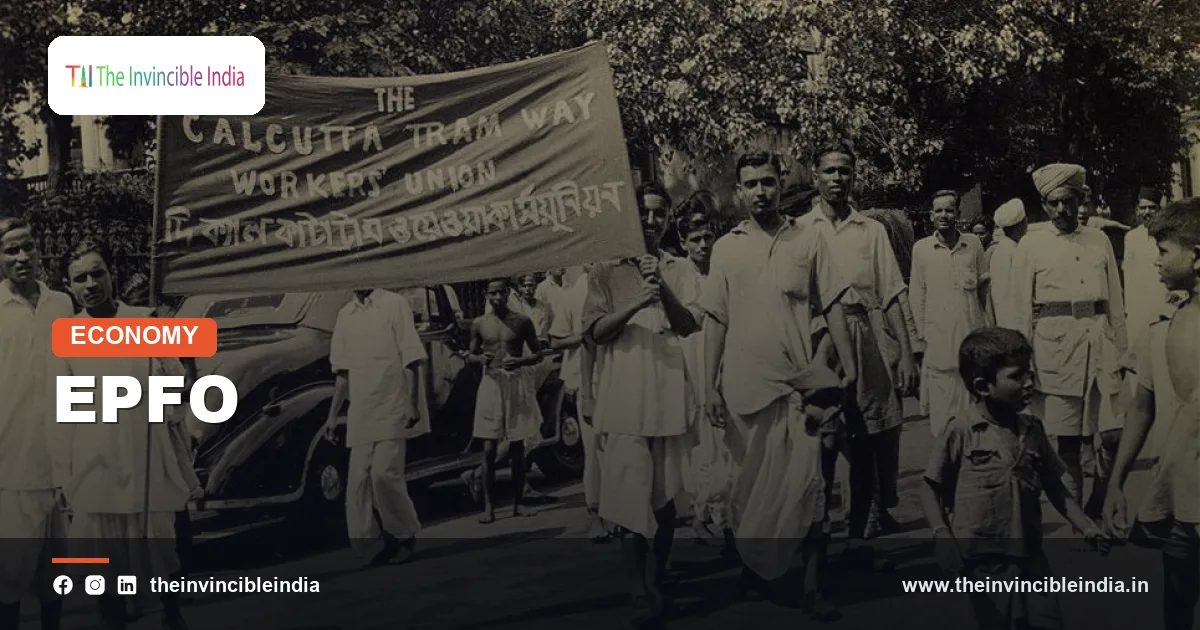
The Employees’ Provident Fund Organisation (EPFO) is the statutory body under the Ministry of Labour and Employment that administers the Employees’ Provident Fund, the Employees’ Pension Scheme and the Employees’ Deposit Linked Insurance scheme for workers in the organised sector in India. Established under the Employees’ Provident Funds and Miscellaneous Provisions Act, 1952, the Employees’ Provident Fund Organisation is regarded as one of the largest social-security organisations in the world in terms of membership and the volume of financial transactions.
For a salaried worker in India, the Employees’ Provident Fund Organisation is the institution that holds a share of every month’s salary as a retirement corpus, tracks it through a Universal Account Number, and later pays out the accumulated balance and a pension. This explainer sets out how the EPFO is structured, how contributions work, who decides the interest rate, and how the organisation is governed. Content last reviewed: 16 October 2026.
| Attribute | Detail |
|---|---|
| Full name | Employees’ Provident Fund Organisation (EPFO) |
| Parent law | Employees’ Provident Funds and Miscellaneous Provisions Act, 1952 |
| Ministry | Ministry of Labour and Employment, Government of India |
| Headquarters | New Delhi |
| Schemes administered | Employees’ Provident Fund Scheme 1952, Employees’ Pension Scheme 1995, Employees’ Deposit Linked Insurance Scheme 1976 |
| Governing body | Central Board of Trustees, Employees’ Provident Fund (tripartite) |
| Chief executive | Central Provident Fund Commissioner |
| Member identifier | Universal Account Number (UAN), a 12-digit number |
| Typical contribution | 12 per cent of basic wages and dearness allowance from the employee and a matching share from the employer |
Key Takeaways
- The Employees’ Provident Fund Organisation administers three schemes: the Employees’ Provident Fund, the Employees’ Pension Scheme 1995 and the Employees’ Deposit Linked Insurance Scheme 1976.
- The Employees’ Provident Fund Organisation operates under the Employees’ Provident Funds and Miscellaneous Provisions Act, 1952, and reports to the Ministry of Labour and Employment.
- The Central Board of Trustees of the Employees’ Provident Fund, a tripartite body of government, employer and employee representatives, governs the Employees’ Provident Fund Organisation and recommends the annual interest rate.
- Under the standard rule, both the employee and the employer contribute 12 per cent of basic wages plus dearness allowance, and the employer’s share is split between the provident fund and the pension scheme.
- Each member of the Employees’ Provident Fund Organisation has a 12-digit Universal Account Number that stays constant across jobs, while the member ID changes with each employer.
- Coverage of the Employees’ Provident Fund Organisation is mandatory for establishments above a prescribed employee threshold, historically 20 employees, and voluntary for smaller ones.
What is the Employees’ Provident Fund Organisation?
The Employees’ Provident Fund Organisation is the central statutory agency that implements India’s provident fund, pension and insurance schemes for employees in covered establishments. The organisation collects contributions, invests the funds, maintains member accounts and pays out benefits on retirement, resignation, death, disability or other eligible events.
The EPFO is commonly confused with the Employees’ Provident Fund, which is only one of its schemes. The provident fund is a savings scheme in which employees and employers deposit money every month. The organisation itself is the administrator of that scheme and also of the pension and insurance schemes that sit alongside it.
The organisation works through a network of zonal, regional and district offices spread over the country. Its administrative head is the Central Provident Fund Commissioner, who also serves as the executive officer of the Central Board of Trustees.
How did the EPFO come into existence?
The Employees’ Provident Fund Organisation traces its origin to the Employees’ Provident Funds Ordinance of 1951, which was replaced by the Employees’ Provident Funds and Miscellaneous Provisions Act of 1952. The first scheme, the Employees’ Provident Fund Scheme, was introduced for a small number of industries and was gradually extended to many more.
The EPF idea built on earlier provident fund arrangements in railways, mines and plantations, and on the broad constitutional goal of social security in the Directive Principles of State Policy. Parliament placed the subject within the framework of labour welfare, where social insurance falls under the Concurrent List of the Constitution.
| Year | Milestone |
|---|---|
| 1951 | Employees’ Provident Funds Ordinance promulgated |
| 1952 | Employees’ Provident Funds and Miscellaneous Provisions Act enacted; the EPF Scheme begins |
| 1971 | Family Pension Scheme introduced |
| 1976 | Employees’ Deposit Linked Insurance Scheme launched |
| 1995 | Employees’ Pension Scheme replaces the Family Pension Scheme |
| 2014 | Universal Account Number introduced for portability across jobs |
| 2020 onward | Code on Social Security, 2020 enacted to consolidate several social-security laws, including the 1952 Act, with phased implementation |
What schemes does the Employees’ Provident Fund Organisation run?
The Employees’ Provident Fund Organisation runs three core schemes: the Employees’ Provident Fund Scheme 1952, the Employees’ Pension Scheme 1995 and the Employees’ Deposit Linked Insurance Scheme 1976. Together they provide retirement savings, a monthly pension and life insurance cover for covered employees.
Employees’ Provident Fund (EPF)
The Employees’ Provident Fund is a defined-contribution savings scheme. Every month a fixed percentage of the employee’s wages is deducted and deposited along with the employer’s share, and the accumulated balance earns interest declared every year. The member receives the corpus on retirement, and may take partial withdrawals for specified purposes such as illness, marriage, education or housing.
Employees’ Pension Scheme (EPS)
The Employees’ Pension Scheme 1995 is a defined-benefit pension scheme funded by part of the employer’s contribution and a government contribution. A member who has completed the minimum service period becomes eligible for a monthly pension, generally on reaching pensionable age, with provisions for early pension, widow, children and nominee pensions, and disability benefits.
Employees’ Deposit Linked Insurance (EDLI)
The Employees’ Deposit Linked Insurance Scheme 1976 gives life insurance cover to members. If a member dies while in service, the nominee or legal heirs receive a lump sum linked to the member’s wages and the PF balance, subject to the scheme’s limits. The employer contributes to this scheme, and the employee does not.
How do contributions to the EPF work?
Contributions to the EPF work on a shared-contribution model in which the employee and the employer each deposit a set percentage of the employee’s monthly wages. Under the standard rate, each pays 12 per cent of basic wages plus dearness allowance, and the employer’s 12 per cent is divided between the provident fund account and the pension scheme.
- Employee’s share: the entire amount goes into the member’s provident fund account.
- Employer’s share: a portion goes to the Employees’ Pension Scheme, subject to a wage ceiling for pension calculation, and the balance goes to the member’s provident fund account.
- Government contribution: the Central Government contributes a small percentage of pensionable wages towards the pension scheme.
- EDLI and administration: the employer also pays small percentages for the insurance scheme and for administrative charges.
A lower rate applies to some categories of establishments under the Act. Exact percentages, wage ceilings and charges are set by notification and have changed over time, so employees and employers should check the current rules. The employer deposits both shares to the EPFO by a monthly due date through an online return.
Who must be covered by the EPFO?
Coverage under the EPFO is mandatory for establishments in notified industries that employ at least the prescribed number of persons, historically twenty, and for employees whose wages are within a prescribed monthly ceiling. Smaller establishments and employees above the wage ceiling may join voluntarily with the agreement of the employer and the Provident Fund authorities.
Once an establishment is covered, it remains covered even if the number of employees later falls below the threshold. The Act applies to factories and other establishments in specified industries, and the Central Government can extend it to other classes of establishments. Some establishments hold exemption by running their own approved provident fund trusts, which are monitored by the EPFO.
Who is outside the EPFO?
Workers in the unorganised sector without a formal employer, many self-employed people, and government employees who are covered by their own pension and provident fund rules are generally outside the EPFO net. Those groups have separate schemes, such as the Public Provident Fund for individuals, the General Provident Fund for government staff, and the National Pension System.
What is the Universal Account Number (UAN)?
The Universal Account Number is a unique 12-digit number issued by the Employees’ Provident Fund Organisation to each member, which stays the same throughout the member’s working life regardless of job changes. Introduced in 2014, the UAN acts as an umbrella under which different member IDs allotted by successive employers are linked.
The UAN is central to the digital services of the EPFO. A member activates it on the member portal, links it with Aadhaar, bank account and PAN as required, and can then view the passbook, download statements, file claims and transfer accounts online. Transfer of the accumulated balance from the previous employer’s account to the new one has become largely online, which reduces the need for paperwork.
- Passbook: a digital statement showing monthly contributions and interest credited, available through the member portal and the UMANG app.
- KYC and nomination: members are encouraged to update identity details and electronically nominate beneficiaries.
- Claims: withdrawal, transfer and pension claims are filed online and processed by regional offices.
Who decides the EPF interest rate?
The interest rate on the EPF is recommended every year by the Central Board of Trustees of the Employees’ Provident Fund and then notified by the Central Government after consultation with the Ministry of Finance. The declared rate is credited to member accounts for the financial year and has generally been higher than the rate on many small-savings schemes.
The Central Board of Trustees considers the income earned from the organisation’s investments, which are made according to an investment pattern prescribed by the Government. The pattern emphasises government securities and other debt instruments, with a limited portion invested in exchange-traded funds that hold equities. The rate can change from year to year because it depends on the actual income of the fund, and the board is expected to keep the rate sustainable.
The interest is computed monthly on the running balance and credited annually. Interest earned on a member’s own contributions above a certain annual limit may attract tax, so high-income members should consider the current tax rules.
Who runs the Employees’ Provident Fund Organisation?
The Employees’ Provident Fund Organisation is run by the Central Board of Trustees, Employees’ Provident Fund, assisted by the Central Provident Fund Commissioner as the chief executive. The Central Board is a tripartite body: it includes representatives of the Central Government, State Governments, employers and employees, and is chaired by the Union Minister for Labour and Employment.
| Body or role | Function |
|---|---|
| Central Board of Trustees (EPF) | Administers the funds, decides policy and recommends the interest rate |
| Executive Committee | Handles day-to-day decisions delegated by the Board |
| Central Provident Fund Commissioner | Chief executive; implements decisions and heads the organisation |
| Regional and zonal offices | Enforce compliance, process claims and handle grievances |
| Ministry of Labour and Employment | Administrative ministry responsible for policy and the parent Act |
| Ministry of Finance | Concurs on interest rate and investment pattern |
The tripartite structure reflects the idea that the fund belongs to workers and employers, not only to the government. Disputes about the dues of establishments are decided by the Provident Fund authorities, with appeals handled through tribunal and court channels established under the law.
How can members withdraw from the EPF and EPS?
Members can withdraw the EPF balance in full on retirement or after a period of unemployment, and can make partial advances earlier for specified needs such as illness, marriage, education, home purchase or home loan repayment. The Employees’ Provident Fund Organisation processes these claims online, and the rules on eligibility and the proportion of the balance that can be withdrawn are laid down in the scheme.
- Retirement: the full balance is payable on retirement at the age specified in the scheme, commonly 58.
- Unemployment: a member who leaves a job may withdraw after a waiting period, though transferring the account to a new employer is the usual choice.
- Partial advances: allowed for medical treatment, marriage, children’s education, housing and certain other purposes, with conditions on service period and amount.
- Pension: a member with the minimum pensionable service becomes entitled to a monthly pension from the pension age, with an option for early pension at a reduced rate.
- Death of a member: nominees receive the PF balance, EDLI benefit and, where eligible, family pension.
Tax rules apply to withdrawals made before completing the prescribed years of continuous service, so members should understand these before making early claims.
What are the criticisms and challenges of the EPFO?
The Employees’ Provident Fund Organisation faces criticism over delays in settling claims, pending dues from establishments, the sustainability of the pension scheme, and disputes about higher pension options. The organisation is a very large institution handling lakhs of claims and a vast number of accounts, and service quality has varied across offices.
- Pension adequacy: the minimum pension under the EPS has been debated for years, with trade unions demanding an increase and the government weighing the funding implications.
- Higher pension litigation: disputes over the option to contribute and draw pension on actual wages, instead of the ceiling, reached the Supreme Court and led to a procedure for exercising the option.
- Compliance gaps: some establishments delay or underpay contributions, and enforcement has to cover a large and varied set of employers.
- Investment returns: there are ongoing debates on how much of the corpus should be exposed to equity-linked instruments and how to balance risk and return.
- Digital friction: mismatches in names, dates or Aadhaar details can delay online claims.
The Code on Social Security, 2020 is designed to bring the 1952 Act and several other laws under a single framework, and its rollout is expected to affect how coverage and benefits are defined in the years ahead.
How does the EPF compare with other savings options?
The EPF differs from other long-term savings options in that it is tied to employment, has mandatory contributions, and is administered by a tripartite statutory board. Alternatives such as the Public Provident Fund and the National Pension System are open to individuals on a voluntary basis.
| Feature | EPF | Public Provident Fund | National Pension System |
|---|---|---|---|
| Who can join | Employees of covered establishments | Any resident individual | Any eligible Indian citizen |
| Contribution | Mandatory percentage of wages with employer match | Voluntary, within an annual limit | Voluntary or employer-linked |
| Administered by | EPFO | Government via post offices and banks | PFRDA-regulated pension fund managers |
| Interest or return | Declared annually | Notified periodically by the Government | Market-linked |
| Pension element | Yes, through EPS | No | Annuity on exit |
Bottom Line
The Employees’ Provident Fund Organisation is the backbone of retirement security for India’s organised workforce, combining a provident fund, a pension scheme and an insurance scheme under one statutory body. Its strengths are scale, mandatory contributions and a portable Universal Account Number, while its challenges include claim delays, pension adequacy and the transition to the Code on Social Security.
Frequently Asked Questions
What is the EPFO?
The EPFO, or Employees’ Provident Fund Organisation, is the statutory body under the Ministry of Labour and Employment that administers the EPF, the Employees’ Pension Scheme and the EDLI scheme. It was set up under the Employees’ Provident Funds and Miscellaneous Provisions Act, 1952. Its headquarters are in New Delhi.
How much do employees and employers contribute to the EPF?
Under the standard rule, the employee and the employer each contribute 12 per cent of basic wages plus dearness allowance. The employer’s share is divided between the provident fund and the pension scheme. Rates and wage ceilings can change by notification, so the current rules should be checked.
Who decides the EPF interest rate?
The Central Board of Trustees of the EPF recommends the annual interest rate, and the Central Government notifies it after consultation with the Ministry of Finance. The rate depends on the income earned from the fund’s investments. It is declared for each financial year and credited to member accounts.
What is the UAN in EPFO?
The UAN, or Universal Account Number, is a unique 12-digit number given to each EPFO member that remains constant across jobs. Different employer-assigned member IDs are linked to it. Members use the UAN to view passbooks, file claims and transfer balances online.
Which establishments must register with the EPFO?
Establishments in notified industries that employ at least the prescribed number of persons, historically twenty, must register with the EPFO. Smaller establishments can join voluntarily. Once covered, an establishment generally remains covered.
What is the difference between EPF and EPS?
The EPF is a savings scheme in which contributions plus interest accumulate in the member’s account and are paid as a lump sum, while the EPS is a defined-benefit scheme that pays a monthly pension. The EPS is funded by part of the employer’s contribution and a government share. Both are administered by the EPFO.
{“@context”:”https://schema.org”,”@graph”:[{“@type”:”FAQPage”,”mainEntity”:[{“@type”:”Question”,”name”:”What is the EPFO?”,”acceptedAnswer”:{“@type”:”Answer”,”text”:”The EPFO, or Employees’ Provident Fund Organisation, is the statutory body under the Ministry of Labour and Employment that administers the EPF, the Employees’ Pension Scheme and the EDLI scheme. It was set up under the Employees’ Provident Funds and Miscellaneous Provisions Act, 1952. Its headquarters are in New Delhi.”}},{“@type”:”Question”,”name”:”How much do employees and employers contribute to the EPF?”,”acceptedAnswer”:{“@type”:”Answer”,”text”:”Under the standard rule, the employee and the employer each contribute 12 per cent of basic wages plus dearness allowance. The employer’s share is divided between the provident fund and the pension scheme. Rates and wage ceilings can change by notification, so the current rules should be checked.”}},{“@type”:”Question”,”name”:”Who decides the EPF interest rate?”,”acceptedAnswer”:{“@type”:”Answer”,”text”:”The Central Board of Trustees of the EPF recommends the annual interest rate, and the Central Government notifies it after consultation with the Ministry of Finance. The rate depends on the income earned from the fund’s investments. It is declared for each financial year and credited to member accounts.”}},{“@type”:”Question”,”name”:”What is the UAN in EPFO?”,”acceptedAnswer”:{“@type”:”Answer”,”text”:”The UAN, or Universal Account Number, is a unique 12-digit number given to each EPFO member that remains constant across jobs. Different employer-assigned member IDs are linked to it. Members use the UAN to view passbooks, file claims and transfer balances online.”}},{“@type”:”Question”,”name”:”Which establishments must register with the EPFO?”,”acceptedAnswer”:{“@type”:”Answer”,”text”:”Establishments in notified industries that employ at least the prescribed number of persons, historically twenty, must register with the EPFO. Smaller establishments can join voluntarily. Once covered, an establishment generally remains covered.”}},{“@type”:”Question”,”name”:”What is the difference between EPF and EPS?”,”acceptedAnswer”:{“@type”:”Answer”,”text”:”The EPF is a savings scheme in which contributions plus interest accumulate in the member’s account and are paid as a lump sum, while the EPS is a defined-benefit scheme that pays a monthly pension. The EPS is funded by part of the employer’s contribution and a government share. Both are administered by the EPFO.”}}]}]}


