

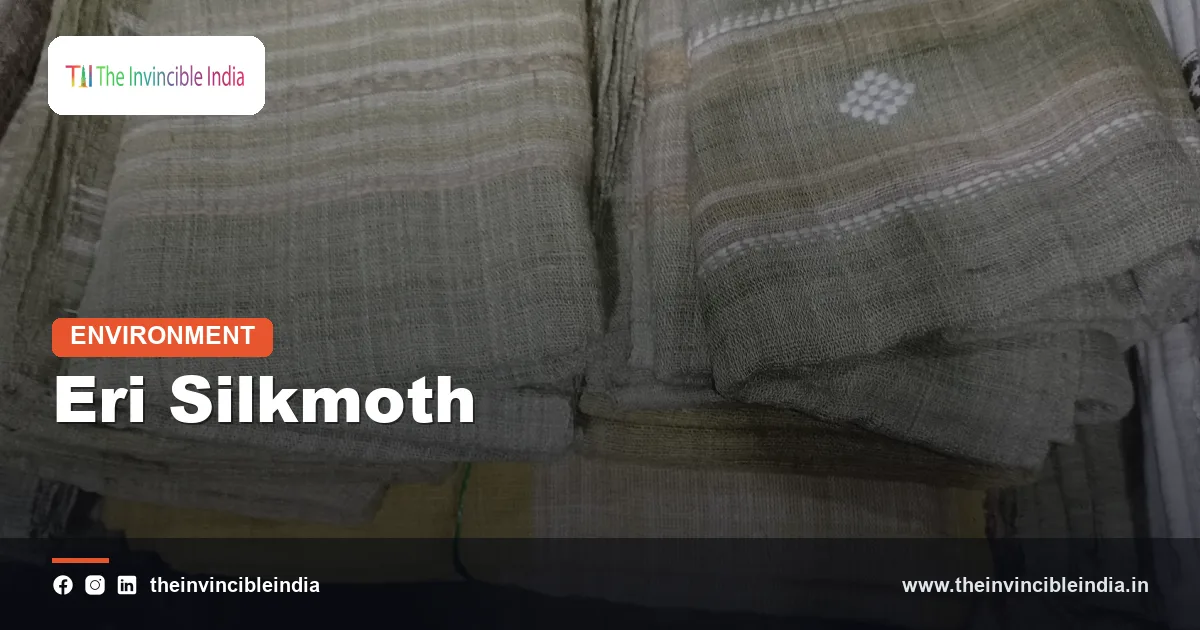
The eri silkmoth is a large, domesticated saturniid moth, Samia ricini, whose caterpillars feed mainly on castor leaves and spin the open-ended cocoons from which eri silk is made. It is the source of the soft, warm, woolly fabric that has long been woven by communities of Assam and the rest of north-east India, and it is often marketed as “ahimsa silk” or “peace silk” because the moth can leave the cocoon before the fibre is spun.
Eri silk is one of the four commercial silks of India, along with mulberry, tasar and muga, and India is the only country that produces all four. The eri silkmoth is also one of the very few silk-producing insects that is reared indoors on a common farm crop, which makes it a practical option for small households. This article explains what the eri silkmoth is, how it lives, how eri silk is made and why the fabric is valued.
Quick Facts
| Common names | Eri silkmoth, eri silkworm, endi silkworm, castor silkworm |
|---|---|
| Scientific name, order, family | Samia ricini (also written Samia cynthia ricini); order Lepidoptera; family Saturniidae |
| Size | Wingspan of the adult moth roughly 10 to 15 cm; full-grown caterpillar around 6 to 8 cm long |
| Habitat in India | Reared indoors; main region is Assam and the north-east, with some rearing in Bihar, Jharkhand, West Bengal and Odisha |
| Diet | Castor leaves (Ricinus communis) mainly; also kesseru, tapioca and some other plants. Adult moth does not feed |
| Life cycle | Egg, five larval stages, pupa in a cocoon, adult; about 6 to 9 weeks depending on season, with several generations a year |
| Economic role | Produces eri silk, a spun silk used for shawls, chaddars, scarves and sarees; a household craft in Assam |
| Notable features | Open-ended cocoon that is spun rather than reeled; fabric is warm, durable and woolly; called ahimsa silk |
| Supporting institution | Central Silk Board (CSB), including its research body in Jorhat, Assam, for muga and eri silks |
Key Takeaways
- The eri silkmoth, Samia ricini, is a domesticated moth of the family Saturniidae whose caterpillars feed mainly on castor leaves.
- Eri silk is made from open-ended cocoons that cannot be reeled into one long thread, so the fibre is degummed, pulled and spun like cotton or wool.
- Eri silk is called ahimsa silk or peace silk because the moth can leave the cocoon naturally before the cocoon is processed.
- Assam is the main eri-producing state in India, and the silk is also woven in Meghalaya, Nagaland, Manipur, Mizoram, Arunachal Pradesh and some eastern states.
- Eri fabric is soft, thick and durable, and it feels warm in cold weather and comfortable in warm weather, which is why it is often called the fabric of the people.
- India produces mulberry, tasar, eri and muga silk, and the eri silkmoth is the source of eri, the only one of the four that is spun from open-ended cocoons.
What is the eri silkmoth?
The eri silkmoth is a large moth of the family Saturniidae, known to science as Samia ricini, which is reared for the silk in its cocoon. It belongs to the same family as the giant silkmoths and emperor moths, a group that includes some of the largest moths in the world.
The caterpillar is thick-bodied, pale greenish-white to yellowish, and often dusted with a whitish powder. Some strains are blue-green and others are cream or yellow. The moth has broad, brownish-grey to reddish wings with a pale crescent mark in each wing and a wavy white band, and a furry body. Females are larger than males and have thicker abdomens full of eggs.
The common name “eri” comes from the Assamese word for castor, which is called era in Assamese and is the main plant the caterpillars eat. The name “endi” is also used for the silk and the cloth made from it. Scientists consider the eri silkmoth to be a domesticated form of a wild Samia species from the north-east of the subcontinent, although the exact wild ancestor is still discussed by taxonomists. Because the moth is closely related to Samia cynthia, some books list it as a subspecies of that species.
Where is the eri silkmoth found in India?
The eri silkmoth is found in India mainly in Assam and the other states of the north-east, which is the traditional home of eri culture. It is a domesticated insect, so it lives wherever people rear it rather than in a natural range of its own.
Assam produces the largest share of India’s eri silk. The districts of the Brahmaputra valley, including areas around Goalpara, Kamrup, Darrang, Lakhimpur and Dhemaji, are linked with traditional weaving. Eri is also important in Meghalaya, Nagaland, Manipur, Mizoram, Arunachal Pradesh and Tripura. Some rearing has spread to Bihar, Jharkhand, West Bengal, Odisha and Andhra Pradesh, where castor is grown as an oilseed crop.
Several communities in the north-east practise eri rearing, including Bodo, Mishing (Miri), Karbi, Rabha and Garo households, and Assamese families in rural districts. In many homes, women rear the worms in a corner of the house, spin the yarn on a drop spindle or a small wheel and weave it on a loin loom for the family’s own clothing. This is one reason why eri is described as a household craft rather than a factory industry.
What does the eri silkmoth eat?
The eri silkmoth caterpillar eats mainly castor leaves, and castor is regarded as its best and most widely used food plant. Because castor is a fast-growing and common plant, eri rearing does not need a special orchard.
Castor leaves are broad, glossy and tender, and the plants can be grown on field boundaries, kitchen gardens and fallow land. Rearers choose tender leaves for young caterpillars and larger, more mature leaves for older ones. Other plants that eri caterpillars accept include:
- Kesseru (Heteropanax fragrans), a tree widely planted in Assam and used in some districts as an alternate feed.
- Tapioca or cassava leaves, used when castor is scarce.
- Payam (Evodia fraxinifolia), papaya and a few others, used in smaller amounts.
The diet affects the cocoon. Castor-fed worms usually give the best cocoon quality and silk yield, while some other leaves produce a slightly different texture or colour. Adult moths do not eat, as they have only vestigial mouthparts, and they live only a few days.
How does the eri silkmoth life cycle work?
The eri silkmoth has a complete life cycle of egg, larva, pupa and adult, and it is multivoltine, meaning it can produce several generations a year. In warm months the cycle takes roughly six to eight weeks, and it can be longer in cold weather.
Egg and larva
A female lays a few hundred small oval eggs in clusters after mating, and the eggs hatch in about a week. The caterpillar grows through five stages separated by four moults. During this time it eats continuously and may increase its body weight many hundred times. The larval period lasts about three to four weeks, depending on the temperature and leaf quality.
Cocoon and pupa
When mature, the caterpillar stops eating and shortens its body, then looks for a place to spin. It spins a loose, elongated, brick-shaped or spindle-shaped cocoon with a thin, open end. Inside, it changes into a dark brown pupa. The pupal stage lasts roughly ten to fifteen days in warm conditions, and longer in winter, when the pupa can remain in a resting state.
Adult moth
The moth pushes open the soft end of the cocoon and emerges without cutting the threads, which is what makes eri silk different from mulberry silk. It dries its wings, mates and lays eggs within a few days, then dies.
Why is the eri cocoon open at one end?
The eri cocoon is open at one end because the caterpillar leaves a loose, unsealed tip where the moth will later emerge, instead of closing the cocoon completely as the mulberry silkworm does. This feature decides how the silk is processed.
In a closed cocoon, the thread is one continuous filament. In an open-ended eri cocoon, the moth can exit without cutting the thread, but the filament is loose and made of many tangled strands that cannot be reeled in one go. For this reason, eri silk is called a spun silk, not a reeled silk. The cocoon is boiled in a mild alkaline solution, often with ash or soda, to soften the gum, and then the fibres are opened, stretched and spun into yarn.
The eri cocoon is also thicker and more porous than the mulberry cocoon. Its colour ranges from white and cream to a reddish brick shade, depending on the strain and the food. Different cocoon colours produce different fabric tones and, when left undyed, the shades give traditional eri cloth its natural look.
How is eri silk made?
Eri silk is made by collecting empty cocoons after the moths have emerged, degumming them, and spinning the fibres into yarn by hand or machine. The steps are shorter than in mulberry reeling, but they need patience and skill.
- The caterpillars are reared on castor leaves until they spin their cocoons.
- Cocoons are collected, and the moths are allowed to emerge naturally. Some are kept for breeding the next generation.
- The empty cocoons are boiled for some time in a mildly alkaline solution to remove most of the sericin gum.
- The softened cocoons are rinsed, opened out into soft, flat sheets of fibre, and dried.
- The fibres are then drawn out and spun on a hand-held drop spindle or on a spinning wheel into a thick, slightly fuzzy yarn.
- The yarn is woven on a handloom into shawls, chaddars, scarves, stoles, sarees and dress material, or blended with cotton, wool or other silks.
Because the yarn is spun, it has a natural slight unevenness, which gives eri cloth its characteristic texture. The Central Silk Board and various state agencies promote improved spinning wheels and blended yarns, and designers now use eri for modern clothing.
Is eri silk really ahimsa silk?
Eri silk is called ahimsa silk because the traditional method lets the moth leave the cocoon before the silk is spun, so the pupa is not killed to obtain the thread. The word ahimsa means non-violence in Sanskrit and several Indian languages.
This description is broadly accurate for the traditional household method, where cocoons are collected only after emergence. However, the label should be read with some care. In larger commercial operations, some producers may stifle pupae or process cocoons before emergence, and the pupae are also eaten as food in some communities of the north-east, where they are treated as a protein-rich delicacy. Buyers who want ahimsa silk specifically are advised to ask producers about how the cocoons were handled.
Even with those caveats, eri silk is the best-known example of silk that can be harvested without killing the pupa, and this is one reason why the fabric has found a market among consumers who prefer cruelty-free textiles.
What is eri silk fabric like?
Eri silk fabric is soft, dense and woolly, with a matte finish, and it is known for warmth in winter and comfort in summer. It is stronger than many people expect, and well-made eri cloth can last for many years.
| Property | Eri silk | Mulberry silk |
|---|---|---|
| Cocoon type | Open-ended | Closed |
| Fibre processing | Spun from short fibres | Reeled as a continuous filament |
| Lustre | Low, matte | High, glossy |
| Feel | Soft, thick, woolly | Smooth, fine |
| Typical use | Shawls, chaddars, stoles, casual wear | Sarees, formal wear, fine fabrics |
| Main food plant | Castor | Mulberry |
The fabric is traditionally woven in natural undyed shades of cream, white and brick red, but it takes dyes well, and natural dyes from plants such as lac, turmeric and indigo have long been used in the region. Eri cloth is relatively easy to wash and does not need heavy starching, which has made it popular for everyday garments, and many weavers also mix it with wool to make fine shawls.
Why does the eri silkmoth matter to rural households?
The eri silkmoth matters because it gives rural families, especially women, an income-generating craft that needs little land, little capital and common farm plants. The household rearing cycle is short, so families can complete several rearing batches in a year.
Eri rearing fits well with mixed farming. Castor can be grown on bunds and small plots, and the caterpillar waste can be used as manure. The craft also keeps traditional knowledge alive, since many Assamese families weave eri cloth for their own use and for local festivals and gifts. In several districts, self-help groups and cooperatives help women sell eri yarn and cloth, and government schemes provide training, spinning devices and market support.
Eri silk has also drawn attention from fashion designers and from consumers looking for natural, sustainable fabrics. At the same time, rearers face challenges, including limited processing technology, the low price of raw cocoons, shortages of disease-free eggs, and competition from cheaper synthetic fibres. Research institutions work on improved breeds, castor varieties and spinning machinery to address these problems.
What threatens eri silk production?
Eri silk production is mainly threatened by diseases of the silkmoth, poor-quality seed, climate stress and weak market links, and not by a shortage of food plants. Eri caterpillars are hardier than mulberry silkworms, but they are still prone to several problems.
- Diseases such as flacherie, grasserie and pebrine can affect eri batches, especially in damp, unclean rearing rooms.
- Predators and parasites, including ants, lizards, birds, rodents and parasitic flies, damage caterpillars and cocoons.
- Weather extremes, particularly heavy rain, humidity and cold, can slow growth and lower cocoon quality.
- Market issues such as the absence of local spinning and processing units and uneven prices.
Good rearing practice includes clean rearing rooms, fresh castor leaves, regular removal of litter and sick larvae, and the use of tested eggs. Government silk departments and the Central Silk Board offer training in these practices.
Bottom Line
The eri silkmoth is a castor-feeding, domesticated moth that produces the soft, warm and durable eri silk of Assam and the north-east. Its open-ended cocoon, spun fibre and peace-silk reputation make it distinct among India’s silks, and it remains a valued source of income and cultural identity for rural households.
Frequently Asked Questions
What is the eri silkmoth?
The eri silkmoth is a domesticated moth, Samia ricini, whose caterpillars feed mainly on castor leaves and spin open-ended cocoons. The cocoons are used to make eri silk, a soft and warm spun fabric. The species belongs to the family Saturniidae, which also includes the giant silkmoths.
Why is eri silk called ahimsa silk?
Eri silk is called ahimsa silk because the traditional method allows the moth to leave the cocoon before the silk is spun, so the pupa is not killed. The word ahimsa means non-violence. Buyers should still ask producers how their cocoons were handled, since commercial practices can vary.
Where is eri silk produced in India?
Eri silk is produced mainly in Assam and other north-eastern states such as Meghalaya, Nagaland, Manipur, Mizoram and Arunachal Pradesh. Smaller amounts are produced in Bihar, Jharkhand, West Bengal and Odisha. Assam has the strongest tradition of eri weaving, where it is also known as endi.
What do eri silkworms eat?
Eri silkworms eat mainly castor leaves, which are considered their best food plant. They also accept kesseru, tapioca, payam and papaya leaves in smaller amounts. The adult moths do not eat at all.
How is eri silk different from mulberry silk?
Eri silk is spun from short fibres taken from open-ended cocoons, while mulberry silk is reeled from a continuous filament of a closed cocoon. As a result, eri silk is matte, thick and woolly, while mulberry silk is smooth and glossy. Eri also uses castor as food, whereas mulberry silk uses mulberry leaves.
Is eri silk warm enough for winter?
Eri silk is warm and is traditionally woven into shawls and chaddars for winter use in the north-east. Its thick, spun fibres trap air and give good insulation. The same fabric can also be comfortable in warmer weather because it is breathable.
{“@context”:”https://schema.org”,”@graph”:[{“@type”:”FAQPage”,”mainEntity”:[{“@type”:”Question”,”name”:”What is the eri silkmoth?”,”acceptedAnswer”:{“@type”:”Answer”,”text”:”The eri silkmoth is a domesticated moth, Samia ricini, whose caterpillars feed mainly on castor leaves and spin open-ended cocoons. The cocoons are used to make eri silk, a soft and warm spun fabric. The species belongs to the family Saturniidae, which also includes the giant silkmoths.”}},{“@type”:”Question”,”name”:”Why is eri silk called ahimsa silk?”,”acceptedAnswer”:{“@type”:”Answer”,”text”:”Eri silk is called ahimsa silk because the traditional method allows the moth to leave the cocoon before the silk is spun, so the pupa is not killed. The word ahimsa means non-violence. Buyers should still ask producers how their cocoons were handled, since commercial practices can vary.”}},{“@type”:”Question”,”name”:”Where is eri silk produced in India?”,”acceptedAnswer”:{“@type”:”Answer”,”text”:”Eri silk is produced mainly in Assam and other north-eastern states such as Meghalaya, Nagaland, Manipur, Mizoram and Arunachal Pradesh. Smaller amounts are produced in Bihar, Jharkhand, West Bengal and Odisha. Assam has the strongest tradition of eri weaving, where it is also known as endi.”}},{“@type”:”Question”,”name”:”What do eri silkworms eat?”,”acceptedAnswer”:{“@type”:”Answer”,”text”:”Eri silkworms eat mainly castor leaves, which are considered their best food plant. They also accept kesseru, tapioca, payam and papaya leaves in smaller amounts. The adult moths do not eat at all.”}},{“@type”:”Question”,”name”:”How is eri silk different from mulberry silk?”,”acceptedAnswer”:{“@type”:”Answer”,”text”:”Eri silk is spun from short fibres taken from open-ended cocoons, while mulberry silk is reeled from a continuous filament of a closed cocoon. As a result, eri silk is matte, thick and woolly, while mulberry silk is smooth and glossy. Eri also uses castor as food, whereas mulberry silk uses mulberry leaves.”}},{“@type”:”Question”,”name”:”Is eri silk warm enough for winter?”,”acceptedAnswer”:{“@type”:”Answer”,”text”:”Eri silk is warm and is traditionally woven into shawls and chaddars for winter use in the north-east. Its thick, spun fibres trap air and give good insulation. The same fabric can also be comfortable in warmer weather because it is breathable.”}}]}]}


