

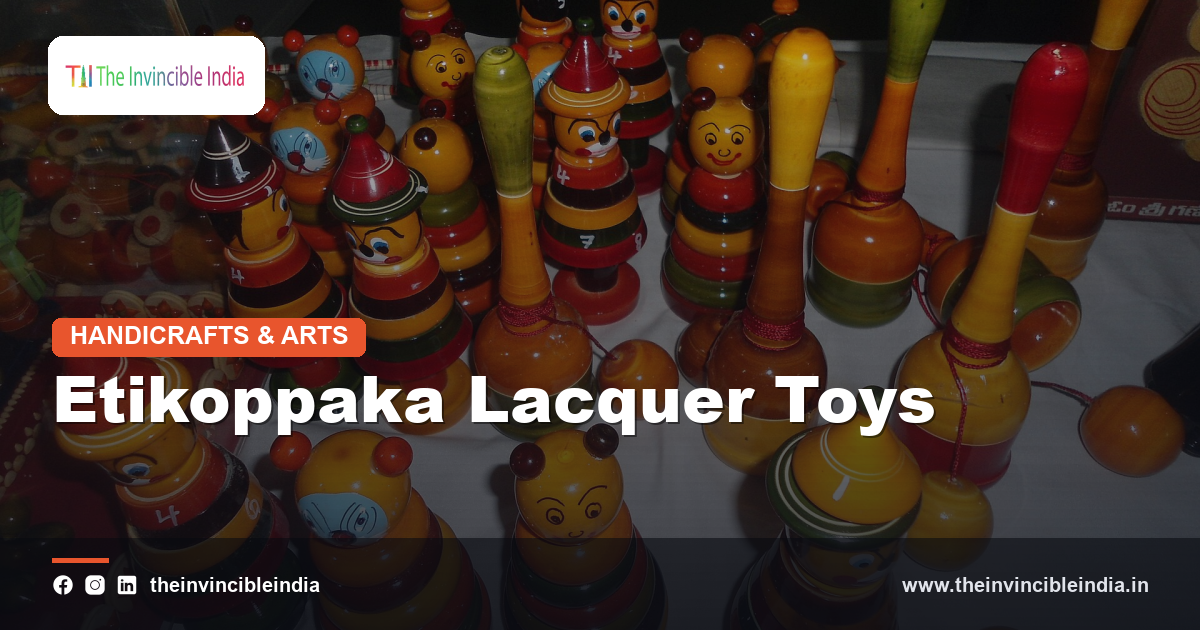
Etikoppaka lacquer toys are a distinctive craft from the village of Etikoppaka in Andhra Pradesh, known for smooth, brightly coloured wooden toys and figurines turned on a lathe and finished with natural, vegetable-based lacquer dyes rather than synthetic paint. Produced using a lightweight local wood, these toys occupy a place among India’s regional wooden toy traditions alongside better-known crafts such as Channapatna toys from Karnataka, though Etikoppaka’s distinctive lacquering technique and use of natural dyes give it a separate identity. Recognised with a Geographical Indication tag, Etikoppaka toys remain closely tied to a single village and its long-standing woodturning families.
Quick Facts
| Detail | Information |
|---|---|
| Also Known As | Etikoppaka lacquerware |
| Primary Region | Etikoppaka village, Andhra Pradesh |
| Wood Used | Ankudu (softwood) |
| Finish | Natural, vegetable-based lac dyes |
| Recognition | Geographical Indication (GI) tag |
| Common Products | Toys, figurines, Golu dolls, decorative items |
Origins in Etikoppaka Village
Etikoppaka lacquer toys take their name from the village of Etikoppaka in the coastal region of Andhra Pradesh, where woodturning and lacquering skills have been practised within local families for many generations. The craft’s identity remains closely bound to this single village.
Generations of artisans in Etikoppaka have refined the techniques of turning and colouring wood into toys and decorative objects, developing a body of specialised knowledge that has largely remained concentrated within the village rather than spreading widely to other regions.
Ankudu Wood: The Craft's Raw Material
Etikoppaka toys are traditionally made from ankudu wood, a soft, lightweight timber sourced from trees found in the surrounding region, chosen for qualities that make it especially well suited to fine lathe turning. This particular wood is central to the craft’s identity.
The softness of ankudu wood allows artisans to shape intricate, rounded forms with relative ease compared to harder timbers, while its light weight makes finished toys comfortable and safe for children to handle, an important consideration for a craft historically centred on toy-making.
Lathe Turning Technique
Shaping Etikoppaka toys begins with turning blocks of ankudu wood on a manually or mechanically operated lathe, where skilled artisans use hand tools to carve the spinning wood into rounded forms such as spinning tops, dolls, and animal figures. This turning stage requires considerable precision and experience.
Because many Etikoppaka products rely on smooth, symmetrical curves for both function and appearance, lathe turning demands a steady hand and an intuitive sense of proportion, skills typically developed over years of practice within artisan families in the village.
Natural Lac and Vegetable Dyes
What most distinguishes Etikoppaka toys from other turned wooden crafts is their finishing process, which uses natural lac combined with vegetable and mineral-based dyes rather than synthetic paints. This approach gives the toys a distinctive soft sheen and non-toxic surface.
Artisans apply coloured lac to the spinning wooden object while it remains on the lathe, allowing friction and heat to melt and bond the lac evenly across the surface, a technique that produces smooth, durable colour without the need for a separate painting stage.
The Lacquering Process in Detail
During lacquering, a stick of coloured lac is pressed against the rotating wooden piece, generating enough heat through friction to soften the lac so that it spreads and adheres directly to the wood’s surface. Multiple colours can be applied in sequence to create patterned effects.
This direct, heat-based application method requires artisans to work quickly and precisely while the wood is still turning, coordinating the pressure and movement of the lac stick with the speed of the lathe to achieve an even, well-bonded finish across the entire object.
Safety and Non-Toxic Reputation
Because Etikoppaka toys are finished with natural lac and vegetable-based colourants rather than synthetic paints, they have gained a reputation as a safer, non-toxic option for children’s toys compared to many mass-produced alternatives. This quality has become an important selling point.
This natural finishing approach also appeals to buyers seeking environmentally conscious products, positioning Etikoppaka toys within a wider market interest in handmade, chemical-free goods that avoid the synthetic coatings common in many contemporary toys.
Traditional Toy Forms
Classic Etikoppaka products include spinning tops, rattles, simple push-and-pull toys, and figurines of animals and human characters, many of which have remained popular designs across generations of production. These forms reflect both playfulness and technical craftsmanship.
Alongside toys intended primarily for children’s play, artisans also produce decorative figurines and ornamental pieces, expanding the craft’s appeal to buyers interested in Etikoppaka work as home décor rather than purely functional toys.
Golu Dolls and Festive Use
Etikoppaka artisans are also known for producing figures used in Golu displays, the tiered arrangements of dolls set up during certain South Indian festivals to depict deities, mythological scenes, and everyday life. These festive figures form an important seasonal product line for the craft.
The demand generated by Golu displays provides Etikoppaka artisans with a significant seasonal market, complementing year-round sales of toys and decorative items and reinforcing the craft’s connection to broader South Indian cultural and religious practice.
Geographical Indication Recognition
Etikoppaka lacquerware has received formal Geographical Indication recognition, identifying the craft as a product specifically associated with Etikoppaka village and helping distinguish genuine pieces from imitation lacquered toys produced elsewhere using different techniques. This status supports both authenticity and artisan livelihoods.
Such recognition has also helped raise the profile of Etikoppaka toys in national and international craft markets, providing a formal basis for promoting the village’s distinct woodturning and lacquering tradition as a protected regional specialty.
Artisan Families and Livelihoods
Etikoppaka’s toy-making tradition remains centred on a network of artisan families who combine woodturning, lacquering, and finishing skills within household workshops, often involving several family members across different stages of production. This family-based structure has sustained the craft over many years.
Government and non-governmental support programmes have worked with these artisan families to improve training, tool access, and market linkages, recognising both the cultural value of the craft and its role in supporting livelihoods within the village.
Design Innovation and New Products
While traditional toy forms remain central to Etikoppaka’s output, some artisans and designers have introduced new product lines, including home décor items, jewellery, and stationery accessories, all finished using the same natural lacquering technique. This diversification has broadened the craft’s market appeal.
Such innovation allows Etikoppaka’s distinctive lacquering process to reach buyers who may not be in the market for children’s toys, helping sustain demand for the underlying craft skills even as consumer tastes and product categories evolve.
Environmental Considerations
The reliance on ankudu wood and natural lac gives Etikoppaka toy-making certain environmental advantages compared to plastic or synthetically finished toys, though sustainable management of wood sources remains an ongoing consideration for the craft’s long-term viability. Responsible sourcing practices help balance production with resource availability.
Craft development initiatives have periodically addressed the need to secure a stable, sustainably managed supply of suitable wood, recognising that the availability of ankudu timber is fundamental to the continuation of Etikoppaka’s distinctive turning and lacquering tradition.
Market Presence and Export Interest
Etikoppaka toys have found markets well beyond Andhra Pradesh, sold through craft emporiums, exhibitions, and increasingly online platforms that connect artisans directly with buyers across India and abroad. This wider market presence has provided important economic support for the village’s craft workshops.
Export interest in Etikoppaka lacquerware has grown alongside broader international appreciation for handmade, naturally finished wooden goods, offering artisan families additional avenues for income beyond domestic sales alone.
Challenges Facing the Craft
Etikoppaka toy-making faces challenges including competition from cheaper mass-produced toys, the labour-intensive nature of hand lathe turning and lacquering, and the need to secure consistent supplies of suitable wood. These pressures affect the craft’s economic sustainability.
Support from craft development organisations, along with growing consumer interest in handmade and non-toxic products, has helped Etikoppaka artisans navigate some of these challenges, though continued attention to training and market access remains important for the craft’s future.
Tools and Workshop Setup
An Etikoppaka workshop is typically organised around a central lathe, supplemented by simple hand tools for shaping wood and a small collection of lac sticks in various colours used for finishing. This modest tool set reflects the craft’s largely manual, skill-dependent nature.
Many workshops remain family-run and located within or adjacent to artisans’ homes, allowing work to be integrated flexibly into daily household routines rather than confined to a separate commercial premises, a pattern common across many of India’s household-based craft traditions.
Colour Choices and Symbolism
Etikoppaka toys are typically finished in bright, cheerful colours, including reds, greens, yellows, and blues, chosen partly for their visual appeal to children and partly for the way they display well against the natural sheen produced by the lac finishing process. Colour combinations are often selected instinctively by experienced artisans.
While specific colours are not usually tied to fixed symbolic meanings, certain combinations have become closely associated with particular toy forms, such as traditional Golu figures, over years of established local practice within the village.
Women's Contribution to the Craft
Women in Etikoppaka artisan households often play an important role in stages of production such as sorting materials, applying finishing touches, and packaging finished toys, contributing significantly to overall workshop output alongside the lathe-turning typically carried out by men. This division of labour reflects broader patterns in household craft production.
Craft development programmes have increasingly recognised and supported women’s participation in Etikoppaka’s toy-making economy, viewing their involvement as important to both household income and the wider sustainability of the craft.
Training the Next Generation
Passing lathe-turning and lacquering skills to younger family members remains central to sustaining Etikoppaka’s craft, with children traditionally introduced to simpler tasks before gradually taking on the more demanding stages of turning and colour application. This gradual apprenticeship model builds competence over years rather than months.
Some craft development programmes have introduced structured training initiatives to supplement this informal family learning, aiming to attract and retain younger artisans in a craft that otherwise depends heavily on generational continuity within a small number of households.
Packaging and Presentation for Sale
As Etikoppaka toys have reached wider markets, artisans and cooperatives have paid increasing attention to packaging and presentation, recognising that attractive, protective packaging helps preserve the delicate lacquered finish during transport and improves the product’s appeal to retail buyers. This attention to presentation supports both durability and sales.
Improved packaging has also supported the craft’s growth in online and export markets, where buyers cannot physically inspect toys before purchase and therefore rely more heavily on careful presentation to convey quality.
Etikoppaka Toys Today
Etikoppaka lacquer toys today remain a distinctive example of India’s regional wooden toy traditions, valued for their smooth turned forms, vibrant natural colouring, and non-toxic finish. Production continues to be centred on the artisan families of Etikoppaka village.
With continued institutional support, Geographical Indication protection, and growing consumer interest in safe, handmade toys, Etikoppaka’s woodturning and lacquering tradition appears well positioned to remain an active and recognised part of India’s craft economy.
Sources & Further Reading
- Ministry of Textiles, Government of India (texmin.nic.in).
- Ministry of Culture, Government of India (indiaculture.gov.in).
Frequently Asked Questions
What are Etikoppaka toys made from?
Etikoppaka toys are made from ankudu, a soft, lightweight wood, which is turned on a lathe and finished with natural lac combined with vegetable and mineral-based dyes.
Are Etikoppaka toys safe for children?
Yes, Etikoppaka toys are widely regarded as safe and non-toxic because they are finished with natural lac and vegetable-based colourants rather than synthetic paints.
How is the colour applied to Etikoppaka toys?
Colour is applied by pressing sticks of coloured lac against the wood while it spins on the lathe, using friction-generated heat to melt and bond the lac evenly onto the surface.
Where are Etikoppaka toys made?
Etikoppaka toys are made in and around Etikoppaka village in Andhra Pradesh, where artisan families have practised woodturning and lacquering for generations.
Do Etikoppaka artisans make anything besides toys?
Yes, in addition to traditional toys and Golu dolls, many artisans now produce lacquered home décor items, jewellery, and stationery accessories using the same technique.


