

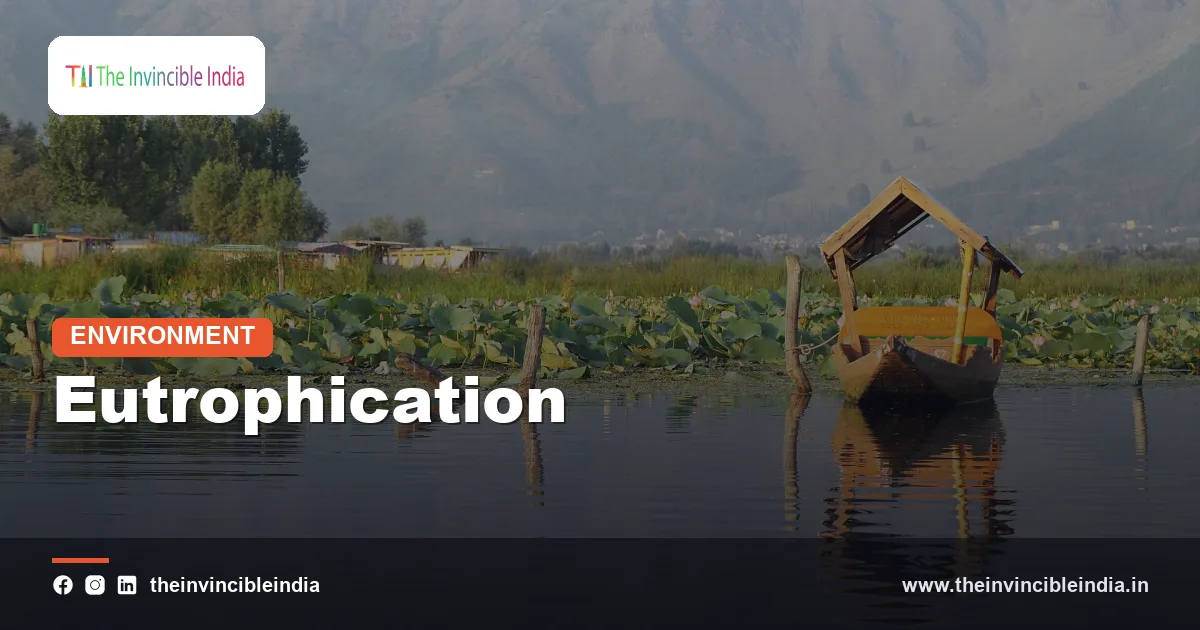
In India, eutrophication is the over-enrichment of lakes, ponds, reservoirs and slow rivers with plant nutrients, mainly nitrogen and phosphorus from sewage, detergents and fertiliser runoff, which fuels explosive growth of algae and weeds, starves the water of oxygen and kills fish. The word comes from Greek roots meaning well nourished, and the irony is that too much nourishment turns a living lake into a green, foul-smelling one.
Few images capture the problem as vividly as Bengaluru’s Bellandur lake, where sewage-laden water has produced towering white foam and, on occasion, fire. But the same process is quietly under way in water bodies from Kashmir’s Dal Lake to village ponds and city tanks across the country. This explainer describes how eutrophication works, why Indian lakes are so vulnerable, what damage it does and how lakes can be brought back.
| Attribute | Detail |
|---|---|
| Definition | Enrichment of water with nutrients, causing excess growth of algae and aquatic plants |
| Key nutrients | Phosphorus and nitrogen |
| Main Indian sources | Untreated sewage, detergents, fertiliser runoff, livestock waste, industrial effluent |
| Typical symptoms | Green scum, algal blooms, water hyacinth, foul smell, low oxygen, fish kills |
| Most affected waters | Urban lakes, ponds, reservoirs, slow rivers, backwaters and some coastal waters |
| Well-known cases | Bellandur and Varthur lakes (Bengaluru), Dal Lake (Srinagar), Hussain Sagar (Hyderabad) |
| Main policy tools | National Plan for Conservation of Aquatic Ecosystems, Wetlands Rules, sewage treatment |
| Core remedy | Stop nutrient inflow first, then restore the lake |
Key Takeaways
- Eutrophication is driven by excess nitrogen and phosphorus, and in Indian towns the biggest source is untreated or poorly treated sewage, with fertiliser runoff the main source in farming areas.
- Algal blooms block sunlight, and when the algae die, bacteria consume dissolved oxygen as they decompose them, which can cause hypoxia and mass fish deaths.
- Some blooms are made of cyanobacteria, which can release toxins that harm fish, livestock, pets and people who use the water.
- Bengaluru’s Bellandur and Varthur lakes became national symbols of the problem through their froth and the fires reported in the mid-2010s.
- Restoring a eutrophic lake works only if the inflow of nutrients is cut first; removing weeds or dredging alone allows the problem to return.
- Sewage treatment, protected wetland buffers, efficient fertiliser use and community stewardship are the most reliable long-term remedies.
What is eutrophication?
Eutrophication is the process by which a water body becomes overly rich in nutrients, so that algae and aquatic plants grow out of control. Nutrients are essential in small amounts, because they support the algae and plants at the base of the food web. The trouble starts when the supply far exceeds what the ecosystem can use.
Limnologists, the scientists who study lakes, rank water bodies along a scale of nutrient richness. A clear, nutrient-poor lake is called oligotrophic. A moderately productive one is mesotrophic. A nutrient-rich one is eutrophic, and a severely overloaded, murky or green one is hypereutrophic. Lakes can move slowly along this scale naturally over centuries as sediment fills them in. The word cultural eutrophication describes the much faster, human-caused version, which can transform a lake within years.
In India, the process is usually discussed in relation to urban lakes and tanks, where the water is shallow, warm and still. These conditions are ideal for algae, which grow fastest in sunlight and warmth. A tropical climate with strong sun for most of the year therefore makes Indian lakes especially quick to respond to nutrient pollution.
What causes eutrophication in India?
Eutrophication in India is caused mainly by sewage, detergents, fertiliser runoff, livestock waste and industrial effluent flowing into lakes and slow-moving waters. Rapid urban growth has outpaced sewage collection and treatment in most Indian cities, so large volumes of nutrient-rich wastewater reach lakes through storm drains.
- Domestic sewage: human waste is rich in nitrogen and phosphorus, and untreated or partly treated sewage is the dominant source in urban lakes.
- Detergents: washing powders and cleaning products can contain phosphates, which act as a potent fertiliser for algae.
- Agricultural runoff: nitrogen and phosphorus fertilisers, along with animal manure, wash off fields in the monsoon into streams, tanks and reservoirs.
- Livestock and aquaculture: dung, feed waste and fish farm effluent add nutrients.
- Industrial effluent: food processing, distilleries, textile units and fertiliser plants can discharge nutrient-heavy wastewater.
- Atmospheric deposition and soil erosion: nitrogen carried by air and nutrient-rich silt from eroded land also settle into lakes.
Encroachment and loss of natural buffers make matters worse. Wetlands and reed beds around a lake filter nutrients before they reach open water, but when these fringes are built over or drained, runoff enters the lake directly. Interlinked tank systems that once recycled water through the landscape have also been broken by roads and buildings, trapping pollutants in single basins.
How does eutrophication harm a lake?
Eutrophication harms a lake by triggering algal blooms, cutting oxygen and light, and replacing a diverse ecosystem with a few tolerant species. The effects cascade through the water in a predictable sequence.
Algal blooms and floating weeds
Extra nutrients allow algae to multiply into dense green mats or scums at the surface. Floating plants such as water hyacinth, an invasive species from South America, spread rapidly in nutrient-rich water and can cover an entire lake. Both block sunlight, so submerged plants below die off, removing food and shelter for fish and invertebrates.
Oxygen depletion and fish kills
When algae and plants die, they sink and are decomposed by bacteria, which use up dissolved oxygen. The resulting low-oxygen condition is called hypoxia, and complete absence of oxygen is anoxia. Fish and other animals suffocate, causing the mass fish deaths that are reported from Indian lakes and ponds, often after the first rains or during hot, still weather. Without oxygen, the lake bottom also begins to release methane, hydrogen sulphide and stored phosphorus, which feeds yet more algae in a self-reinforcing loop.
Toxins, smell and lost uses
Certain cyanobacteria, commonly called blue-green algae, produce toxins such as microcystins that can poison livestock and wildlife and cause illness in people. Eutrophic water also smells, looks unpleasant and is more expensive to treat if it is a source of drinking water. Lakes lose their value for fishing, boating, tourism and groundwater recharge, and surrounding communities often suffer from mosquitoes and odour.
Why did Bellandur Lake foam and catch fire?
Bellandur Lake foamed and caught fire because it received huge volumes of untreated sewage and industrial effluent that loaded it with detergents, phosphates, oils and organic matter. It is the largest lake in Bengaluru, and it sits downstream of a densely built-up catchment that has grown far faster than the city’s sewage system.
The white froth that drifted over roads in the mid-2010s was produced when surfactants from detergents and other organic compounds were churned up where water flowed over weirs and sluices. Froth is not in itself proof of a particular chemical, but it signals a heavily polluted water body. Reports of fire on the lake surface in the same period were linked by investigators to flammable materials, such as oils, solvents and methane gas, which accumulated in the polluted water and were ignited. The incidents attracted action from the National Green Tribunal and the Karnataka High Court, which ordered stricter controls on effluent and encroachment.
The neighbouring Varthur Lake is part of the same chain of lakes and shows similar symptoms. Bengaluru’s lakes were designed centuries ago as a connected cascade of tanks that stored rainwater for irrigation, and they now serve as the end point of the city’s wastewater. The case shows that eutrophication in a big city is a systems failure of sewage and land-use planning more than a problem of any single lake.
How has eutrophication affected Dal Lake and other Indian lakes?
Dal Lake in Srinagar is among the most studied cases of eutrophication in India: nutrient inputs from sewage, houseboats, settlements and surrounding farmland have fuelled weed growth, algal blooms and the shrinking of its open water. The lake once sparkled as a symbol of Kashmir, and decades of pressure have reduced its clarity and area.
The Dal supports tourism, floating vegetable gardens, fishing and a large resident community, and nutrients flow from all these uses. Authorities have run a long-term conservation programme through the Lakes and Waterways Development Authority, which has included removing weeds, installing sewage treatment plants, rehabilitating some residents from the lake and shoreline, and restoring inflow channels. Results have been partial, because pressures from population and tourism continue, but the lake has also shown signs of recovery in sections where measures were sustained.
Other Indian lakes face comparable problems. Hussain Sagar in Hyderabad, Ooty Lake in Tamil Nadu, Ulsoor Lake in Bengaluru, Powai Lake in Mumbai and countless village ponds have experienced algal blooms, weed infestations or fish kills. Reservoirs and slow rivers can be affected too, and the foam seen on the Yamuna near Delhi is widely linked to detergents and phosphates in untreated sewage and industrial discharge.
Does eutrophication occur in the sea around India?
Eutrophication also occurs in coastal waters, where river-borne nutrients and sewage can set off algal blooms, oxygen-poor zones and fish kills. Estuaries, bays and backwaters near big cities and river mouths are the most exposed.
Seasonal oxygen-poor water has been recorded in some shelf waters along the west coast of India during and after the monsoon, particularly off Kerala and Goa. These events involve natural coastal upwelling as well as nutrient inputs, so scientists treat them carefully and avoid blaming human pollution alone. Kerala’s backwaters and some estuaries have also reported fish kills and blooms linked to sewage and agricultural runoff, and harmful algal blooms have caused shellfish poisoning in some coastal regions. The Bay of Bengal and Arabian Sea each contain large natural oxygen minimum zones, so human nutrient loads are layered on top of a vulnerable natural background.
How can eutrophic lakes be restored?
Eutrophic lakes can be restored by first stopping the inflow of nutrients and then repairing the lake itself, since treating the symptoms alone will not last. Experience from India and abroad shows that recovery is possible but slow, because nutrients stored in lake sediments can keep feeding algae for years.
| Step | Measure | Purpose |
|---|---|---|
| Control inflow | Divert sewage, build treatment plants, treat drains before they enter the lake | Stop nutrients at the source |
| Protect the catchment | Wetland buffers, reed beds, vegetated banks, no encroachment | Filter runoff naturally |
| Reduce farm losses | Balanced fertiliser, neem-coated urea, split doses, organic manure | Cut nitrogen and phosphorus runoff |
| Treat the lake | Harvest weeds, remove sludge, aerate, restore native plants and fish | Remove stored nutrients and rebuild the ecosystem |
| Manage long term | Monitoring, community groups, enforcement of rules | Prevent relapse |
Experience shows that dredging, weed harvesting or chemical treatments without stopping sewage rarely last. Lake restoration also must account for the many people who depend on lakes, such as fishers and farmers, to be socially fair and workable.
What policies address eutrophication in India?
India addresses eutrophication through lake conservation programmes, wetland rules, sewage treatment investment and fertiliser policy, but implementation is uneven and no law sets nutrient limits for lakes. The National Lake Conservation Plan began in the 2000s and was later merged into the National Plan for Conservation of Aquatic Ecosystems, which funds restoration projects with state governments.
The Wetlands (Conservation and Management) Rules of 2017 give states responsibility for regulating activities in notified wetlands. Missions such as Namami Gange and AMRUT support sewage infrastructure in cities, which is the heart of the matter. Neem-coated urea, made mandatory for domestic urea supply since 2015, is intended to slow the release of nitrogen so less is lost to water. State pollution control boards monitor lake water quality, and courts, particularly the National Green Tribunal, have often acted as the main enforcers when authorities have not.
The recurring weakness is capacity. Many treatment plants are underused or poorly run, drains still bypass them, and responsibility for a single lake can be divided among several agencies. Citizens’ groups in Bengaluru, Hyderabad and other cities have shown that community monitoring and stewardship can help fill the gap.
Bottom Line
Eutrophication is the predictable result of letting sewage and fertiliser run into still water. Bellandur’s foam and fire and the long struggle to save Dal Lake are two faces of the same problem. Lakes can recover, but only when cities treat their sewage, protect the land around the water and keep up the effort for years rather than weeks.
Frequently Asked Questions
What is eutrophication in simple words?
Eutrophication is the over-feeding of a lake or pond with nutrients such as nitrogen and phosphorus, which makes algae and weeds grow wildly. When the plants die and rot, they use up the oxygen in the water, and fish can die. It is mostly caused by sewage and fertiliser runoff.
What causes eutrophication of Indian lakes?
Indian lakes become eutrophic mainly because untreated sewage, detergents, fertiliser runoff, animal waste and industrial effluent carry nitrogen and phosphorus into them. Loss of wetland buffers and encroachment make the problem worse. In cities, sewage is generally the main cause, while farm runoff dominates in rural areas.
Why did Bellandur Lake produce foam and fire?
Bellandur Lake foamed because it received large amounts of untreated sewage and industrial waste containing detergents, phosphates and organic matter. Churning at weirs turned this into white froth. Fires reported on the lake were linked to flammable oils, solvents and gases floating in the polluted water.
What is an algal bloom and is it dangerous?
An algal bloom is a rapid build-up of algae that turns water green and scummy. Blooms can be harmful because they cut oxygen when they die and decompose, and some blue-green algae release toxins. These toxins can harm fish, livestock and people, so bloom-affected water should not be used for drinking or bathing.
Can a eutrophic lake recover?
Yes, a eutrophic lake can recover if the inflow of sewage and fertiliser is stopped and the lake is then restored by removing sludge and weeds and rebuilding natural plant buffers. Recovery is slow because nutrients stored in the sediment keep feeding algae. Dal Lake and several other Indian lakes show partial recovery where efforts have been sustained.
How can ordinary people help reduce eutrophication?
People can help by using phosphate-free detergents and less detergent overall, keeping sewage out of storm drains, not dumping waste or immersion material in lakes, and using fertiliser carefully in gardens and farms. Supporting local lake groups and demanding sewage treatment from city authorities makes a larger difference.
{“@context”:”https://schema.org”,”@graph”:[{“@type”:”FAQPage”,”mainEntity”:[{“@type”:”Question”,”name”:”What is eutrophication in simple words?”,”acceptedAnswer”:{“@type”:”Answer”,”text”:”Eutrophication is the over-feeding of a lake or pond with nutrients such as nitrogen and phosphorus, which makes algae and weeds grow wildly. When the plants die and rot, they use up the oxygen in the water, and fish can die. It is mostly caused by sewage and fertiliser runoff.”}},{“@type”:”Question”,”name”:”What causes eutrophication of Indian lakes?”,”acceptedAnswer”:{“@type”:”Answer”,”text”:”Indian lakes become eutrophic mainly because untreated sewage, detergents, fertiliser runoff, animal waste and industrial effluent carry nitrogen and phosphorus into them. Loss of wetland buffers and encroachment make the problem worse. In cities, sewage is generally the main cause, while farm runoff dominates in rural areas.”}},{“@type”:”Question”,”name”:”Why did Bellandur Lake produce foam and fire?”,”acceptedAnswer”:{“@type”:”Answer”,”text”:”Bellandur Lake foamed because it received large amounts of untreated sewage and industrial waste containing detergents, phosphates and organic matter. Churning at weirs turned this into white froth. Fires reported on the lake were linked to flammable oils, solvents and gases floating in the polluted water.”}},{“@type”:”Question”,”name”:”What is an algal bloom and is it dangerous?”,”acceptedAnswer”:{“@type”:”Answer”,”text”:”An algal bloom is a rapid build-up of algae that turns water green and scummy. Blooms can be harmful because they cut oxygen when they die and decompose, and some blue-green algae release toxins. These toxins can harm fish, livestock and people, so bloom-affected water should not be used for drinking or bathing.”}},{“@type”:”Question”,”name”:”Can a eutrophic lake recover?”,”acceptedAnswer”:{“@type”:”Answer”,”text”:”Yes, a eutrophic lake can recover if the inflow of sewage and fertiliser is stopped and the lake is then restored by removing sludge and weeds and rebuilding natural plant buffers. Recovery is slow because nutrients stored in the sediment keep feeding algae. Dal Lake and several other Indian lakes show partial recovery where efforts have been sustained.”}},{“@type”:”Question”,”name”:”How can ordinary people help reduce eutrophication?”,”acceptedAnswer”:{“@type”:”Answer”,”text”:”People can help by using phosphate-free detergents and less detergent overall, keeping sewage out of storm drains, not dumping waste or immersion material in lakes, and using fertiliser carefully in gardens and farms. Supporting local lake groups and demanding sewage treatment from city authorities makes a larger difference.”}}]}]}


