

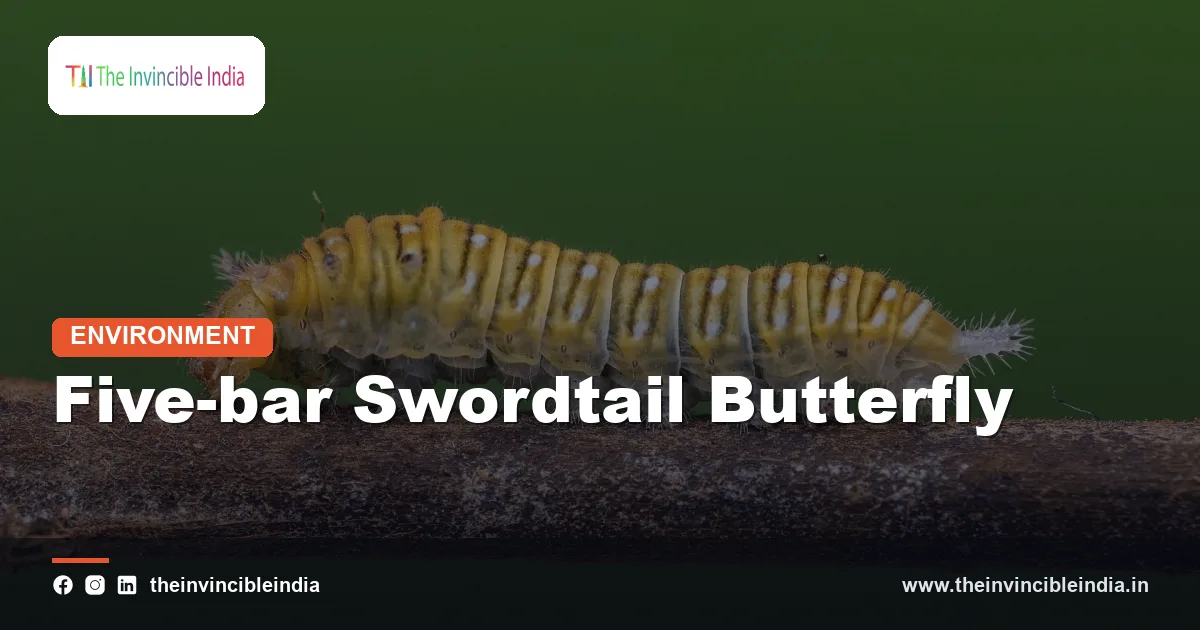
The five-bar swordtail (Graphium antiphates) is a pale, fast-flying swallowtail butterfly of India with black bars across its wings and long, slender tails, found mainly in the humid forests of the Himalayan foothills, the north-east and the Western Ghats. Among the many swallowtails of the subcontinent, the five-bar swordtail is one of the easiest to recognise in flight, because its whitish wings, bold black bands and sword-like tails make it look like a flickering paper kite among the trees.
The five-bar swordtail belongs to the family Papilionidae, the swallowtails, and to the genus Graphium, whose members are often called swordtails, jays and bluebottles. This article explains how to identify the five-bar swordtail, where it lives in India, what its caterpillars eat, why males gather at mud, and how its life cycle unfolds.
| Quick Facts: Five-bar Swordtail | |
|---|---|
| Common name | Five-bar swordtail (also written five-bar sword-tail) |
| Scientific name | Graphium antiphates (Cramer, 1775) |
| Family | Papilionidae (swallowtails) |
| Wingspan | Roughly 8 to 10 cm, excluding the long tails |
| Host plants | Members of the custard-apple family (Annonaceae), such as Polyalthia, Annona, Artabotrys and related species |
| Range in India | Foothills of the Himalaya eastwards, the north-east, and hill forests of the Western Ghats; also found in Sri Lanka and parts of South-East Asia |
| Habitat | Evergreen and moist deciduous forest, forest edges, streams and shaded tracks |
| Flight season | Seen over many months in warm regions; peaks usually follow the rains; several broods in a year |
| Notable features | Pale wings with black bars, very long tails, rapid flight, regular mud-puddling by males, wings rarely opened at rest |
Key Takeaways
- The five-bar swordtail (Graphium antiphates) is a swallowtail butterfly in the family Papilionidae, recognised by pale wings, black bars and very long tails.
- The five-bar swordtail occurs in the Himalayan foothills, north-east India and the Western Ghats, usually in humid forest and along shaded streams.
- Caterpillars of the five-bar swordtail feed on plants of the custard-apple family (Annonaceae), including Polyalthia and Annona species.
- Males of the five-bar swordtail gather at wet mud and sand to drink water and absorb dissolved salts, a habit called mud-puddling.
- The five-bar swordtail is a very fast, restless flier that rarely opens its wings at rest, so photographing it requires patience.
- The five-bar swordtail is widespread within its forest range and is not considered rare, but it depends on intact forest and clean streams.
What is the five-bar swordtail?
The five-bar swordtail is a medium-sized swallowtail butterfly named for the dark bars on its wings and the long, thin tail on each hindwing. Its scientific name is Graphium antiphates, and it was described by the Dutch naturalist Pieter Cramer in the eighteenth century from specimens collected in Asia.
The genus Graphium contains many forest butterflies of tropical Asia, Africa and Australasia. In India it includes the common jay, the tailed jay, the common bluebottle, the spot swordtail and the five-bar swordtail. Members of this genus are usually quick, strong fliers that settle at damp ground, but they seldom linger at flowers for long.
Like all swallowtails, the five-bar swordtail has a complete metamorphosis with four stages: egg, caterpillar, pupa and adult. Its caterpillar has a hidden, forked scent organ behind the head, known as the osmeterium, which it extends when disturbed.
How can you identify the five-bar swordtail?
The five-bar swordtail can be identified by its pale cream or whitish wings crossed by black bars, and by a very long, slim tail on each hindwing that is tipped with white. The bars on the forewing give the species its name, although the exact number can look different depending on the angle and the wear on the wing.
The ground colour of the wings is often a soft creamy white with a faint greenish or yellowish wash. The black markings are bold and evenly spaced, which gives the butterfly a striped appearance. The underside carries touches of ochre or orange near the base of the hindwing, though these are visible only when the wings are held open or when the butterfly is feeding at mud with its wings half spread.
Key identification features
- Pale, almost translucent wings with strong black bars across the forewing.
- A long, narrow, ribbon-like tail on each hindwing, noticeably longer than in most other Indian swallowtails.
- Fast, direct flight, usually at or just above head height.
- Males and females look broadly alike, although females often appear slightly broader-winged and duller.
- The wings are usually held closed over the back when the butterfly rests, showing the underside.
Several regional forms (subspecies) of the five-bar swordtail have been named, and they differ slightly in the width of the bars and the length of the tails. A beginner does not need to separate them to identify the species in the field.
Where is the five-bar swordtail found in India?
The five-bar swordtail is found in India along the Himalayan foothills from the west of the range eastwards, throughout the north-eastern states, and in the hill forests of the Western Ghats. Outside India, the five-bar swordtail ranges through Sri Lanka, Myanmar, Thailand and other parts of South-East Asia, and further east into southern China.
The species is a butterfly of moist forest rather than open scrub or dry plains. It is most often seen:
- Along forest streams and sandy riverbanks, where males gather in small groups.
- On shaded forest roads, trails and clearings that stay damp after rain.
- At the edges of evergreen and semi-evergreen forest in the foothills and lower mountain slopes.
- In well-wooded plantations and gardens that sit close to forest, especially where custard-apple relatives grow.
In the Himalayan foothills the five-bar swordtail is usually recorded at lower and middle elevations, while in the Western Ghats it favours humid evergreen belts. It is generally absent from the dry interior plains and desert regions of the country.
Why does the five-bar swordtail drink from mud?
The five-bar swordtail drinks from wet mud and sand because males need dissolved minerals, especially sodium, that nectar alone does not supply. This behaviour is called mud-puddling, and it is common among swallowtails, whites and sulphurs across tropical Asia.
At a puddling spot, several males of the five-bar swordtail often settle together with their wings partly open and probe the damp ground with the proboscis. They may share the spot with other Graphium species, such as the common jay and the tailed jay, and with pierids and lycaenids. The salts and amino acids absorbed in this way are thought to be passed to females during mating and to improve the survival of eggs.
Puddling groups are easier to watch than a butterfly in flight. Because the insects are busy feeding, they allow a patient observer to approach slowly. Even so, the group will often scatter at a sudden shadow or movement and then return to the same patch within minutes.
What does the five-bar swordtail caterpillar eat?
The caterpillar of the five-bar swordtail eats the leaves of trees and climbers in the custard-apple family, Annonaceae. Recorded host plants in India include the false ashoka (Polyalthia longifolia), the custard apple (Annona squamosa) and several Artabotrys and Uvaria climbers, along with other forest members of the same family.
The female lays her eggs singly on young, tender leaves, since the freshly sprouted leaves are softer and more nutritious for the newly hatched caterpillar. Because the host plants are widely planted as avenue trees and garden shrubs, the five-bar swordtail can sometimes breed in towns and hill stations near forest. The caterpillars cause no meaningful damage to the trees.
The adult butterflies feed on nectar from a range of forest flowers and from lantana and other garden plants, but they are less devoted to flowers than many other butterflies, and the males spend much of their time near water.
What is the life cycle of the five-bar swordtail?
The life cycle of the five-bar swordtail has four stages, egg, caterpillar, pupa and adult, and in warm conditions the whole cycle takes roughly one to two months. Several generations can occur in a year wherever the climate stays warm and the host plants keep producing fresh leaves.
| Stage | What it looks like | What happens |
|---|---|---|
| Egg | Small, round and pale, laid singly | Placed on a tender leaf of an Annonaceae host plant; hatches in a few days |
| Caterpillar | Green and smooth, with fine pale lines and a forked scent organ (osmeterium) behind the head | Feeds on the host leaf, moults several times and grows through successive stages called instars |
| Pupa (chrysalis) | Green or brownish, leaf-like, held upright by a silk girdle and a silk pad | Metamorphosis occurs inside; the camouflage resembles a leaf or twig |
| Adult | Pale, black-barred butterfly with long tails | Feeds, mates, puddles (males) and lays eggs (females); lives for a few weeks |
Like other swallowtail pupae, the pupa of the five-bar swordtail is attached at the tail end and supported by a thin silk band around the middle. This arrangement keeps the chrysalis upright and well hidden against a stem or leaf. In regions with a marked dry season, the pupa may pause its development for a longer time and emerge when the rains return.
How does the five-bar swordtail behave and fly?
The five-bar swordtail flies rapidly and in a straight, darting line, often along forest paths and streams, and it seldom pauses for long. Observers describe the flight as swift and almost restless, with the long tails trailing behind.
Several behaviours are typical of the species:
- Wings closed at rest: The five-bar swordtail usually settles with the wings folded above the body, so the pattern of the underside is on display, and the upper surface is rarely visible.
- Hovering visits: At flowers the butterfly often keeps its wings in rapid motion rather than landing, which makes photographs difficult.
- Territorial patrol: Males patrol a stretch of stream or path and may chase other males or other butterflies that enter the area.
- Roosting: At night the butterflies rest under leaves, hanging with the wings closed, where the pale underside blends with the dappled forest light.
The long tails of swordtails are often explained as a way of confusing predators. A bird that strikes at the tail may pull away only a fragment of the wing and miss the body, and many wild swallowtails are found with damaged tails for this reason.
Which butterflies look like the five-bar swordtail?
The five-bar swordtail is most often confused with other pale, tailed members of the genus Graphium, particularly the spot swordtail (Graphium nomius), the common jay (Graphium doson) and the tailed jay (Graphium agamemnon). The comparison below lists the main differences that a field observer can use.
| Butterfly | Wing colour and pattern | Tail | Useful clue |
|---|---|---|---|
| Five-bar swordtail | Whitish to pale cream with strong black bars | Very long and slim | Striped, pale look; extremely fast flight |
| Spot swordtail | Pale with black bars and a row of spots | Long | More spotted, with a different hindwing pattern |
| Common jay | Black with pale green or turquoise patches | Short and spatulate | Green patches rather than white bars |
| Tailed jay | Black with a row of bright green spots | Short | Green spots on dark ground and a small tail |
| Common bluebottle | Dark with a broad blue-green band | None | Tailless; strong blue-green band |
A useful rule of thumb is that a pale butterfly with a very long tail and a striped appearance, flying quickly along a damp forest track in the hills, is likely to be a five-bar swordtail.
Is the five-bar swordtail threatened, and how can it be watched responsibly?
The five-bar swordtail is not regarded as a rare butterfly across its forest range, but like many forest insects it depends on intact habitat, clean streams and a continuing supply of native host plants. Loss of moist forest, the clearing of streamside vegetation and the heavy use of pesticides near forest edges can reduce local numbers.
Butterflies in India are covered by the Wildlife (Protection) Act, 1972, and collecting them inside protected areas is not permitted without authorisation. Observing and photographing the five-bar swordtail is the best approach for most people, and the following habits help protect both the insect and its habitat:
- Walk slowly along stream banks and do not trample damp sand where puddling groups gather.
- Avoid handling butterflies, since the scales on their wings are easily damaged.
- Plant native Annonaceae trees in gardens near forests to support breeding.
- Record sightings with the date and place through community butterfly surveys, which build long-term knowledge of seasonal patterns.
- Avoid spraying insecticides on or near host plants that are in leaf.
Field guides and local butterfly groups can help beginners confirm identification, and monsoon and post-monsoon months often provide the best sightings in the forests where the species occurs.
Bottom Line
The five-bar swordtail is a pale, boldly barred swallowtail whose very long tails, rapid flight and love of damp forest ground make it a distinctive butterfly of India’s hills. It is a good indicator of healthy streamside forest, and protecting those habitats and the custard-apple relatives it feeds on is the surest way to keep it flying.
Frequently Asked Questions
What is the scientific name of the five-bar swordtail?
The scientific name of the five-bar swordtail is Graphium antiphates. It belongs to the swallowtail family Papilionidae and was formally described by Pieter Cramer in the eighteenth century. Several regional subspecies have since been named across Asia.
Where can you see the five-bar swordtail in India?
The five-bar swordtail can be seen in the Himalayan foothills, north-eastern India and the humid forests of the Western Ghats. It is most often found along shaded forest streams, damp tracks and forest edges. It is generally absent from the dry plains and desert regions.
What do five-bar swordtail caterpillars eat?
Five-bar swordtail caterpillars eat leaves of trees and climbers in the custard-apple family, Annonaceae. Known host plants include Polyalthia, Annona and Artabotrys species. The female lays single eggs on tender young leaves so that the hatchlings can feed on soft growth.
Why do five-bar swordtail butterflies sit on mud?
Five-bar swordtail butterflies sit on mud to drink water and absorb dissolved minerals, especially sodium. This behaviour is called mud-puddling and is mostly performed by males. The nutrients are believed to support mating success and the survival of eggs.
How is the five-bar swordtail different from the common jay?
The five-bar swordtail is pale with black bars and very long tails, while the common jay is black with green or turquoise patches and short tails. The colour of the wings is the quickest way to tell them apart. Both species are Graphium swallowtails and may even puddle together at the same mud patch.
Is the five-bar swordtail a rare butterfly?
The five-bar swordtail is not considered rare within its forest range in India. It can be locally common where moist forest and streams remain intact. Its numbers still depend on habitat quality, so forest loss and pesticide use can reduce local populations.
{“@context”:”https://schema.org”,”@graph”:[{“@type”:”FAQPage”,”mainEntity”:[{“@type”:”Question”,”name”:”What is the scientific name of the five-bar swordtail?”,”acceptedAnswer”:{“@type”:”Answer”,”text”:”The scientific name of the five-bar swordtail is Graphium antiphates. It belongs to the swallowtail family Papilionidae and was formally described by Pieter Cramer in the eighteenth century. Several regional subspecies have since been named across Asia.”}},{“@type”:”Question”,”name”:”Where can you see the five-bar swordtail in India?”,”acceptedAnswer”:{“@type”:”Answer”,”text”:”The five-bar swordtail can be seen in the Himalayan foothills, north-eastern India and the humid forests of the Western Ghats. It is most often found along shaded forest streams, damp tracks and forest edges. It is generally absent from the dry plains and desert regions.”}},{“@type”:”Question”,”name”:”What do five-bar swordtail caterpillars eat?”,”acceptedAnswer”:{“@type”:”Answer”,”text”:”Five-bar swordtail caterpillars eat leaves of trees and climbers in the custard-apple family, Annonaceae. Known host plants include Polyalthia, Annona and Artabotrys species. The female lays single eggs on tender young leaves so that the hatchlings can feed on soft growth.”}},{“@type”:”Question”,”name”:”Why do five-bar swordtail butterflies sit on mud?”,”acceptedAnswer”:{“@type”:”Answer”,”text”:”Five-bar swordtail butterflies sit on mud to drink water and absorb dissolved minerals, especially sodium. This behaviour is called mud-puddling and is mostly performed by males. The nutrients are believed to support mating success and the survival of eggs.”}},{“@type”:”Question”,”name”:”How is the five-bar swordtail different from the common jay?”,”acceptedAnswer”:{“@type”:”Answer”,”text”:”The five-bar swordtail is pale with black bars and very long tails, while the common jay is black with green or turquoise patches and short tails. The colour of the wings is the quickest way to tell them apart. Both species are Graphium swallowtails and may even puddle together at the same mud patch.”}},{“@type”:”Question”,”name”:”Is the five-bar swordtail a rare butterfly?”,”acceptedAnswer”:{“@type”:”Answer”,”text”:”The five-bar swordtail is not considered rare within its forest range in India. It can be locally common where moist forest and streams remain intact. Its numbers still depend on habitat quality, so forest loss and pesticide use can reduce local populations.”}}]}]}


