

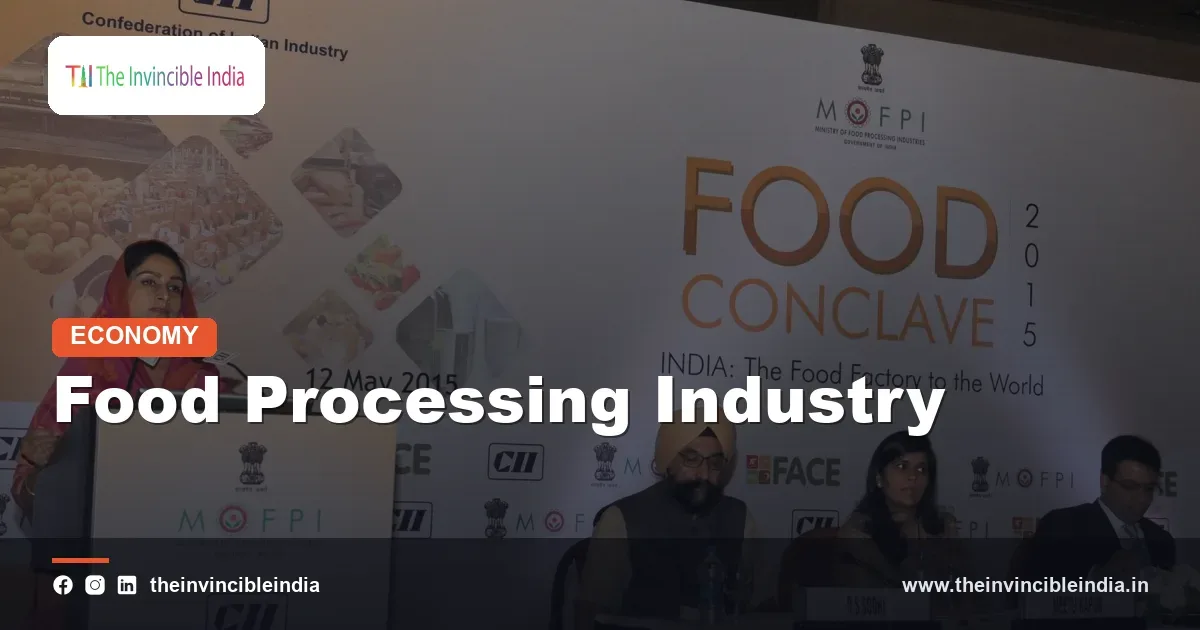
The food processing industry in India is the sector that converts raw agricultural, dairy, meat and marine produce into preserved, packaged and value-added food products, and it is widely described as a “sunrise” sector because it links farms to consumer markets and has large room to grow. India is one of the world’s largest producers of milk, pulses, fruits, vegetables and cereals, yet only a modest share of that output is processed, so the sector carries high potential for raising farm incomes, creating jobs and cutting waste.
The Ministry of Food Processing Industries (MoFPI) leads national policy through schemes such as Pradhan Mantri Kisan SAMPADA Yojana, the Production Linked Incentive (PLI) scheme and the PM Formalisation of Micro Food Processing Enterprises (PMFME) scheme. This explainer covers what the sector includes, how its segments differ, which institutions regulate it, how government schemes work, and what challenges remain. It was last reviewed on 8 October 2026.
Quick Facts
| Item | Details |
|---|---|
| Nodal ministry | Ministry of Food Processing Industries (MoFPI), established in 1988 |
| Food safety regulator | Food Safety and Standards Authority of India (FSSAI), under the Food Safety and Standards Act, 2006 |
| Major segments | Dairy, fruits and vegetables, grains and milling, meat and poultry, marine, and packaged foods |
| Flagship infrastructure scheme | Pradhan Mantri Kisan SAMPADA Yojana (from 2016-17) |
| Manufacturing incentive scheme | Production Linked Incentive Scheme for Food Processing Industry (approved in 2021) |
| Micro-enterprise scheme | PM Formalisation of Micro Food Processing Enterprises (launched in 2020) |
| Export promotion bodies | APEDA (agri and processed foods) and MPEDA (marine products) |
| Foreign direct investment | 100 percent permitted through the automatic route in food product manufacturing |
Key Takeaways
- The food processing industry in India includes dairy, fruit and vegetable, grain milling, meat and poultry, marine, and packaged and convenience food segments.
- The Ministry of Food Processing Industries (MoFPI), set up in 1988, formulates policy and runs central schemes to expand processing capacity and cold-chain infrastructure.
- Food processing is a small share of the Indian economy compared with the scale of raw production, and the level of processing of perishables such as fruits and vegetables remains low relative to the major producing countries.
- Post-harvest losses, caused by gaps in storage, transport and cold chains, are a major reason the government promotes processing infrastructure.
- The Pradhan Mantri Kisan SAMPADA Yojana, the PLI scheme and the PMFME scheme target infrastructure, large-scale manufacturing and micro-enterprises respectively.
- Foreign direct investment of up to 100 percent is allowed under the automatic route in the manufacture of food products in India.
What is the food processing industry in India?
The food processing industry in India is the group of enterprises that clean, grade, preserve, transform, package and distribute food from agricultural, animal and marine sources. It covers simple activities such as rice milling and pickling as well as advanced manufacturing like ready-to-eat meals, dairy products and frozen foods.
The industry is commonly divided into primary and secondary processing. Primary processing includes cleaning, sorting, grading, drying, milling and cold storage, which keep raw produce fit for sale. Secondary processing involves manufacturing products with a longer shelf life or higher value, such as juices, jams, biscuits, cheese and snacks. Tertiary processing refers to ready-to-eat and ready-to-cook foods.
The sector is a crucial link in the agricultural value chain. Farmers gain a market for produce that might otherwise rot or sell at low prices, manufacturers gain raw material, and consumers gain safer, convenient and longer-lasting food. The sector also provides employment, particularly in rural and semi-urban areas, where many units are small and household-based.
Why is food processing called a sunrise sector?
Food processing is called a sunrise sector because it is a relatively young, fast-growing industry with large untapped potential, driven by rising incomes, urbanisation and changing eating habits. A small share of India’s perishable output is processed, so even modest increases in processing yield large gains.
Several factors support the label:
- Rising urban populations and nuclear families raise demand for packaged, convenient and ready-to-eat food.
- Growth of organised retail, e-commerce and quick-service restaurants creates new demand channels.
- Greater health awareness increases interest in fortified, organic, millet-based and protein-rich products.
- Exports of processed foods offer a way to move beyond selling raw commodities.
- Government policy has repeatedly placed the sector among priorities for investment and employment.
The sector’s scale is large even in qualitative terms: it is regularly cited as one of the largest in terms of production, consumption, exports and prospective growth in the Indian economy. However, the share of fresh produce that undergoes processing, especially in fruits and vegetables, remains well below that in many developed and some emerging economies.
What are the main segments of the food processing industry?
The main segments of the food processing industry in India are dairy, fruits and vegetables, grains and cereals, meat and poultry, marine products, and packaged and convenience foods. Each segment has its own structure, supply chain and regulatory needs.
| Segment | What it includes | Key features in India |
|---|---|---|
| Dairy | Liquid milk, butter, ghee, cheese, curd, milk powder, ice cream | India is the world’s largest milk producer; strong cooperative sector led by Amul and State federations; Operation Flood from 1970 |
| Fruits and vegetables | Pulp, juices, canned and dried products, frozen foods, pickles | Among the largest producers globally; low processing levels and high wastage |
| Grains and cereals | Rice, wheat flour, pulses, oilseeds, edible oils, bakery items | Largest segment by volume; includes large numbers of small mills |
| Meat and poultry | Buffalo meat, poultry, eggs, processed meat | Significant export of buffalo meat; growing poultry sector |
| Marine and fisheries | Frozen shrimp, fish, canned and dried seafood | Major export earner; regulated for export by MPEDA and Export Inspection Council |
| Packaged and consumer foods | Biscuits, snacks, confectionery, beverages, ready-to-eat meals | Fast growth driven by urban consumption and organised retail |
Dairy has the best-developed processing chain thanks to the cooperative model, in which village societies collect milk from farmers and federations process and market it. The model was nurtured by the National Dairy Development Board (NDDB), set up in 1965.
Who regulates and supports the food processing industry?
The food processing industry in India is supported by the Ministry of Food Processing Industries and regulated by the Food Safety and Standards Authority of India (FSSAI), alongside export promotion bodies and sectoral agencies. The roles are distinct: one ministry promotes, one authority regulates for safety.
- Ministry of Food Processing Industries (MoFPI): Formulates policy, administers schemes, supports infrastructure and oversees institutes such as the Indian Institute of Food Processing Technology in Thanjavur and the National Institute of Food Technology Entrepreneurship and Management.
- FSSAI: Established under the Food Safety and Standards Act, 2006, FSSAI sets standards for food products, licenses and registers food businesses, and oversees labelling, additives and testing.
- APEDA: The Agricultural and Processed Food Products Export Development Authority, created in 1985, promotes exports of fruits, vegetables, cereals and processed products.
- MPEDA: The Marine Products Export Development Authority, created in 1972, regulates and promotes seafood exports.
- NDDB and State dairy federations: Develop and support the dairy cooperative network.
- Ministry of Agriculture and Farmers Welfare and Department of Animal Husbandry and Dairying: Handle farm production, livestock and fisheries policy that feed into processing.
The Legal Metrology (Packaged Commodities) Rules also govern packaging declarations, and the Bureau of Indian Standards (BIS) and Agmark certify certain products.
What is Pradhan Mantri Kisan SAMPADA Yojana?
Pradhan Mantri Kisan SAMPADA Yojana (PMKSY) is the umbrella scheme of the Ministry of Food Processing Industries that finances modern processing infrastructure and supply chains from the farm gate to the retail outlet. SAMPADA stands for Scheme for Agro-Marine Processing and Development of Agro-Processing Clusters, and it was approved for implementation from the 2016-17 period.
The scheme covers several components:
- Mega Food Parks: Cluster-based facilities built on a hub-and-spoke model, with collection centres and primary processing centres feeding a central processing centre, where multiple food companies set up units.
- Integrated Cold Chain and Value Addition Infrastructure: End-to-end cold chain facilities, including pre-cooling, storage, refrigerated transport and packhouses, to cut perishability.
- Creation or Expansion of Food Processing and Preservation Capacities: Grants for individual units to build or expand capacity.
- Agro-Processing Clusters: Common infrastructure for groups of enterprises in a region.
- Backward and Forward Linkages: Support for setting up links between farmers, processors and retailers.
- Food Safety and Quality Assurance Infrastructure: Laboratories and testing facilities.
- Operation Greens: A price-stabilisation and value-chain component initially focused on tomatoes, onions and potatoes and later expanded to other perishables.
The Mega Food Park scheme, launched in 2008, was the forerunner, and its parks were absorbed under the broader SAMPADA umbrella. The aim is to ensure that farmers can supply produce in a form and quantity that processors can use, and that perishables are moved through unbroken cold storage.
How do the PLI and PMFME schemes work?
The Production Linked Incentive scheme for food processing offers financial incentives tied to sales growth for large manufacturers, while the PM Formalisation of Micro Food Processing Enterprises (PMFME) scheme gives credit-linked support to small unorganised units. The two schemes target opposite ends of the industry.
PLI Scheme for Food Processing Industry (PLISFPI)
The PLI scheme was approved in 2021 as part of the wider Atmanirbhar Bharat push to build manufacturing champions. It offers incentives on incremental sales of qualifying products over a multi-year period. The first category covered products such as ready-to-cook and ready-to-eat foods, processed fruits and vegetables, marine products and mozzarella cheese. A second category supports branding and marketing abroad. A third category supports small, innovative and organic product manufacturers. Millet-based products were later added. The purpose is to create Indian companies of global scale and to boost exports of processed products.
PM Formalisation of Micro Food Processing Enterprises (PMFME)
PMFME was launched in 2020 and follows a “One District One Product” (ODOP) approach, under which each district focuses on a food product suited to local produce. The scheme offers credit-linked capital subsidy for upgrading existing micro-units, seed capital for self-help group members, and support for branding, marketing, training and common infrastructure. It also helps units obtain FSSAI registration and bring informal operations into the formal economy. Micro-units make up the great majority of food processing enterprises, and many are family-run and unregistered, so formalisation is a central goal.
How does food processing reduce post-harvest wastage?
Food processing reduces post-harvest wastage by converting perishable produce into stable, longer-lasting products and by building storage and cold-chain systems that keep fresh produce usable for longer. Post-harvest losses in India occur at several points: harvesting, handling, storage, transport and marketing.
The losses are highest in perishables such as fruits, vegetables, milk, fish and meat. They arise from inadequate cold storage, long transit distances, poor road and rail connectivity, rough handling and lack of grading facilities. Studies by government bodies have estimated notable losses across categories, though the numbers differ by crop and by study, so they are best treated as indicative.
The ways in which processing helps include:
- Drying, canning, freezing, pulping and pickling extend shelf life.
- Primary processing centres near farms allow quick pre-cooling and sorting.
- Cold chains maintain the temperature from farm to retail.
- A steady processing demand gives farmers a market for lower-grade or surplus produce.
- Value addition means farmers and processors capture more of the final price.
Reducing wastage has wider benefits. It improves food availability without extra land or water, raises farm incomes, and helps stabilise prices of items like tomatoes and onions, which are prone to sharp seasonal swings.
What is the role of exports and foreign investment?
Exports and foreign investment are drivers of growth in the food processing industry, bringing in capital, technology and access to global markets. India exports agricultural and processed products, including marine products, basmati and non-basmati rice, buffalo meat, spices, tea, coffee, fruit pulp, and processed foods.
Export promotion is handled by APEDA and MPEDA, and compliance with the importing country’s food safety rules is critical. Exporters must meet standards on residues, traceability and hygiene, and shipments are sometimes rejected on quality grounds, which has driven investment in testing laboratories and certified supply chains.
On investment, India permits 100 percent FDI under the automatic route in the manufacture of food products. Trading, including through e-commerce, of food products manufactured or produced in India is also open to FDI, subject to conditions. Global food and beverage companies have established plants in India, and many Indian firms have grown through domestic and cross-border acquisitions. World Food India, an international event hosted by the Ministry, is used to attract investment.
What challenges does the industry face?
The challenges facing the food processing industry in India include weak cold-chain infrastructure, fragmented supply chains, a large unorganised segment, quality and safety compliance, and uneven access to finance. These factors limit scale and raise costs.
| Challenge | Description |
|---|---|
| Cold-chain gaps | Inadequate refrigerated storage and transport, particularly in rural areas and for perishables |
| Fragmented supply | Small and scattered landholdings make it hard for processors to source consistent quality and quantity |
| Unorganised sector | Large numbers of micro-units lack technology, branding and formal registration |
| Quality and safety | Meeting FSSAI and export standards requires testing facilities and training |
| Access to finance | Small units often struggle to obtain credit and working capital |
| Seasonality and input prices | Raw material availability and prices vary with weather and crop cycles |
| Logistics costs | High transport costs and delays reduce competitiveness |
Policymakers address these through infrastructure schemes, cluster development, farmer producer organisations (FPOs) that aggregate farmers, contract farming reforms and the formalisation of micro-enterprises. Progress is gradual, and the sector’s growth depends on coordination between the Centre, States, farmers and companies.
Bottom Line
The food processing industry in India sits at the junction of agriculture, manufacturing and retail, and it offers one of the most direct routes to raise farm incomes and cut wastage. Government schemes cover infrastructure, large-scale manufacturing and micro-enterprises, while FSSAI and export bodies set the standards for quality. The sector’s potential is large, and the pace at which cold chains, aggregation and formalisation improve will determine how much of that potential is realised.
Frequently Asked Questions
What is the food processing industry in India?
The food processing industry in India is the sector that turns raw agricultural, dairy, meat and marine produce into preserved, packaged and value-added foods. It includes dairy, fruits and vegetables, grains, meat and poultry, marine products and packaged foods. The Ministry of Food Processing Industries leads policy, and FSSAI regulates food safety.
Why is the food processing industry called a sunrise sector?
The food processing industry is called a sunrise sector because it is a growing field with large untapped potential. Only a modest share of India’s output of perishables is processed, while demand for packaged and convenient food is rising with urbanisation and incomes. Government support and export opportunities add to its growth prospects.
What does the Ministry of Food Processing Industries do?
The Ministry of Food Processing Industries (MoFPI) formulates policy and implements central schemes to develop the food processing sector. It funds infrastructure such as mega food parks and cold chains, runs the PLI and PMFME schemes, and supports training and research institutes. The ministry was established in 1988.
What is PM Kisan SAMPADA Yojana?
PM Kisan SAMPADA Yojana is the umbrella scheme of MoFPI that finances modern food processing infrastructure and supply chains. Its components include mega food parks, integrated cold chains, agro-processing clusters, forward and backward linkages and food safety laboratories. It was approved from 2016-17 and aims to reduce wastage and raise farmers’ incomes.
How does food processing help farmers?
Food processing helps farmers by creating a steady market for their produce, reducing spoilage and enabling value addition. Processors buy surplus and lower-grade produce that might otherwise be wasted, and better storage lets farmers sell at better prices. Linkages through farmer producer organisations and cooperatives help farmers share in the higher value of processed goods.
Is 100 percent FDI allowed in food processing in India?
Yes, 100 percent foreign direct investment is allowed under the automatic route in the manufacture of food products in India. Trading, including e-commerce, of food products made or produced in India is also open to FDI under specified conditions. This policy is meant to bring in capital, technology and export linkages.
{“@context”:”https://schema.org”,”@graph”:[{“@type”:”FAQPage”,”mainEntity”:[{“@type”:”Question”,”name”:”What is the food processing industry in India?”,”acceptedAnswer”:{“@type”:”Answer”,”text”:”The food processing industry in India is the sector that turns raw agricultural, dairy, meat and marine produce into preserved, packaged and value-added foods. It includes dairy, fruits and vegetables, grains, meat and poultry, marine products and packaged foods. The Ministry of Food Processing Industries leads policy, and FSSAI regulates food safety.”}},{“@type”:”Question”,”name”:”Why is the food processing industry called a sunrise sector?”,”acceptedAnswer”:{“@type”:”Answer”,”text”:”The food processing industry is called a sunrise sector because it is a growing field with large untapped potential. Only a modest share of India’s output of perishables is processed, while demand for packaged and convenient food is rising with urbanisation and incomes. Government support and export opportunities add to its growth prospects.”}},{“@type”:”Question”,”name”:”What does the Ministry of Food Processing Industries do?”,”acceptedAnswer”:{“@type”:”Answer”,”text”:”The Ministry of Food Processing Industries (MoFPI) formulates policy and implements central schemes to develop the food processing sector. It funds infrastructure such as mega food parks and cold chains, runs the PLI and PMFME schemes, and supports training and research institutes. The ministry was established in 1988.”}},{“@type”:”Question”,”name”:”What is PM Kisan SAMPADA Yojana?”,”acceptedAnswer”:{“@type”:”Answer”,”text”:”PM Kisan SAMPADA Yojana is the umbrella scheme of MoFPI that finances modern food processing infrastructure and supply chains. Its components include mega food parks, integrated cold chains, agro-processing clusters, forward and backward linkages and food safety laboratories. It was approved from 2016-17 and aims to reduce wastage and raise farmers’ incomes.”}},{“@type”:”Question”,”name”:”How does food processing help farmers?”,”acceptedAnswer”:{“@type”:”Answer”,”text”:”Food processing helps farmers by creating a steady market for their produce, reducing spoilage and enabling value addition. Processors buy surplus and lower-grade produce that might otherwise be wasted, and better storage lets farmers sell at better prices. Linkages through farmer producer organisations and cooperatives help farmers share in the higher value of processed goods.”}},{“@type”:”Question”,”name”:”Is 100 percent FDI allowed in food processing in India?”,”acceptedAnswer”:{“@type”:”Answer”,”text”:”Yes, 100 percent foreign direct investment is allowed under the automatic route in the manufacture of food products in India. Trading, including e-commerce, of food products made or produced in India is also open to FDI under specified conditions. This policy is meant to bring in capital, technology and export linkages.”}}]}]}


