

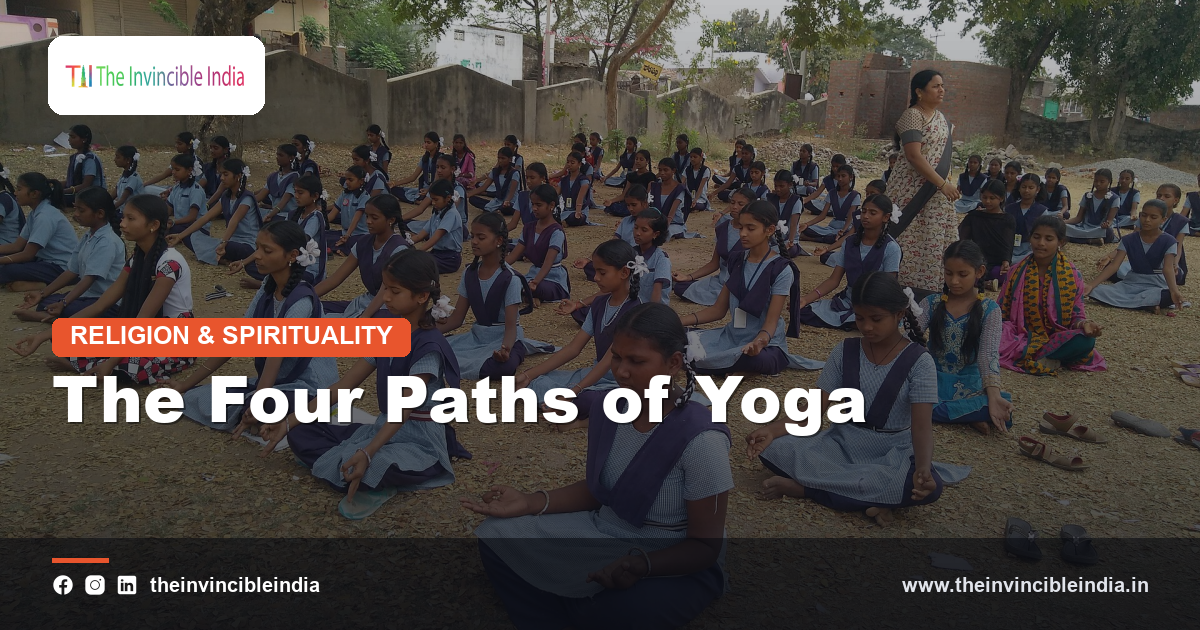
Yoga, in its broadest classical sense, is not a single discipline but a family of spiritual paths, each suited to a different temperament and way of engaging with the world. Rooted in the Bhagavad Gita and elaborated within Indian philosophical and Vedantic thought, the tradition speaks of four principal paths: the path of knowledge, the path of devotion, the path of selfless action, and the path of meditative discipline. Rather than competing doctrines, these four paths of yoga are widely understood as complementary approaches to a shared goal, that of self-realization and inner freedom. Together they reflect the breadth of Indian spiritual thought, offering a route suited to the intellect, the heart, the will, or the disciplined mind.
Quick Facts
| Detail | Information |
|---|---|
| Sanskrit Names | Jnana, Bhakti, Karma, and Raja Yoga |
| Central Text | Bhagavad Gita |
| Core Aim | Self-realization and inner freedom |
| Tradition | Hindu and Vedantic philosophy |
| Nature of the Paths | Complementary, not mutually exclusive |
| Modern Relevance | Foundational to many contemporary yoga schools |
Understanding Yoga as a Spiritual Science
Long before yoga became associated primarily with physical postures, it was understood in India as a comprehensive discipline for uniting the individual consciousness with a higher reality. The word itself, related to the idea of “union,” points to this goal of integration rather than mere exercise. Classical thought recognized that people differ greatly in temperament, some inclined toward reflection, others toward feeling, action, or discipline, and that a single method could not serve everyone equally well.
Out of this recognition arose the framework of the four paths of yoga, each offering a distinct but valid route to the same destination. This plurality is one of the most notable features of Indian spiritual thought, treating diversity of approach as a strength rather than a contradiction, and allowing seekers to progress according to their own nature.
Origins in the Bhagavad Gita
The clearest and most influential articulation of the four paths appears in the Bhagavad Gita, a philosophical dialogue embedded within the larger epic of the Mahabharata. In this text, the paths of knowledge, devotion, and action are presented as responses to a central human dilemma: how to live rightly and find inner peace amid the demands and uncertainties of the world.
The Gita does not present the paths as rigid categories but as intertwined ways of approaching the same truth, often blending elements of each. Later commentators and philosophical schools drew on this foundation to develop more systematic classifications, eventually giving the fourfold scheme, including the path of meditative discipline, the coherent shape by which it is popularly known today.
Jnana Yoga: The Path of Knowledge
Jnana Yoga is the path of knowledge and discernment, intended for those with a strongly reflective or philosophical temperament. It emphasizes the use of reason and inquiry to distinguish the permanent from the impermanent, and the true self from the many roles and identities a person assumes in daily life. Study, contemplation, and sustained questioning are its principal tools.
This path is often regarded as demanding, since it requires sustained mental discipline and a willingness to look honestly beyond surface appearances. Its aim is direct insight into the nature of reality rather than belief alone, and it has historically been associated with renunciate and monastic traditions that prize study and contemplation above ritual or worldly engagement.
Practices Associated with Jnana Yoga
Traditional practice within the path of knowledge involves careful study of philosophical texts under the guidance of a teacher, along with structured reflection intended to sharpen the practitioner’s capacity for discernment. Dialogue and questioning play a central role, encouraging the seeker to examine assumptions rather than accept them passively.
Silence, solitude, and periods of withdrawal from ordinary social life have also been valued as aids to concentrated reflection. While demanding, this path is not seen as cold or detached from feeling; rather, the clarity it seeks is understood to bring its own form of quiet contentment, as confusion about one’s true nature gives way to steady understanding.
Bhakti Yoga: The Path of Devotion
Bhakti Yoga is the path of loving devotion, oriented toward the heart rather than the intellect. It holds that a personal relationship with the divine, cultivated through love, surrender, and remembrance, can itself be a complete spiritual practice. This path has historically been the most widely accessible of the four, open to people of every background and station in life.
Central to Bhakti is the cultivation of emotional sincerity: gratitude, humility, and longing directed toward a chosen form of the divine. Because it does not require advanced philosophical training, this path has played an especially significant role in bringing spiritual practice into the daily lives of ordinary households and communities across the subcontinent.
Expressions of Bhakti in Indian Life
Devotional practice takes many outward forms, including singing of devotional songs, communal chanting, storytelling about revered figures, and simple acts of ritual offering performed with heartfelt attention. The Bhakti movement of medieval India gave this path renewed vitality, producing a rich body of devotional poetry and music in regional languages that remains widely cherished.
Pilgrimage, too, is closely associated with this path, as visiting sacred sites is often understood as an act of devotion in itself. Across these varied expressions, the underlying spirit of Bhakti remains constant: the conviction that sincere love, more than ritual correctness or intellectual sophistication, draws the devotee closer to the divine.
Karma Yoga: The Path of Selfless Action
Karma Yoga is the path of action performed without attachment to personal reward. It teaches that ordinary duties and responsibilities, carried out with a spirit of dedication rather than self-interest, can themselves become a spiritual discipline. This path holds particular appeal for those whose temperament inclines them toward engagement with the world rather than withdrawal from it.
The key teaching of Karma Yoga is the distinction between action and the fruits of action. A person is encouraged to perform their duties conscientiously while releasing anxious attachment to outcomes, an attitude that is said to bring composure and freedom from the constant strain of craving particular results.
Karma Yoga in Everyday Life
Because it does not require withdrawal from family, work, or social obligation, Karma Yoga has often been described as the path most suited to householders living active lives. Work performed as service, whether in the home, in a trade, or in the wider community, becomes an offering rather than a mere transaction.
This orientation reframes even mundane tasks as opportunities for spiritual growth, provided they are approached with integrity and a lack of selfish calculation. Over time, such disciplined, selfless engagement is held to purify the mind and gradually loosen the grip of ego, preparing the practitioner for deeper insight.
Raja Yoga: The Path of Meditation
Raja Yoga, sometimes called the royal or supreme path, is centered on the systematic training of the mind through meditation and inner discipline. Where the other three paths work primarily through knowledge, feeling, or action, Raja Yoga approaches the same goal by directly calming and focusing consciousness itself.
This path is associated with structured meditative technique, including postural steadiness, breath regulation, and progressive stages of mental concentration leading toward deep absorption. It appeals particularly to those drawn to introspection and methodical practice, offering a disciplined framework for observing and ultimately transcending the restless activity of the ordinary mind.
The Eight Limbs and Their Connection to Raja Yoga
Raja Yoga is closely associated with the classical eightfold structure of yogic discipline, which outlines a graduated path from ethical conduct through physical and breath discipline to progressively subtler stages of meditative absorption. This structure gives the path of meditation its systematic, step-by-step character.
Ethical restraint and observance form the foundation, ensuring that meditative practice rests on a stable and honest way of living rather than being pursued in isolation from conduct. From this base, the practitioner moves through bodily and mental disciplines toward states of concentrated stillness, illustrating how Raja Yoga integrates ethics, body, and mind into a single coherent path.
How the Four Paths Complement One Another
Although each path of yoga has its own distinct emphasis, Indian tradition generally treats them as interconnected rather than rigidly separate. A devoted practitioner of Bhakti may still cultivate discernment associated with Jnana, while someone pursuing Karma Yoga may find that selfless service naturally deepens their capacity for meditative calm.
Many teachers have described the paths as different doors opening onto the same room, each accessible from a different direction. This integrative view discourages sectarian rivalry between approaches and instead encourages practitioners to draw on whichever combination of paths best serves their own spiritual development at a given stage of life.
Choosing a Path According to Temperament
Traditional guidance holds that the most suitable path depends on an individual’s natural temperament and circumstances rather than on any fixed hierarchy of value. A reflective person may gravitate toward Jnana, an emotionally expressive person toward Bhakti, an active person toward Karma, and a contemplative person toward Raja Yoga.
Teachers within this tradition often encourage seekers to begin with the path that feels most natural, while remaining open to elements of the others as their practice matures. This flexible approach reflects a broader principle in Indian spiritual thought: that genuine growth honors individual disposition rather than imposing a single uniform method on everyone.
The Four Paths and the Wider Bhagavad Gita Teaching
Within the Bhagavad Gita, the discussion of these paths arises in the context of a broader meditation on duty, action, and the nature of the self. The dialogue addresses the question of how one can act rightly in the world while remaining inwardly steady, and the four paths emerge as complementary answers to that question.
This context matters because it grounds the paths not in abstract theory alone but in the practical challenge of living a meaningful life. The enduring popularity of the Gita as a source for the fourfold scheme owes much to this practical orientation, which speaks to universal questions of purpose, duty, and inner peace.
Influence on Indian Philosophy and Society
The framework of the four paths has shaped Indian philosophical discourse for centuries, informing later schools of thought and providing a shared vocabulary for discussing spiritual practice across otherwise diverse traditions. Its emphasis on plural, temperament-based paths has contributed to a broader cultural openness toward multiple legitimate ways of pursuing the sacred.
Socially, the accessibility of Bhakti and Karma Yoga in particular allowed spiritual practice to extend well beyond specialized renunciate communities into the daily life of households, workplaces, and villages. This inclusiveness helped devotional and service-oriented practice become deeply woven into everyday Indian life rather than remaining confined to formal religious settings.
Adaptation in Modern Yoga Practice
In the modern era, the four paths continue to inform how yoga is taught and understood, even as physical postural practice has gained wide popularity around the world. Contemporary teachers frequently draw on the language of Karma, Bhakti, Jnana, and Raja Yoga to describe complementary dimensions of a well-rounded practice.
Meditation programs, community service initiatives, devotional gatherings, and philosophical study groups can each be traced back to one or more of these classical paths, even when they are not explicitly labeled as such. This continuity illustrates how a centuries-old framework remains adaptable to changing cultural contexts.
The Four Paths of Yoga Today
Today, the four paths of yoga remain a widely referenced framework for understanding the diversity of spiritual practice within Indian tradition and beyond. Whether approached through study, devotion, service, or meditation, each path continues to offer a structured way of pursuing self-understanding and inner peace.
As interest in yoga’s philosophical dimensions continues alongside its physical popularity, the fourfold scheme serves as a reminder that yoga was conceived, from its earliest articulation, as a comprehensive path of transformation rather than a single technique, inviting each practitioner to find the approach best suited to their own nature.
Sources & Further Reading
- Ministry of Culture, Government of India (indiaculture.gov.in).
- Sahitya Akademi.
Frequently Asked Questions
What are the four paths of yoga?
The four paths are Jnana Yoga, the path of knowledge; Bhakti Yoga, the path of devotion; Karma Yoga, the path of selfless action; and Raja Yoga, the path of meditation. Together they represent complementary routes toward self-realization.
Is one path considered better than the others?
No single path is regarded as superior in classical teaching. Each is considered suited to a different temperament, and many practitioners draw on more than one path over the course of their spiritual life.
Can the four paths be practiced together?
Yes, the paths are generally understood as complementary rather than mutually exclusive. A person may emphasize one path while still incorporating elements of the others into daily practice.
Where do the four paths of yoga originate?
The clearest classical articulation of the four paths appears in the Bhagavad Gita, though the ideas were further developed within later Hindu and Vedantic philosophical traditions.
Is yoga only about physical postures?
Physical postures are only one part of a much broader tradition. The four paths of yoga address knowledge, devotion, action, and meditation as equally valid dimensions of spiritual practice.


