

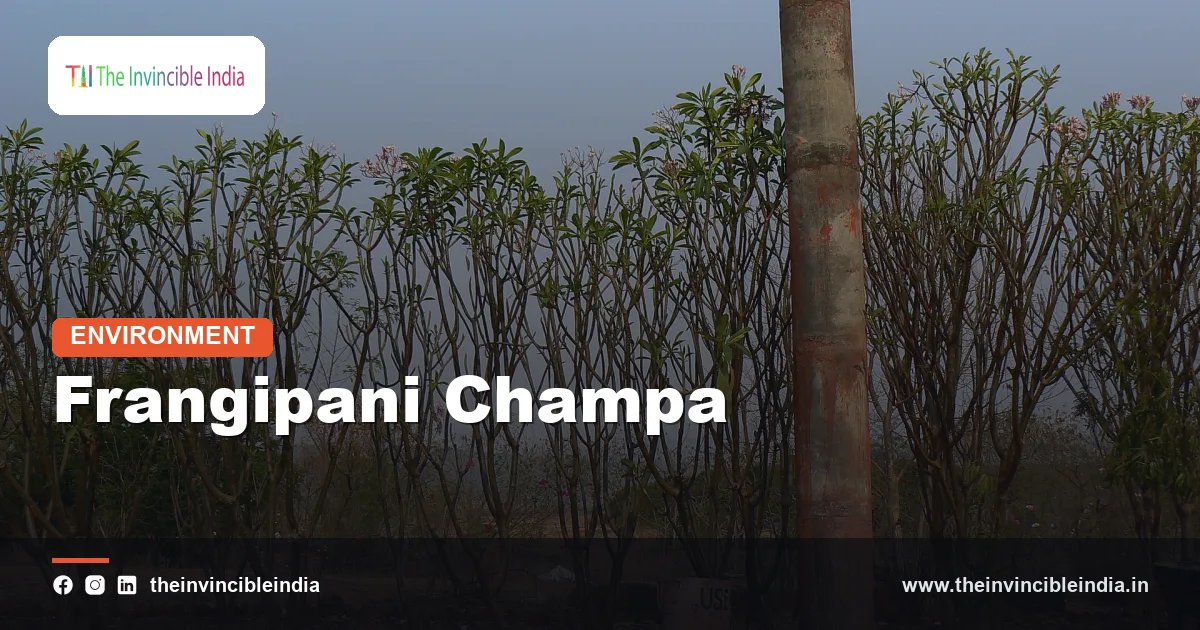
The frangipani (genus Plumeria), known across India as champa, is a small tropical tree with thick, fleshy branches and clusters of waxy, intensely fragrant flowers, usually white with a yellow centre, that are widely offered in temples and grown in gardens. The tree is not native to India. It originates in tropical America and has been grown in the subcontinent for so long that it now seems part of the landscape, especially around shrines, courtyards and old city compounds.
In Hindi the tree is called champa or gulachin, and in English it is also known as the temple tree or pagoda tree. It flowers for many months, drops its leaves in the cooler season, and produces a milky sap that serves the plant as a defence. This article explains what the frangipani is, how it grows, how it is used and why it matters culturally.
Quick Facts
| Common name | Frangipani, champa, temple tree, pagoda tree |
|---|---|
| Scientific name | Plumeria (commonly Plumeria rubra and Plumeria obtusa in India) |
| Family | Apocynaceae (the dogbane or oleander family) |
| Indian names | Champa, gulachin (Hindi); khair champa and other regional forms; names vary by language |
| Height and form | A small deciduous or semi-evergreen tree or large shrub, usually 3 to 8 m tall, with thick, blunt branches |
| Flowering season | Mainly the warm months, often from spring through the rains and into autumn |
| Native range | Tropical America: Mexico, Central America and the Caribbean; widely naturalised and cultivated in Asia |
| Sap | Milky white latex that can irritate skin and eyes |
| Main uses | Temple offerings, garlands, garden ornament, perfumery and shade in compounds |
Key Takeaways
- The frangipani is a tropical tree of the genus Plumeria that originates in Mexico, Central America and the Caribbean, not in India.
- The frangipani is called champa in Hindi and is commonly planted beside Indian temples and shrines.
- Frangipani flowers have five overlapping, waxy petals arranged in a spiral and give off a sweet fragrance that is strongest in the evening.
- The frangipani produces a milky latex that is irritating to skin and eyes and should not be eaten.
- The frangipani is easily propagated from cuttings of its thick branches, which makes it a popular and inexpensive garden tree.
- The champa of the frangipani should not be confused with the golden champak, Magnolia champaca, which is a different tree.
What is the frangipani?
The frangipani is a flowering tree of the genus Plumeria, belonging to the family Apocynaceae, that is grown across the tropics for its scented, waxy flowers. The genus is named after Charles Plumier, a seventeenth-century French botanist who travelled in the Caribbean and described many tropical plants.
The common name “frangipani” has an interesting story. A widely told explanation links it to a noble Italian family named Frangipani, said to have made a perfume that smelled like the flower, although the exact origin of the word is uncertain. What is clear is that the name spread through European languages and is now used for the tree around the world.
The family Apocynaceae also includes oleander, periwinkle and the milkweeds, many of which share the trait of producing milky sap. Plumeria belongs to the group of trees in the family with showy, funnel-shaped flowers.
What does the frangipani look like?
The frangipani looks like a small, rounded tree with thick, fleshy, grey-green branches that fork in a candelabra-like pattern, large leaves bunched at the branch tips and clusters of waxy flowers at the ends of the twigs. In the cooler months the tree often drops its leaves and stands bare, with stout, blunt branches that look almost like a succulent.
Branches and leaves
The branches are soft, thick and brittle, filled with milky latex, and break easily in strong wind. The leaves are large, simple and glossy, and their shape depends on the species. In Plumeria rubra they are long, narrow and pointed, while in Plumeria obtusa they are broader with rounded tips and tend to remain on the tree for longer.
Flowers
The flowers have five thick petals that overlap in a spiral and open into a pinwheel shape. They grow in terminal clusters and last several days. The classic form in India has white petals and a yellow throat, but cultivated forms range from pure white to pink, red and deep yellow, as well as blends of these. The fragrance, often compared to jasmine, citrus and coconut, is strongest in the evening and at night.
Fruit and seed
The fruit is a pair of long, narrow pods that split open to release flat, winged seeds. Many cultivated trees set seed rarely, and gardeners generally rely on cuttings rather than seed.
Is the frangipani native to India?
No, the frangipani is not native to India. The genus Plumeria originates in tropical America, including Mexico, Central America and the Caribbean, and it was carried to Asia and other tropical regions by travellers and traders in the centuries after European contact with the Americas.
Once in South Asia, the tree adapted easily. It tolerates heat, seasonal drought and a variety of soils, and it can be grown from simple cuttings, so it spread quickly between gardens and temple compounds. Over time it became so closely tied to local religious and cultural life that many people regard it as an indigenous tree. Botanists call such a plant a naturalised or long-introduced species.
The tree has similarly become part of the culture of other tropical regions, including Southeast Asia, Sri Lanka, the Pacific islands and parts of Africa.
How do the common frangipanis grown in India differ?
The frangipanis grown in India differ mainly in leaf shape, flower colour and how long the tree keeps its leaves, and gardeners usually distinguish a few well-known types. Several of the plants sold in nurseries are hybrids and cultivars, so names are not always precise.
| Type | Leaves | Flowers | Notes |
|---|---|---|---|
| Plumeria rubra | Long, narrow, pointed; deciduous in the cool season | White, pink, red or yellow; strongly scented | The most widely grown kind; many colour forms |
| Plumeria obtusa | Broad, glossy, rounded tips; mostly evergreen | White with a yellow centre; sweet scent | Often called the Singapore or evergreen frangipani |
| Plumeria pudica | Spoon-shaped, glossy, evergreen | White; held in small clusters | Sometimes called the bridal bouquet |
| Garden hybrids | Varies | Vivid mixed colours such as rainbow forms | Propagated from cuttings by nurseries |
For temple use, the classic white-and-yellow champa is the favourite, because its colour and scent suit ritual offerings. For ornamental gardens, coloured forms of Plumeria rubra are popular.
When does the frangipani flower?
The frangipani flowers mainly in the warm months, typically from spring through the monsoon and often into autumn, though the exact timing depends on the region and the type grown. A tree that has been pruned or stressed may flower earlier, later or less heavily.
The tree flowers on mature wood, so cuttings need a few years before they bloom. Flowering also depends on light. Frangipanis that receive at least six hours of direct sun a day usually flower far better than those growing in shade. In cooler parts of north India, the tree often drops its leaves in winter and needs protection from frost, since freezing temperatures can damage the thick branches.
The flowers fall cleanly when they are spent, and the scattered white and yellow blossoms on the ground are a familiar sight around temple courtyards.
How is the frangipani used in Indian life?
The frangipani is used mainly as a temple and garden flower, and its blossoms are offered to deities, strung into garlands, floated in bowls of water and used to scent homes. The flowers last well after picking and have a firm, wax-like texture that keeps their shape.
Common uses include:
- Religious offerings: the white-and-yellow flowers are offered in temples, and the tree is often planted in temple compounds and ashrams.
- Garlands and decoration: the flowers are threaded for garlands and used in festive decoration.
- Perfumery: the fragrance has been used in perfumery and scented oils.
- Ornamental planting: the tree is valued as a low-maintenance shade and display tree in homes, hotels, campuses and parks.
- Traditional remedies: parts of the tree appear in folk medicine, but its sap is irritating and these uses should be left to qualified practitioners.
Elsewhere in the tropics, frangipani flowers are made into the leis of Hawaii and are used in offerings in Bali and other parts of Southeast Asia. In many places the flower is linked to hospitality, welcome and devotion.
Is the frangipani the same as champa?
In everyday Hindi, champa refers to the frangipani, but the word is also used for a different tree, the golden champak (Magnolia champaca), so context matters. The two trees belong to different families and have different flowers.
The golden champak, a member of the magnolia family, grows into a tall evergreen tree and bears narrow, golden-yellow to orange flowers with a rich, heady scent. It has deep roots in Indian literature, perfumery and temple tradition, and it is sometimes called sonchampa. The frangipani, by contrast, is a small tree with broad, waxy, five-petalled flowers and thick branches.
This overlap in names can cause confusion in books, recipes and perfumes. When a text refers to champa, it helps to check the plant’s description. The scientific name settles the matter: Plumeria for frangipani, Magnolia champaca for the golden champak.
How do you grow and care for a frangipani?
A frangipani is grown from a cutting of a mature branch, planted in a sunny spot with very well-drained soil, and watered sparingly. The tree is hardy and forgiving, and its main requirements are sun, warmth and drainage.
- Propagation: take a cutting about 30 to 60 centimetres long, let the cut end dry and callus for several days, then plant it in a gritty mix. Roots develop in a few weeks.
- Sunlight: give the tree full sun for the heaviest flowering.
- Watering: water moderately in the growing season and very little in the cool season, when the tree is dormant.
- Soil: use sandy, well-drained soil, because waterlogging causes rot at the base.
- Pruning: trim lightly after flowering to shape the tree, and wear gloves because the sap irritates.
Common problems include rust, a fungal disease that leaves orange powder on the undersides of leaves, and sap-sucking insects. Good air circulation and avoiding overwatering reduce most issues. In pots, the tree can be kept compact and moved indoors during cold spells.
Is the frangipani safe to handle?
The frangipani is safe to touch for most people, but its milky sap can irritate skin and eyes, and the plant should not be eaten. Like other members of the Apocynaceae family, it contains compounds that serve as a defence against animals.
Simple precautions are enough. Wash hands after pruning or breaking branches, keep sap away from eyes and avoid letting children or pets chew the leaves or stems. People with sensitive skin may want to wear gloves when working with the plant. The flowers themselves are routinely handled in temples and garlands without concern.
Why does the frangipani matter?
The frangipani matters because it is one of the best-known ornamental trees of tropical Asia, linking gardens, religion, perfume and local culture across a wide region. It shows how a plant brought from another continent can become a part of a country’s traditions.
The tree is also valuable in practical terms. It needs little water, grows in poor soil, resists many pests and gives shade and colour for much of the year. Its flowers provide a source of income for flower sellers near temples, and nurseries propagate many cultivars for gardens and landscaping.
Bottom Line
The frangipani, or champa, is a hardy tropical tree from the Americas that has become a familiar part of Indian temples and gardens. Its scented, waxy flowers, easy propagation and tolerance of heat make it a popular choice, while its milky sap calls for sensible handling. Knowing it apart from the golden champak avoids a common naming mix-up.
Frequently Asked Questions
What is a frangipani?
A frangipani is a small tropical tree of the genus Plumeria that bears fragrant, waxy, five-petalled flowers. In India it is called champa and is widely grown in gardens and temple compounds. It belongs to the Apocynaceae family.
Is the frangipani the same as champa?
In everyday use, yes, champa usually means the frangipani, but the name is also used for the golden champak (Magnolia champaca), which is a different tree. The frangipani has thick branches and white, pink or yellow flowers, while the golden champak is a tall evergreen with narrow golden-yellow flowers.
Is the frangipani native to India?
No, the frangipani is native to tropical America, including Mexico, Central America and the Caribbean. It was introduced to Asia long ago and is now so widely grown in India that it is considered naturalised.
When does the frangipani bloom?
The frangipani blooms mainly in the warm months, usually from spring through the rainy season and often into autumn. It needs plenty of sun to flower well, and trees that are shaded or very young may bloom less.
Is frangipani sap poisonous?
The milky sap of the frangipani is irritating to skin and eyes, and the plant should not be eaten. Washing hands after handling the plant and keeping sap away from eyes is usually enough to avoid problems.
How do you grow a frangipani from a cutting?
To grow a frangipani, cut a healthy branch about 30 to 60 centimetres long, let the cut end dry for several days, and plant it in sandy, well-drained soil in full sun. Water lightly until roots form, which takes a few weeks, and avoid overwatering because the cutting can rot.
{“@context”:”https://schema.org”,”@graph”:[{“@type”:”FAQPage”,”mainEntity”:[{“@type”:”Question”,”name”:”What is a frangipani?”,”acceptedAnswer”:{“@type”:”Answer”,”text”:”A frangipani is a small tropical tree of the genus Plumeria that bears fragrant, waxy, five-petalled flowers. In India it is called champa and is widely grown in gardens and temple compounds. It belongs to the Apocynaceae family.”}},{“@type”:”Question”,”name”:”Is the frangipani the same as champa?”,”acceptedAnswer”:{“@type”:”Answer”,”text”:”In everyday use, yes, champa usually means the frangipani, but the name is also used for the golden champak (Magnolia champaca), which is a different tree. The frangipani has thick branches and white, pink or yellow flowers, while the golden champak is a tall evergreen with narrow golden-yellow flowers.”}},{“@type”:”Question”,”name”:”Is the frangipani native to India?”,”acceptedAnswer”:{“@type”:”Answer”,”text”:”No, the frangipani is native to tropical America, including Mexico, Central America and the Caribbean. It was introduced to Asia long ago and is now so widely grown in India that it is considered naturalised.”}},{“@type”:”Question”,”name”:”When does the frangipani bloom?”,”acceptedAnswer”:{“@type”:”Answer”,”text”:”The frangipani blooms mainly in the warm months, usually from spring through the rainy season and often into autumn. It needs plenty of sun to flower well, and trees that are shaded or very young may bloom less.”}},{“@type”:”Question”,”name”:”Is frangipani sap poisonous?”,”acceptedAnswer”:{“@type”:”Answer”,”text”:”The milky sap of the frangipani is irritating to skin and eyes, and the plant should not be eaten. Washing hands after handling the plant and keeping sap away from eyes is usually enough to avoid problems.”}},{“@type”:”Question”,”name”:”How do you grow a frangipani from a cutting?”,”acceptedAnswer”:{“@type”:”Answer”,”text”:”To grow a frangipani, cut a healthy branch about 30 to 60 centimetres long, let the cut end dry for several days, and plant it in sandy, well-drained soil in full sun. Water lightly until roots form, which takes a few weeks, and avoid overwatering because the cutting can rot.”}}]}]}


