


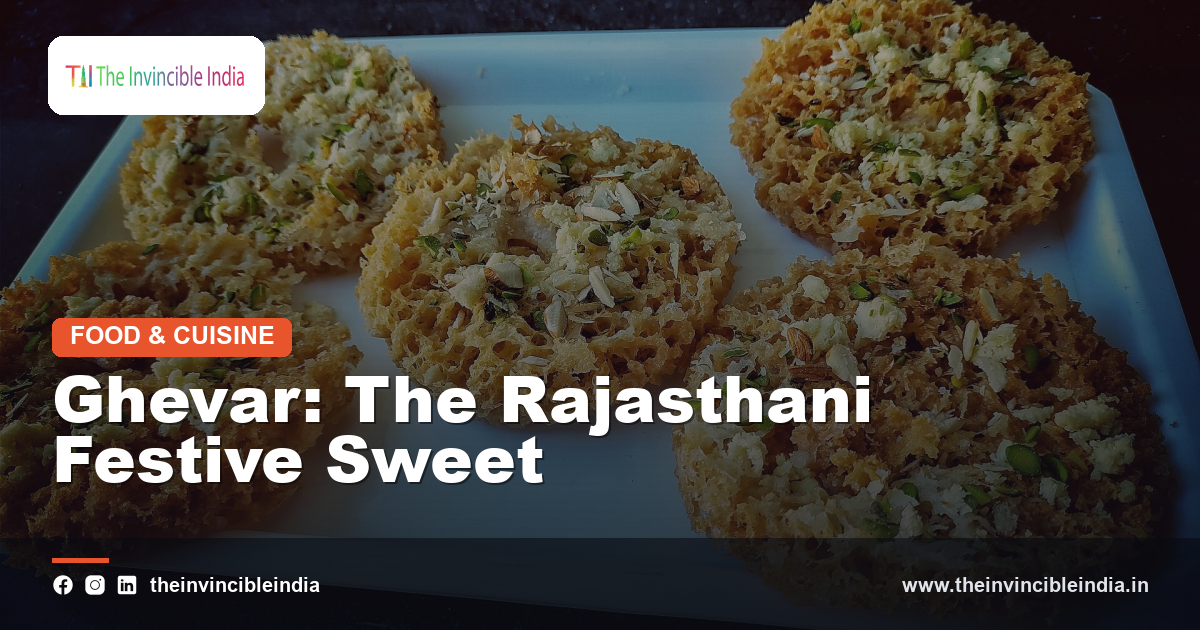
Among the many regional specialties documented among the famous sweets of India, ghevar occupies a distinctive place as one of the most visually striking and technically demanding preparations to come out of Rajasthan. Shaped as a large, flat disc riddled with a delicate, honeycomb-like network of holes, ghevar is made by pouring a thin batter into hot ghee in a way that allows it to set into this lacy structure, a technique unlike most other Indian sweets. It is intimately tied to the monsoon season and to festivals such as Teej and Raksha Bandhan, when sweet shops across Rajasthan and beyond fill their display cases with fresh batches. Topped with rabri, dry fruits, or a dusting of silver varq, ghevar balances a crisp, porous base with rich, creamy garnishes. This guide traces its history, preparation, varieties, and enduring place within Rajasthani festive culture.
Quick Facts
| Detail | Information |
|---|---|
| Type | Disc-shaped fried sweet |
| Main Ingredients | Ghee, flour, milk or water batter |
| Texture | Honeycomb, lace-like and porous |
| Popular Toppings | Rabri, silver varq, chopped nuts |
| Regional Origin | Rajasthan |
| Festive Association | Teej and Raksha Bandhan |
What Is Ghevar
Ghevar is a traditional Rajasthani sweet shaped into a wide, flat disc, instantly recognizable for the intricate lattice of tiny holes running through its body. This distinctive appearance results from a specialized frying technique in which a thin batter is poured in stages into hot ghee, allowing steam and trapped air to create the sweet’s signature honeycomb structure as it sets. Once fried, the disc is soaked briefly in sugar syrup, which seeps into the porous holes and lends a light sweetness without making the sweet heavy or soggy. Ghevar is often finished with additional toppings such as rabri, chopped nuts, or a thin sheet of edible silver foil, transforming a relatively simple base into an elaborate festive treat. Its combination of a crisp yet delicate base with rich garnishes has made it one of the most recognizable and celebrated sweets associated specifically with Rajasthani culinary tradition.
Origins and History
Ghevar is widely regarded as a sweet native to Rajasthan, with roots that trace back through generations of regional confectionery tradition rather than any single documented invention. Its association with the desert state is longstanding, and it is often described as one of the signature sweets that define Rajasthani festive cuisine alongside other regional specialties. The technique required to create ghevar’s distinctive honeycomb structure suggests a preparation refined carefully over a long period, as achieving the correct batter consistency and frying temperature demands considerable skill and experience. Traditionally, its preparation has been closely tied to the monsoon season, when it is most commonly made and sold, reinforcing its identity as a seasonal rather than year-round treat. While exact historical origins remain part of regional oral tradition rather than precise record, ghevar’s deep and continuing association with Rajasthan reflects a sweet that has been cultivated, perfected, and cherished within that specific regional culinary heritage for a very long time.
The Distinctive Honeycomb Structure
The defining feature of ghevar is its honeycomb-like structure, a network of small, irregular holes running throughout the disc that gives the sweet both its visual character and its distinctive texture. This structure forms because the thin batter is poured gradually into very hot ghee, causing rapid evaporation and bubbling that creates pockets of air as the batter sets almost instantly on contact with the heat. Achieving a consistent, even honeycomb pattern requires careful control of batter thickness, ghee temperature, and pouring technique, since any imbalance can result in a denser, less porous result. This porous quality is not merely decorative; it allows the sweet to absorb sugar syrup and toppings like rabri more evenly, ensuring that sweetness and richness are distributed throughout rather than concentrated only on the surface. The honeycomb structure is, in many ways, the technical signature that distinguishes ghevar from virtually every other sweet in the broader Indian confectionery repertoire.
Traditional Preparation Method
Making ghevar traditionally begins with a thin batter prepared from flour combined with water or milk, mixed to a consistency that flows easily while still being able to form the desired lattice pattern when fried. This batter is poured in small, controlled amounts into a deep vessel of very hot ghee, typically using a specific pouring motion that allows each addition to set before the next is added, gradually building up the characteristic disc shape from the base upward. The high heat causes the batter to bubble and expand almost immediately, forming the porous structure that defines the finished sweet. Once the disc reaches the desired size and thickness, it is carefully removed from the ghee and allowed to drain before being briefly soaked in warm sugar syrup. This entire process demands considerable skill, timing, and experience, which is why ghevar is often associated with specialized sweet makers rather than casual home preparation.
Role of Ghee in the Batter
Ghee plays an essential role in ghevar preparation, serving not only as the frying medium but also as a key ingredient that influences the sweet’s final texture and flavor. The batter itself is typically enriched with a small amount of ghee before frying, which is believed to contribute to the delicate, flaky quality of the finished structure. Frying in pure ghee at a carefully maintained high temperature is central to achieving the rapid bubbling and setting that produces ghevar’s signature honeycomb pattern, since the specific heat properties of ghee support this reaction more effectively than many other fats. The rich, characteristic aroma of ghee also permeates the finished sweet, adding a depth of flavor that complements the added sweetness from the sugar syrup and any toppings. This reliance on ghee, both within the batter and as the frying medium, reflects a broader pattern in Indian sweet-making where ghee is prized for the specific textures and flavors it can achieve.
Ghevar Molds and Traditional Tools
Preparing ghevar traditionally relies on a specific set of tools designed to manage the unique demands of its frying process. A deep, narrow vessel is generally used to hold the hot ghee, its shape helping guide the batter as it is poured and allowing the disc to form with relatively even sides. A perforated or ring-shaped mold is sometimes used to help maintain the disc’s circular form as it fries, ensuring a consistent shape across batches. Long-handled skimmers and ladles are essential for carefully removing the finished ghevar from the hot ghee without damaging its delicate, porous structure, which can break easily if handled roughly. These specialized tools, often passed down or maintained specifically for ghevar-making within sweet shops, reflect how central proper equipment is to producing a good result. Without the right tools and technique working together, achieving ghevar’s characteristic texture and appearance becomes considerably more difficult, if not impossible, for an inexperienced cook.
Classic Varieties: Plain, Mawa, and Malai Ghevar
Several classic varieties of ghevar have developed over time, each distinguished mainly by its toppings and additional ingredients rather than the fundamental frying technique. Plain ghevar, sometimes called sada ghevar, is served simply soaked in sugar syrup, allowing the honeycomb texture and subtle ghee flavor to take center stage without additional embellishment. Mawa ghevar incorporates khoya, or reduced milk solids, either mixed into the topping or spread generously over the disc, adding a dense, milky richness. Malai ghevar is topped with a layer of fresh cream or thickened milk, offering a lighter, softer contrast to the crisp base beneath. Each variety appeals to slightly different preferences, from those who favor a more restrained sweetness to those who prefer an indulgent, rich topping. Despite their differences, all three varieties share the same essential honeycomb structure, which remains the technical foundation upon which every version of ghevar is built.
Ghevar and Teej Festival
Ghevar is most closely associated with Teej, a monsoon festival celebrated with particular importance in Rajasthan, during which the sweet becomes especially prominent in households and markets alike. As Teej approaches, sweet shops across the region begin preparing large quantities of ghevar, often displaying multiple varieties prominently to meet seasonal demand. The sweet is exchanged among family members, gifted between relatives, and served during festive gatherings connected to the celebration, reinforcing its role as more than an everyday treat. This strong seasonal association means that ghevar, though enjoyed at other times as well, reaches its peak popularity and freshest availability specifically around the Teej period. The timing of this connection, coinciding with the monsoon season, also aligns with older associations between the rains and celebratory sweets in Rajasthani tradition. For many families, the arrival of ghevar in local markets serves as an informal seasonal marker, signaling that Teej celebrations are near.
Ghevar and Raksha Bandhan
Beyond Teej, ghevar also holds a significant place in celebrations surrounding Raksha Bandhan, a festival that similarly falls during the monsoon months and often overlaps closely with the period when ghevar is most widely available. During this time, the sweet is frequently included among gifts exchanged between siblings, alongside other traditional treats, reflecting its broader identity as a festive rather than purely everyday food. Sweet shops often see a noticeable rise in demand for ghevar around this period, further reinforcing the seasonal rhythm that governs its production and sale. This dual association with both Teej and Raksha Bandhan has helped cement ghevar’s reputation as one of the defining sweets of the monsoon festive season in Rajasthan and neighboring regions. Rather than being tied to a single occasion, ghevar’s popularity spans this broader festive window, making it a recurring feature of celebration during these particular weeks of the year.
Rabri and Ghevar Pairing
One of the most popular ways to serve ghevar is topped generously with rabri, a thickened, sweetened milk preparation made by slowly reducing milk until it develops a dense, creamy consistency. When spooned over a fried ghevar disc, rabri seeps gently into the honeycomb structure, softening the crisp base slightly while adding a rich, dairy-forward sweetness that complements the ghee-fried foundation. This pairing is especially popular during festive occasions, when the combination of rabri and ghevar is often considered the most indulgent and celebratory way to enjoy the sweet. The contrast between the airy, porous ghevar and the dense, smooth rabri creates a layered eating experience that has made this particular combination especially beloved among those familiar with Rajasthani sweets. Many sweet shops prepare rabri specifically to accompany their ghevar offerings during the festive season, treating the pairing as a signature presentation rather than an optional addition.
Regional Sweet Shops and Seasonal Production
Ghevar production is closely tied to a defined seasonal window, with many traditional sweet shops in Rajasthan preparing it almost exclusively around the monsoon and festive period rather than throughout the year. This seasonal approach reflects both the sweet’s strong association with specific festivals and practical considerations, since the demanding preparation process is often reserved for periods of highest demand. Specialized sweet makers, some of whom have focused on ghevar for generations, are frequently sought out specifically for their skill in achieving the correct honeycomb texture and consistent quality across large batches. In cities and towns across Rajasthan, certain shops have built strong local reputations around their ghevar, drawing customers who return year after year during the festive season. This concentrated seasonal production has helped preserve ghevar’s identity as a special-occasion sweet, distinguishing it from more commonly available everyday treats that are prepared and sold consistently throughout the year.
Ghevar Compared to Other Indian Sweets
Placed alongside other well-known Indian sweets, ghevar stands out for both its unusual preparation method and its distinctive texture, setting it apart from more familiar categories such as milk-based sweets or syrup-soaked fried treats. While many Indian sweets rely on reduced milk or dense batters, ghevar’s thin, rapidly fried batter produces a light, porous structure unlike almost anything else in the wider sweet-making tradition. Its closest points of comparison might be other syrup-soaked fried sweets, yet even these typically lack the same intricate honeycomb pattern and delicate crispness that define ghevar specifically. This uniqueness has helped ghevar maintain a distinct identity even as it has become more widely known and available outside Rajasthan. Rather than blending into a broader category of syrup-soaked sweets, ghevar is generally recognized and appreciated specifically for its singular technique and appearance, reinforcing its regional origin whenever it appears on a menu or in a sweet shop display.
Preparation Skill and Craftsmanship
Making good ghevar is widely regarded as a skill that takes considerable time and practice to master, given the precision required in batter consistency, ghee temperature, and pouring technique. Even small deviations, such as batter that is too thick or ghee that is not hot enough, can prevent the characteristic honeycomb structure from forming correctly, resulting in a denser or uneven disc. Experienced sweet makers often develop an intuitive sense for these variables, adjusting their technique based on subtle visual and textural cues rather than relying solely on fixed measurements. This craftsmanship is frequently passed down within families or workshops that specialize in ghevar, with newer cooks learning gradually under the guidance of more experienced practitioners. The specialized nature of this skill helps explain why ghevar, despite its popularity, remains a sweet more commonly purchased from skilled makers than attempted casually at home, reinforcing its status as a preparation that rewards dedicated expertise.
Nutritional Character
As a sweet prepared through deep frying in ghee and finished with sugar syrup and often rich toppings, ghevar is best understood as an indulgent, occasional treat rather than an everyday food. Its porous structure, while contributing to its distinctive texture, also means it can absorb a notable amount of ghee and syrup during preparation, adding to its overall richness. Toppings such as rabri or khoya further increase its dairy and sugar content, making varieties like malai or mawa ghevar particularly rich compared to the plainer version. Like many traditional Indian sweets tied closely to festive occasions, ghevar is generally consumed in moderation and associated specifically with celebration rather than routine eating. Its nutritional character, centered on ghee, flour, and dairy, reflects ingredients that have long been valued in Indian sweet-making for the specific flavors and textures they provide, even as they are enjoyed with an awareness of their rich, occasional nature.
Ghevar in Rajasthani Households and Celebrations
Within Rajasthani households, ghevar carries meaning that extends beyond its taste, closely tied to memories of festive gatherings, family visits, and seasonal celebration. Its arrival in local markets each year during the monsoon months is often anticipated, with families making a point of purchasing or preparing it specifically to mark the beginning of the festive season. Sharing ghevar with relatives and neighbors during Teej and Raksha Bandhan reinforces its role as a sweet connected to social bonds and hospitality rather than solitary indulgence. In some families, particular sweet shops or makers are favored year after year, with loyalty built around consistent quality and familiar taste developed over many seasons. This deep embedding within household tradition helps explain why ghevar remains so strongly associated with a specific time of year, carrying an emotional and cultural weight that persists even as tastes and food habits continue to evolve more broadly.
Ghevar Today
Today, ghevar continues to thrive as one of Rajasthan’s most recognizable festive sweets, prepared by specialized sweet shops that maintain traditional techniques while also innovating with new toppings and presentations. Its availability has expanded beyond Rajasthan itself, with sweet shops in other parts of India and among the Rajasthani diaspora preparing it especially around the Teej and Raksha Bandhan season, helping introduce the sweet to wider audiences. Despite this broader reach, ghevar has largely retained its identity as a seasonal, celebratory treat rather than becoming an everyday commercial product, preserving the special anticipation associated with its arrival each year. Contemporary variations, including chocolate or fruit-topped versions, have appeared in some markets, yet the classic combination of a crisp honeycomb base with rabri or khoya remains the most cherished form. As Rajasthani cuisine continues to gain wider recognition, ghevar stands as one of its clearest and most distinctive culinary ambassadors, a sweet whose intricate craft continues to be honored during the very festivals that first shaped its significance.
Sources & Further Reading
- Ministry of Culture, Government of India (indiaculture.gov.in).
- Ministry of Food Processing Industries, Government of India (mofpi.gov.in).
Frequently Asked Questions
What is ghevar made of?
Ghevar is made from a thin flour batter fried in hot ghee to create a honeycomb-like disc, which is then soaked in sugar syrup and often topped with rabri, khoya, or dry fruits.
Why is ghevar associated with Teej?
Ghevar is prepared and sold in large quantities around Teej, a monsoon festival celebrated especially in Rajasthan, where it is exchanged as gifts and served during festive family gatherings.
What are the main types of ghevar?
The main varieties are plain (sada) ghevar, mawa ghevar topped with reduced milk solids, and malai ghevar topped with fresh cream, each offering a different level of richness.
Why does ghevar have holes in it?
The holes result from pouring thin batter into very hot ghee in stages, which causes rapid bubbling and evaporation that creates ghevar’s signature porous, honeycomb texture as it fries.
Is ghevar only available during festivals?
Ghevar is most commonly made and sold around Teej and Raksha Bandhan, though some sweet shops, especially outside Rajasthan, now offer it more broadly during other times of year as well.