

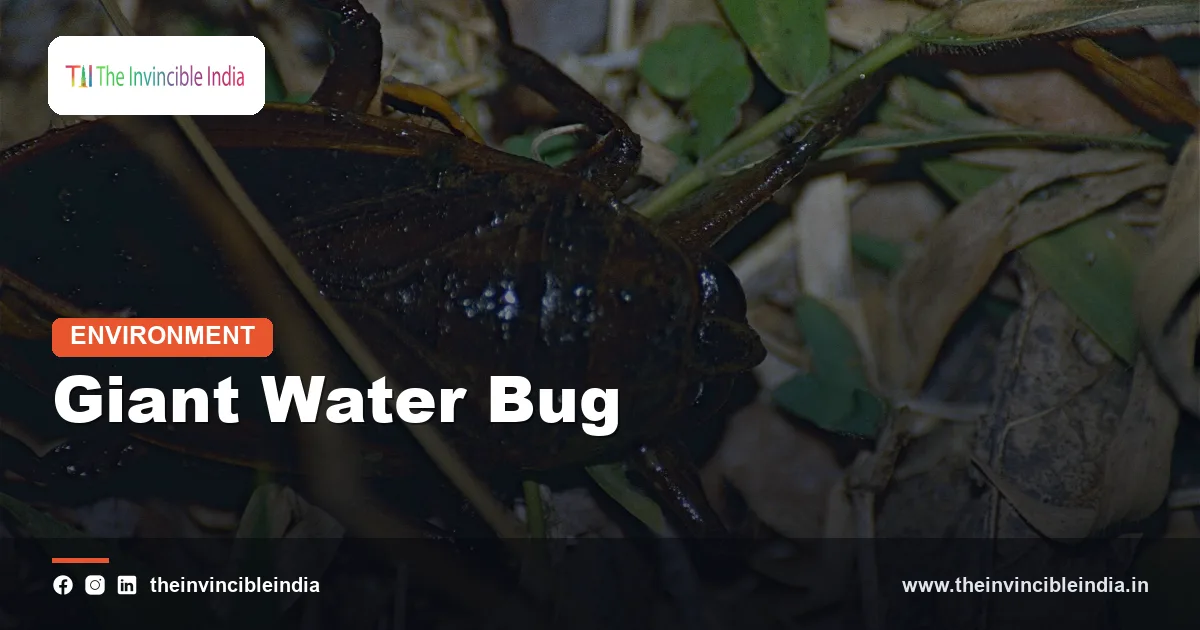
A giant water bug is a large, flat-bodied, predatory aquatic insect of the family Belostomatidae that lives in ponds, tanks, paddy fields and slow streams, where it seizes tadpoles, fish, snails and other insects with powerful front legs and feeds on them through a piercing beak. Some Indian species grow to well over five centimetres in length, and in several of them the father plays an unusual part in looking after the eggs.
The giant water bug is often noticed only when it flies to a streetlight on a monsoon night or when a swimmer or fish farmer finds one in a pond. This article explains what a giant water bug is, how it breathes and hunts, which kinds occur in India, how the males care for the eggs, and whether it is a danger to people.
Quick Facts
| Common name | Giant water bug (also called toe-biter, electric-light bug or belostomatid) |
|---|---|
| Scientific classification | Order Hemiptera, suborder Heteroptera; family Belostomatidae |
| Size | About 1.5 to 3 cm in the smaller Indian genera; up to roughly 7 to 8 cm in the largest species such as Lethocerus indicus |
| Habitat in India | Still or slow freshwater: ponds, tanks, ditches, rice fields, marshes and pools with vegetation |
| Diet | Aquatic insects and their larvae, tadpoles, small fish, snails, and sometimes small frogs |
| Life cycle | Incomplete metamorphosis: egg, five nymph stages, adult; males guard or carry the eggs |
| Ecological role | Top invertebrate predator in small water bodies; controls mosquito larvae and other aquatic insects |
| Notable features | Raptorial front legs, short breathing straps at the tip of the abdomen, strong flight and attraction to lights |
Key Takeaways
- The giant water bug belongs to the family Belostomatidae and is among the largest true bugs, with some Indian species longer than five centimetres.
- A giant water bug catches prey with strong, hooked front legs and feeds by injecting digestive saliva through a short beak.
- In some giant water bug species, such as those of the genus Diplonychus, the female glues her eggs onto the male’s back and he carries them until they hatch.
- A giant water bug breathes air through a pair of short straps at the tip of its abdomen, which it pushes above the water surface.
- The giant water bug can fly well between ponds and is often attracted to street lamps and verandah lights at night during the rainy season.
- A giant water bug will bite in defence if handled, and the bite is painful but not dangerous in a medical sense.
What is a giant water bug and how is it classified?
A giant water bug is a member of the family Belostomatidae, a group of aquatic true bugs in the order Hemiptera. The family contains more than a hundred species in several genera, and it is found on most continents. Within the order, its closest relatives include water scorpions, backswimmers and the small water striders, all of which live in or on freshwater.
Biologists divide the family into subfamilies. The Lethocerinae include the very large forms, such as the genus Lethocerus, whose members are among the biggest insects of freshwater habitats. The Belostomatinae include smaller, oval species, such as the genus Diplonychus, which is common in ponds and rice fields across India. The distinction matters because the two groups differ in size and in how the males look after the eggs.
The family name comes from Belostoma, the genus whose Greek roots refer to a dart-like or piercing mouth. The common names are numerous and vivid. In North America the insects are called toe-biters, because they bite the feet of waders, and electric-light bugs, because they swarm at lamps.
What does a giant water bug look like?
A giant water bug has a broad, flat, oval body that is brown or olive, a short head with large eyes, a short and strong beak, and a pair of thick front legs shaped like hooks. The flattened outline and the muted colours let it hide among mud and plant debris.
Several features identify the insect:
- Raptorial front legs: The front legs are thickened and end in a curved claw, much like those of a praying mantis, and they fold against the body when at rest.
- Paddle-like hind legs: The middle and hind legs are flattened and fringed with fine hairs for swimming.
- Breathing straps: At the rear end of the abdomen there are two short, retractable straps that form a breathing tube when pressed together at the surface.
- Wings: Fully developed wings are folded over the back, and the insect can fly even though it spends most of its life in water.
The common Indian giant water bug Lethocerus indicus is a large, brown insect with a long, slightly narrowed body and may reach seven or eight centimetres. Diplonychus species are much smaller, roughly two to three centimetres long, with a rounder body.
Where does the giant water bug live in India?
The giant water bug lives in still and slow-moving freshwater across India, including village ponds, irrigation tanks, ditches, marshes, lake margins and flooded rice fields. It prefers water with plenty of plants, since the vegetation gives it hiding places and supports the prey on which it feeds.
The insect tends to wait among submerged plants and roots, often head down with the breathing straps just touching the surface. In summer, as ponds shrink, giant water bugs may become concentrated in the remaining pools, and when the pond dries up, they fly off to find another. During the monsoon they are especially active, and many are seen far from water as they disperse.
Giant water bugs are widespread in the Gangetic plains, peninsular India and the Northeast, with Lethocerus indicus known across South and Southeast Asia. The related water scorpions and backswimmers are found in the same habitats, but are easy to tell apart by their shape and behaviour.
How does a giant water bug breathe underwater?
A giant water bug breathes atmospheric air, not dissolved oxygen, by pushing a pair of short breathing straps at the tip of its abdomen through the water surface. The straps form a tube through which air passes into the tracheal system, and the bug also keeps a film of air under its wings and on its body.
Because it needs surface air, the insect must return periodically to the top of the water, even though it hunts below. It often hangs head downwards from a plant stem with the tip of the abdomen at the surface, a position that also helps it to ambush passing prey. A layer of air trapped beneath the wing covers acts like a small air tank, allowing the bug to stay submerged for a considerable time.
This reliance on air explains why giant water bugs can live in warm, stagnant, low-oxygen ponds where many fish cannot. It also explains their strong flight: since water bodies are temporary in much of India, the ability to leave one pond and find another is essential for survival.
What does a giant water bug eat?
A giant water bug eats a wide range of small aquatic animals, including mosquito larvae, other insect larvae, snails, tadpoles, small fish and, in the case of larger species, small frogs. Almost any animal that it can seize and hold is a possible meal.
The bug waits motionless, then grabs the prey with its front legs in a rapid strike. It stabs the victim with its beak and injects saliva that paralyses it and begins to digest its tissues from the inside. The bug then sucks up the liquefied contents, leaving a hollow shell. This process, known as external digestion, can take from several minutes to an hour.
Giant water bugs sometimes capture prey much larger than themselves. Reports from fish hatcheries and nurseries in Asia show that they can reduce the number of fish fry and fingerlings in small ponds. At the same time, the insects eat large numbers of mosquito larvae and other aquatic pests, so they play a dual role in human-managed waters.
How do male giant water bugs care for the eggs?
In many giant water bugs the male looks after the eggs: in Diplonychus and related genera, the female glues her eggs to the male’s back, and he carries them until they hatch, while in Lethocerus the male guards eggs laid on plants above the water. This paternal care is rare among insects and has been studied intensively.
Egg-carrying males
In the Belostomatinae, a mating pair spends time together, and the female deposits eggs in neat rows onto the back wings of the male. The number of eggs varies by species, and may be several dozen. The male carries this load for a week or two, and he repeatedly lifts his body to the surface or performs push-up movements in the water to aerate the eggs and keep them from fungal infection. A male that is carrying eggs has reduced mobility and is a less efficient hunter, but he protects the clutch from predators and drying.
Egg-guarding males
In the Lethocerinae, such as Lethocerus indicus, the female lays eggs above the water line on reeds or other emergent plants. The male stays close, climbs up to the eggs, and wets them regularly by dipping his body in the water and returning. Without this care the eggs would dry out. When the nymphs hatch, they drop into the water and begin life as independent predators.
What is the life cycle of the giant water bug?
The giant water bug develops by incomplete metamorphosis: the egg hatches into a nymph that resembles a small wingless adult, and the nymph grows through five moults before becoming a winged adult. There is no pupal stage and no larva that looks different from the adult.
Nymphs are predators from the start and eat small prey such as mosquito larvae and tiny crustaceans. As they grow, they take larger prey. Development from egg to adult can take roughly two to three months in warm weather, and adults can live for several months or longer, overwintering in cooler regions. Females may lay eggs more than once during a season.
The table below summarises the main stages.
| Stage | What happens |
|---|---|
| Egg | Laid on a male’s back (Diplonychus) or on plants above water (Lethocerus); hatches in about one to two weeks |
| Nymph, five instars | Wingless predator; grows by moulting; feeds on small aquatic animals |
| Adult | Winged, able to fly between ponds; mates and lays eggs |
Is the giant water bug dangerous to humans?
The giant water bug is not dangerous to humans in any serious sense, but it can deliver a painful bite if it is picked up or stepped on. The bite results from the digestive saliva injected through the beak and is typically sharp, with local pain and swelling that fades in a few hours to a couple of days.
The insect does not attack people and avoids contact, and many bites occur when children or swimmers handle one or when it lands on a person near a light. When disturbed, the bug may also play dead, lying completely still for some time before swimming away. Some species release an unpleasant-smelling secretion.
If a bite occurs, the area should be washed with soap and water, and a cold compress may relieve the pain. The bug does not carry known human diseases through its bite. Medical help should be sought only if swelling spreads or an unusual reaction develops.
Why does the giant water bug matter for ponds and people?
The giant water bug matters because it is a major invertebrate predator in small freshwater habitats, helping to control mosquito larvae and other aquatic insects while also serving as food for birds, fish and some human communities. Its presence is generally a sign of a reasonably healthy pond with enough prey.
Several points help to explain its importance:
- Natural mosquito control: Nymphs and adults eat mosquito larvae, which is helpful in villages where small ponds breed mosquitoes.
- Food web link: Giant water bugs are eaten by herons, kingfishers, fish and large frogs.
- Human food: In parts of Southeast Asia, Lethocerus species are a traditional food and a flavouring, and are sold in markets.
- Fish farming: They can harm fry and fingerlings in nurseries, so hatchery managers often net them out or use screens.
The insect is also affected by human activity. Drying of ponds, pollution, heavy pesticide use in rice fields and loss of wetlands reduce its habitat. Light pollution may also draw large numbers of bugs away from ponds, where they die at lamps.
Bottom Line
The giant water bug is a powerful and specialised pond predator, notable for its raptorial legs, its air-breathing straps and the unusual paternal care shown by the males. It is harmless to people who do not handle it, and it is a useful part of the food web in Indian ponds and paddy fields.
Frequently Asked Questions
What is a giant water bug?
A giant water bug is a large aquatic insect of the family Belostomatidae that preys on other water animals. It has strong front legs for grabbing prey and a beak for sucking out the body fluids. Several species live in Indian ponds, tanks and paddy fields.
Does a giant water bug bite humans?
A giant water bug can bite humans if it is handled or stepped on, and the bite is painful. The pain and swelling usually fade within a day or two. The bug is not aggressive and does not pursue people.
Why do male giant water bugs carry eggs?
Male giant water bugs of some genera, such as Diplonychus, carry eggs because the female glues them onto his back. The male protects the eggs and keeps them aerated until they hatch. In other genera, such as Lethocerus, the male instead guards eggs laid on plants and keeps them moist.
Can a giant water bug fly?
A giant water bug can fly well, despite living in water. It uses its wings to move between ponds, especially at night. This is why it is often found around street lights during the monsoon.
What does a giant water bug eat?
A giant water bug eats mosquito larvae, other aquatic insects, snails, tadpoles and small fish, and larger species may take small frogs. It injects digestive saliva into its prey and sucks up the liquefied tissues. This makes it a significant predator in small ponds.
How is a giant water bug different from a water scorpion?
A giant water bug is broad, flat and oval with short breathing straps, whereas a water scorpion is long and thin with a long, tail-like breathing tube. Both are predatory aquatic bugs with grasping front legs. The water scorpion is generally less common and more slender.
{“@context”:”https://schema.org”,”@graph”:[{“@type”:”FAQPage”,”mainEntity”:[{“@type”:”Question”,”name”:”What is a giant water bug?”,”acceptedAnswer”:{“@type”:”Answer”,”text”:”A giant water bug is a large aquatic insect of the family Belostomatidae that preys on other water animals. It has strong front legs for grabbing prey and a beak for sucking out the body fluids. Several species live in Indian ponds, tanks and paddy fields.”}},{“@type”:”Question”,”name”:”Does a giant water bug bite humans?”,”acceptedAnswer”:{“@type”:”Answer”,”text”:”A giant water bug can bite humans if it is handled or stepped on, and the bite is painful. The pain and swelling usually fade within a day or two. The bug is not aggressive and does not pursue people.”}},{“@type”:”Question”,”name”:”Why do male giant water bugs carry eggs?”,”acceptedAnswer”:{“@type”:”Answer”,”text”:”Male giant water bugs of some genera, such as Diplonychus, carry eggs because the female glues them onto his back. The male protects the eggs and keeps them aerated until they hatch. In other genera, such as Lethocerus, the male instead guards eggs laid on plants and keeps them moist.”}},{“@type”:”Question”,”name”:”Can a giant water bug fly?”,”acceptedAnswer”:{“@type”:”Answer”,”text”:”A giant water bug can fly well, despite living in water. It uses its wings to move between ponds, especially at night. This is why it is often found around street lights during the monsoon.”}},{“@type”:”Question”,”name”:”What does a giant water bug eat?”,”acceptedAnswer”:{“@type”:”Answer”,”text”:”A giant water bug eats mosquito larvae, other aquatic insects, snails, tadpoles and small fish, and larger species may take small frogs. It injects digestive saliva into its prey and sucks up the liquefied tissues. This makes it a significant predator in small ponds.”}},{“@type”:”Question”,”name”:”How is a giant water bug different from a water scorpion?”,”acceptedAnswer”:{“@type”:”Answer”,”text”:”A giant water bug is broad, flat and oval with short breathing straps, whereas a water scorpion is long and thin with a long, tail-like breathing tube. Both are predatory aquatic bugs with grasping front legs. The water scorpion is generally less common and more slender.”}}]}]}


