

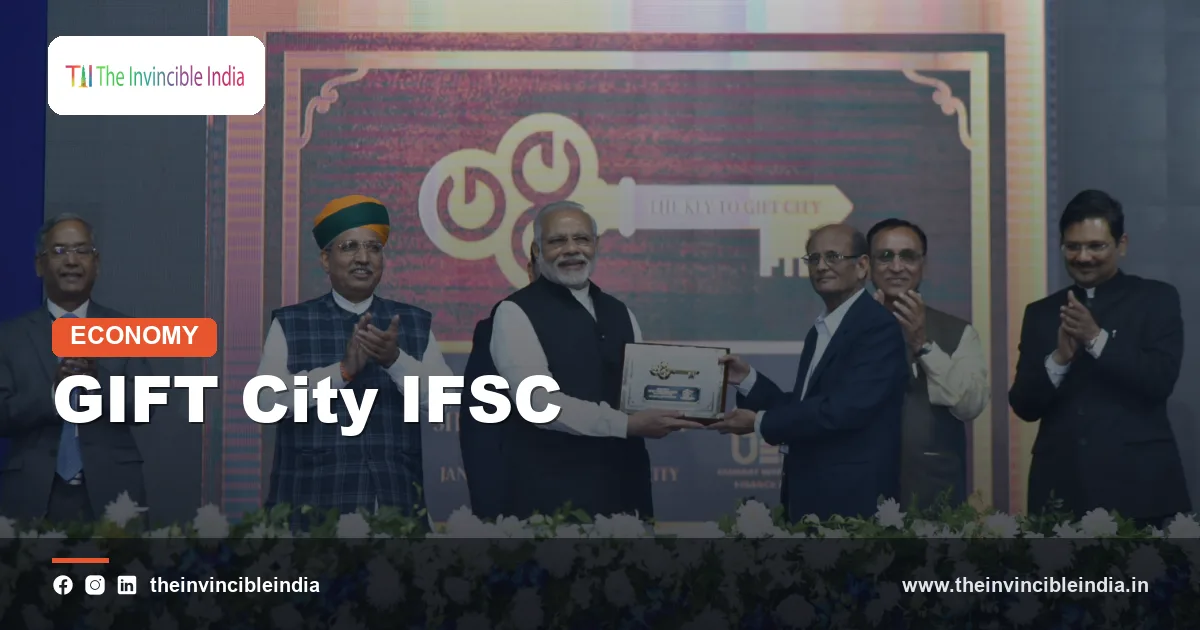
On the western bank of the Sabarmati river, between the cities of Ahmedabad and Gandhinagar in Gujarat, a planned business district of glass towers has been taking shape since the late 2000s. This is GIFT City, short for Gujarat International Finance Tec-City, and it is home to India’s first International Financial Services Centre (IFSC). The idea is to bring financial services that Indian businesses have long obtained from hubs like Singapore, Dubai, London and Hong Kong onto Indian soil, under a regulatory and tax regime designed to compete with those centres.
The project is as much about regulation as about real estate. Financial institutions in GIFT City operate in a special framework that treats the area as a jurisdiction outside India’s domestic financial and tax system for many purposes, and a single regulator, the International Financial Services Centres Authority (IFSCA), oversees most activities. This explainer covers what GIFT City is, how it came about, what activities take place there, how the regulator works, what tax incentives are available, and what its backers hope it will achieve.
| Feature | Details |
|---|---|
| Full name | Gujarat International Finance Tec-City (GIFT City) |
| Location | On the Sabarmati riverfront near Gandhinagar, Gujarat |
| Concept and promoters | Conceived in the mid-2000s by the Gujarat government, developed with infrastructure financier IL&FS |
| IFSC status | India’s first operational International Financial Services Centre, from 2015 |
| Unified regulator | International Financial Services Centres Authority (IFSCA), established in April 2020 |
| Legal basis | IFSCA Act, 2019, and the Special Economic Zones framework |
| Key activities | Offshore banking, capital markets, bullion trading, fund management, insurance, aircraft and ship leasing |
| Notable exchanges | India INX, NSE International Exchange and the India International Bullion Exchange |
What Is GIFT City?
GIFT City is a purpose-built smart city and business district which combines a financial centre with commercial, residential and social infrastructure. The idea is that people can live, work and relax in the same area, and the project is often described as a walk-to-work city. Its master plan includes high-rise office towers, a financial and business district, residential complexes, schools and hospitals, retail and entertainment spaces, and underground utility tunnels.
It consists of two broad parts. One is the Special Economic Zone (SEZ) area, which has the status of a processing and service zone within which the IFSC is located. The other is the domestic tariff area, which hosts other commercial and residential development under normal Indian regulations. Financial entities that want the benefits of the international centre must operate from the IFSC portion.
Technology and infrastructure features
- A district cooling system that supplies chilled water for air conditioning, reducing energy use.
- An automated, underground waste collection system that avoids garbage trucks.
- Common utility tunnels carrying power, water and communication lines.
- Dedicated data infrastructure, as financial services depend on fast and secure connectivity.
- Planned public transport connectivity to Ahmedabad and Gandhinagar, including metro links.
Origin and History of the Project
The idea for a global-standard financial services hub in India was conceived in the mid-2000s by the Gujarat government. The state wanted a location that could attract back-office and front-office financial operations to India. The project was developed by a company set up as a joint venture between Gujarat state agencies and Infrastructure Leasing and Financial Services (IL&FS), with the foundation of the city laid around 2007 to 2008.
The early years were slow, because India lacked a legal and regulatory framework for an international financial centre. Financial regulators were wary of creating a separate jurisdiction, and global institutions waited to see a clear policy. A decisive turn came when the Government of India declared the GIFT SEZ an International Financial Services Centre in 2015, and rules were framed to allow banks, insurers and capital market intermediaries to operate. In the following years, the first exchanges started trading, and foreign and Indian banks opened units.
Timeline of key developments
- Mid-2000s: Concept of a financial city is developed by the Gujarat government.
- 2007 to 2008: The project and company are formally launched and work on the site begins.
- 2015: The first IFSC in India is operationalised within the GIFT SEZ.
- 2017 to 2018: The first international exchanges, India INX and NSE IX, are inaugurated and begin trading.
- 2019: Parliament enacts the International Financial Services Centres Authority Act.
- 2020: IFSCA is established as the unified regulator in April.
- 2022 to 2023: Launch of the bullion exchange and the NSE-SGX arrangement that migrates Nifty derivatives trading to GIFT City.
Why India Needed an International Financial Services Centre
A significant portion of financial activity connected with India, such as derivatives trading in Indian equity indices, dollar bond issuances by Indian companies and fund management for investments into India, was historically done in offshore centres. Indian companies and investors went to Singapore, Dubai, Mauritius, London or New York to take advantage of flexible regulation, deep markets and favourable taxation. This led to jobs, tax revenue, trading volumes and skilled talent being located outside India.
An IFSC is meant to reverse this flow. By offering a competitive environment on Indian soil, the government aims to attract international businesses, provide Indian companies with easier access to global capital, and create high-quality jobs in finance, law, accounting and technology. The ambition is often expressed as bringing offshore finance onshore, while still keeping that activity within reach of Indian regulation and supervision.
- Retaining financial services business that previously migrated overseas.
- Allowing Indian firms to raise and manage foreign currency funds more easily.
- Supporting India’s international trade and capital flows with local infrastructure.
- Developing a pool of skilled financial professionals.
IFSCA: The Unified Regulator
One of the biggest challenges in building a financial centre was regulatory fragmentation. In the domestic system, the Reserve Bank of India regulates banking, the Securities and Exchange Board of India regulates capital markets, the Insurance Regulatory and Development Authority of India regulates insurance, and the Pension Fund Regulatory and Development Authority oversees pensions. For an international centre, working with several regulators was seen as a barrier to speed and clarity.
To solve this, Parliament passed the International Financial Services Centres Authority Act in 2019, and the International Financial Services Centres Authority (IFSCA) was set up in April 2020, with its headquarters in GIFT City. IFSCA acts as a unified regulator for financial products, services and institutions in the IFSC. It takes over the functions that these various regulators exercise in the domestic market, with the benefit of a single point of contact for businesses.
What IFSCA does
- Frames regulations for banking, capital markets, insurance, fund management and other financial services in the IFSC.
- Licenses and supervises entities operating from the centre.
- Promotes the development of new products, such as green finance and fintech.
- Works with international regulators and standard-setting bodies to align practices with global norms.
Banking and Capital Market Activities
Banking in GIFT City is carried out through IFSC Banking Units (IBUs), which are branches of domestic or foreign banks that deal in foreign currency, mainly in the US dollar, rather than the rupee. They can lend to Indian and overseas clients in foreign currency, accept deposits from non-residents and offer trade finance and treasury services. Several Indian public and private sector banks and international banks have established units here.
The capital market side is anchored by two international exchanges. India INX, promoted by the Bombay Stock Exchange, was inaugurated in 2017 as India’s first international exchange. The NSE International Exchange (NSE IX), set up by the National Stock Exchange, followed. They offer trading in equity derivatives, currency and commodity derivatives, and also provide a platform for listing of debt securities such as foreign-currency bonds, including green and sustainable bonds.
Direct listing abroad
Amendments to the Companies Act in 2020 enabled Indian public companies to list directly on foreign exchanges, with IFSC exchanges seen as a natural starting point. This allows firms to raise capital in foreign currency without establishing offshore holding structures.
NSE-SGX Connect and GIFT Nifty
For years, a large share of trading in derivatives linked to the Nifty 50 index took place on the Singapore Exchange as SGX Nifty. This meant that liquidity and revenue related to an Indian index were located abroad. Under an arrangement known as the NSE-SGX Connect, announced in 2022, this trading was moved to NSE IX in GIFT City, and the product was relaunched as GIFT Nifty in July 2023.
The move is regarded as one of the significant early successes of the centre. It brought a major share of offshore Nifty derivatives activity to an Indian jurisdiction. Traders and institutions around the world can access the product, and GIFT Nifty is also widely watched as an early indicator of the opening mood of Indian equity markets because it trades for long hours.
The India International Bullion Exchange
India is one of the world’s largest consumers of gold, and the country has historically depended heavily on imports. The India International Bullion Exchange (IIBX), inaugurated in 2022 in GIFT City, is meant to bring gold and silver trading within a regulated Indian platform. It allows qualified jewellers and other participants to import bullion through the exchange and to trade standardised products, with the aim of improving price discovery and transparency.
The exchange issues Bullion Depository Receipts that represent gold held in vaults, which can be traded, delivered or converted into physical bullion. The long-term goal is to give India a stronger voice in global gold pricing, instead of simply being a price taker in markets such as London or Dubai. Vaulting and clearing services are provided by specialised institutions in the IFSC.
Aircraft Leasing, Ship Leasing and Fund Management
Beyond banking and exchanges, GIFT City has been developed as a hub for specialised financial activities.
Aircraft leasing
Indian airlines lease a significant proportion of their aircraft, historically through lessors based in Ireland, Singapore and the Gulf. A framework for aircraft leasing in the IFSC allows lessors to set up in GIFT City, with tax and regulatory incentives. The Union Budget of 2022-23 and subsequent decisions have given further support to the sector, and several lessors have established operations.
Ship leasing and financing
A similar framework was developed for ship leasing, aiming to bring Indian shipping finance into a local jurisdiction. This supports the shipping and maritime sectors and aligns with the national push on ports and logistics.
Fund management and insurance
Fund managers can set up funds and manage investments for global and Indian investors from the IFSC, in various structures. Insurers and reinsurers have set up offices to write international business, and the centre also provides for fintech, sustainable finance and capital market intermediaries. Several global universities have also been permitted to set up campuses in GIFT City, in order to build a skilled talent pool.
Tax Incentives and Regulatory Benefits
A major attraction of the IFSC is its attractive tax and regulatory regime, which is designed to be competitive with other international financial centres. The key benefits are summarised below.
| Area | Broad benefit |
|---|---|
| Income tax | Tax holiday for a block of years, for example full exemption for ten out of fifteen years for qualifying units |
| Minimum Alternate Tax | Concessional rate for IFSC units |
| Capital gains | Exemption on transfer of certain securities listed on IFSC exchanges |
| Transaction taxes | Exemption from securities and commodities transaction taxes on trades on IFSC exchanges |
| GST | Services provided to IFSC units and to certain foreign customers are exempt or zero-rated |
| Stamp duty and other levies | Exemptions on certain transactions in the IFSC |
| Foreign exchange | Operations in foreign currency; the zone is treated as outside India for foreign exchange rules |
Besides the tax benefits, the regulatory regime is more flexible than in the domestic market, with single-window approvals and an overall emphasis on speed and clarity. The exact rates and conditions are changed from time to time through Budget announcements and notifications, so businesses typically consult current rules before planning.
The Vision: Onshoring Offshore Finance
The central vision of GIFT City is often expressed as bringing Indian offshore financial activity back to India. Rather than losing business to foreign hubs, India aims to build a centre that is globally connected and domestically regulated. The expectation is that this will create jobs, generate tax revenue in the long run, improve capital access for Indian firms and develop financial expertise in the country.
The IFSC also fits into the larger aim of making India a major player in global finance as its economy grows. Policy priorities include green finance, fintech, bullion, derivatives, and the internationalisation of the rupee where feasible. In some of these areas, GIFT City is envisaged as a testing ground, where new products can be introduced under a simplified regime before being considered for the rest of the country.
Challenges
- Competition: Established centres such as Singapore, Dubai, Hong Kong and London have deep talent pools, ecosystems and long track records.
- Ecosystem building: A financial hub needs not only firms but also lawyers, accountants, schools, housing and a high quality of life for global professionals.
- Regulatory clarity: Continued alignment between domestic regulators, tax authorities and IFSCA is needed to avoid ambiguities.
- Scale and liquidity: Exchanges and products need a critical mass of volume and participants to become globally relevant.
- Talent and connectivity: Attracting senior global professionals depends on lifestyle, connectivity and policy certainty.
Conclusion
GIFT City has moved from a concept on the banks of the Sabarmati to a functioning financial centre with banks, exchanges, a bullion platform, leasing companies and a unified regulator. Its journey highlights how financial centres are built through a combination of physical infrastructure, clear regulation, tax certainty and a supportive ecosystem. Whether it will eventually rank alongside the world’s leading hubs depends on growth in scale and depth, but its role as India’s gateway for international financial services is already established.
Frequently Asked Questions
What does GIFT City stand for and where is it located?
GIFT City stands for Gujarat International Finance Tec-City. It is located on the banks of the Sabarmati river near Gandhinagar, between Gandhinagar and Ahmedabad in Gujarat.
What is an International Financial Services Centre?
An IFSC is a jurisdiction within a country that offers financial services to non-residents and residents in foreign currency under a special regulatory and tax regime. GIFT City hosts India’s first operational IFSC, which began in 2015.
What is IFSCA?
The International Financial Services Centres Authority is the unified regulator for financial products and services in the IFSC. It was established in April 2020 under the 2019 IFSCA Act and has its headquarters in GIFT City.
What financial activities take place in GIFT City?
Activities include offshore banking through IFSC Banking Units, trading on international exchanges, bullion trading, fund management, insurance and reinsurance, aircraft and ship leasing, and fintech. The NSE-SGX arrangement also moved Nifty derivatives trading to GIFT City as GIFT Nifty.
What tax benefits are available in the IFSC?
Qualifying units can receive an income tax holiday for a block of years, concessional minimum alternate tax, exemption from certain capital gains and transaction taxes on IFSC exchanges, and GST relief on specified services. The details are revised from time to time, so current notifications should be checked.
What is the main vision behind GIFT City?
The main vision is to bring offshore financial activity related to India onshore, by offering a competitive, globally connected financial centre on Indian soil. This is intended to create jobs, give Indian companies easier access to global capital and build financial expertise within the country.


