


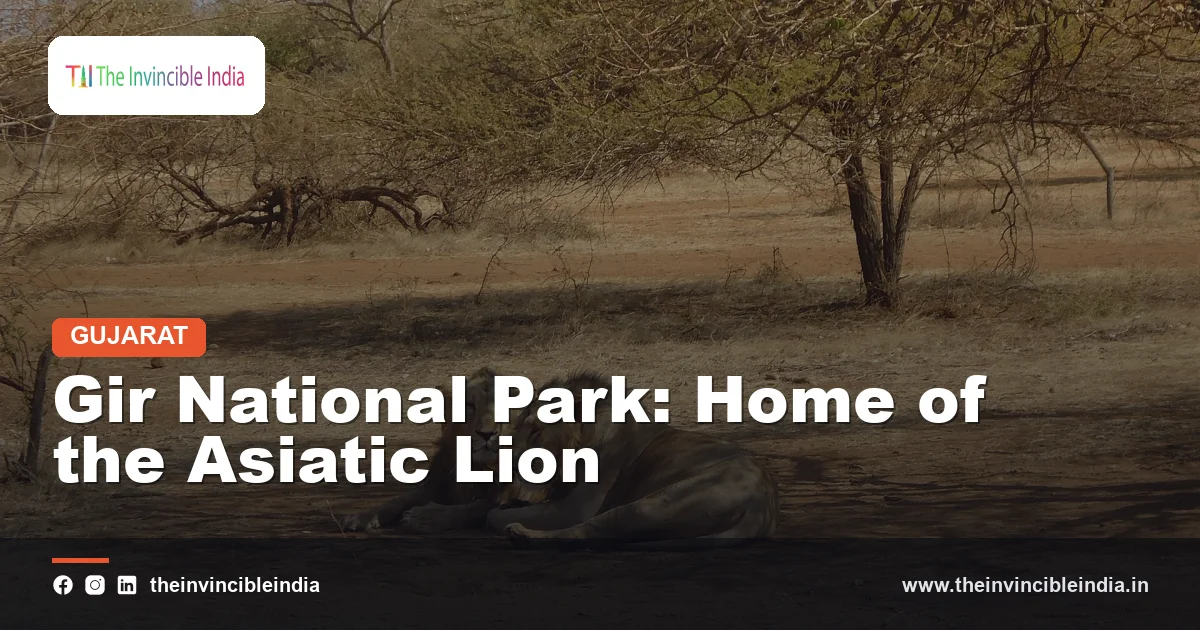
Deep in the state of Gujarat lies Gir National Park, one of the most important wildlife sanctuaries in the world and the last refuge of the magnificent Asiatic lion. This is the only place on Earth where these majestic big cats roam free in the wild, making Gir a destination of extraordinary significance for wildlife lovers and conservationists alike. From near-extinction, the Asiatic lion has made a remarkable recovery here, a triumph of dedicated conservation. This guide explores Gir National Park, its lions and other wildlife, and how to experience this unique corner of India.
Quick Facts: Gir National Park
| Detail | Information |
|---|---|
| Location | Junagadh district, Gujarat |
| Famous for | The only wild population of Asiatic lions |
| Lion population (2020) | Around 674 |
| Established | As a sanctuary in 1965 |
| Best time to visit | December to March |
| Park closed | Mid-June to mid-October (monsoon) |
The Last Home of the Asiatic Lion
The Asiatic lion once ranged across a vast territory stretching from the Middle East through Persia to India, but centuries of hunting and habitat loss drove it to the very brink of extinction. Today, the last wild population survives only in and around Gir National Park in Gujarat, making this forest the single most important place in the world for the species. Slightly smaller than its African cousin and distinguished by a fold of skin along its belly and a somewhat shorter mane, the Asiatic lion is a magnificent and increasingly rare creature whose survival is a matter of national and global importance.
A Conservation Success Story
The recovery of the Asiatic lion is one of the great conservation success stories of the modern age. By the early 20th century, the population had fallen to a perilously low number, perhaps only a few dozen animals. It was thanks to the early protection efforts of the Nawab of Junagadh, who banned lion hunting on his lands, and later the sustained conservation work of the Gujarat government and forest department, that the species was brought back from the edge. Successive censuses have shown a steady increase, with the 2020 count recording around 674 lions, a remarkable achievement of which the region is justly proud.
The Landscape of Gir
Gir National Park protects a large expanse of dry deciduous forest, scrubland, grasslands and rocky hills, interspersed with rivers and reservoirs that sustain its wildlife. This varied and rugged terrain, quite different from the dense jungles of central India, provides the ideal habitat for the lions and the rich array of other creatures that share the forest. The teak-dominated woodlands, seasonal streams and open clearings create a landscape of subtle beauty that changes with the seasons, and the network of tracks through the reserve allows visitors to explore this distinctive and important ecosystem.
Wildlife Beyond the Lions
While the Asiatic lion is the star attraction, Gir is home to a wealth of other wildlife that makes it a rewarding destination for any nature lover. The park shelters a significant population of leopards, along with jungle cats, striped hyenas, jackals and other carnivores. Herbivores such as spotted deer (chital), sambar, nilgai, chinkara and wild boar are abundant and form the prey base for the predators. Gir is also excellent for birdwatching, with hundreds of species recorded, and its rivers and reservoirs are home to the marsh crocodile, adding to the remarkable diversity of the reserve.
Going on a Safari in Gir
The best way to experience Gir is on a jeep safari through the forest, accompanied by trained guides and trackers who know the movements of the lions and other animals. Safaris are conducted along designated routes at set times of day, and while sightings of lions are relatively good compared to the difficulty of spotting big cats elsewhere, patience and a little luck are always part of the adventure. The thrill of encountering a wild Asiatic lion in its natural home, along with the many other creatures and the beauty of the forest, makes a Gir safari an unforgettable experience.
The Maldhari Community
An interesting feature of Gir is the presence of the Maldharis, a traditional community of herders who have lived within and around the forest for generations, coexisting with the lions. These pastoral people, who keep buffalo and cattle, have a unique relationship with the wildlife of Gir, and their way of life is deeply intertwined with the forest. Conservation efforts have sought to balance the needs of the Maldharis with the protection of the lions and their habitat, and their presence adds a fascinating human dimension to the story of Gir and its remarkable wildlife.
Planning Your Visit
Gir National Park is located in the Junagadh district of Gujarat, with the town of Sasan Gir serving as the main base for visitors. The nearest airports and railheads are at Rajkot, Junagadh, Diu and Keshod, and the park is well connected by road. The park is open from around mid-October to mid-June and remains closed during the monsoon months. The best time to visit is from December to March, when the weather is pleasant. Safari permits should be booked in advance, especially during the peak season, as they are limited and in high demand.
The Threats Facing Asiatic Lions
Despite the encouraging recovery of the Asiatic lion, the species remains vulnerable precisely because its entire wild population is concentrated in a single area. This makes the lions dangerously exposed to threats such as disease outbreaks, natural disasters or other localised catastrophes, any of which could devastate the population. Other challenges include occasional conflict with people living near the forest, the risk of animals straying onto railway lines or into wells, and pressures on habitat. For these reasons, conservationists have long discussed the importance of establishing a second, separate population elsewhere as a safeguard, to reduce the risk of the species being wiped out by a single disaster.
The Devalia Safari Park
For visitors who wish to be more certain of seeing lions, or who cannot obtain a permit for the main park, the Devalia Safari Park, also known as the Gir Interpretation Zone, offers an excellent alternative. This enclosed area within the Gir region contains a representative sample of the sanctuary’s wildlife, including lions, leopards and various herbivores, in a natural setting. Guided tours take visitors through the zone, offering a good chance of seeing the animals in a shorter time. Devalia serves both to reduce pressure on the main sanctuary and to give visitors a reliable and educational wildlife experience.
The Cultural Significance of Lions
The lion holds deep cultural and symbolic significance in India, adding another dimension to the importance of protecting the Asiatic lion. The lion features prominently in Indian art, mythology and heraldry, and the famous Lion Capital of Ashoka, depicting four lions standing back to back, was adopted as the national emblem of India. In this light, the survival of the Asiatic lion in Gir carries a resonance that goes beyond conservation, connecting to the nation’s heritage and identity. The pride that the region and the country take in these magnificent animals is a powerful force behind the ongoing efforts to protect them.
Other Attractions Near Gir
A visit to Gir can be combined with several other attractions in the surrounding region of Gujarat. The nearby town of Junagadh, with its ancient fort, the sacred Girnar hills and their pilgrimage temples, and historic monuments, offers a rich cultural experience. The coastal town of Somnath, home to one of the most revered Shiva temples in India, and the beaches of Diu are within reach, allowing travellers to blend wildlife with history, spirituality and the seaside. This variety makes the Gir region a rewarding destination that offers far more than the lions alone, appealing to a wide range of interests.
Responsible Wildlife Tourism
As tourism to Gir grows, responsible and respectful behaviour becomes ever more important to protect the lions and their habitat. Visitors can contribute by following all park rules, keeping a respectful distance from the animals, never feeding wildlife, avoiding loud noises, and refraining from littering. Choosing authorised operators and guides, and supporting local communities and conservation initiatives, helps ensure that tourism benefits both people and wildlife. By treading lightly and putting the welfare of the animals first, visitors can enjoy the extraordinary privilege of seeing wild Asiatic lions while helping to secure their future for generations to come.
The Pride of Gujarat
The Asiatic lions of Gir are a source of enormous pride for Gujarat and for all of India, symbolising both the nation’s rich natural heritage and the success of its conservation efforts. The people of the region have developed a deep bond with the lions, and their protection is regarded as a shared responsibility and a matter of honour. This local pride and involvement has been a crucial factor in the recovery of the species, showing how conservation succeeds best when communities are invested in the wellbeing of the wildlife around them. The story of Gir stands as an inspiring example of how a species can be brought back from the brink through dedication, care and collective will.
A Unique Wildlife Destination
Gir National Park offers a wildlife experience unlike any other in the world, for it is the only place where one can see the magnificent Asiatic lion roaming free in its natural habitat. Combined with its rich variety of other wildlife, its distinctive dry-forest landscape, its fascinating human history and its proximity to other attractions in Gujarat, Gir is a destination of exceptional appeal for nature lovers and travellers alike. A journey to this remarkable sanctuary is not only a thrilling adventure but also a chance to witness first-hand one of conservation’s greatest triumphs, and to appreciate the extraordinary importance of protecting our natural world.
A Triumph Worth Celebrating
The story of Gir and its Asiatic lions stands as one of the most heartening achievements in the history of wildlife conservation. From the brink of extinction, these magnificent animals have been brought back to a thriving population through decades of dedication, care and collective effort. Their survival is a testament to what can be accomplished when a society commits itself to protecting its natural heritage. For every visitor who witnesses a wild lion in the forests of Gir, the experience is a powerful reminder of the beauty of the natural world and the profound importance of safeguarding it for the future.
Frequently Asked Questions
Why is Gir National Park famous?
Gir National Park is famous as the only place in the world where Asiatic lions live in the wild, making it one of the most important wildlife sanctuaries on Earth.
How many lions are in Gir?
According to the 2020 census, Gir and its surrounding areas are home to around 674 Asiatic lions, a number that has steadily grown thanks to conservation efforts.
What is the best time to visit Gir?
The best time to visit is from December to March, when the weather is pleasant. The park is closed during the monsoon, roughly from mid-June to mid-October.
What other wildlife can be seen in Gir?
Besides lions, Gir is home to leopards, hyenas, jackals, spotted deer, sambar, nilgai, marsh crocodiles and hundreds of species of birds.