

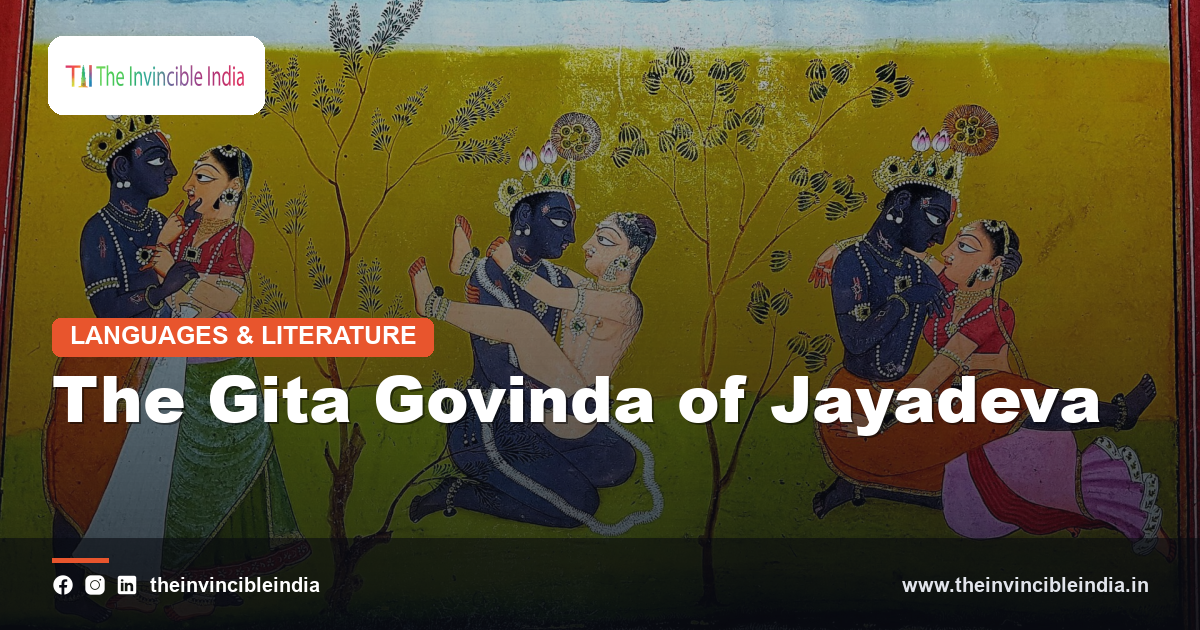
The Gita Govinda is a lyrical Sanskrit poem composed by the poet Jayadeva, celebrated as one of the most influential works of devotional literature in the classical tradition explored in our Sanskrit language guide. Structured as a sequence of musical songs, it narrates the love of the divine figures Radha and Krishna through verses marked by emotional intensity and refined poetic craft. Associated closely with the eastern region of Odisha, the poem blends courtly Sanskrit tradition with a distinctly musical, song-like quality that set it apart from earlier devotional works. Its themes of longing, union and divine love went on to shape dance, music and painting traditions across India. This guide surveys its origins, structure and enduring legacy.
Quick Facts
| Detail | Information |
|---|---|
| Category | Sanskrit lyrical devotional poem (Gitikavya) |
| Traditional Author | Jayadeva |
| Language | Sanskrit |
| Regional Association | Odisha |
| Central Theme | Divine love of Radha and Krishna |
| Legacy | Foundational influence on Odissi dance, painting and bhakti poetry |
What Is the Gita Govinda
The Gita Govinda is a lyrical Sanskrit poem composed in the medieval period, structured as a sequence of songs that together narrate the love between the god Krishna and his consort Radha. Unlike much of the formal court poetry that preceded it, the work is built around musical compositions meant to be sung, giving it a distinctly lyrical and emotionally charged character.
The poem is widely regarded as a landmark in the tradition of Sanskrit devotional literature, admired both for its poetic refinement and for the intensity of feeling it conveys through the relationship of its central figures. Its combination of religious devotion, romantic imagery and musical structure has made it one of the most celebrated works of its kind within Indian literary history.
The Poet Jayadeva
The Gita Govinda is traditionally attributed to Jayadeva, a Sanskrit poet remembered as a devoted worshipper of Krishna and a figure of considerable literary skill. Later tradition surrounds Jayadeva with numerous legends emphasising his piety and devotion, reflecting the reverence in which he came to be held by subsequent generations of readers and devotees.
While detailed biographical information about Jayadeva remains limited, his authorship of the Gita Govinda secured him a lasting place among the most celebrated poets of Sanskrit devotional literature. His careful fusion of refined poetic technique with heartfelt religious sentiment is often cited as the defining achievement of his literary legacy, one that continued to inspire poets and devotees long after his own lifetime.
Regional Roots in Odisha
The Gita Govinda is closely associated with the eastern region of Odisha, where it came to hold a particularly cherished place in religious and cultural life. The poem’s verses became deeply integrated into local devotional practice, most notably within temple worship traditions that continue to honour Krishna as a central deity.
This regional association helped shape the poem’s reception and continued transmission, as Odisha’s temple institutions, court patronage and artistic communities embraced the work as a central devotional and cultural text. The enduring bond between the Gita Govinda and Odisha illustrates how a Sanskrit literary composition could become deeply woven into the religious and artistic identity of a particular region while retaining wider pan-Indian significance.
Meaning of the Title
The title Gita Govinda translates broadly as the song of Govinda, one of the names traditionally used for Krishna, and it directly signals the poem’s central musical and devotional character. This naming choice reflects the work’s identity as a song-poem rather than a purely narrative composition, distinguishing it from earlier forms of Sanskrit epic and courtly verse.
The emphasis on song within the title also points to the poem’s intended mode of performance, since its verses were composed to be sung rather than simply read or recited. This musical dimension, embedded even within its title, underscores the extent to which the Gita Govinda represents a fusion of literary and musical art within a single devotional work.
Structure: Cantos and Ashtapadis
The Gita Govinda is organised into a series of cantos, each containing lyrical songs traditionally known as ashtapadis, a term referring to their characteristic eight-couplet structure. This formal arrangement gives the poem a clear musical architecture, with each song functioning as a self-contained lyrical unit within the broader narrative sequence.
Interspersed among these songs are shorter narrative and descriptive verses that connect the individual ashtapadis into a continuous storyline, guiding the reader through the unfolding relationship between Radha and Krishna. This careful balance between lyrical song and narrative connection reflects the sophisticated structural design underlying the poem’s apparent simplicity.
Sanskrit Language and Lyrical Style
Although composed in Sanskrit, the Gita Govinda departs from the dense, elaborate style often associated with classical Sanskrit court poetry, favouring instead a more direct, musical and emotionally accessible mode of expression. Its language is carefully crafted for rhythm and sound, supporting the poem’s identity as a work meant primarily to be sung.
This lyrical quality, combined with the poem’s use of repetition and refrain within individual songs, gives the Gita Govinda a distinctive stylistic signature within the wider Sanskrit literary tradition. The accessibility of its language, despite its Sanskrit medium, has been credited with helping the poem reach and move audiences well beyond narrow scholarly circles.
The Story of Radha and Krishna
At the heart of the Gita Govinda lies the evolving relationship between Radha and Krishna, portrayed through alternating episodes of longing, estrangement and eventual reunion. The poem traces an emotional arc rather than a strictly chronological narrative, focusing on the intensity of feeling experienced by its central figures at each stage of their relationship.
Krishna’s momentary attraction to other companions and Radha’s resulting distress form an important part of this emotional narrative, ultimately resolved through reconciliation and renewed devotion. This portrayal of love, tested and ultimately affirmed through hardship, provides the poem’s central storyline while simultaneously carrying deeper devotional significance for its readers.
Theme of Divine Love and Bhakti
Beyond its surface narrative, the Gita Govinda is widely interpreted as an allegory of divine love, in which the passionate relationship between Radha and Krishna symbolises the yearning of the devotee for union with the divine. This devotional reading situates the poem firmly within the broader bhakti tradition of intense, personal religious devotion.
Within this framework, Radha’s longing for Krishna becomes a model for the soul’s longing for the divine, while their eventual reunion represents the fulfilment of devoted spiritual aspiration. This layered meaning, combining romantic narrative with devotional symbolism, has been central to the poem’s enduring religious significance across generations of readers and worshippers.
Theme of Separation and Longing
A recurring emotional theme throughout the Gita Govinda is viraha, the pain of separation experienced by lovers apart from one another, expressed with particular intensity in the verses describing Radha’s distress. This theme is treated with considerable psychological depth, capturing the restlessness, sorrow and yearning that accompany prolonged separation from a beloved.
The poem’s sustained attention to viraha reflects a broader convention within Indian devotional and romantic literature, in which the pain of separation is treated as an occasion for profound emotional and spiritual expression. By dwelling on this theme at length, the Gita Govinda deepens the emotional resonance of its eventual depiction of reunion and reconciliation.
Musical Qualities and Ragas
Each song within the Gita Govinda is traditionally associated with a particular musical mode or raga, along with a suggested rhythmic pattern, reflecting the poem’s fundamental identity as a musical composition rather than purely literary text. This close pairing of verse and melody distinguishes the work from most other Sanskrit poetry of its era.
The musical dimension of the Gita Govinda has contributed significantly to its enduring popularity, as its songs have continued to be performed within classical and devotional musical traditions across different regions of India. This integration of poetry and music underscores the holistic artistic vision behind the poem’s original composition.
Connection to Odissi Dance
The Gita Govinda holds a particularly important place within the classical dance tradition of Odissi, where its songs and themes have long provided source material for choreographed performance. Dancers interpret the poem’s verses through expressive movement and gesture, bringing its depiction of divine love vividly to life on stage.
This close relationship between text and dance reflects a broader pattern within Indian classical performing arts, in which literary and devotional works are given expressive embodiment through structured movement. The continuing prominence of Gita Govinda themes within Odissi repertoire illustrates the poem’s lasting influence well beyond the domain of written literature.
Influence on Indian Painting Traditions
The vivid imagery and emotional intensity of the Gita Govinda made it a favoured subject for painters working within various regional traditions, who produced illustrated manuscripts and miniature paintings depicting its scenes of divine love. These visual interpretations captured key episodes from the poem with rich colour and expressive detail.
Painters associated with different regional schools brought their own distinctive stylistic sensibilities to depictions of the Gita Govinda, resulting in a diverse visual legacy inspired by a single literary source. This enduring appeal to artists across regions and periods highlights the poem’s exceptional capacity to inspire visual as well as literary and musical creativity.
Role in Temple Traditions
Within Odisha, the Gita Govinda came to hold a significant place in temple worship, with its songs traditionally performed as part of daily devotional ritual honouring Krishna. This integration into temple practice reflects the poem’s status as more than a literary text, functioning instead as a living element of religious observance.
The continued performance of Gita Govinda verses within temple settings has helped preserve both the text and its associated musical traditions across generations, ensuring an unbroken connection between the poem and the devotional community it was originally intended to serve. This ritual role remains one of the clearest expressions of the work’s religious significance.
Influence on the Bhakti Movement
The devotional themes and emotional intensity of the Gita Govinda resonated strongly with the broader bhakti movement, a widespread current of passionate, personal devotion that flourished across many regions of India. Poets and devotees within this movement found in the Gita Govinda a compelling model for expressing intense love of the divine.
This influence extended to subsequent devotional poetry and religious practice associated with Krishna worship, in which the emotional vocabulary and imagery established by the Gita Govinda continued to be drawn upon and reinterpreted. The poem’s contribution to the wider language of bhakti devotion represents one of its most significant and lasting legacies.
Influence on Music and Dance Across India
Beyond its strong association with Odisha and Odissi dance, the Gita Govinda has influenced musical and dance traditions in other regions of India, where its songs have been adapted and performed within diverse classical and devotional contexts. Musicians and dancers across different traditions have drawn upon its verses as a shared source of inspiration.
This wide-reaching influence reflects the poem’s capacity to transcend regional and stylistic boundaries, appealing to performers working within markedly different artistic idioms. The presence of Gita Govinda themes across such a broad range of performing arts traditions attests to the enduring reach of Jayadeva’s original composition.
Manuscripts and Preservation
The Gita Govinda has been preserved through numerous manuscript copies produced across different regions and periods, many of them accompanied by illustrative paintings that reflect local artistic traditions. This wide manuscript tradition attests to the poem’s popularity and its wide geographic circulation within pre-modern India.
Scholars have studied these varied manuscripts to trace the poem’s transmission and reception across different regions, noting both consistencies and variations in text and illustration. The survival of such a rich manuscript record has been essential in allowing modern readers and researchers continued access to this influential devotional work.
The Gita Govinda Today
Today, the Gita Govinda continues to be read, performed and studied as one of the most significant works of Sanskrit devotional literature, valued for both its artistic achievement and its religious meaning. Its songs remain central to Odissi dance repertoire and continue to be performed in temple and concert settings alike.
The poem’s enduring appeal lies in its rare fusion of poetic refinement, musical structure and devotional depth, qualities that continue to resonate with performers, scholars and devotees many centuries after its composition. As a living devotional and artistic tradition, the Gita Govinda retains a vital place within India’s cultural heritage.
Sources & Further Reading
- Sangeet Natak Akademi (sangeetnatak.gov.in).
- Ministry of Culture, Government of India (indiaculture.gov.in).
Frequently Asked Questions
What is the Gita Govinda?
The Gita Govinda is a lyrical Sanskrit poem attributed to the poet Jayadeva, composed of musical songs that narrate the love between Radha and Krishna and carry deep devotional meaning.
Who wrote the Gita Govinda?
The poem is traditionally attributed to Jayadeva, a Sanskrit poet remembered for his devotion to Krishna and his skill in combining lyrical poetry with musical structure.
What are ashtapadis?
Ashtapadis are the eight-couplet songs that make up the main body of the Gita Govinda, each traditionally associated with a particular musical mode and rhythmic pattern.
How is the Gita Govinda connected to Odissi dance?
The poem’s verses have long provided source material for Odissi choreography, with dancers interpreting its themes of divine love through expressive movement and gesture.
Why is the Gita Govinda important to the bhakti tradition?
Its depiction of longing and reunion between Radha and Krishna is widely read as an allegory of devotional love, making it an influential model within the broader bhakti movement.


