

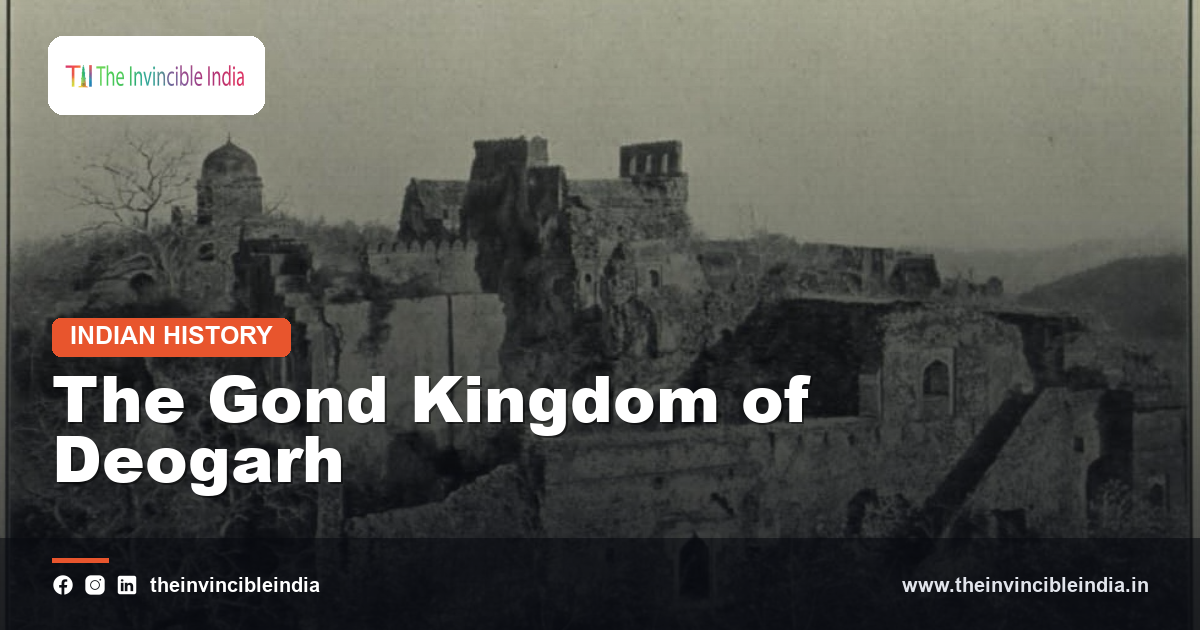
The Gond kingdom of Deogarh was one of the Gond states of central India, prominent roughly from the sixteenth to the eighteenth century, centred on Deogarh in the Chhindwara and Nagpur region of the present-day states of Madhya Pradesh and Maharashtra. Ruled by Gond rajas, the kingdom held the hilly and forested country of this part of central India and is remembered in connection with the ruler Bakht Buland Shah, who is linked in tradition with the founding of the city of Nagpur. In its later history the kingdom gave way to the rising power of the Marathas, and especially the Bhonsle house, who came to dominate the region. As a regional power of central India, the Gond kingdom of Deogarh belongs to the same era as the great power described in our guide to the Maratha Empire. Because several dates and details rest on tradition and a limited record, this guide keeps to general terms where the account is uncertain.
Quick answer: The Gond kingdom of Deogarh was one of the Gond states of central India, prominent roughly from the sixteenth to the eighteenth century, centred on Deogarh in the Chhindwara and Nagpur region of present-day Madhya Pradesh and Maharashtra. Ruled by Gond rajas, it is remembered in connection with the ruler Bakht Buland Shah, who is linked in tradition with the founding of the city of Nagpur. In its later history the kingdom gave way to the rising power of the Marathas, especially the Bhonsle house, who came to dominate the region.
Key Takeaways
- The Gond kingdom of Deogarh was one of the Gond states of central India, centred on Deogarh in the Chhindwara and Nagpur region.
- It was prominent roughly from the sixteenth to the eighteenth century and was ruled by Gond rajas.
- The kingdom held the hilly and forested country of this part of present-day Madhya Pradesh and Maharashtra.
- The ruler Bakht Buland Shah is linked in tradition with the founding of the city of Nagpur.
- In its later history the kingdom gave way to the rising power of the Marathas, especially the Bhonsle house.
- Several dates and details of the kingdom rest on tradition and a limited record.
Read on for the history, culture, and legacy in detail.
Quick Facts
| Detail | Information |
|---|---|
| Kingdom | The Gond kingdom of Deogarh |
| People | The Gonds, a major people of central India |
| Period | Prominent roughly in the 16th-18th century |
| Region | Chhindwara and Nagpur region, central India |
| Centre | Deogarh (Devgad) |
| Notable Ruler | Bakht Buland Shah (linked with the founding of Nagpur) |
| Succeeded By | The Marathas (the Bhonsle house) |
| Related Kingdoms | The Gond states of Garha-Mandla and Chanda |
| Legacy | A major Gond state of central India |
What Was the Gond Kingdom of Deogarh?
The Gond kingdom of Deogarh was one of the Gond states of central India, a regional kingdom ruled by Gond rajas and centred on Deogarh in the Chhindwara and Nagpur region of the present-day states of Madhya Pradesh and Maharashtra. Prominent roughly from the sixteenth to the eighteenth century, the kingdom held the hilly and forested country of this part of central India, one of several Gond states that governed large tracts of the region in this period. The kingdom is remembered as a notable power of central India and in connection with rulers such as Bakht Buland Shah, linked in tradition with the founding of Nagpur. In its later history the kingdom gave way to the rising power of the Marathas. As one of the major Gond states, the kingdom of Deogarh holds an important place in the history of central India. Its story reflects the world of the Gond kingdoms and the changing politics of the region.
Where Was Deogarh Located?
Deogarh, also rendered Devgad, was located in the Chhindwara and Nagpur region of central India, in the hilly and forested country of the present-day border lands of Madhya Pradesh and Maharashtra. Set among the hills of this part of central India, Deogarh formed the centre of the Gond kingdom, commanding the surrounding country of forests, hills and valleys. The region lay in the heart of the subcontinent, in a tract long associated with the Gond peoples and their states, and in contact with the wider powers of central India and the Deccan. The geography of hills and forests shaped the character and defence of the kingdom, offering strongholds such as the hill fort associated with Deogarh. The position of the kingdom placed it among the powers of central India. Deogarh anchored the dynasty in the historical geography of the Chhindwara and Nagpur region. The kingdom was thus firmly rooted in the forested uplands of central India.
Who Were the Gonds?
The Gonds are one of the major peoples of central India, a large community long associated with the hilly and forested country of the region, who gave their name to the tract known as Gondwana. Through the medieval and early modern periods, the Gonds established a number of kingdoms across central India, ruled by Gond rajas, of which Deogarh was one of the most notable, alongside the states of Garha-Mandla and Chanda. As one of the great peoples of the region, the Gonds have a rich heritage of traditions, customs and ways of life, rooted in the forests and hills of central India. The Gond kingdoms represented the political expression of this community, holding large territories and contending with the wider powers of the subcontinent. The Gonds are treated here with respect as one of the peoples who shaped the history of central India. The Gond kingdoms, including Deogarh, form an important chapter in the history of the region.
What Was the Gond Kingdom of Deogarh Known For?
The Gond kingdom of Deogarh was known above all as one of the major Gond states of central India and for its connection with the ruler Bakht Buland Shah, linked in tradition with the founding of the city of Nagpur. The kingdom held the hilly and forested country of the Chhindwara and Nagpur region and formed a significant power of central India in its period of prominence. It is remembered for its Gond rajas, for its strongholds such as the hill fort associated with Deogarh, and for its place in the political world of central India before the rise of the Marathas. The kingdom is also connected with the development of the region around Nagpur, which would grow into an important city. The details of its history are drawn from tradition and the record of the region and are described in general terms. The Gond kingdom of Deogarh is thus known as a notable Gond state and for its links with the founding of Nagpur.
When Did the Deogarh Kingdom Flourish?
The Gond kingdom of Deogarh is generally held to have flourished roughly from the sixteenth to the eighteenth century, the period in which the Gond states of central India were at their most prominent. During this period the kingdom held the hilly and forested country of the Chhindwara and Nagpur region, one of several Gond states that governed large tracts of central India. The height of the kingdom is associated with rulers such as Bakht Buland Shah, under whom the state is remembered for its prominence and its connection with the development of the Nagpur region. In the later part of this period the kingdom came increasingly under the influence and then the power of the rising Marathas. The chronology of the kingdom is reconstructed from tradition and the record of the region, and the dating of individual rulers and events is treated with scholarly care. The details of the chronology are described in general terms, reflecting the limited record. The kingdom of Deogarh thus belongs to the early modern history of central India.
Who Was Bakht Buland Shah?
Bakht Buland Shah was the best-known ruler of the Gond kingdom of Deogarh, a Gond raja remembered for the prominence of the kingdom under his rule and for his connection in tradition with the founding of the city of Nagpur. Under his rule the kingdom is remembered as a significant power of central India, and he is especially associated with the development of the region around Nagpur, which would grow into an important city. According to the traditions of the region, Bakht Buland Shah played a key part in the rise of Nagpur, a connection cherished in the memory of the area. His name is linked with the standing of the Deogarh kingdom at the height of its prominence. As with other rulers of the region, the details of his reign are drawn from tradition and the record of the region and are described in general terms, with several points uncertain. Bakht Buland Shah thus stands as the most celebrated ruler of the Gond kingdom of Deogarh.
How Was Nagpur Founded?
The founding of the city of Nagpur is linked in tradition with the Gond kingdom of Deogarh and especially with the ruler Bakht Buland Shah, who is remembered for his part in the development of the Nagpur region. According to the traditions of the region, the growth of Nagpur as a town and centre is connected with the Gond rulers of Deogarh, who fostered its development in the country under their authority. In the later history of the region, Nagpur would grow into an important city, becoming the centre of the power of the Bhonsle Marathas who succeeded the Gonds in the region. The association of Nagpur with the Gond kingdom of Deogarh thus links the origins of the city to the Gond rulers of central India. The details of this founding are drawn from tradition and the record of the region and are described in general terms. The connection between Nagpur and the Gond kingdom of Deogarh remains a cherished part of the history of the region.
How Was the Gond Kingdom Governed?
The Gond kingdom of Deogarh was governed by its Gond rajas, whose authority rested on control of the hilly and forested country of the Chhindwara and Nagpur region, its people and its resources. The rulers maintained their authority through the forms of kingship of the region, supported by chiefs, officials and local figures who held responsibilities within the state and its defence. The kingdom drew its strength from the resources of its forested and hilly country, and from the organisation of its people, with local Gond chiefs holding their lands under the authority of the ruling house. The strongholds of the kingdom, such as the hill fort associated with Deogarh, provided bases for its power and defence. In the absence of a continuous chronicle, the details of the administration are reconstructed from tradition and the record of the region and are described in general terms. The system of governance enabled the Gond rajas of Deogarh to hold their country through the period of the kingdom’s prominence.
What Was the Religion and Culture of the Gond Court?
The religion and culture of the Gond kingdom of Deogarh reflected the traditions of the Gond people and the wider heritage of central India, blended over time with the influences of the surrounding powers. The Gonds have a rich heritage of their own traditions, customs and beliefs, rooted in the forests and hills of central India, which shaped the culture of the kingdom. Over the course of its history, the court was also touched by the wider traditions of the region, including the influences of the surrounding Indian and Islamic worlds, as reflected in the names and titles of some of its rulers. The kingdom patronised the religious and cultural life of its country, maintaining the traditions of its people and the wider region. The arts, traditions and ways of life of the kingdom reflected this heritage. The details of this culture are drawn from tradition and the record of the region and are described in general terms. Through this heritage the Gond kingdom of Deogarh contributed to the culture of central India.
What Were the Other Gond Kingdoms?
The Gond kingdom of Deogarh was one of several Gond states of central India, which together governed large tracts of the region through the medieval and early modern periods. Among the most notable of these were the Gond kingdom of Garha-Mandla, in the country to the north, and the Gond kingdom of Chanda, in the country to the south, alongside Deogarh in the Chhindwara and Nagpur region. These Gond states, ruled by their own rajas, held the hilly and forested lands of central India, the tract long known as Gondwana, and each has its own history and heritage. Together they represented the political power of the Gond people in the region, contending with the wider powers of the subcontinent. The relations among these kingdoms and with their neighbours form part of the rich history of central India. The Gond kingdom of Deogarh thus belongs to a wider family of Gond states that shaped the history of the region.
How Did the Gond Kingdom Relate to the Mughals?
The Gond kingdom of Deogarh, like the other Gond states of central India, related to the Mughal Empire through the patterns of contact, submission and accommodation by which the regional powers dealt with the imperial authority. As the Mughal Empire extended its influence across central India, the Gond states came within its sphere, and their rulers entered into relations with the empire, acknowledging its authority while retaining their own territory and standing. The names and titles of some Gond rulers, including Bakht Buland Shah, reflect the influence of this contact with the wider Indian and Islamic world. These relations placed the Gond kingdoms within the broader framework of Mughal power in central India. The details of these dealings are drawn from tradition and the record of the period and are described in general terms. Through such accommodation the Gond kingdom of Deogarh preserved its position during the age of Mughal influence in central India. Its relations with the empire form part of the wider history of the region.
How Did the Marathas Rise in the Region?
In the later history of the region, the Gond kingdom of Deogarh gave way to the rising power of the Marathas, and especially the Bhonsle house, who came to dominate the country around Nagpur. As the Maratha power expanded across central India in the eighteenth century, the Marathas extended their authority into the Gond country, and the Bhonsle house established its power in the region, with Nagpur as its centre. The rise of the Marathas brought the decline of the independent power of the Gond kingdom of Deogarh, as the region passed under Maratha dominance. This transition was part of the broader expansion of Maratha power across the subcontinent in the period. The details of this change are drawn from tradition and the record of the period and are described in general terms. The rise of the Bhonsle Marathas thus marked the end of the prominence of the Gond kingdom of Deogarh and the reshaping of the politics of the region.
How Did Deogarh Decline?
The Gond kingdom of Deogarh declined in the course of the eighteenth century, as the rising power of the Marathas, and especially the Bhonsle house, came to dominate the country of central India around Nagpur. As the Maratha power expanded into the Gond country, the authority of the Gond rajas of Deogarh gave way, and the region passed under Maratha dominance, with Nagpur becoming the centre of Bhonsle power. The decline of the kingdom was part of the broader transformation of the politics of central India in the period, as older regional powers gave way to the expanding Maratha state. The details of this decline are drawn from tradition and the record of the period and are described in general terms, with several points uncertain. The long prominence of the Gond kingdom of Deogarh nonetheless left a mark on the region, seen above all in the development of Nagpur. The decline of the kingdom thus belongs to the wider history of central India in the early modern period.
What Heritage Survives?
The Gond kingdom of Deogarh left a heritage seen in the strongholds and remains of the Chhindwara and Nagpur region, in the traditions of the Gond people, and in the connection of the kingdom with the founding of Nagpur. The hill fort and remains associated with Deogarh bear witness to the history of the kingdom and the building traditions of the region, standing among the heritage sites of central India. The traditions of the Gond people, one of the major communities of the region, continue to carry forward the heritage of the Gond kingdoms. The city of Nagpur, linked in tradition with the Gond rulers of Deogarh, grew into an important city and preserves this connection in its history. These remains and traditions are studied through archaeology, tradition and the records of the region. The heritage of the Gond kingdom of Deogarh thus endures in the forts, traditions and historical memory of central India. It forms a valued part of the region’s history.
Why Is the Gond Kingdom of Deogarh Significant?
The Gond kingdom of Deogarh is significant as one of the major Gond states of central India and as a kingdom whose history illustrates the political world of the region before the rise of the Marathas. Its rule over the hilly and forested country of the Chhindwara and Nagpur region, its Gond rajas, and its connection with the founding of Nagpur mark an important chapter in the history of central India. The figure of Bakht Buland Shah and the links of the kingdom with the development of Nagpur reflect its place in the history of the region. The kingdom represents the political power of the Gond people, one of the great communities of central India, whose states shaped the history of the region. Its history, reconstructed from tradition and the record of the region, offers a window onto a part of Indian history often less prominent in the general narrative. For students of Indian history, the Gond kingdom of Deogarh offers a vivid example of a regional Gond state.
The Gond Kingdom of Deogarh Today
The Gond kingdom of Deogarh is remembered today through the heritage of the Chhindwara and Nagpur region of central India, the strongholds and remains associated with the kingdom, and the living traditions of the Gond people. The hill fort and remains linked with Deogarh stand as reminders of the Gond state that once held the country, drawing the interest of visitors and students of history. The city of Nagpur, connected in tradition with the Gond rulers of Deogarh, has grown into an important city and preserves this link in its history. The Gond people continue to form one of the great communities of central India, carrying forward their rich heritage and traditions. Scholars continue to study the tradition and record of the region to refine the understanding of the kingdom and its history. For readers of Indian history, the Gond kingdom of Deogarh offers a striking example of a Gond state of central India. Its legacy endures in the forts, traditions and historical memory of the region.
Sources & Further Reading
- Archaeological Survey of India (asi.nic.in).
- Ministry of Culture, Government of India (indiaculture.gov.in).
- Department of Archaeology and Museums, Government of Madhya Pradesh.
Frequently Asked Questions
What was the Gond kingdom of Deogarh?
The Gond kingdom of Deogarh was one of the Gond states of central India, ruled by Gond rajas and centred on Deogarh in the Chhindwara and Nagpur region. It was prominent roughly from the sixteenth to the eighteenth century, before the rise of the Marathas in the region.
Who was Bakht Buland Shah?
Bakht Buland Shah was the best-known ruler of the Gond kingdom of Deogarh, remembered for the prominence of the kingdom under his rule and for his connection in tradition with the founding of the city of Nagpur. The details of his reign rest largely on tradition and the record of the region.
How is the Gond kingdom of Deogarh connected to Nagpur?
The founding and development of the city of Nagpur are linked in tradition with the Gond kingdom of Deogarh, especially with the ruler Bakht Buland Shah. Nagpur later grew into an important city and became the centre of the power of the Bhonsle Marathas who succeeded the Gonds.
Who were the Gonds?
The Gonds are one of the major peoples of central India, long associated with the hilly and forested country of the region, who gave their name to the tract known as Gondwana. They established a number of kingdoms, including Deogarh, Garha-Mandla and Chanda.
How did the Gond kingdom of Deogarh end?
The Gond kingdom of Deogarh declined in the eighteenth century as the rising power of the Marathas, especially the Bhonsle house, came to dominate the country around Nagpur. The region passed under Maratha dominance, ending the prominence of the Gond kingdom.
What were the other Gond kingdoms?
Besides Deogarh, the major Gond states of central India included the kingdom of Garha-Mandla to the north and the kingdom of Chanda to the south. Together these Gond states governed large tracts of the region known as Gondwana.


