

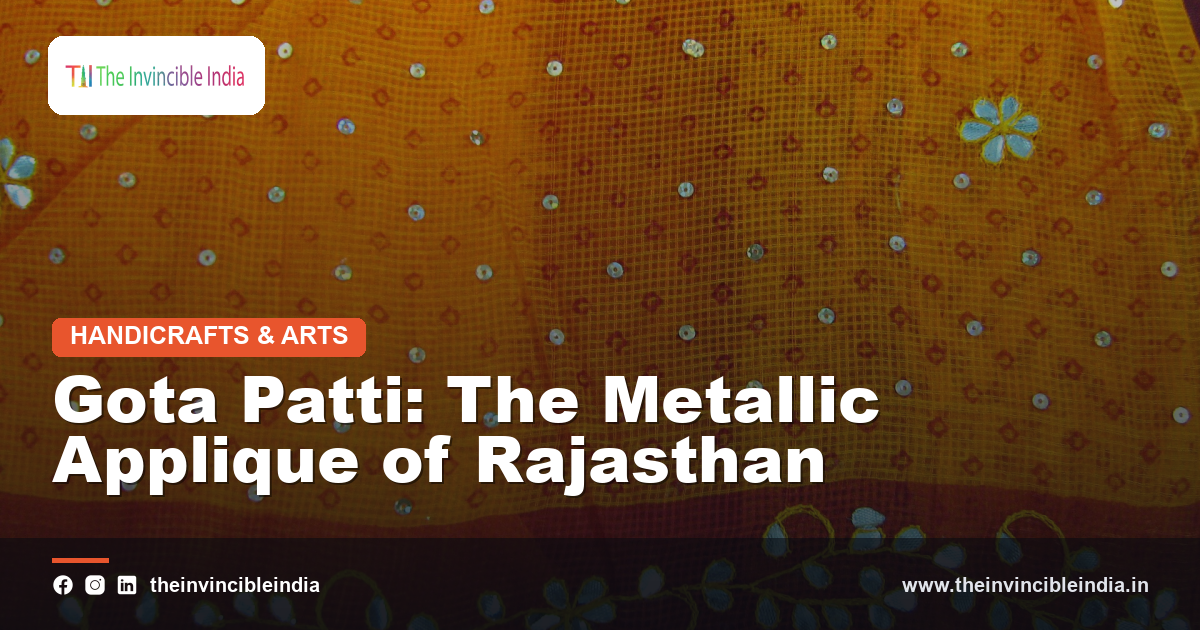
Gota Patti is a distinctive applique craft from Rajasthan in which narrow strips of metallic ribbon, known as gota, are cut into shapes and stitched onto fabric to build raised, shimmering motifs without any underlying embroidery thread. Rooted in the wider decorative textile traditions of the region alongside crafts such as those documented in traditional handicrafts of Rajasthan, Gota Patti developed as a technique for achieving the visual richness of gold and silver zari work while remaining comparatively lighter and more affordable than solid metal thread embroidery. Closely associated with bridal wear and festive garments, Gota Patti has grown from a regional courtly craft into one of the most recognisable decorative techniques used across Indian fashion today.
Quick Facts
| Detail | Information |
|---|---|
| Also Known As | Gota work |
| Primary Region | Rajasthan (Jaipur, Udaipur, Ajmer) |
| Core Material | Metallic gota ribbon |
| Base Fabric | Silk, cotton, or georgette |
| Common Uses | Lehengas, dupattas, bridal blouses |
| Related Technique | Zari and zardozi embroidery |
Origins in Rajasthani Court Culture
Gota Patti is understood to have developed within the courtly and aristocratic households of Rajasthan, where demand for richly decorated garments encouraged artisans to experiment with metallic ribbon as an alternative to more time-consuming thread-based zari embroidery. This origin placed the craft firmly within a tradition of ornamental textile work tied to royal patronage.
Over time, techniques refined for court wardrobes gradually spread into wider artisan communities across the region, who adapted the applique method for a broader range of garments and occasions. This transition from courtly workshops to widespread regional practice has shaped Gota Patti’s identity as a craft associated with both luxury and everyday festive wear.
What Gota Refers To
The term gota refers specifically to a narrow ribbon woven or coated with a metallic finish, traditionally using real gold or silver thread in its most luxurious form, though most contemporary gota uses more affordable metallic-coated yarns. This ribbon forms the essential raw material of the entire craft.
Patti, meaning strip or band, describes the cut pieces of this ribbon that are shaped and arranged to form larger decorative motifs on the fabric surface. Together, the terms describe both the material and the fundamental unit of construction used throughout the applique process.
The Applique Technique Explained
Unlike embroidery techniques that build motifs through stitched thread alone, Gota Patti works by cutting the metallic ribbon into small shaped pieces, folding or pleating them as needed, and then stitching these pieces directly onto the base fabric to form the desired pattern. This applique method produces a raised, dimensional surface texture.
Because the ribbon itself carries the metallic sheen and pattern, artisans can achieve visually striking effects relatively quickly compared to techniques that require building shine and texture through individual embroidered stitches. This efficiency has contributed significantly to the craft’s widespread commercial popularity.
Cutting and Shaping the Ribbon
Skilled artisans cut gota ribbon into precise shapes, ranging from simple geometric forms such as triangles and squares to more elaborate floral petals and paisley outlines, depending on the complexity of the intended design. This cutting stage requires a steady hand and careful measurement to ensure consistency across a garment.
Some techniques involve folding or pleating the ribbon before stitching, creating three-dimensional effects such as small gathered petals or layered borders. This shaping work adds considerable visual depth to finished pieces, distinguishing fine Gota Patti work from simpler flat applique.
Stitching Motifs onto Fabric
Once cut and shaped, gota pieces are stitched onto the base fabric using fine thread, typically secured along the edges so that the metallic surface of the ribbon remains fully visible while the stitching itself stays largely hidden. This attention to concealment of stitches helps preserve the seamless, glossy appearance of the finished motif.
Artisans often work from a pre-marked design outline, building up larger patterns piece by piece as individual gota shapes are positioned and secured in sequence. This methodical process allows for intricate, symmetrical designs even though each motif is assembled from many small individual components.
Common Motifs and Patterns
Gota Patti work commonly features floral motifs, paisleys, geometric borders, and traditional Rajasthani decorative elements, often arranged in repeating patterns along the borders, necklines, and hemlines of garments. These motifs draw on a broader vocabulary shared with other regional textile and decorative arts.
More elaborate pieces may incorporate figurative elements such as peacocks, elephants, or floral vines, particularly on bridal garments where a denser, more ornate design is often desired. This range of motifs allows Gota Patti to suit both understated and highly decorative garment styles.
Fabrics Used for Gota Work
Gota Patti is applied to a wide variety of base fabrics, including silk, cotton, georgette, and chiffon, with the choice of fabric affecting both the visual weight and drape of the finished garment. Heavier silk fabrics are often chosen for bridal lehengas, while lighter fabrics suit everyday festive wear.
The compatibility of gota applique with such a broad range of fabrics has contributed significantly to its versatility, allowing the technique to be used across garments ranging from lightweight dupattas to heavily structured bridal ensembles. This adaptability has helped the craft remain relevant across changing fashion preferences.
Craft Centres in Rajasthan
Jaipur, Udaipur, and Ajmer are among the most prominent centres associated with Gota Patti production, each home to communities of artisans specialising in various aspects of the craft, from ribbon preparation to final garment assembly. These cities have developed reputations for particular styles and levels of craftsmanship.
Workshops in these centres often combine traditional hand techniques with organised production processes to meet demand from both local markets and the broader Indian fashion industry. This concentration of skilled labour has helped Rajasthan maintain its position as the primary home of authentic Gota Patti work.
Gota Patti in Bridal Wear
Gota Patti has become especially closely associated with bridal wear, where its metallic shimmer and raised texture suit the celebratory and ornate character expected of wedding garments. Lehengas, blouses, and dupattas heavily embellished with gota work are a common sight at weddings across northern India.
The relative lightness of gota compared to solid metal thread embroidery also makes it a practical choice for bridal garments that must be worn comfortably over long ceremonies, combining visual richness with wearability. This balance has helped sustain strong demand for gota-embellished bridal wear even as fashion trends evolve.
Everyday and Festive Applications
Beyond bridal wear, Gota Patti is widely used on garments intended for festivals, religious ceremonies, and other celebratory occasions, offering a more affordable way to achieve a festive, embellished look compared to heavier embroidery techniques. Simple gota borders on everyday kurtas and dupattas remain popular across many regions.
This broader everyday use has helped Gota Patti reach a much wider consumer base than more exclusive embroidery crafts, contributing to its recognition as one of the most commercially significant decorative textile techniques associated with Rajasthan.
Relationship to Zari and Zardozi Work
Gota Patti is often discussed alongside zari and zardozi embroidery, both of which also use metallic materials to create decorative effects on fabric, though through different techniques involving thread-based stitching rather than applique. Gota generally offers a lighter, quicker alternative to these more labour-intensive methods.
Some garments combine gota applique with zari or zardozi elements, using each technique where it is most effective, such as gota for larger motifs and finer metal thread work for intricate detailing. This complementary use illustrates how Rajasthan’s various metallic decorative crafts often intersect within a single finished garment.
Artisan Skill and Training
Producing high-quality Gota Patti work requires considerable skill in cutting, shaping, and stitching ribbon with precision, expertise typically developed through years of hands-on training within artisan families or workshop apprenticeships. Consistency across a large garment demands both patience and a practised eye for proportion.
Many artisans specialise in particular aspects of the craft, such as ribbon cutting or motif assembly, allowing larger workshops to divide labour efficiently while maintaining overall quality. This specialisation has helped the craft scale to meet commercial demand without entirely sacrificing traditional handwork.
Commercial Growth and Market Reach
Gota Patti has expanded well beyond its regional origins to become a staple decorative technique across the Indian fashion industry, appearing on garments sold in markets throughout the country and increasingly in international boutiques specialising in Indian wear. Designers frequently incorporate gota work into contemporary silhouettes, from fusion jackets to Western-style gowns finished with traditional metallic borders.
This commercial growth has created substantial employment opportunities for artisans in Rajasthan, though it has also introduced competition from machine-assisted production methods that aim to replicate the applique effect at lower cost. Balancing authentic handwork with market demand remains an ongoing consideration for the craft, one that trade bodies and exporters continue to navigate as international interest in Indian embellishment techniques grows.
Challenges Facing the Craft
Gota Patti artisans face challenges including fluctuating raw material costs, competition from mechanised imitation techniques, and the need to continually adapt designs to changing fashion preferences while preserving traditional skill. These pressures affect both established workshops and individual artisans working from smaller home-based setups.
Craft development organisations and designer collaborations have sought to address some of these challenges by promoting authentic handcrafted gota work as a premium product distinct from mass-produced alternatives. Continued support for skill training and fair artisan compensation remains important to the craft’s long-term sustainability, particularly as younger family members weigh traditional craftwork against other livelihood options.
Regional Variations Across Rajasthan
Although Gota Patti is closely associated with Rajasthan as a whole, individual weaving and embroidery centres within the state have developed subtle stylistic differences, reflecting local preferences in motif density, ribbon width, and colour combination. Jaipur workshops, for instance, are often noted for finely detailed floral compositions, while other centres favour bolder, more geometric arrangements.
These regional distinctions, though sometimes subtle to an outside observer, are well recognised within the trade and can influence how a particular piece is valued or attributed. Buyers familiar with the craft often learn to identify a garment’s likely centre of production simply from the density and style of its gota work, underscoring how a single broad tradition can still accommodate considerable local variation.
Gota Patti Today
Gota Patti today remains one of Rajasthan’s most visible and commercially successful decorative textile crafts, instantly recognisable for its shimmering, raised metallic motifs across bridal and festive wear. Its adaptability across fabrics and garment types has helped it maintain broad appeal.
As long as artisan communities in Jaipur, Udaipur, and other Rajasthani centres continue to train new generations in the craft’s cutting, shaping, and stitching techniques, Gota Patti is likely to remain a defining feature of Indian celebratory fashion for years to come.
Sources & Further Reading
- Ministry of Textiles, Government of India (texmin.nic.in).
- Ministry of Culture, Government of India (indiaculture.gov.in).
Frequently Asked Questions
What is Gota Patti made from?
Gota Patti is made from narrow strips of metallic ribbon called gota, which is cut into shapes and stitched onto fabric using an applique technique rather than traditional embroidery thread.
How is Gota Patti different from zari embroidery?
Gota Patti uses pre-made metallic ribbon applied through applique, while zari embroidery builds patterns using fine metal thread stitched directly into the fabric, making zari generally more time-consuming.
Which fabrics work well with Gota Patti?
Gota Patti is commonly applied to silk, cotton, georgette, and chiffon, with fabric choice affecting the drape and visual weight of the finished garment.
Why is Gota Patti popular for bridal wear?
Gota Patti offers a shimmering, festive look that is lighter and often more affordable than solid metal thread embroidery, making it practical and visually rich for bridal garments worn over long ceremonies.
Where in Rajasthan is Gota Patti mainly produced?
Jaipur, Udaipur, and Ajmer are among the most prominent centres for Gota Patti production, each home to skilled artisan communities specialising in the craft.


