

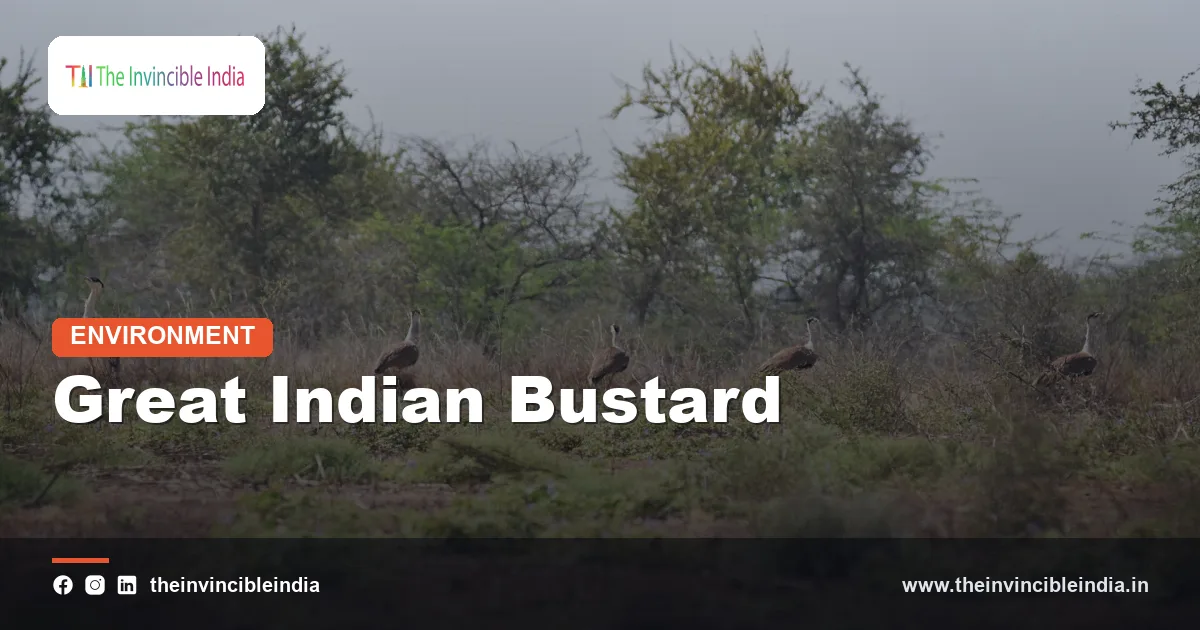
The Great Indian Bustard (Ardeotis nigriceps) is one of the largest flying birds in the world and one of the most critically endangered birds in India. Standing about a metre tall, with a long neck, pale head and a black crown, this ground-dwelling giant once roamed the open grasslands of much of the subcontinent. Today it survives in only a few scattered pockets, chiefly in the arid landscapes of western India, and it is the state bird of Rajasthan, where it is known locally as the Godawan.
The story of the Great Indian Bustard is a story of vanishing grasslands, invisible dangers such as overhead power lines, and a race against time to breed and protect the remaining birds. This explainer covers its biology, habitat, the collapse in numbers, the threats it faces, the conservation breeding programme, the Supreme Court’s intervention on power lines, and the national effort often described as Project Great Indian Bustard.
| Fact | Detail |
|---|---|
| Scientific name | Ardeotis nigriceps |
| Local names | Godawan (Rajasthan), Maldhok (Maharashtra), among others |
| Status in India | State bird of Rajasthan; protected under Schedule I of the Wildlife (Protection) Act, 1972 |
| IUCN status | Critically Endangered |
| International listing | CITES Appendix I; also listed under Appendix I of the Convention on Migratory Species |
| Stronghold | Desert National Park and surrounding areas, Jaisalmer, Rajasthan |
| Other pockets | Parts of Gujarat, Maharashtra, Karnataka and Andhra Pradesh |
| Main threat | Collision with overhead power lines, along with habitat loss |
| Breeding rate | Typically a single egg per clutch |
Meet the Great Indian Bustard
The Great Indian Bustard belongs to the bustard family, a group of large, long-legged birds that prefer open country and spend most of their lives on the ground. Males are much larger than females; an adult male can weigh well over a dozen kilograms, which makes it among the heaviest birds capable of flight. Its plumage is sandy brown with a black cap on the head and a band of black across the chest in males, giving it a distinctive profile in the dry scrub.
Diet and behaviour
The bird is omnivorous. It feeds on grasshoppers, beetles and other insects, on seeds and grain, and on small reptiles and rodents. It walks slowly and methodically through grassland, rarely flying unless disturbed. Because of this ground-based lifestyle, the species depends heavily on large expanses of undisturbed land.
Courtship display
During the breeding season, males gather in loose display grounds known as leks. A male inflates a throat pouch, fans out its tail and struts to attract females, producing a deep booming call that carries across the plains. The female then makes a simple scrape on the ground, often hidden in grass or scrub, and typically lays only one egg. This low breeding rate is one of the main reasons the species recovers very slowly from losses.
Habitat: Dry Grasslands and the Thar
The Great Indian Bustard is a bird of open, semi-arid grasslands, scrubland and low-intensity farmland. It needs flat or gently undulating terrain with short grass for foraging and taller clumps for nesting and cover. Historically it occurred across large parts of the Indian subcontinent, from the northwest to the Deccan plateau, but its range has shrunk to a fraction of what it once was.
Desert National Park, Jaisalmer
The most important remaining stronghold lies in the Thar Desert region of Rajasthan, in and around Desert National Park near Jaisalmer, which spreads over more than three thousand square kilometres. Its sand dunes, thorny scrub and sparse grasslands support not only the bustard but also chinkara, the desert fox, the desert cat and several raptors. Areas near Pokaran and other parts of the Jaisalmer and Barmer region form additional habitat.
Other pockets
- Gujarat: small populations in the grasslands of Kachchh, including the Naliya region.
- Maharashtra: remnants in the Solapur and Chandrapur belts, which once held sanctuaries created for the species.
- Karnataka and Andhra Pradesh: a few surviving birds in dry grassland patches, with sporadic records in other places.
Grasslands are not wastelands
A major conservation challenge has been the old administrative practice of labelling natural grasslands and scrub as “wasteland” available for conversion. In reality these open natural ecosystems are home to specialised wildlife, store carbon, recharge groundwater and support pastoral livelihoods. The decline of the bustard is closely tied to this misunderstanding of their value.
The Collapse in Numbers
Only a few decades ago the Great Indian Bustard was found in many more states, and observers described it as widespread, though never abundant. Over the twentieth century its numbers collapsed due to hunting, the conversion of grassland to cropland, irrigation, infrastructure and disturbance. The species disappeared from many regions entirely, and it is now considered to have vanished from most of its historic range.
In recent estimates, the global population is believed to be well under two hundred individuals, with the great majority in Rajasthan. Because population estimates are difficult for such a shy and sparsely spread bird, exact numbers vary by survey, but every credible assessment shows a species on the brink.
Why a small population is so vulnerable
- Low reproductive rate: usually one egg per year, and not every pair breeds every year.
- Long time to maturity, which slows recovery after losses.
- Ground nesting, which exposes eggs and chicks to predators and disturbance.
- Small, scattered subpopulations that cannot easily exchange birds, increasing risk from chance events and inbreeding.
A bird nearly chosen as national bird
The ornithologist Salim Ali famously proposed the Great Indian Bustard as a candidate for India’s national bird. The peacock was eventually chosen in 1963, but the debate ensured that the bustard became a symbol of India’s grassland heritage and a flagship species for dry-land conservation.
Threat One: Overhead Power Lines
The single most serious modern threat to the Great Indian Bustard is collision with overhead power lines. The birds are heavy, and their large bodies make them slow to change direction in flight. Their eyes are placed on the sides of the head and they are reported to have a limited ability to see obstacles directly ahead while flying, so thin cables strung across their flight paths are hard to detect, especially at dawn, dusk or in low light.
Why collisions are often fatal
A collision with a high-tension line usually kills the bird immediately or injures it so badly that it cannot survive. Studies and field reports from the Thar region have documented a steady loss of birds to power lines, which for a species with so few individuals is an enormous blow. Even the loss of a handful of adults in a year can reverse the gains made by other conservation efforts.
Why the problem has grown
The Thar region has become a major centre for wind and solar power, and with it has come a dense network of transmission lines crossing the bustard’s habitat. Renewable energy is vital for India’s climate commitments, which makes the challenge one of siting and design: how to expand clean energy without wiping out a critically endangered species.
Mitigation measures
- Placing lines underground wherever technically feasible in priority bustard habitat.
- Fitting bird diverters, which are reflective or flapping devices that make cables more visible, on lines that cannot yet be moved or buried.
- Re-routing proposed lines away from key breeding and feeding areas.
- Careful site selection for wind and solar projects based on wildlife mapping.
Threat Two: Habitat Loss and Degradation
The slow disappearance of habitat has been the underlying cause of the species’ decline. Grasslands have been converted to farmland, tree plantations and industrial or infrastructure sites. Canal irrigation, such as in parts of Rajasthan, has turned dry scrub into intensively farmed fields where bustards cannot nest. The use of pesticides and heavy farm machinery further reduces insect food and disturbs nests.
Fragmentation and disturbance
Roads, fences, wind turbines, mining and human settlement break up the landscape. Disturbance during the nesting season, from vehicles, dogs, noise and people, can cause birds to abandon eggs. Over-grazing and the spread of invasive woody plants such as Prosopis juliflora also alter the structure of grasslands.
Hunting in the past
Hunting once played a major part in the decline, as the bird was a prized game species. Today the species is fully protected, and direct hunting is no longer the main cause, though poaching incidents have been reported in some areas, especially near the border regions.
Threat Three: Predators and Free-Ranging Dogs
Because the Great Indian Bustard lays a single egg on open ground, predation on eggs and chicks is a significant concern. Natural predators such as foxes, mongooses, monitor lizards and some birds of prey take eggs and young, but the presence of free-ranging dogs, which have increased near villages, has made the problem worse. Dogs can reach nesting sites that were once remote and can also harass adult birds.
Managing predation
Conservation teams have experimented with fencing nesting areas, guarding known nests, controlling feral dogs in cooperation with local authorities, and protecting enclosures in which eggs and chicks can be raised safely. These tools are most effective when combined with community support, as local people are often best placed to report nests and watch for threats.
The role of local communities
Pastoral communities in Jaisalmer have long shared the land with the bird, and many consider the Godawan an important part of local identity. Community-based protection, awareness programmes and engagement with traditional sacred groves and grazing commons, known in Rajasthan as orans, are important ways of keeping the habitat intact without disrupting livelihoods.
Legal Protection and International Status
The Great Indian Bustard is listed in Schedule I of the Wildlife (Protection) Act, 1972, which gives it the highest level of legal protection in India, with severe penalties for hunting or trading in the species. Internationally, it is listed in Appendix I of CITES, which prohibits international commercial trade, and the IUCN classifies it as Critically Endangered.
In 2020, at the conference of parties of the Convention on Migratory Species held in Gandhinagar, Gujarat, the species was given a place on the list of species requiring strict protection and international cooperation. Because the bird’s range is now almost entirely within India, however, the responsibility for its survival lies mainly with the Indian government and the states concerned.
Protected areas and community reserves
- Desert National Park in Rajasthan, a key stronghold.
- Sanctuaries created specifically for bustards in Maharashtra, Karnataka and Andhra Pradesh in the past, some of which now have very few or no birds.
- Conservation areas and community reserves proposed or notified in Gujarat and Rajasthan.
Conservation Breeding: A Safety Net
With the wild population small and declining, conservation breeding has become a central strategy. The idea is to collect eggs from nests that are at high risk, incubate them in a safe facility, raise the chicks and later release the next generation into protected habitat. This approach is intended as an insurance population as well as a source of birds for strengthening the wild stock.
The breeding centres
The Wildlife Institute of India, working with the Rajasthan Forest Department and the Union Ministry of Environment, Forest and Climate Change, set up breeding facilities near Jaisalmer, at Sam and Ramdevra. These centres house birds in large enclosures that mimic natural grassland and use expert care, incubators and careful monitoring to raise chicks. The programme is part of the Species Recovery component supported under the Centre’s scheme for integrated development of wildlife habitats.
Progress and challenges
Captive-bred chicks have hatched and survived at the centres, and the programme has reported steps such as the use of advanced techniques to increase breeding success. At the same time, the process is slow, since the bird breeds sparingly and is sensitive to stress. Releasing captive-bred birds into the wild is possible only when their habitat is secure from power lines, predators and disturbance.
The Supreme Court and the Power Line Case
The conflict between renewable energy infrastructure and the bustard reached the Supreme Court of India through a petition seeking urgent protection for the species. In April 2021 the Court directed that, in areas identified as priority bustard habitat in Rajasthan and Gujarat, existing overhead low-voltage lines should be converted to underground cables and that future lines should be laid underground wherever feasible, while high-voltage lines were to be fitted with bird diverters.
Why the order drew debate
Power companies and the government pointed out the technical and financial difficulty of putting very high-voltage transmission underground and the importance of renewable energy to national climate goals. Conservationists, on the other hand, argued that the extinction of a species is irreversible and that existing technology and routing options could reduce the risk.
Later developments
In 2024 the Supreme Court revisited its earlier direction, setting up an expert committee to balance conservation with renewable energy and to suggest how the bustard could be protected without halting clean energy expansion. The Court also noted that the right to be free from the adverse effects of climate change forms part of the fundamental rights to life and equality under the Constitution, recognising that climate action and biodiversity protection are linked rather than opposed.
Project Great Indian Bustard
To give conservation a clear direction, the Rajasthan government launched Project Great Indian Bustard in 2013, designed to protect habitat in Jaisalmer, reduce threats and support the breeding programme. The project and its related national-level efforts combine several activities in one framework.
- Habitat protection: fencing and managing key grassland patches, controlling invasive plants and limiting disturbance.
- Monitoring: regular surveys, tracking of birds and recording of nests.
- Conservation breeding: raising chicks from rescued or at-risk eggs.
- Power line mitigation: burying lines and installing diverters in priority areas.
- Community engagement: awareness drives, local guardians, and compensation or support for people affected by conservation measures.
Coordination between agencies
The success of the project depends on cooperation between the forest department, the Wildlife Institute of India, power transmission companies, district administrations, the Border Security Force which patrols part of the habitat, and local communities. Such cooperation is vital because the bird’s survival depends as much on decisions about energy, land use and roads as on traditional wildlife management.
Why the Great Indian Bustard Matters
Ecologists treat the Great Indian Bustard as an umbrella and indicator species of grassland ecosystems. If the bustard thrives, it implies that a large and healthy stretch of grassland, with its insects, small mammals, reptiles and plants, is intact. Protecting the bird therefore protects the many other species that share its habitat, including the blackbuck, chinkara, wolf, desert fox and lesser florican.
The bird also carries cultural meaning, particularly in Rajasthan, where it appears in local folklore and is an emblem of the desert. Its disappearance would represent not just the loss of one species, but the collapse of an entire open-land ecosystem that is often overlooked in conservation planning.
What can help
- Recognising grasslands as valuable ecosystems in land-use and renewable energy planning.
- Making bird-safe design a standard requirement for new transmission lines.
- Continuing support for conservation breeding and secure release sites.
- Involving pastoral communities as partners in protection.
Conclusion
The Great Indian Bustard stands at the edge of extinction, but it has not yet crossed that line. The combination of legal protection, conservation breeding, power-line mitigation, community engagement and judicial oversight offers a real, if narrow, path to recovery. Whether the species survives will depend on how well India can reconcile its clean-energy ambitions with the protection of its natural heritage, and how quickly it can act.
Frequently Asked Questions
Why is the Great Indian Bustard critically endangered?
Its population has collapsed because of habitat loss, collisions with overhead power lines, disturbance, predation of eggs and chicks, and past hunting. It also breeds very slowly, usually laying a single egg, so losses are hard to replace.
Where is the Great Indian Bustard found in India?
The largest remaining population lives in and around Desert National Park near Jaisalmer in Rajasthan. Smaller numbers survive in parts of Gujarat, Maharashtra, Karnataka and Andhra Pradesh.
Why are power lines so dangerous for the bustard?
The bird is heavy and slow to change direction in flight, and it has limited ability to spot thin cables ahead of it. Collisions with high-tension lines are often fatal and are considered the biggest single threat today.
What did the Supreme Court order about the Great Indian Bustard?
In April 2021 the Supreme Court directed that power lines in priority bustard habitat in Rajasthan and Gujarat be placed underground where feasible and fitted with bird diverters otherwise. In 2024 the Court revisited the order and set up an expert committee to balance conservation with renewable energy needs.
What is Project Great Indian Bustard?
It is a conservation initiative, launched by the Rajasthan government in 2013, to protect the bustard’s habitat, reduce threats, monitor the birds and support conservation breeding. It works alongside national programmes run with the Wildlife Institute of India.
Is the Great Indian Bustard the state bird of any state?
Yes, it is the state bird of Rajasthan, where it is called the Godawan. It was also considered as a candidate for India’s national bird before the peacock was chosen in 1963.


