

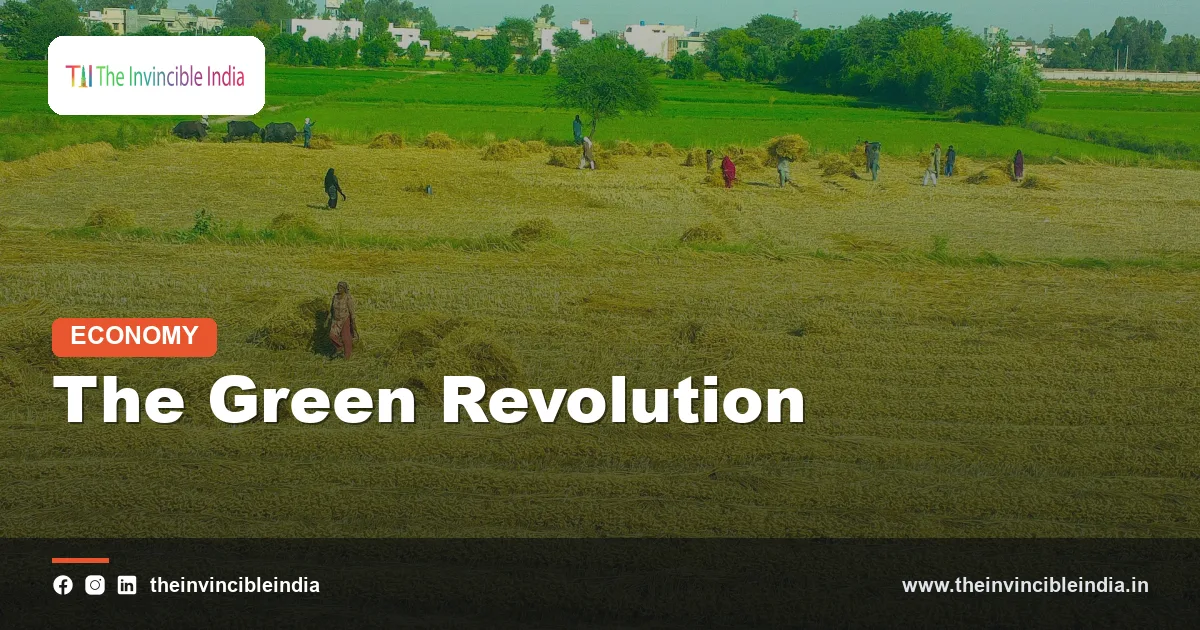
The Green Revolution was the transformation of Indian agriculture, beginning in the mid-1960s, that turned a food-deficit country into a self-sufficient and, in good years, surplus producer of food grains. Within about a decade, a nation that depended on imported wheat and was often described as living “ship to mouth” was building buffer stocks in its own warehouses.
It was not one invention but a package: high-yielding seeds, chemical fertilisers, assured irrigation, crop protection, machinery and a supportive framework of credit, assured prices and public procurement. This explainer covers the background, the main ingredients, the people behind it, the regions and crops it favoured, and the costs that India is still working through today.
| Period | Mid-1960s onwards, with the High Yielding Varieties Programme starting in 1966-67 |
|---|---|
| Called the “Father” of the movement in India | M.S. Swaminathan (1925-2023) |
| Agriculture Minister at the time | C. Subramaniam (1964-67) |
| International scientific link | Norman Borlaug, Nobel Peace Prize 1970 |
| Core technology | Dwarf, high-yielding wheat and rice varieties, fertiliser, irrigation |
| Epicentre | Punjab, Haryana and western Uttar Pradesh |
| Main crops affected | Wheat first, rice next; maize, bajra and jowar to a lesser extent |
| Key institutions | Food Corporation of India, Agricultural Prices Commission (now CACP), ICAR, agricultural universities |
| Main criticisms | Regional imbalance, falling water tables, soil and chemical stress, neglect of pulses and millets |
Why India Needed a Green Revolution
At Independence in 1947, India inherited an agricultural economy marked by low yields, small and fragmented holdings, heavy dependence on the monsoon and the memory of the 1943 Bengal famine. Partition had also cut off some of the most productive irrigated lands. Planners in the First and Second Five Year Plans invested in dams, canals and community development, and output did rise, but population grew nearly as fast.
The crisis came in the mid-1960s. Two consecutive droughts, in 1965-66 and 1966-67, caused harvests to fall sharply, and Bihar in particular faced severe distress. India imported huge quantities of wheat, much of it under the United States’ Public Law 480 (PL-480) programme, which supplied surplus American grain on concessional terms.
Dependence and the push for self-reliance
The dependence was uncomfortable in political as well as economic terms. Food shipments arrived at a time when India’s relations with major powers were tense, and leaders felt that a country relying on another’s surplus could not fully control its own policy. Prime Minister Lal Bahadur Shastri’s slogan “Jai Jawan, Jai Kisan” captured the mood: the soldier and the farmer were both pillars of national security. Self-reliance in food became a stated national goal, and it set the stage for a decisive change in farm strategy.
Scientists and administrators also drew a lesson from the earlier decades. Spreading modest investments evenly over the whole country had produced slow gains. What was needed was a concentrated, science-led push that could raise yields per hectare within a few seasons, because there was little land left to bring under the plough.
The Core Package of Practices
The strategy abandoned the earlier approach of spreading effort thinly across all districts. Instead it concentrated resources on areas that could respond quickly, offering farmers a complete package of inputs rather than any single element. The logic was simple: a new seed gives high yields only if it is fed, watered and protected, and each of these inputs needs the others.
- High-yielding variety (HYV) seeds bred to respond strongly to fertiliser and to resist lodging (falling over).
- Chemical fertilisers, mainly nitrogen, with phosphate and potash following.
- Assured irrigation from canals, tubewells and pump sets.
- Pesticides and herbicides to protect the denser, higher-value crop.
- Mechanisation such as tractors, threshers and seed drills.
- Institutional support in the form of credit, assured prices, procurement and extension services.
Government demonstration plots, field days and the training of extension workers helped carry the message from laboratory to village. Early adopters showed their neighbours that the package worked, and adoption spread by example.
High-Yielding Variety Seeds
The scientific heart of the story is the dwarf cereal. Traditional tall wheat and rice plants put energy into stalk growth, and when heavily fertilised they became top-heavy and collapsed. Breeders solved this by using genes for short stature, so that the plant devoted more of its energy to grain.
Wheat
American agronomist Norman Borlaug, working in Mexico, had developed semi-dwarf, high-yielding wheat lines using dwarfing genes traced to Japanese wheat. Indian scientists, notably at the Indian Agricultural Research Institute (IARI) in Delhi, tested Mexican material and in 1966 India imported a large consignment of Mexican seed for distribution. Indian breeders then crossed and selected for local conditions, grain colour and taste, releasing varieties such as Kalyan Sona and Sonalika that spread rapidly across the northwest.
Rice
For rice, the International Rice Research Institute in the Philippines produced IR8, nicknamed “miracle rice”. Taichung Native 1 and IR8 were introduced in India in the mid-1960s, and Indian breeders later developed their own HYVs such as Jaya and Ratna. Rice followed wheat a few years later, and its spread was tied closely to the availability of irrigation.
Fertilisers, Irrigation and Machinery
HYVs were thirsty and hungry. They gave their best yields only with regulated water and measured doses of nutrients, so the Green Revolution also meant a rapid expansion of the fertiliser industry, with new plants, imports and subsidised pricing designed to bring the cost within reach of ordinary farmers.
Water control
Irrigation was the make-or-break variable. Punjab and Haryana already had a network of canals, and projects such as the Bhakra-Nangal system extended it. Just as important was the boom in private tubewells, driven by cheap electric and diesel pumps and by subsidised or flat-rate power. Groundwater, not just canal water, became the engine of the new farming.
Machines and crop protection
Because HYVs matured faster, farmers could often sow two or even three crops a year, which raised cropping intensity. That put pressure on labour at sowing and harvest time, and tractors, threshers and later combine harvesters spread across the northwest. Pesticides and herbicides were adopted to protect a denser crop that was more attractive to pests and weeds.
Institutions: Prices, Procurement and Research
Technology alone would not have persuaded farmers to take the risk of a new crop. The state therefore built a supporting framework in the same years.
- Agricultural Prices Commission (1965): advised the government on prices; it later became the Commission for Agricultural Costs and Prices (CACP).
- Minimum Support Price (MSP): a floor price announced before sowing, giving farmers confidence that they would not be forced to sell at a loss.
- Food Corporation of India (1965): set up to buy, store, transport and distribute food grains and to maintain buffer stocks.
- Public Distribution System: the supply channel that moved procured grain to ration shops and kept urban prices stable.
- Agricultural universities: modelled on the American land-grant system, beginning with Pantnagar in 1960, they combined teaching, research and extension.
- Rural credit and cooperatives: expanded lending to finance seed, fertiliser and equipment.
The assured-procurement model was especially effective in Punjab and Haryana, where government agencies bought large volumes of wheat and later rice at the MSP, giving farmers a guaranteed market. The combination of a known price, a known buyer and subsidised inputs sharply reduced the risk of trying new methods.
M.S. Swaminathan and C. Subramaniam
Two names are most often linked to this period. C. Subramaniam, as Union Agriculture Minister in the mid-1960s, took the politically difficult decision to commit to the new seeds and to guaranteed prices, and to import seed on a large scale before the benefits were proven. He backed scientists, reformed the policy framework and created institutions such as the Food Corporation of India and the Agricultural Prices Commission.
Mankombu Sambasivan Swaminathan, a plant geneticist, is widely called the “Father of the Green Revolution in India”. He worked on wheat breeding, helped bring Borlaug’s material to India, and later led IARI and the Indian Council of Agricultural Research (ICAR). In 1987 he received the first World Food Prize, and he was awarded the Bharat Ratna posthumously after his death in 2023. In his later years he argued for what he called an “Evergreen Revolution”, meaning higher productivity without ecological harm. His foundation in Chennai continues research on sustainable agriculture and rural livelihoods.
The Epicentre: Punjab, Haryana and Western Uttar Pradesh
The Green Revolution did not arrive evenly. It took root first in Punjab, Haryana (formed as a separate state in 1966) and western Uttar Pradesh. These areas had fertile alluvial soil, relatively larger and more consolidated farms, existing canal networks, good rural roads and electricity, and enterprising farmers ready to adopt new methods.
Why the northwest led
- Assured irrigation from rivers and the potential to tap shallow groundwater.
- Better infrastructure for markets, storage and transport.
- Strong state support through procurement at announced prices.
- A farming culture open to machinery and new inputs.
The impact was visible in rising rural incomes, new agro-processing and farm-machinery industries, and a strengthening of rural markets. The contribution of Punjab and Haryana to the central grain pool became very large relative to their size, and the two states came to be called the “granary” or “food bowl” of India.
Results: From Shortage to Surplus
The results were dramatic by the standards of the time. Wheat output rose rapidly within a few years of the first HYV sowings, and India’s total food-grain production crossed the 100 million tonne mark around 1970. In recent years it has been well above 300 million tonnes, many times higher than at Independence, while the population has grown far more modestly in comparison.
| Outcome | What changed |
|---|---|
| Wheat output | Rose sharply from the late 1960s and became the most visible success story |
| Rice output | Followed wheat, driven by irrigated HYV paddy in the northwest and the south |
| Imports and aid | Large-scale wheat imports under PL-480 were phased out by the 1970s |
| Buffer stocks | Government built reserves to cushion bad monsoons |
| Famine-level shortages | Mass starvation of the 1940s and 1960s type was effectively ended |
| Food policy | Enabled the public distribution system and, later, a legal right to food |
Perhaps the most important achievement was strategic. A country that had once been at the mercy of external food supply could now ride out a drought, feed its poorest citizens through public programmes, and even export in some years. Food security became a settled national priority rather than a recurring emergency.
The Costs and Criticisms
Even supporters of the Green Revolution acknowledge that it came with real costs, many of which emerged only after some decades.
Regional and crop imbalance
Because the strategy favoured already-irrigated, well-endowed regions, eastern, central and rain-fed India lagged behind, widening regional disparities. The emphasis also fell on wheat and rice. Pulses, coarse cereals and millets, once traditional staples, lost area to the more profitable and better-supported grains, which affected dietary diversity and the availability of protein-rich crops.
Water, soil and inequality
- Falling water tables: water-intensive paddy in a semi-arid region and free or cheap power for pumps led to heavy groundwater extraction, and water tables have dropped sharply in parts of Punjab and Haryana.
- Soil health: continuous wheat-rice rotation, imbalanced fertiliser use and falling organic matter have reduced soil fertility and increased input costs.
- Chemical load: overuse of fertilisers and pesticides raised concerns about contamination and health.
- Inequality: larger farmers could afford the inputs and machinery first, while small and marginal farmers often struggled with debt and rising costs.
- Stubble burning: short gaps between paddy harvest and wheat sowing contribute to seasonal air pollution in the northern plains.
Over time, yield growth also slowed in the heartland as responses to additional fertiliser diminished, while the cost of cultivation kept rising. This combination of stagnating returns and higher costs is one reason farm distress remains a policy concern even in regions that led the revolution.
Benefits versus costs at a glance
| Benefits | Costs |
|---|---|
| Self-sufficiency in cereals | Declining groundwater in the northwest |
| Buffer stocks and food security | Soil degradation and nutrient imbalance |
| Higher farm incomes in adopting regions | Regional and farm-size inequality |
| Growth of fertiliser, machinery and agro-industries | Neglect of pulses, millets and other crops |
| Foundation for public distribution | Heavy dependence on subsidies and procurement |
Towards an Evergreen Revolution
Today’s debate is less about whether the Green Revolution was necessary and more about how to fix its side effects while keeping India food secure. Swaminathan’s call for an “Evergreen Revolution” stressed productivity gains in perpetuity without ecological harm, using integrated nutrient management, water conservation and better seeds.
Directions being discussed
- Crop diversification: shifting some paddy area in water-stressed regions to pulses, oilseeds, maize or millets, with suitable price support to make the switch viable.
- Water efficiency: micro-irrigation, drip and sprinkler systems, direct-seeded rice and rules on the timing of paddy transplanting.
- Soil health: soil testing, balanced fertiliser use, organic matter and natural farming approaches.
- Second Green Revolution in the east: bringing HYV technology and better procurement to eastern states such as Bihar, Odisha, West Bengal and eastern Uttar Pradesh.
- Climate resilience: heat-tolerant and drought-tolerant varieties, along with improved storage and markets.
International interest in millets, which India has promoted as “Shree Anna”, reflects a growing view that nutrition, climate resilience and productivity should be pursued together.
Other “Revolutions” in Indian Agriculture
The success of the grain programme led commentators to use the colour label for other sectors. The terms are informal, but they describe real campaigns to raise output.
- White Revolution (Operation Flood): launched in 1970 under the National Dairy Development Board, with Verghese Kurien as its best-known leader, it built a cooperative dairy network and made India among the world’s largest milk producers.
- Yellow Revolution: a push to raise oilseed production in the 1980s through a technology mission, aimed at reducing edible oil imports.
- Blue Revolution: expansion of fisheries and aquaculture, both inland and marine.
Each followed a similar logic: science, organised markets and public support together lift output, and each also raised questions about sustainability.
Conclusion
The Green Revolution remains one of the most consequential episodes in independent India’s economic history. It ended the era of food aid and recurring famine, and it showed that policy, science and farmers working together could change a country’s destiny in a short span of time. Its legacy also holds a lesson: a strategy that solves one problem can create another if water, soil and diversity are ignored. The next phase of Indian agriculture is therefore about doing more with less, and doing it fairly across regions and farm sizes.
Frequently Asked Questions
What was the Green Revolution in India?
It was the period of rapid agricultural change from the mid-1960s in which high-yielding seeds, fertilisers, irrigation and supportive policies sharply raised food-grain output. It turned India from a food-importing country into one that was self-sufficient in cereals.
Who is called the Father of the Green Revolution in India?
M.S. Swaminathan is widely called the Father of the Green Revolution in India for his role in wheat breeding and in bringing the new technology into Indian farming. Norman Borlaug, who developed dwarf wheat in Mexico, is regarded as the father of the global Green Revolution, and C. Subramaniam was the Agriculture Minister who drove the policy.
Which states benefited most from the Green Revolution?
Punjab, Haryana and western Uttar Pradesh benefited most, thanks to fertile soil, existing irrigation, better infrastructure and assured procurement. Wheat was the first crop to show dramatic gains, followed by rice.
Which crops were most affected by the Green Revolution?
Wheat and rice were the main beneficiaries. Pulses, millets and coarse grains saw much less improvement and in many areas lost acreage to wheat and paddy.
What were the main drawbacks of the Green Revolution?
The main drawbacks were regional and farm-size inequality, falling groundwater levels, soil degradation, heavy chemical use and a narrowing of the crop base. These concerns have led to calls for crop diversification and an “Evergreen Revolution”.
What role did MSP and the Food Corporation of India play?
The Minimum Support Price gave farmers an assured floor price, and the Food Corporation of India bought, stored and distributed grain and maintained buffer stocks. Together they reduced price risk and encouraged farmers to adopt the new seeds.


