

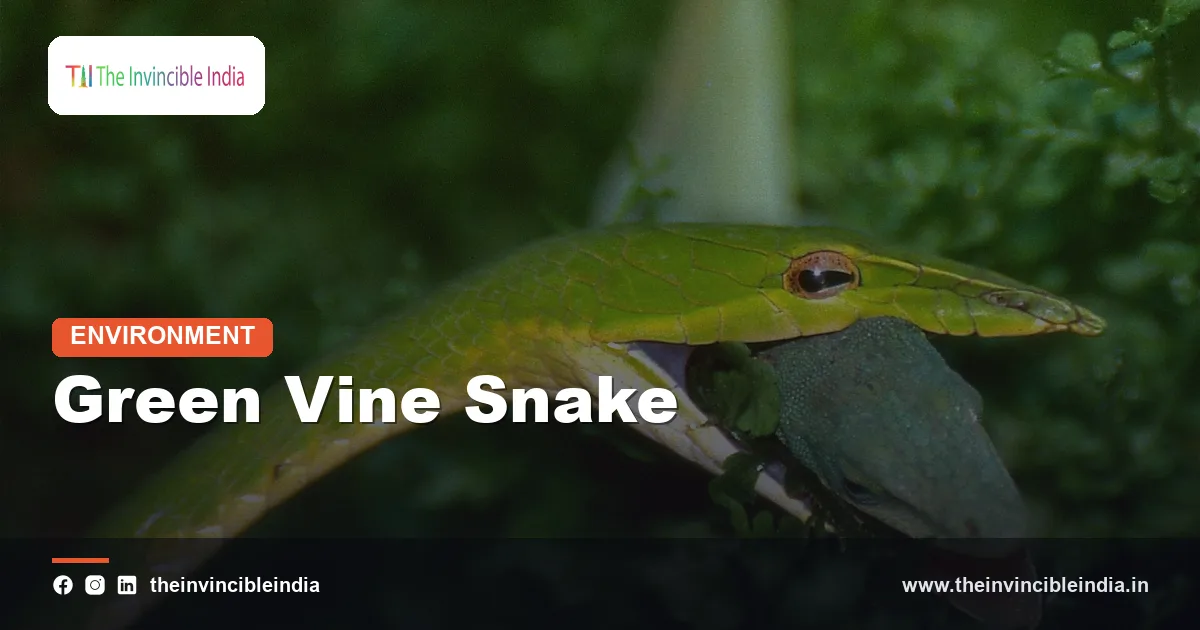
The green vine snake (Ahaetulla nasuta) is a slender, bright-green, tree-dwelling snake of India and Sri Lanka, famous for its pointed snout, horizontal keyhole-shaped pupils and extraordinary camouflage among leaves and twigs. Although it is technically a mildly venomous, rear-fanged snake, its venom is meant for small lizards and frogs and is not considered dangerous to humans, so the green vine snake is regarded as harmless to people.
This evergreen explainer describes how to recognise the green vine snake, why its eyes are so unusual, what it eats, how it defends itself, how it breeds and why it should be left alone. Last updated: 22 October 2026.
| Quick Facts | Details |
|---|---|
| Common names | Green vine snake, common vine snake, long-nosed whip snake |
| Scientific name | Ahaetulla nasuta (Lacépède, 1789) |
| Family | Colubridae |
| Venom status | Mildly venomous and rear-fanged; not dangerous to humans |
| Typical adult length | About 1 to 1.5 metres, very slender; some individuals are longer |
| Habitat | Trees, shrubs, hedges and gardens in forests, scrub and farmland; mainly south India and Sri Lanka |
| Eyes | Horizontal keyhole-shaped pupils with grooves enabling binocular vision |
| Reproduction | Viviparous (gives birth to live young), usually in the monsoon season |
| Main diet | Lizards (especially garden lizards), frogs, and occasionally small birds |
Key Takeaways
- The green vine snake (Ahaetulla nasuta) is a thin, bright-green arboreal snake whose body blends almost perfectly with leaves, vines and twigs.
- The green vine snake has horizontal, keyhole-shaped pupils and forward-facing grooves on its face that give it binocular vision for judging distance.
- The green vine snake is rear-fanged and mildly venomous, but its venom is not considered dangerous to humans.
- When threatened, the green vine snake inflates its throat, opens its mouth wide and shows contrasting black-and-white or bluish skin to look bigger.
- The green vine snake gives birth to live young and feeds mainly on lizards and frogs, which helps control insect-eating prey populations in gardens.
- The belief that the green vine snake attacks human eyes is a myth, and the species should never be killed or handled needlessly.
What is the green vine snake?
The green vine snake is a thin, long, diurnal tree snake, scientifically named Ahaetulla nasuta, that belongs to the family Colubridae and lives in the vegetation of India and Sri Lanka. It is also known as the common vine snake or long-nosed whip snake, and it is one of several vine snakes found in the Indian subcontinent.
The genus Ahaetulla includes a number of related species in South and Southeast Asia, including the brown vine snake (Ahaetulla pulverulenta) and other species found in the Western Ghats. The green vine snake, however, is the one most often seen in gardens and woodlands because of its bright colour and diurnal habits.
Most of these snakes are rear-fanged. That means their fangs are at the back of the mouth, small, grooved and positioned to inject a mild venom while the snake chews on small prey. They are very different from the front-fanged, medically significant snakes of India, such as the cobra, krait and vipers.
What does the green vine snake look like?
The green vine snake looks like a very slender, whip-like, leaf-green snake with a long pointed head, a narrow body and a thin, tapering tail that ends in a point. Its lime or parrot-green upper body is often lined along the sides with thin pale yellow or white lines, and its belly is lighter green or yellowish.
The key identifying features are:
- Long, pointed snout: The snout ends in a small, soft, fleshy tip that projects slightly forward, which is the origin of the species name “nasuta”, meaning “nosed”.
- Keyhole-shaped pupils: The horizontal pupil is a distinctive feature that is not found in most other Indian snakes.
- Slim body and long tail: The body is extremely thin compared with its length, and the tail makes up about a third of the total length.
- Colour variation: Besides the common bright green, there are yellowish, bronze and grey-brown forms, which are less often noticed.
An adult is usually between 1 and 1.5 metres long but may be a little longer. A young green vine snake looks similar, only smaller and slightly paler. The skin between the scales often shows contrasting colours that stay hidden until the snake puffs itself up.
Why does the green vine snake have horizontal keyhole pupils?
The green vine snake has horizontal keyhole-shaped pupils because they work with shallow grooves in front of the eyes to give the snake binocular vision, which helps it judge distances accurately when striking at prey among branches. Most snakes have eyes placed on the sides of the head and see poorly in depth, so this feature is highly unusual.
The grooves run from the eyes toward the tip of the snout. When the snake looks forward, each eye can see along the groove, and the visual fields of both eyes overlap. The overlapping vision creates depth perception, much as in humans, cats and birds of prey. This is important for a hunter that must strike accurately at a lizard sitting on a swaying twig.
A vine snake can stay motionless for long periods and track a lizard with just its eyes. The long pointed head also acts as a streamlined sensor that lets the snake scan between leaves.
How does the green vine snake camouflage itself?
The green vine snake camouflages itself by matching its body colour and shape to the green leaves and thin stems around it, and by swaying slowly like a vine or twig moved by the wind. This combination of colour, shape and movement makes the snake nearly invisible to both predators and prey.
Camouflage works in several ways. The slim, elongated body looks like a creeper, the colour is similar to foliage, and the snake often holds half of its body stretched out stiffly from a branch, resembling a thin stem. When there is a breeze, it sways gently with it. That behaviour is called “mimetic swaying”, and it helps the snake appear to be part of the plant.
This camouflage is crucial for survival. Many birds of prey, crows, mongooses, lizards and other snakes feed on vine snakes, so staying unseen matters. It also helps the snake approach prey without being noticed. People usually spot one only after it moves or when it is on the ground crossing a path.
Is the green vine snake venomous or dangerous to humans?
The green vine snake is mildly venomous but not dangerous to humans: it is rear-fanged, its venom is designed to immobilise lizards and frogs, and it rarely bites people. Medical reports of bites from Ahaetulla species describe mostly local effects, such as pain and swelling at the bite site, and serious systemic harm is not considered typical.
A bite is unlikely in normal circumstances because the snake prefers to stay still, flee or display its threat posture. Bites mostly occur when a person handles or pins the snake. The fangs are small and located at the back of the mouth, so the snake must chew to deliver any venom.
Even so, no one should assume that a snake is harmless. Anyone who has been bitten by a snake that cannot be identified for certain should stay calm, keep the limb still and go to a hospital. People should not cut the wound, suck it or use home or traditional remedies. Doctors can judge the situation correctly, and the right medical response is always safer than guesswork.
What does the green vine snake eat?
The green vine snake eats mainly lizards, such as garden lizards, and frogs, and sometimes small birds, rodents or other small animals, which it catches by stalking and a very quick strike. It is a diurnal hunter that relies on sight.
The hunting technique is patient. The snake stays frozen on a branch, often with its front part stretched out, and follows a lizard with its binocular vision. When the prey comes within reach, the snake lunges, seizes it and holds on while the venom in its rear fangs starts to work. It then swallows the prey head first.
By feeding on garden lizards and frogs, the green vine snake helps regulate those populations, which in turn affects insect numbers. It is itself part of a food chain that connects insects, reptiles and amphibians, and birds of prey.
How does the green vine snake defend itself when threatened?
The green vine snake defends itself first by staying still and relying on camouflage, and if discovered it inflates the front of its body, opens its mouth wide and shows a dark inner mouth and brightly contrasting skin as a bluff. This threat display is meant to scare off predators and is not a sign of attack.
The defensive sequence usually goes as follows:
- The snake freezes or sways gently so that it resembles a vine moved by the wind.
- If approached, it flattens or inflates its throat, which reveals patches of black, white or bluish skin between the scales.
- It opens its mouth, displaying a dark lining, and may hold its head back in a striking posture.
- Only if it is cornered or handled does it strike or bite, and it is just as likely to simply drop from the branch or glide away.
The behaviour is often misread as aggression. The snake has little protection except its camouflage and bluff, so the best response to seeing a display is to step back and leave the animal alone.
Does the green vine snake attack human eyes?
No, the green vine snake does not attack human eyes: the belief that it darts at people’s eyes or can blind them is a myth with no scientific support. The myth seems to come from the snake’s sharp pointed head and forward-facing eyes, which make it look as if it is staring at people.
The snake is far more interested in escaping or hiding than in attacking a human. In some parts of India, the idea that vine snakes strike the eyes has led people to kill them on sight. Wildlife biologists have found no evidence for such behaviour. If a vine snake strikes near a person’s face, it usually happens because the person came very close or tried to grab the snake.
Other related stories, such as the idea that the vine snake is a “poison-spitting” or “whip” snake that lashes at people, are just as unfounded. The common name “whip snake” refers to the thin, whip-like shape of the animal, not to any habit of whipping.
How does the green vine snake breed?
The green vine snake breeds by giving birth to live young, a pattern called viviparity, and females usually deliver their young in the rainy season after carrying them for several months. The number of young varies with the size of the mother and may range from a handful to around two dozen.
Unlike many snakes that lay eggs, the green vine snake retains the developing embryos inside her body, which gives them some protection. The babies are born about 20 to 25 centimetres long, light green or brownish, and fully capable of hunting small prey such as insects, tiny lizards and tree frogs.
Young vine snakes disperse into nearby shrubs and trees. They are especially vulnerable to birds, larger snakes and lizards, so only a small portion survive to adulthood.
How does the green vine snake compare with other green snakes in India?
The green vine snake differs from other green snakes in India mainly through its keyhole pupil, very slender body and pointed snout, while pit vipers and other green snakes have rounder, thicker heads and often triangular bodies. Telling the difference is useful, because some green snakes in India are venomous vipers.
| Feature | Green vine snake (Ahaetulla nasuta) | Green pit vipers (Trimeresurus group) |
|---|---|---|
| Body shape | Extremely slender and whip-like | Thicker, heavier body |
| Head | Long, narrow and pointed with a fleshy snout tip | Broad, triangular head distinct from the neck |
| Pupil | Horizontal keyhole-shaped | Vertical, cat-like pupil |
| Heat pits | Absent | Present between eye and nostril |
| Danger to humans | Not dangerous | Venomous; bites need urgent medical care |
| Typical movement | Slow, swaying, graceful | Slow and ambush-oriented, coils on branches |
Because mistaking a harmless snake for a dangerous one (or the other way round) can have serious consequences, anyone who is not sure about a snake’s identity should keep a safe distance and contact a trained rescuer.
Why should the green vine snake be left alone?
The green vine snake should be left alone because it is harmless to people, plays a useful role in controlling lizards and frogs, and is legally protected in India along with most native snakes. Killing or capturing wildlife without authorisation can attract penalties under the Wildlife (Protection) Act, 1972, and the forest department can advise on the species’ legal status.
Threats to the species include habitat loss from clearing trees and hedges, road kills, persecution through the eye-attack myth and capture for the pet trade, because wild vine snakes often do poorly in captivity and frequently refuse food. They are delicate and stressed by handling, so most captive vine snakes die.
Anyone who finds a green vine snake in a garden or on a window ledge should simply give it space. It will usually move on by itself. If it is trapped in a house or on a road, a trained snake rescuer can move it to nearby vegetation.
Bottom Line
The green vine snake is a camouflaged, slender, mildly venomous tree snake that is harmless to humans and helpful in gardens and woods. Its keyhole pupils and leaf-like colour are remarkable adaptations, and the best way to appreciate them is to observe the snake from a distance.
Frequently Asked Questions
Is the green vine snake poisonous?
The green vine snake is mildly venomous, not poisonous, and its venom is not considered dangerous to humans. It is rear-fanged and uses the venom mainly to subdue lizards and frogs. Anyone bitten by an unidentified snake should still seek medical advice promptly.
Why does the green vine snake have horizontal pupils?
The green vine snake has horizontal keyhole-shaped pupils that, together with grooves on its snout, give it binocular vision. This allows the snake to judge distance well when striking at prey on branches. Most other snakes lack this ability.
Does the green vine snake attack people’s eyes?
No, the green vine snake does not attack people’s eyes, and the belief is a myth. The snake prefers to hide, stay still or flee, and it bites only when cornered or handled. Killing it because of this belief is unnecessary and harmful.
What does the green vine snake eat?
The green vine snake eats mainly lizards, such as garden lizards, and frogs, and occasionally small birds. It hunts in the daytime using sight and a fast strike. This diet helps maintain balance among small animals in gardens and woodlands.
How big does the green vine snake grow?
An adult green vine snake is usually about 1 to 1.5 metres long, though some individuals are longer. The body is extremely thin, and the tail forms roughly a third of the length. Newborns are about 20 to 25 centimetres long.
What should I do if I find a green vine snake in my garden?
Leave the snake alone and keep children and pets away, since it will usually move on by itself. Do not try to grab or hit it, because a stressed snake may bite. If it is in a risky place, call a trained snake rescuer or the local forest department.
{“@context”:”https://schema.org”,”@graph”:[{“@type”:”FAQPage”,”mainEntity”:[{“@type”:”Question”,”name”:”Is the green vine snake poisonous?”,”acceptedAnswer”:{“@type”:”Answer”,”text”:”The green vine snake is mildly venomous, not poisonous, and its venom is not considered dangerous to humans. It is rear-fanged and uses the venom mainly to subdue lizards and frogs. Anyone bitten by an unidentified snake should still seek medical advice promptly.”}},{“@type”:”Question”,”name”:”Why does the green vine snake have horizontal pupils?”,”acceptedAnswer”:{“@type”:”Answer”,”text”:”The green vine snake has horizontal keyhole-shaped pupils that, together with grooves on its snout, give it binocular vision. This allows the snake to judge distance well when striking at prey on branches. Most other snakes lack this ability.”}},{“@type”:”Question”,”name”:”Does the green vine snake attack people’s eyes?”,”acceptedAnswer”:{“@type”:”Answer”,”text”:”No, the green vine snake does not attack people’s eyes, and the belief is a myth. The snake prefers to hide, stay still or flee, and it bites only when cornered or handled. Killing it because of this belief is unnecessary and harmful.”}},{“@type”:”Question”,”name”:”What does the green vine snake eat?”,”acceptedAnswer”:{“@type”:”Answer”,”text”:”The green vine snake eats mainly lizards, such as garden lizards, and frogs, and occasionally small birds. It hunts in the daytime using sight and a fast strike. This diet helps maintain balance among small animals in gardens and woodlands.”}},{“@type”:”Question”,”name”:”How big does the green vine snake grow?”,”acceptedAnswer”:{“@type”:”Answer”,”text”:”An adult green vine snake is usually about 1 to 1.5 metres long, though some individuals are longer. The body is extremely thin, and the tail forms roughly a third of the length. Newborns are about 20 to 25 centimetres long.”}},{“@type”:”Question”,”name”:”What should I do if I find a green vine snake in my garden?”,”acceptedAnswer”:{“@type”:”Answer”,”text”:”Leave the snake alone and keep children and pets away, since it will usually move on by itself. Do not try to grab or hit it, because a stressed snake may bite. If it is in a risky place, call a trained snake rescuer or the local forest department.”}}]}]}


