

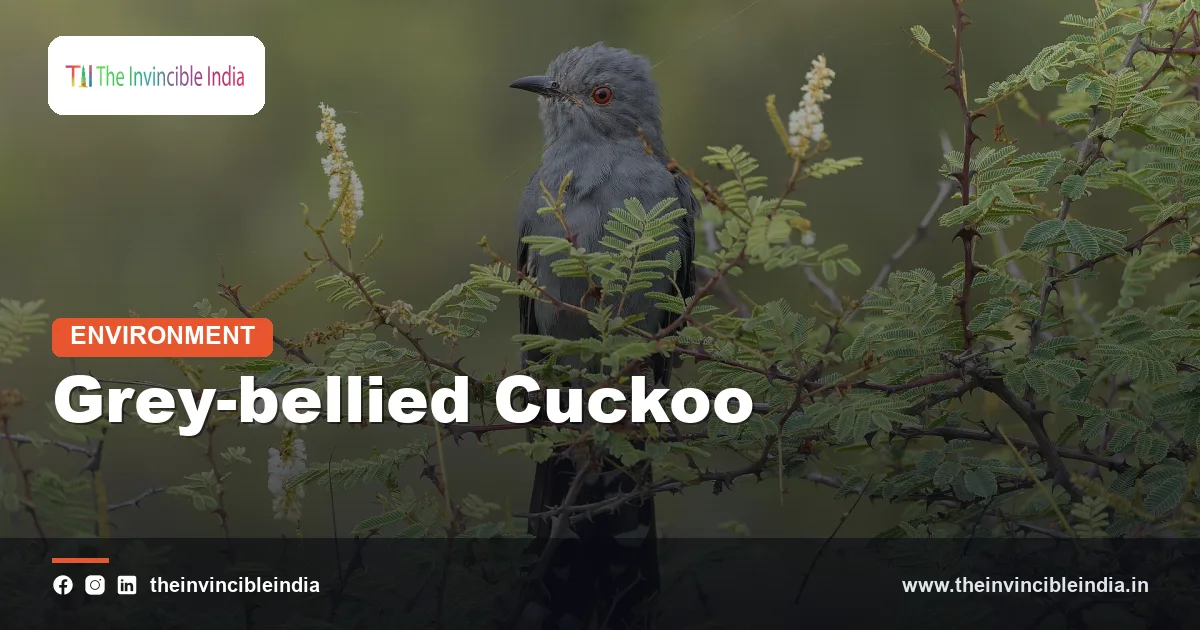
The grey-bellied cuckoo (Cacomantis passerinus) is a small, slim, long-tailed cuckoo of the Indian subcontinent that lives in scrub, open woodland and gardens, eats mainly caterpillars and other insects, and lays its eggs in the nests of smaller birds such as prinias. It is a brood parasite, which means that the grey-bellied cuckoo never raises its own young and leaves the work to its foster parents.
The grey-bellied cuckoo is easy to overlook because it is small, shy and often hidden in foliage, but its loud, rising whistled call is a familiar sound of the Indian monsoon. This article explains how to identify the species and its rufous or hepatic female form, where it lives, what it eats, how its parasitic breeding works and how it differs from similar cuckoos.
| Quick Facts: Grey-bellied Cuckoo | |
|---|---|
| Common names | Grey-bellied cuckoo; sometimes called the grey-bellied plaintive cuckoo in older literature |
| Scientific name | Cacomantis passerinus |
| Family | Cuculidae (cuckoos), order Cuculiformes |
| Size | Roughly 22 to 24 cm in length, with a slim body and a long, rounded tail |
| Range | Indian subcontinent, including most of peninsular India, the plains and the lower Himalayan foothills, and Sri Lanka |
| Habitat | Scrub, thorn forest, dry deciduous woodland, orchards, gardens and farmland edges |
| Diet | Mainly caterpillars, including hairy ones, plus other insects; occasionally fruit |
| Breeding | Brood parasite; lays eggs in the nests of small birds, especially prinias, mostly during and around the monsoon |
| Conservation status | Least Concern on the IUCN Red List; protected as a wild bird under the Wildlife (Protection) Act, 1972 |
Key Takeaways
- The grey-bellied cuckoo is a small, slim cuckoo, about 22 to 24 cm long, found across the Indian subcontinent in scrub, light woodland and gardens.
- The grey-bellied cuckoo is an obligate brood parasite that lays its eggs in the nests of other small birds, most often prinias, and never builds a nest of its own.
- The male grey-bellied cuckoo is grey above and on the breast, while some females have a rufous, barred plumage known as the hepatic form.
- The call of the grey-bellied cuckoo is a loud series of whistled notes that rise in pitch and speed up, and it is heard most often around the monsoon.
- The grey-bellied cuckoo eats many hairy caterpillars that most birds avoid, which makes it a useful natural controller of crop and tree pests.
- The grey-bellied cuckoo is listed as Least Concern by the IUCN and is common across much of its range.
What is the grey-bellied cuckoo?
The grey-bellied cuckoo is a small member of the cuckoo family, Cuculidae, and belongs to the genus Cacomantis, a group of slim, long-tailed cuckoos found from South Asia to Australasia. Its scientific name is Cacomantis passerinus, and it is native to India, Sri Lanka and neighbouring countries.
For many years the bird was treated as a form of the plaintive cuckoo (Cacomantis merulinus), a similar species with a rufous or orange belly. Ornithologists now treat the grey-bellied cuckoo as a separate species, because the two differ in belly colour, voice and geography. Because of this history, older books may list the same bird under a different name.
The cuckoo family is large and varied. It includes parasitic species such as the grey-bellied cuckoo, the Asian koel and the pied cuckoo, and non-parasitic species such as the greater coucal and the malkohas, which build their own nests and raise their own chicks.
How can you identify a grey-bellied cuckoo?
A grey-bellied cuckoo can be identified by its small size, slim build, long graduated tail with white tips, slate-grey upperparts and grey throat and breast in the male, and a yellow ring around the eye. It perches in an upright posture on a bush or wire, and its tail often droops or is slightly fanned.
Key identification features
- Male: ash-grey above, with a grey throat and breast that give the species its name, and a paler, whitish or buffy lower belly.
- Eye ring: a thin yellow or yellowish ring around the dark eye, more visible at close range.
- Tail: long, dark and rounded, with white spots or bars along the edges and tips, easy to see when the bird flies off.
- Bill: slender and slightly curved, dark above and paler at the base below.
- Female: may be grey like the male, or rufous brown and barred, which is called the hepatic form.
- Juvenile: brownish and finely barred, resembling the hepatic female, but with a dull look and often a begging posture.
The grey-bellied cuckoo spends much of its time among leaves, so a birdwatcher usually hears it first. Seeing the bird clearly often needs patience, since it tends to sit still in a tree or tall shrub and then dive into dense foliage.
What is the hepatic form of the grey-bellied cuckoo?
The hepatic form of the grey-bellied cuckoo is a rufous-brown plumage morph, strongly barred with black on the back, wings and underparts, that is found mainly in females. The word “hepatic” comes from the Greek and Latin for liver and refers to the liver-brown colour.
The hepatic plumage looks so different from the grey male that early observers sometimes thought the two were different species. In reality, the grey and hepatic forms are variations within one species. The hepatic female resembles a young bird and also resembles the hepatic forms of related cuckoos, such as the banded bay cuckoo.
Biologists have suggested several reasons why female cuckoos may have a barred hepatic morph, including resemblance to hawks that may deter host birds from approaching, or to the colours of the surrounding foliage. None of these ideas is settled, and the question remains an active area of study in cuckoo biology.
Where does the grey-bellied cuckoo live in India?
The grey-bellied cuckoo lives across most of peninsular and central India and extends to the plains and lower hills of the north, favouring scrub, thorn forest, dry deciduous woodland, orchards, gardens and farmland edges. It is less common in dense evergreen forest and in extremely dry desert areas.
The species is partly migratory, and its numbers in a given place change with the seasons and the monsoon. Some birds move locally or across regions after breeding, so a garden that has no grey-bellied cuckoo in winter may hold several calling males when the rains arrive.
The bird is a regular in the gardens and wooded edges of Indian towns, in cashew and mango orchards, and on the fringes of cultivated fields where small warblers and prinias nest. It does best in a landscape with many shrubs and tall grass, which also supports its host birds.
What does the grey-bellied cuckoo eat?
The grey-bellied cuckoo eats mainly caterpillars, and it is one of the few birds that regularly swallow hairy caterpillars, which many other birds avoid. It also eats beetles, grasshoppers, ants and other insects, and it occasionally takes small fruits.
The bird hunts by watching from a perch among leaves and branches and then flitting to a nearby twig to pluck prey from the foliage. It sometimes takes a short flight to snatch an insect from the air or from the ground.
Hairy caterpillars are a major pest of crops and trees, and cuckoos can cope with the irritating hairs, partly by shedding the lining of the stomach from time to time. By eating large numbers of these larvae, the grey-bellied cuckoo helps limit damage in orchards and farmland, though its contribution is only part of the work done by many insect-eating birds.
What does the grey-bellied cuckoo sound like?
The grey-bellied cuckoo has a loud, whistled song that begins with a few separated notes and then rises in pitch and speed into a rapid, ringing run, and it repeats this phrase many times in succession. The call is clear and plaintive, and it is often heard from a tree top or an exposed branch during the breeding season.
The song is among the most noticeable sounds in many Indian gardens in the monsoon, and calling is common at all hours, including on overcast days and sometimes at night. Males call mainly to advertise their territory and attract females. Each male tends to call from a few favourite perches.
The call is easy to confuse with that of the plaintive cuckoo, which has a similar but not identical song. Experienced listeners separate the two by the pattern of notes and by the location, since the plaintive cuckoo is found more in the Himalayan foothills, the Northeast and Southeast Asia.
How does the grey-bellied cuckoo breed?
The grey-bellied cuckoo breeds by brood parasitism: the female lays a single egg in the nest of another small bird while the host is away, and the host raises the cuckoo chick as its own. The breeding season in much of India is linked to the monsoon, when insects are plentiful and host birds are nesting.
The stages of brood parasitism
- Host selection: the female watches small birds, especially prinias and other warblers, and locates their nests.
- Egg laying: the female visits the nest when the host is absent, often removes one host egg, and lays a single egg of her own.
- Hatching: the cuckoo egg often hatches slightly earlier than the host eggs.
- Chick growth: the cuckoo chick demands food loudly and grows rapidly, and in many cuckoos it ejects or outcompetes the host’s own eggs or chicks.
- Fledging: the young cuckoo leaves the nest, is fed by the foster parents for some time, and then becomes independent.
Common hosts of the grey-bellied cuckoo include the ashy prinia, the plain prinia and other small warblers that build neat, domed nests in grass and low shrubs. A cuckoo chick can be much larger than its foster parents, and the sight of a tiny prinia feeding a chick several times its size is a classic scene of Indian bird life.
Why do cuckoos lay eggs in other birds’ nests?
Cuckoos lay eggs in other birds’ nests because brood parasitism is an evolved breeding strategy that saves the parent the time and energy of building a nest and raising chicks, allowing the female to lay more eggs in a season. Brood parasitism has evolved several times in birds, and roughly two out of every five cuckoo species worldwide are brood parasites, while the rest raise their own young.
The strategy puts the cost on the host species, which spends effort on an unrelated chick and may lose its own offspring. Over many generations this creates an evolutionary arms race. Some hosts learn to recognise and reject odd eggs, and parasites in turn evolve eggs that match host eggs in colour and pattern.
Females of some cuckoo lineages are specialists on a single host species and lay eggs matched to it. Others, including the grey-bellied cuckoo, use several hosts. The behaviour is innate, since a young cuckoo has no parents to teach it, and yet it recognises its own species and learns the calls when it matures.
How is the grey-bellied cuckoo different from other Indian cuckoos?
The grey-bellied cuckoo differs from other Indian cuckoos mainly in its small size, grey belly and breast, and rising whistled song. Several small and medium cuckoos overlap in India, and the table below summarises the main differences.
| Species | Approximate size | Key feature | Call or habit |
|---|---|---|---|
| Grey-bellied cuckoo | 22 to 24 cm | Grey throat and breast in the male; rufous hepatic female | Rising whistled series that ends in a rapid run |
| Plaintive cuckoo | About 21 to 23 cm | Orange-rufous belly and lower breast in adults | Plaintive whistled series; found more in the northeast and the foothills |
| Banded bay cuckoo | About 22 to 24 cm | Rufous upperparts finely barred with black | Plaintive whistled notes from forest trees |
| Common hawk-cuckoo | About 34 cm | Hawk-like barred underparts | Loud, rising “brain-fever” call |
| Asian koel | About 43 cm | Black male; spotted brown female; red eye | Loud “ko-el” call in summer |
The plaintive cuckoo is the closest relative and the most likely to be confused with the grey-bellied cuckoo. The key difference is the belly, which is grey or whitish in the grey-bellied cuckoo and distinctly orange-rufous in the plaintive cuckoo. The hepatic female can be told from the banded bay cuckoo by size, voice and range.
Is the grey-bellied cuckoo threatened?
The grey-bellied cuckoo is not threatened and is listed as Least Concern by the International Union for Conservation of Nature (IUCN), because it has a wide range and is fairly common in suitable habitat. The population is believed to be stable overall.
Local problems exist nonetheless. The clearing of scrub and grassland, the heavy use of pesticides that remove caterpillars, and the loss of host birds’ nesting habitat can all reduce numbers. Because the cuckoo depends on small host birds, anything that harms prinias and warblers also harms the cuckoo.
All native wild birds, including cuckoos, are protected in India under the Wildlife (Protection) Act, 1972. Gardeners and farmers can help by leaving patches of shrubs and tall grass, limiting broad-spectrum sprays and avoiding the removal of nests during the monsoon.
Why does the grey-bellied cuckoo matter?
The grey-bellied cuckoo matters because it helps control caterpillar pests and because its parasitic breeding offers a clear, observable example of coevolution between a parasite and its hosts. It also acts as a seasonal marker, since its loud call in many regions signals the arrival of the rains.
For students and naturalists, the species is a good starting point for learning about bird calls and bird behaviour in everyday settings, since it occurs in gardens and campuses and not only in protected forests. Recording calls and dates on citizen-science platforms such as eBird helps scientists follow the bird’s movements across the country.
Respect for the host birds is part of watching cuckoos. If you find a nest with a cuckoo chick, it is best to observe from a distance and leave it undisturbed, because the foster parents are carrying out a natural process, and nest disturbance can cause them to abandon it.
Bottom Line
The grey-bellied cuckoo is a small, slim, grey-breasted cuckoo that calls loudly in the monsoon, feeds on caterpillars and lays its eggs in the nests of prinias and other small birds. It is common and secure, and it can be found in an ordinary Indian garden or scrub patch by listening for its rising whistled song.
Frequently Asked Questions
What is a grey-bellied cuckoo?
A grey-bellied cuckoo is a small, slim, long-tailed cuckoo, scientifically named Cacomantis passerinus, found across the Indian subcontinent. The male is grey above and on the breast, and some females have a rufous, barred hepatic plumage. It is a brood parasite that eats mainly caterpillars.
Why is it called the grey-bellied cuckoo?
It is called the grey-bellied cuckoo because the adult has a grey breast and belly, unlike the closely related plaintive cuckoo, which has an orange-rufous belly. The grey underparts are the easiest feature to separate the two species in the field. The name also helps to distinguish the species from the rufous-barred hepatic female.
Does the grey-bellied cuckoo build a nest?
No, the grey-bellied cuckoo does not build a nest, because it is an obligate brood parasite. The female lays a single egg in the nest of another small bird, often a prinia, and the host raises the cuckoo chick. This saves the cuckoo the effort of nest building and chick rearing.
What does the grey-bellied cuckoo eat?
The grey-bellied cuckoo eats mainly caterpillars, including hairy ones that many birds avoid. It also eats beetles, grasshoppers, ants and other insects, and sometimes small fruits. This diet makes it a useful natural controller of crop and tree pests.
What does the grey-bellied cuckoo sound like?
The grey-bellied cuckoo gives a loud, whistled call that starts with a few notes and rises in pitch and speed into a rapid, ringing run, repeated many times. It is heard most often during the breeding season around the monsoon. The song is similar to that of the plaintive cuckoo but is not identical.
Is the grey-bellied cuckoo rare?
No, the grey-bellied cuckoo is not rare and is listed as Least Concern by the IUCN because it has a wide range and is fairly common in scrub, gardens and light woodland. Local declines can occur where scrub is cleared or pesticides remove its caterpillar prey. It is protected in India under the Wildlife (Protection) Act, 1972.
{“@context”:”https://schema.org”,”@graph”:[{“@type”:”FAQPage”,”mainEntity”:[{“@type”:”Question”,”name”:”What is a grey-bellied cuckoo?”,”acceptedAnswer”:{“@type”:”Answer”,”text”:”A grey-bellied cuckoo is a small, slim, long-tailed cuckoo, scientifically named Cacomantis passerinus, found across the Indian subcontinent. The male is grey above and on the breast, and some females have a rufous, barred hepatic plumage. It is a brood parasite that eats mainly caterpillars.”}},{“@type”:”Question”,”name”:”Why is it called the grey-bellied cuckoo?”,”acceptedAnswer”:{“@type”:”Answer”,”text”:”It is called the grey-bellied cuckoo because the adult has a grey breast and belly, unlike the closely related plaintive cuckoo, which has an orange-rufous belly. The grey underparts are the easiest feature to separate the two species in the field. The name also helps to distinguish the species from the rufous-barred hepatic female.”}},{“@type”:”Question”,”name”:”Does the grey-bellied cuckoo build a nest?”,”acceptedAnswer”:{“@type”:”Answer”,”text”:”No, the grey-bellied cuckoo does not build a nest, because it is an obligate brood parasite. The female lays a single egg in the nest of another small bird, often a prinia, and the host raises the cuckoo chick. This saves the cuckoo the effort of nest building and chick rearing.”}},{“@type”:”Question”,”name”:”What does the grey-bellied cuckoo eat?”,”acceptedAnswer”:{“@type”:”Answer”,”text”:”The grey-bellied cuckoo eats mainly caterpillars, including hairy ones that many birds avoid. It also eats beetles, grasshoppers, ants and other insects, and sometimes small fruits. This diet makes it a useful natural controller of crop and tree pests.”}},{“@type”:”Question”,”name”:”What does the grey-bellied cuckoo sound like?”,”acceptedAnswer”:{“@type”:”Answer”,”text”:”The grey-bellied cuckoo gives a loud, whistled call that starts with a few notes and rises in pitch and speed into a rapid, ringing run, repeated many times. It is heard most often during the breeding season around the monsoon. The song is similar to that of the plaintive cuckoo but is not identical.”}},{“@type”:”Question”,”name”:”Is the grey-bellied cuckoo rare?”,”acceptedAnswer”:{“@type”:”Answer”,”text”:”No, the grey-bellied cuckoo is not rare and is listed as Least Concern by the IUCN because it has a wide range and is fairly common in scrub, gardens and light woodland. Local declines can occur where scrub is cleared or pesticides remove its caterpillar prey. It is protected in India under the Wildlife (Protection) Act, 1972.”}}]}]}


