

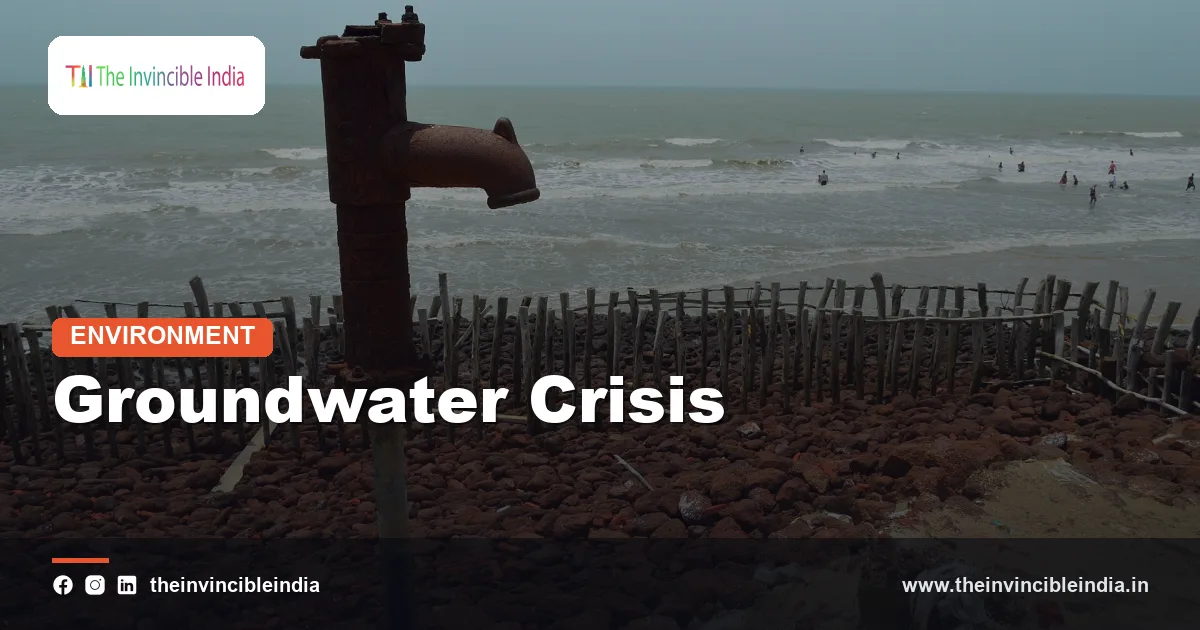
Beneath the fields of Punjab, the towns of Rajasthan and the apartment blocks of Bengaluru lies a hidden resource that has quietly powered India’s farms and cities for half a century. The groundwater crisis in India is the story of what happens when that resource is drawn down faster than rain can refill it. India is widely regarded as the world’s largest user of groundwater, pumping more than any other country, and a very large share of its irrigation and rural drinking water now depends on wells and tubewells.
The trouble is that groundwater is invisible, which makes its depletion easy to ignore until wells run dry, pumping costs rise or the water turns saline or toxic. This explainer describes how India came to rely on groundwater, which regions are most affected, how the problem is measured by the Central Ground Water Board, what contamination adds to the picture, and what policies such as the Atal Bhujal Yojana and rainwater harvesting are doing about it.
Quick Facts
| Item | Detail |
|---|---|
| Global position | India is the world’s largest extractor of groundwater, by a wide margin |
| Main use | Irrigation, which accounts for the bulk of withdrawals; also most rural and a large part of urban drinking water |
| Assessment agency | Central Ground Water Board (CGWB), under the Ministry of Jal Shakti, with State groundwater departments |
| Assessment unit | Blocks, mandals or talukas, classed as Safe, Semi-critical, Critical or Over-exploited |
| Regulatory authority | Central Ground Water Authority, constituted in 1996 under the Environment (Protection) Act, 1986 |
| Key contaminants | Fluoride, arsenic, nitrate, salinity, iron and, in some places, uranium |
| Flagship scheme | Atal Bhujal Yojana, launched on 25 December 2019 |
| Most stressed regions | North-western India (Punjab, Haryana, Rajasthan, Delhi), parts of Gujarat, Tamil Nadu and Karnataka |
India’s Dependence on Groundwater
Groundwater is the water stored in the pores and cracks of soil and rock, in layers called aquifers. In India it is replenished mainly by monsoon rain and, to a lesser extent, by seepage from rivers, canals, tanks and irrigated fields. Because it is stored below the surface, it is available through the year and is less affected by seasonal drying than a river.
These qualities have made it the backbone of Indian agriculture. Over half of irrigated land depends on wells and tubewells rather than on canals, and a very large share of villages rely on handpumps and borewells for drinking water. In cities, municipal supply is routinely supplemented by private borewells. Groundwater is therefore not just a farm input but an essential part of the country’s water security and economy.
Why groundwater became so popular
- It is available on demand, near the point of use, without waiting for a canal release.
- It is controlled by the individual farmer or household rather than by a distant authority.
- Pumps, borewells and drilling technology became cheap and widely available.
- Unlike a canal, a well requires no collective maintenance.
The Green Revolution and the Rise of Tubewells
Until the mid-twentieth century most Indian irrigation came from canals, tanks and traditional hand-dug wells. The Green Revolution, which took off in the mid-1960s, changed this. High-yielding varieties of wheat and rice needed assured, timely water, and canals could not always supply it. Farmers in Punjab, Haryana and western Uttar Pradesh turned to electric and diesel tubewells, and the area irrigated by groundwater expanded rapidly over the following decades.
The new system rewarded rice and wheat strongly. Government procurement at minimum support prices made these two crops an assured source of income, and paddy in particular is a very thirsty crop. In north-western India, a region with limited natural rainfall, the cultivation of rice over a large area became possible only because of groundwater, and this shaped the entire regional water balance.
Credit, pumps and technology
Rural electrification, bank loans for pump sets and improvements in drilling machines made it easy to dig deeper. As shallow aquifers fell, farmers installed more powerful pumps and drilled further down, which in turn further lowered the water table for their neighbours. This is a classic case of the “tragedy of the commons”, in which individually rational decisions add up to a collective problem.
Free and Cheap Power: The Policy Link
Groundwater depletion in India is closely tied to energy policy. In many states farmers receive electricity for agricultural pumping free or at heavily subsidised flat rates, often unconnected to how much they actually use. Since the cost of an extra hour of pumping to the farmer is close to zero, there is little incentive to economise on water.
- Flat-rate or free power encourages over-pumping and water-intensive cropping.
- Lower-priced power for farmers is politically popular, which makes reform difficult.
- State electricity boards bear heavy financial losses from agricultural subsidies.
- Deeper wells need more electricity, creating a cycle in which falling water tables raise energy demand.
Attempts at reform
Gujarat’s Jyotigram Yojana, started in the early 2000s, provided separate electricity feeders for farm and household use and delivered farm power on a fixed schedule, which is credited with reducing waste. Other approaches include direct benefit transfers in place of free power, solar pumps that give farmers an incentive to sell surplus power to the grid, and state laws regulating when paddy may be transplanted. Punjab’s Preservation of Subsoil Water Act, 2009, for example, delays paddy transplanting until the monsoon is nearer, in order to cut the use of groundwater in the hot early weeks.
Falling Water Tables and Over-Exploited Regions
The result of decades of heavy pumping is that water tables have fallen steadily in many parts of the country, particularly the north-west. Satellite gravity-measurement studies and the monitoring of observation wells have repeatedly shown declines across Punjab, Haryana, Rajasthan and Delhi. In some areas, farmers have had to deepen their borewells several times, and shallow handpumps have gone dry.
Regional patterns
- North-west India: Intensive rice-wheat farming has produced the best-known zone of depletion.
- Peninsular hard-rock areas: Parts of Karnataka, Tamil Nadu, Andhra Pradesh, Telangana and Maharashtra have aquifers in hard rock that store limited water and recharge slowly, so borewells fail quickly in dry years.
- Coastal areas: Over-pumping can draw seawater into freshwater aquifers, causing salinity.
- Cities: Delhi, Chennai, Bengaluru, Hyderabad and others have seen falling groundwater levels where paved surfaces block recharge and extraction is high.
By contrast, some regions, such as parts of the eastern Gangetic plain and the north-east, have relatively abundant groundwater and are under-utilised, which makes the national picture one of striking regional contrast.
How Groundwater Is Assessed: The Central Ground Water Board
The Central Ground Water Board (CGWB), the apex national agency for scientific groundwater management, has its origins in the Exploratory Tubewells Organisation of the 1950s and was given its present name and role in 1970. It works under the Ministry of Jal Shakti. Together with State groundwater departments, it periodically carries out the Dynamic Ground Water Resources Assessment of the country.
The categories used
The assessment is carried out by block, mandal or taluka. It compares the annual groundwater recharge with the amount extracted and expresses this as the “stage of groundwater extraction”. Units are then classified as follows.
| Category | Stage of extraction | Meaning |
|---|---|---|
| Safe | Below 70 per cent | Extraction is well within recharge |
| Semi-critical | 70 to 90 per cent | Needs monitoring and caution |
| Critical | 90 to 100 per cent | Close to the limit of annual recharge |
| Over-exploited | Above 100 per cent | Extraction exceeds annual recharge, so storage is being mined |
The term “dark zones” was used in older assessments for over-exploited areas, and it is still used informally. A further category covers areas where the water is saline. Notified over-exploited areas may face restrictions on new wells and on the sale of groundwater. Another national effort, the National Aquifer Mapping and Management Programme (NAQUIM), maps aquifers in detail to guide local management.
Contamination: Fluoride, Arsenic and Other Pollutants
The crisis has a quality dimension as well as a quantity dimension. Even where groundwater is available, it may not be safe to drink. Contamination is of two broad kinds: natural (geogenic) and man-made.
Natural contaminants
- Fluoride: Excess fluoride, found in granite and gneiss regions of Rajasthan, Andhra Pradesh, Telangana, Karnataka and elsewhere, causes dental and skeletal fluorosis. The Bureau of Indian Standards sets a desirable limit of 1.0 mg per litre and a permissible limit of 1.5 mg per litre in the absence of alternatives.
- Arsenic: Found in the alluvial aquifers of the Ganga-Brahmaputra plains in West Bengal, Bihar, Uttar Pradesh, Assam and neighbouring states, long-term exposure can cause skin lesions and increases cancer risk. The standard limit is 0.01 mg per litre.
- Salinity: Common in coastal belts and in parts of Rajasthan, Gujarat and Haryana.
- Iron and uranium: Iron is widespread in the east and north-east, and traces of uranium have been reported in parts of north-west India.
Man-made pollution
Fertiliser use, leaking septic tanks and untreated industrial effluents can add nitrates, heavy metals and chemicals to aquifers. Falling water tables worsen some natural contamination, because pumping deeper can draw in water with higher fluoride or arsenic. Once an aquifer is polluted, cleaning it is slow and expensive.
Consequences for Farmers, Cities and the Economy
The effects of depletion are felt in many ways. Farmers must spend more on drilling and electricity, and smaller farmers who cannot afford deeper borewells may be pushed out of cultivation. Rural households, particularly women and girls, may have to travel farther for drinking water. Municipal supply in cities becomes less reliable, and private tanker markets grow.
Wider risks
- Food security: A large portion of India’s wheat and rice output depends on groundwater irrigation, so sustained depletion is a threat to the grain basket of the north-west.
- Climate vulnerability: As rainfall becomes more erratic, farmers lean more on groundwater, which compounds the problem.
- Energy and fiscal burden: Deeper pumping raises power demand and subsidy bills.
- Health: Contaminated water raises the burden of disease, including fluorosis and arsenic-related illness.
- Land subsidence: In some places, heavy extraction can cause the ground to sink.
Legal and Institutional Framework
Groundwater governance in India is unusual because the law has traditionally treated it as an appendage of land ownership. Under the Indian Easements Act, 1882, a landowner may draw water from beneath their own land without restriction, which means that anyone able to afford a borewell can extract as much as they like. Water itself is a State subject in the Constitution, so the main laws are state laws.
Key measures
- The Central Ground Water Authority, constituted in 1996 in line with a Supreme Court direction, regulates and controls groundwater development in notified areas, including granting no-objection certificates to industry and infrastructure users.
- The Union government has circulated a Model Groundwater Bill to states, urging them to adopt a framework treating groundwater as a public trust. Several states have passed their own versions of regulation, with varying degrees of enforcement.
- The National Water Policy emphasises demand management, recharge and the equitable use of water.
- Courts, including the National Green Tribunal, have issued orders on illegal extraction and on rainwater harvesting.
Enforcement remains the main difficulty. With millions of individual wells, licensing and metering are hard to implement, and political sensitivities around farm power make strict regulation unpopular.
Atal Bhujal Yojana
The Atal Bhujal Yojana, often called Atal Jal, is a central sector scheme launched on 25 December 2019 with support from the World Bank. Its stated aim is to improve groundwater management through community participation in water-stressed areas. It covers priority areas in seven states: Gujarat, Haryana, Karnataka, Madhya Pradesh, Maharashtra, Rajasthan and Uttar Pradesh, and works through thousands of gram panchayats.
How the scheme works
- Communities prepare water security plans that combine supply-side recharge works with demand-side measures.
- Panchayats and water user groups are trained to monitor groundwater levels and to maintain water budgets.
- Funds are given to states as incentives linked to measurable results, for instance improvements in groundwater levels and the adoption of efficient irrigation, rather than being provided only for construction.
- Convergence is sought with other schemes such as MGNREGA, PM Krishi Sinchayee Yojana and Jal Jeevan Mission.
The scheme is notable for its emphasis on behaviour change and local ownership, since the experience of many earlier programmes shows that recharge structures built by government alone are seldom maintained. Other related efforts include the Jal Shakti Abhiyan, begun in 2019 as a national campaign on water conservation, and the Jal Jeevan Mission, which aims to supply tap water to rural households and in turn depends on dependable local sources.
Rainwater Harvesting and Recharge
Because the underlying problem is that withdrawals exceed recharge, one response is to put more water back into the ground. India has a long tradition of doing this. Rajasthan’s johads, Gujarat’s stepwells, Maharashtra’s bandharas and the tank systems of the south are historical examples of capturing monsoon water.
Methods in use today
- Rooftop rainwater harvesting: Rainwater from roofs is passed into a recharge pit, trench or borewell. Many cities and municipalities have made it mandatory for larger buildings.
- Check dams and percolation tanks: Small structures across streams and in low-lying land slow the flow and allow it to soak into the ground.
- Recharge wells and shafts: These carry water directly into deeper aquifers.
- Watershed management: Contour bunds, farm ponds and afforestation on slopes increase infiltration across a whole catchment.
- Reviving traditional water bodies: Restoring ponds, lakes and stepwells brings both storage and recharge benefits.
Community-led success stories, such as the work in the Alwar district of Rajasthan and in Hiware Bazar in Maharashtra, are often cited to show that local effort can revive water tables. The lesson drawn from them is that recharge works best together with limits on water use and a shift in cropping patterns.
The Way Forward
Specialists generally argue that recharge alone cannot fix the problem, and that demand must also fall. A number of measures are discussed widely.
- Crop diversification: Moving some area from water-guzzling paddy and sugarcane to millets, pulses, oilseeds and maize in stressed regions.
- Efficient irrigation: Drip and sprinkler systems, laser land levelling, direct-seeded rice and alternate wetting and drying in paddy.
- Smarter power policy: Metering, separate feeders, solar pumps and direct benefit transfers to nudge farmers to economise.
- Better data and mapping: Real-time monitoring and aquifer-level planning.
- Wastewater reuse: Treating and reusing urban wastewater in agriculture and industry.
- Participatory management: Giving communities a real role in sharing and protecting aquifers.
Conclusion
India’s groundwater boom delivered food security and rural livelihoods, but at a cost that is now becoming visible in falling water tables and contaminated aquifers. The scale of the challenge is large, and the answers lie as much in policy, pricing and farmer behaviour as in engineering. Efforts such as the Atal Bhujal Yojana, aquifer mapping, rainwater harvesting and reforms in power and cropping offer a path forward, but their success depends on sustained community participation and political will.
Frequently Asked Questions
Why is India the world’s largest user of groundwater?
A huge farming population, limited canal coverage in many regions, the spread of cheap tubewells since the Green Revolution, and low-cost or free farm electricity have together made groundwater the main source of irrigation. India also depends on it for most rural drinking water.
What do “dark zones” or over-exploited blocks mean?
The Central Ground Water Board classifies assessment units by the stage of extraction. A block is called over-exploited when annual extraction exceeds annual recharge, meaning that stored groundwater is being depleted. Such areas are informally called dark zones.
Which parts of India face the worst groundwater depletion?
North-western India, including Punjab, Haryana, Rajasthan and Delhi, shows the best-known declines, and many hard-rock districts of the peninsula and several cities also face serious stress. Some eastern and north-eastern regions have comparatively abundant groundwater.
Why are fluoride and arsenic found in Indian groundwater?
Both occur naturally in certain rocks and sediments. Fluoride is linked to granite and gneiss regions, while arsenic is found in the alluvial aquifers of the Ganga-Brahmaputra plains. Heavy pumping can sometimes worsen the problem by drawing contaminated water from deeper layers.
What is the Atal Bhujal Yojana?
It is a central sector scheme launched on 25 December 2019 with World Bank support to improve groundwater management through community participation. It covers water-stressed areas in seven states and rewards states and communities for measurable improvements in groundwater management.
How can rainwater harvesting help?
Rainwater harvesting captures rain that would otherwise run off and lets it soak into the soil to recharge aquifers, through roof-top pits, check dams, percolation tanks and recharge wells. It works best alongside measures to cut water use, such as efficient irrigation and crop diversification.


