

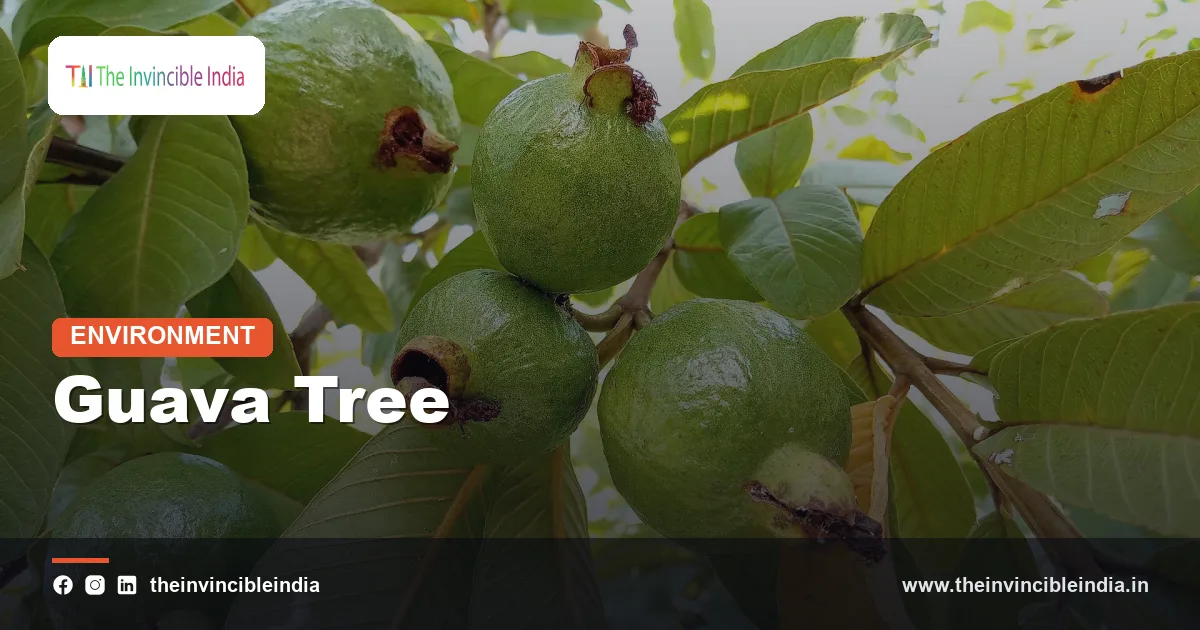
The guava tree (Psidium guajava) is a hardy, small evergreen tree of the myrtle family that bears the round, vitamin-C-rich fruit known in India as amrood, and it is grown across the country’s plains and subtropical belts, with Uttar Pradesh, Madhya Pradesh, Bihar and West Bengal among the leading states. The guava tree is native to tropical Central America, but it has been grown in India for several centuries and is now one of the country’s major fruit crops.
The tree is valued because it grows in poor soils, gives fruit within a few years, and produces a fruit that is cheap, nutritious and widely loved, from roadside chaat stalls to Allahabad’s famous orchards. This explainer covers what the guava tree is, where it came from, how it is grown, its major varieties and what its fruit offers nutritionally.
Quick Facts
| Attribute | Detail |
|---|---|
| Scientific name | Psidium guajava |
| Family | Myrtaceae (myrtle family) |
| Common names | Amrood or amrud (Hindi), peru (Gujarati, Marathi), peyara (Bengali), koyya (Tamil), jama (Telugu), perakka (Malayalam) |
| Native range | Tropical Central America and northern South America |
| Introduced to India | By European traders, probably in the 17th century |
| Typical size | A bushy tree of about 3 to 10 metres with smooth, mottled bark |
| First fruiting | About 2 to 3 years for grafted or layered plants |
| Leading Indian states | Uttar Pradesh, Madhya Pradesh, Bihar, West Bengal, Maharashtra, Gujarat, Andhra Pradesh, Haryana, Punjab |
| Famous varieties | Allahabad Safeda, Lucknow-49 (Sardar), Arka Mridula, Lalit, Hisar Safeda |
Key Takeaways
- The guava tree (Psidium guajava) belongs to the myrtle family, is native to tropical Central America, and has grown in India since European traders brought it, probably in the 17th century.
- Guava fruit is among the richest common fruits in vitamin C, with typical analyses reporting several times the vitamin C of an orange per 100 grams.
- Allahabad Safeda is the best-known Indian guava variety, prized for its white flesh and sweet taste, and is associated with the orchards of Prayagraj in Uttar Pradesh.
- Guava trees are propagated mainly by air layering (gootee) and bear fruit in two to three years, which is far sooner than most fruit trees.
- Indian guava trees flower in three seasons, and the winter crop (mrig bahar) is generally the sweetest and best in quality.
- Fruit fly, guava wilt and anthracnose are the main problems of Indian guava orchards.
What is the guava tree?
The guava tree is a small, evergreen, spreading tree, Psidium guajava, grown for its aromatic, round to pear-shaped fruit, which is eaten raw, juiced or turned into jelly and sweets. It belongs to the family Myrtaceae, which also includes eucalyptus, clove and jamun (Indian blackberry).
The tree has smooth, peeling, greenish-brown bark that gives the trunk a patchy look, and oval leaves with prominent veins. Its white flowers have many fluffy stamens and are visited by bees. The fruit has a thin skin that is green turning yellow when ripe, and inside is a layer of firm flesh surrounding a softer pulp that holds many hard seeds. In white-fleshed varieties the flesh is creamy, and in pink or red-fleshed varieties it is rich in the pigment lycopene.
The guava tree is notable for its toughness. It tolerates drought, poor soils, some salinity and a wide temperature range, which is why it spread so quickly through the tropics after its introduction from the Americas.
Where did the guava tree come from, and how did it reach India?
The guava tree came from tropical Central America and northern South America and reached India through European traders, most probably in the 17th century. Portuguese and Spanish voyagers carried the plant across the tropics, and by the following century the guava was growing widely across the Indian subcontinent.
Because the fruit was readily eaten by birds, bats and mammals that scatter its seeds, the guava spread without much human help. Today the tree has naturalised on forest edges, roadsides and waste ground in many parts of India. Guava is regarded as an invasive plant in some island ecosystems elsewhere in the world, though in India it is mainly valued as a crop.
The common Hindi name “amrood” is also used in the north to describe the fruit, while in the west and south the Portuguese-influenced “peru” or “perakka” family of names is common. These regional names are a reminder of the tree’s arrival through coastal trade.
Where is the guava tree grown in India?
The guava tree is grown across the plains and subtropical parts of India, with Uttar Pradesh, Madhya Pradesh, Bihar, West Bengal, Maharashtra, Gujarat, Andhra Pradesh, Haryana and Punjab among the leading producing states. Guava is one of the major fruit crops in India by area, along with mango, banana and citrus, and India is among the world’s largest producers.
- Uttar Pradesh: the heartland of the crop, especially around Prayagraj (Allahabad) and Lucknow, where the famous Allahabad Safeda and Lucknow-49 varieties are grown.
- Bihar and West Bengal: large areas under both table varieties and traditional types.
- Madhya Pradesh and Maharashtra: expanding commercial orchards supplying city markets.
- Haryana and Punjab: orchards of varieties from Hisar and other research centres, supplying northern markets.
Guava is also a common backyard and roadside tree in villages and towns across the country, often planted from seed and fruiting without any care.
How is the guava tree cultivated?
The guava tree is cultivated by planting vegetatively propagated saplings, most often made by air layering, in well-drained soil with moderate watering and pruning. Air layering, locally called gootee, involves ringing a branch, wrapping the cut in moist material until roots form, and then separating the rooted branch as a new plant. Grafting and budding are also used, and seedlings are used mostly for rootstock or for backyards, because they do not come true to type.
What spacing and care does the guava tree need?
The traditional spacing is about 6 metres between trees, while high-density orchards use much closer spacing with regular pruning to keep the trees small. Young plants need regular watering and protection from frost in cold areas, and mature trees need only occasional irrigation, organic manure and annual pruning. Heading back the branches after harvest stimulates fresh shoots, which carry the next crop.
When do guava trees flower and fruit?
Guava trees flower and fruit three times a year in many parts of India, and growers manage the crop by controlling irrigation to favour the season they want. The three flowering seasons, called bahars, give three harvests:
- Ambe bahar: flowers in February to March, fruits in the rainy season (July to September); fruit is often watery and less sweet.
- Mrig bahar: flowers in June to July, fruits in the winter (November to February); this crop is usually the sweetest and best in quality.
- Hasta bahar: flowers in October, fruits in February to March; it is the least common.
Many orchardists in northern India prefer to concentrate on the winter crop, because the fruit fetches higher prices and suffers less from fruit fly damage than the rainy-season crop. Water stress, root exposure and pruning are the tools used to shift the tree towards the winter flush.
What are the main varieties of guava grown in India?
The main varieties of guava grown in India include Allahabad Safeda, Lucknow-49 (also called Sardar), Hisar Safeda, Arka Mridula, Lalit and Apple Colour. Each has different qualities, such as flesh colour, seed hardness, sweetness and keeping time.
| Variety | Key features | Origin or notes |
|---|---|---|
| Allahabad Safeda | White flesh, sweet, round fruit, good aroma | The classic variety of Prayagraj; widely grown in northern India |
| Lucknow-49 (Sardar) | Large, sweet, with fewer seeds | A leading variety of Uttar Pradesh |
| Hisar Safeda | Fine white flesh, good keeping quality | Released from research at Hisar, Haryana |
| Arka Mridula | Soft seeds, white flesh, sweet | Developed by the Indian Institute of Horticultural Research, Bengaluru |
| Lalit | Saffron-yellow skin, deep pink to red flesh | Developed at the central subtropical horticulture institute in Lucknow |
| Apple Colour | Red-blushed skin, attractive appearance | Popular for eye appeal in markets |
The “Thai guava” or similar large-fruited varieties with thick walls and few seeds have also gained popularity among commercial growers because of their size and shelf life, though some people find them less aromatic than Allahabad Safeda.
What nutrients does guava fruit provide?
Guava fruit provides very high levels of vitamin C, plenty of dietary fibre and modest amounts of potassium, vitamin A and folate for relatively few calories. Typical analyses report vitamin C at roughly two hundred milligrams or more per 100 grams of fruit, which is several times higher than an orange of the same weight.
- Fibre: the edible seeds and flesh give a good amount of dietary fibre, which supports digestion.
- Antioxidants: pink and red varieties contain lycopene, and the fruit has other plant compounds studied for antioxidant effects.
- Glycaemic response: guava has a relatively low glycaemic index, but people with diabetes should still watch portions and consult their doctor.
- Leaves: guava leaf tea is a traditional home remedy for stomach upsets, but scientific evidence is limited and it should not replace medical treatment.
The amount of vitamin C varies with variety, ripeness and storage, so figures should be read as typical ranges, not fixed values.
How is guava eaten and processed in India?
Guava is eaten in India as a fresh fruit, usually cut and sprinkled with chaat masala or black salt, and is also processed into jelly, juice, jam and sweets. Roadside vendors sell sliced amrood with salt, chilli and lemon, especially in winter, when the best crop arrives in markets.
- Guava jelly and jam: the fruit is rich in pectin, which helps jelly set well.
- Guava cheese: a firm, sliceable sweet made from guava pulp and sugar; in Goa it is known as perad.
- Juice and pulp: pink guava pulp is used in drinks, ice creams and desserts.
- Chutneys and pickles: raw guava is used in some regional chutneys.
The tree’s wood is hard and is used for small tools and for fuel, and its leaves and bark contain tannins that have traditionally been used in dyeing and tanning.
What climate and soil does the guava tree need?
The guava tree needs a warm tropical or subtropical climate and grows best in well-drained loamy soil, although it tolerates a much wider range of conditions than most fruit trees. It grows from the plains up to elevations of about 1,500 metres in suitable areas, thrives in regions with moderate rainfall, and can bear in drier tracts with irrigation.
- Temperature: the tree grows best in warm weather, but mature trees survive light cold; young plants can be damaged by hard frost in the northern plains.
- Soil: guava tolerates sandy, clayey and mildly saline or alkaline soils, though waterlogging encourages root diseases.
- Water: established trees withstand dry spells, but regular irrigation at flowering and fruit growth improves yield and fruit size.
- Light: the tree needs full sun for good fruit colour and sweetness, so orchards avoid heavy shade.
This adaptability explains why guava is common both on large commercial farms and on small homesteads, and why it is considered a suitable crop for marginal and rain-fed lands where mango or citrus would struggle.
Why is the guava tree important for farmers and the environment?
The guava tree is important for farmers because it gives a quick, regular income from small plots and for the environment because its fruit feeds birds, bats and other wildlife. A grafted tree begins fruiting within a few years and can bear for many years with modest inputs, which makes guava attractive to smallholders who cannot wait a decade for returns, as they must with mango.
Guava fruits are eaten by parrots, mynas, bulbuls, squirrels and fruit bats, and its flowers support bees. Guava is also a common feature of village homesteads, where one or two trees supply fruit for the family and for neighbours. As a fresh fruit it is relatively affordable, which is why it is sometimes described as the “poor man’s apple”, although that phrase understates its nutritional value.
Because of the tree’s habit of escaping into the wild, orchard owners and foresters in some regions watch for seedlings that spread beyond cultivated areas, particularly on island and forest-edge habitats where native vegetation could be displaced.
What pests and diseases affect guava orchards?
The main pests and diseases of guava orchards in India are fruit flies, guava wilt, anthracnose and mealybugs. Fruit fly maggots spoil ripening fruit, especially in the rainy-season crop, and growers fight them with traps, sanitation and bagging of individual fruits.
- Fruit fly: females lay eggs in ripening fruit; maggots then make the flesh soft and unmarketable. Bagging fruits and picking up fallen fruit help.
- Guava wilt: a soil-borne disease, in which branches wilt and the tree dies, caused by a fungus, sometimes helped by root nematodes. It is a serious problem in parts of Uttar Pradesh and Bihar, and resistant rootstocks and good drainage are used against it.
- Anthracnose: a fungal disease causing dark sunken spots on fruit and twigs, especially in humid weather.
- Mealybugs and scale insects: sap-sucking pests that weaken shoots and fruit.
Good orchard hygiene, balanced fertiliser use and timely pruning keep these problems manageable. Crop regulation to concentrate fruiting in winter also reduces fruit fly pressure.
Bottom Line
The guava tree is one of India’s most practical fruit trees: easy to grow, quick to bear and rich in vitamin C and fibre. From Allahabad Safeda in Prayagraj to red-fleshed Lalit in Lucknow, its varieties suit different tastes, and good orchard management against fruit fly and wilt keeps the crop profitable for growers.
Frequently Asked Questions
Is the guava tree native to India?
No, the guava tree is not native to India; it originated in tropical Central America and northern South America. It was introduced by European traders, probably in the 17th century. It has since naturalised widely and is now a major Indian fruit crop.
How long does a guava tree take to bear fruit?
A grafted or air-layered guava tree usually begins to bear fruit in about two to three years. Trees grown from seed take longer and give fruit of variable quality. Grafted or layered plants are therefore preferred for orchards.
Which is the best guava variety in India?
Allahabad Safeda is widely regarded as the best-known and most popular guava variety in India for its sweet white flesh and aroma. Lucknow-49 (Sardar) is another leading variety, and Lalit offers red flesh. The best choice depends on taste, region and market.
When is the best season for guava in India?
The best season for guava in India is winter, from about November to February. This crop, called the mrig bahar crop, is generally sweeter and better in quality than the rainy-season crop. Winter guavas also suffer less fruit fly damage.
Does guava have more vitamin C than orange?
Yes, guava typically has several times more vitamin C than an orange of the same weight. Typical analyses report roughly two hundred milligrams or more per 100 grams of guava. Exact levels vary with variety, ripeness and storage.
What are the main diseases of the guava tree?
The main diseases of the guava tree are guava wilt and anthracnose, along with pest damage from fruit flies. Guava wilt is a soil-borne disease that can kill whole trees, especially in poorly drained soils. Using resistant rootstocks, good drainage, fruit bagging and orchard sanitation helps to control these problems.
{“@context”:”https://schema.org”,”@graph”:[{“@type”:”FAQPage”,”mainEntity”:[{“@type”:”Question”,”name”:”Is the guava tree native to India?”,”acceptedAnswer”:{“@type”:”Answer”,”text”:”No, the guava tree is not native to India; it originated in tropical Central America and northern South America. It was introduced by European traders, probably in the 17th century. It has since naturalised widely and is now a major Indian fruit crop.”}},{“@type”:”Question”,”name”:”How long does a guava tree take to bear fruit?”,”acceptedAnswer”:{“@type”:”Answer”,”text”:”A grafted or air-layered guava tree usually begins to bear fruit in about two to three years. Trees grown from seed take longer and give fruit of variable quality. Grafted or layered plants are therefore preferred for orchards.”}},{“@type”:”Question”,”name”:”Which is the best guava variety in India?”,”acceptedAnswer”:{“@type”:”Answer”,”text”:”Allahabad Safeda is widely regarded as the best-known and most popular guava variety in India for its sweet white flesh and aroma. Lucknow-49 (Sardar) is another leading variety, and Lalit offers red flesh. The best choice depends on taste, region and market.”}},{“@type”:”Question”,”name”:”When is the best season for guava in India?”,”acceptedAnswer”:{“@type”:”Answer”,”text”:”The best season for guava in India is winter, from about November to February. This crop, called the mrig bahar crop, is generally sweeter and better in quality than the rainy-season crop. Winter guavas also suffer less fruit fly damage.”}},{“@type”:”Question”,”name”:”Does guava have more vitamin C than orange?”,”acceptedAnswer”:{“@type”:”Answer”,”text”:”Yes, guava typically has several times more vitamin C than an orange of the same weight. Typical analyses report roughly two hundred milligrams or more per 100 grams of guava. Exact levels vary with variety, ripeness and storage.”}},{“@type”:”Question”,”name”:”What are the main diseases of the guava tree?”,”acceptedAnswer”:{“@type”:”Answer”,”text”:”The main diseases of the guava tree are guava wilt and anthracnose, along with pest damage from fruit flies. Guava wilt is a soil-borne disease that can kill whole trees, especially in poorly drained soils. Using resistant rootstocks, good drainage, fruit bagging and orchard sanitation helps to control these problems.”}}]}]}


