

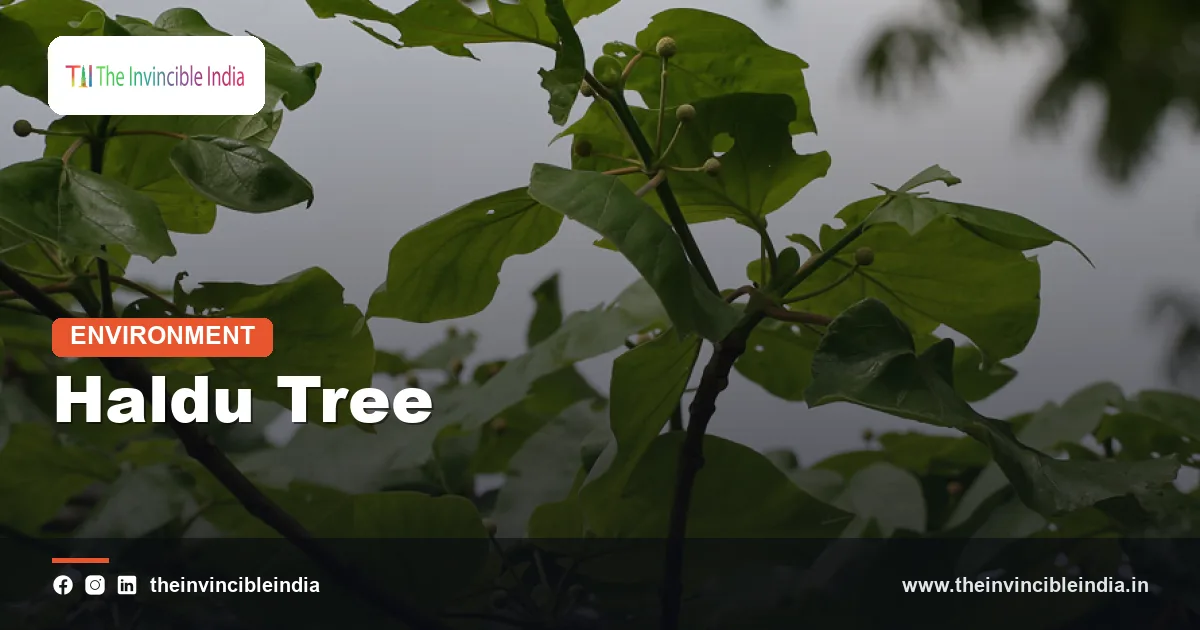
Haldu is the common Hindi name of Haldina cordifolia, a tall deciduous hardwood tree of Indian forests that is known for its heart-shaped leaves, its ball-like yellowish flower heads and its fine yellow timber, which is used for furniture, carving, turnery and construction. The tree is native to the Indian subcontinent and parts of Southeast Asia, and it grows in dry and moist deciduous forests from the Himalayan foothills to peninsular India.
The name haldu comes from haldi, the Hindi word for turmeric, and refers to the bright yellow colour of the heartwood. Haldu is a handsome, valuable and widely distributed forest tree, though it is far less known to the public than teak or sal, and it is sometimes still listed under its older scientific name, Adina cordifolia.
| Quick Facts | Details |
|---|---|
| Common names | Haldu, haldi (Hindi); manjakadambu (Tamil); yellow teak (trade and English usage) |
| Scientific name | Haldina cordifolia (earlier Adina cordifolia) |
| Family | Rubiaceae (the coffee and madder family) |
| Native range | India, Nepal, Bangladesh, Sri Lanka, Myanmar, Thailand and neighbouring parts of Southeast Asia |
| Where grown in India | Deciduous forests of the Himalayan foothills, central India, the Eastern Ghats and the Western Ghats |
| Part used | Heartwood (timber), bark, leaves and flower heads |
| Products and uses | Furniture, carving, turnery, beams, boards, agricultural implements, plywood and folk medicine |
| Tree size | Large deciduous tree often 25 to 30 metres tall with a straight trunk |
| Notable fact | The yellow heartwood gives the tree its name, linked to the colour of turmeric (haldi) |
Key Takeaways
- Haldu is the Hindi name for Haldina cordifolia, a large deciduous hardwood tree native to India and neighbouring countries.
- The word haldu derives from haldi, the Hindi word for turmeric, because the heartwood of the haldu tree is yellow.
- Haldu timber is yellowish-brown, fine-grained and moderately hard, and it is used for furniture, carving, turnery and construction.
- The haldu tree belongs to the Rubiaceae family, which also includes coffee and the kadamba tree.
- Haldu bears distinctive ball-shaped flower heads, and its leaves are broad and heart-shaped at the base.
- Haldu grows in deciduous forests across the Himalayan foothills, central India and the Western and Eastern Ghats.
What is the haldu tree?
The haldu tree is a large deciduous tree of the coffee family, Rubiaceae, whose scientific name is Haldina cordifolia, and it is a valued source of yellow hardwood in Indian forests. It stands out among forest trees for its tall, straight, cylindrical trunk, which may be clear of branches for a considerable height in dense forest.
The tree commonly reaches 25 to 30 metres, and in a favourable site it can grow even taller. Its crown is dense and rounded, and its bark is rough, greyish brown and cracked into small plates. When freshly cut, the inner wood shows a bright yellow colour that later deepens to a warm brown.
Haldu is a deciduous tree, which means that it sheds its leaves for a short period in the dry season. The new leaves come with the warmer weather, and they are thin and tender before hardening into the broad green foliage of the monsoon.
How can you identify a haldu tree?
A haldu tree can be identified by its broad, heart-shaped leaves with long stalks, its globe-shaped flower heads, and its tall, straight trunk. The species name cordifolia means heart-leaved, and the leaf blade does indeed have a rounded or heart-shaped base and a pointed tip.
The key identification features can be listed as follows.
- Leaves: opposite, large and broad, with a heart-shaped base, and often with a slight softness on the underside.
- Flowers: small, pale yellow, tightly packed into round heads about the size of a small ball, appearing in the middle of the year.
- Fruit: tiny capsules that cluster in dense, round fruiting heads and release very small seeds.
- Bark: rough, grey-brown and fissured.
- Stipules: leaf-like scales at the base of the leaf stalk, typical of members of the coffee family.
The round flower head is the most reliable feature. It looks like a pom-pom made up of many tiny flowers, and a single tree in bloom can carry hundreds of these heads.
Why is the tree called haldu?
The tree is called haldu because the Hindi word haldi means turmeric, and the heartwood of the haldu tree is a similar bright yellow. In many Indian languages, trees and plants are named for their visible properties, and the colour of the wood was an obvious feature to carpenters and forest workers.
The yellow colour also explains the English trade name yellow teak, which is sometimes used for haldu timber even though the tree is not a true teak. True teak belongs to the genus Tectona in the family Lamiaceae, and haldu belongs to the unrelated family Rubiaceae. The resemblance is only in the golden colour and the general suitability for furniture.
In Tamil the tree is known as manjakadambu, meaning yellow kadamba, a reference to a close botanical relative that also forms round flower heads. This link is useful for understanding the plant: haldu and kadamba share the same family and a similar flower structure.
Where does haldu grow in India?
Haldu grows in the dry and moist deciduous forests of India, from the foothills of the Himalaya through central and eastern India to the Western Ghats and parts of the peninsula. It is common in states with extensive deciduous forests, such as Uttarakhand, Uttar Pradesh, Madhya Pradesh, Chhattisgarh, Odisha, Maharashtra, Karnataka and Kerala.
The tree is often found on moist, deep, well-drained soils, along valley bottoms and near streams, where it can grow tall. It also occurs with other deciduous species such as sal, teak, bamboo and terminalia, forming a part of the forest canopy. Outside India, haldu occurs in Nepal, Bangladesh, Sri Lanka, Myanmar and Thailand.
Foresters sometimes plant haldu in plantations and avenue lines, but it is mostly harvested from natural stands, so a significant portion of its supply still depends on managed forests.
What is haldu wood like?
Haldu wood is yellowish to light brown, moderately hard and fine in texture, with a smooth finish and a faint lustre when polished. It is a moderately heavy timber, with a straight to slightly interlocked grain, and it seasons with comparatively little shrinkage and cracking when dried carefully.
The properties that carpenters appreciate are summarised below.
| Property | Haldu timber |
|---|---|
| Colour | Yellow to yellowish-brown heartwood, with a paler sapwood |
| Texture | Fine and even, with a smooth surface after planing |
| Weight and hardness | Moderately heavy and moderately hard |
| Seasoning | Dries with little warping when stacked well |
| Working qualities | Saws, planes, turns and carves cleanly |
| Durability | Moderate; best used indoors or under cover |
The wood takes polish well and holds screws and nails reasonably. It is not as durable in the open as teak, and it is therefore usually kept for indoor furniture and under-cover structures, or treated if it must be exposed.
What is haldu timber used for?
Haldu timber is used mainly for furniture, carving, turnery, building work and agricultural implements, because it is easy to work and takes a smooth finish. It has long been a choice of carpenters in central and northern India for tables, cots, doors, window frames and cabinets.
The main uses of haldu wood include the following.
- Furniture and cabinet work: chairs, tables, beds and wardrobes.
- Carving and turnery: toys, bowls, handles, spindles and decorative items.
- Construction: beams, rafters, planks, door and window frames used indoors.
- Agricultural implements: ploughs, tool handles and cart parts in rural areas.
- Plywood and veneer: peeled and sliced for decorative and structural panels.
- Musical items and small crafts: the even grain suits small, finely turned objects.
Haldu is not a bulk plantation timber like eucalyptus or poplar. It is valued for its quality in specific uses, and a good log can command a better price than ordinary building wood.
How does the haldu tree grow and reproduce?
The haldu tree grows steadily and reproduces by seed, flowering in the middle of the year and ripening its tiny seed capsules in the cooler months. It grows well on deep, moist soil, and young trees need light and space in the forest to grow straight.
The seeds are extremely small and light, so they are carried by wind and dropped over a wide area. Regeneration in natural forest is helped by gaps in the canopy that let in sunlight. Seedlings are raised in forest nurseries and planted out at the start of the rainy season.
Haldu is considered a medium-speed grower, slower than plantation species like gamhar or eucalyptus, but faster than slow hardwoods such as sal. The trunk is usually tall and clear, which suits it to the production of long, straight timbers.
Does the haldu tree have medicinal and other uses?
Haldu has folk and traditional medicinal uses, mostly of its bark and leaves, and it also has ecological value as a forest tree and a source of nectar. These medicinal uses are traditional and have not been established as treatments, so any use should be guided by a qualified practitioner.
The tree has other uses besides timber and traditional medicine.
- Bark: used in some local practices, and the tree features in descriptions of traditional remedies.
- Leaves: lopped as fodder for cattle and goats in some regions.
- Flowers: provide nectar and pollen to bees and other insects.
- Shade and ecology: the tall crown shelters birds and supports forest wildlife.
How does haldu compare with teak and sal?
Haldu differs from teak and sal in family, wood colour and durability, and it is generally regarded as a good-quality but less durable hardwood than either of them. Teak is golden-brown and extremely durable outdoors, sal is a very heavy and strong construction timber, and haldu is a lighter, finer-grained wood suited to furniture and carving.
| Feature | Haldu | Teak | Sal |
|---|---|---|---|
| Scientific name | Haldina cordifolia | Tectona grandis | Shorea robusta |
| Family | Rubiaceae | Lamiaceae | Dipterocarpaceae |
| Heartwood colour | Yellow to yellowish-brown | Golden to dark brown | Light to dark brown |
| Texture | Fine and even | Coarse to moderately fine, oily | Coarse, with interlocked grain |
| Outdoor durability | Moderate | Very high | High |
| Main use | Furniture, carving, turnery | Premium furniture, doors, shipbuilding | Beams, sleepers, heavy construction |
Is the haldu tree protected or under threat?
The haldu tree is not generally listed as globally threatened, but it is a valuable forest species, and its felling in natural forests is regulated under Indian forest laws and state rules. Forest departments control the cutting and transport of timber from government forests, and permits are required for many species.
Pressure on haldu arises from the demand for its timber, forest clearing and the loss of old, tall trees that take decades to replace. Conservation advice for such species usually involves sustainable harvesting, protection of seed trees and planting of new stock in suitable sites. Local rules on felling on private land differ from state to state, so landowners should check with the forest department before cutting a mature tree.
Why does the haldu tree matter?
The haldu tree matters because it adds to the diversity of India’s deciduous forests and supplies a fine hardwood that reduces dependence on a few famous timber species. A forest with many valuable species is more resilient than one dominated by a single tree, and haldu is one of the quieter contributors to that mix.
For rural communities, a species like haldu can also supply local materials for tools, furniture and houses. For wildlife, its flowers, canopy and seeds are part of the web of life in the forest. Understanding such lesser-known trees helps the public to see the Indian forest as a varied ecosystem, not just as a source of teak and sal.
Bottom Line
Haldu, or Haldina cordifolia, is a tall Indian hardwood with heart-shaped leaves, ball-shaped flower heads and yellow timber that is prized for furniture and carving. It is a valuable but often overlooked part of the country’s deciduous forests.
Frequently Asked Questions
What is haldu?
Haldu is the Hindi name for Haldina cordifolia, a large deciduous hardwood tree of Indian forests. It has heart-shaped leaves, round yellowish flower heads and yellow timber. It belongs to the coffee family, Rubiaceae.
Why is haldu called haldu?
Haldu gets its name from haldi, the Hindi word for turmeric, because the heartwood of the tree is bright yellow. Carpenters and forest workers named the tree after its visible wood colour. The timber is sometimes called yellow teak in English, although the tree is not a true teak.
What is haldu wood used for?
Haldu wood is used for furniture, carving, turnery, indoor building work and agricultural implements. It is fine-grained, moderately hard and easy to work, and it takes a good polish. It is less durable than teak when exposed to the weather.
Where does the haldu tree grow in India?
The haldu tree grows in deciduous forests from the Himalayan foothills through central and eastern India to the Western and Eastern Ghats. It is found in states such as Uttarakhand, Madhya Pradesh, Chhattisgarh, Odisha, Maharashtra, Karnataka and Kerala. It prefers deep, moist soils near valleys and streams.
Is haldu the same as turmeric?
No, haldu is a large forest tree, while turmeric, or haldi, is a herb whose underground stem is used as a spice. The tree is named after turmeric only because its heartwood has a similar yellow colour. The two plants belong to entirely different families.
How can you recognise a haldu tree?
A haldu tree is recognised by its tall, straight trunk, its broad heart-shaped leaves and its round, ball-like flower heads. The bark is grey-brown and rough. Cut wood shows a bright yellow heartwood.
{“@context”:”https://schema.org”,”@graph”:[{“@type”:”FAQPage”,”mainEntity”:[{“@type”:”Question”,”name”:”What is haldu?”,”acceptedAnswer”:{“@type”:”Answer”,”text”:”Haldu is the Hindi name for Haldina cordifolia, a large deciduous hardwood tree of Indian forests. It has heart-shaped leaves, round yellowish flower heads and yellow timber. It belongs to the coffee family, Rubiaceae.”}},{“@type”:”Question”,”name”:”Why is haldu called haldu?”,”acceptedAnswer”:{“@type”:”Answer”,”text”:”Haldu gets its name from haldi, the Hindi word for turmeric, because the heartwood of the tree is bright yellow. Carpenters and forest workers named the tree after its visible wood colour. The timber is sometimes called yellow teak in English, although the tree is not a true teak.”}},{“@type”:”Question”,”name”:”What is haldu wood used for?”,”acceptedAnswer”:{“@type”:”Answer”,”text”:”Haldu wood is used for furniture, carving, turnery, indoor building work and agricultural implements. It is fine-grained, moderately hard and easy to work, and it takes a good polish. It is less durable than teak when exposed to the weather.”}},{“@type”:”Question”,”name”:”Where does the haldu tree grow in India?”,”acceptedAnswer”:{“@type”:”Answer”,”text”:”The haldu tree grows in deciduous forests from the Himalayan foothills through central and eastern India to the Western and Eastern Ghats. It is found in states such as Uttarakhand, Madhya Pradesh, Chhattisgarh, Odisha, Maharashtra, Karnataka and Kerala. It prefers deep, moist soils near valleys and streams.”}},{“@type”:”Question”,”name”:”Is haldu the same as turmeric?”,”acceptedAnswer”:{“@type”:”Answer”,”text”:”No, haldu is a large forest tree, while turmeric, or haldi, is a herb whose underground stem is used as a spice. The tree is named after turmeric only because its heartwood has a similar yellow colour. The two plants belong to entirely different families.”}},{“@type”:”Question”,”name”:”How can you recognise a haldu tree?”,”acceptedAnswer”:{“@type”:”Answer”,”text”:”A haldu tree is recognised by its tall, straight trunk, its broad heart-shaped leaves and its round, ball-like flower heads. The bark is grey-brown and rough. Cut wood shows a bright yellow heartwood.”}}]}]}


