

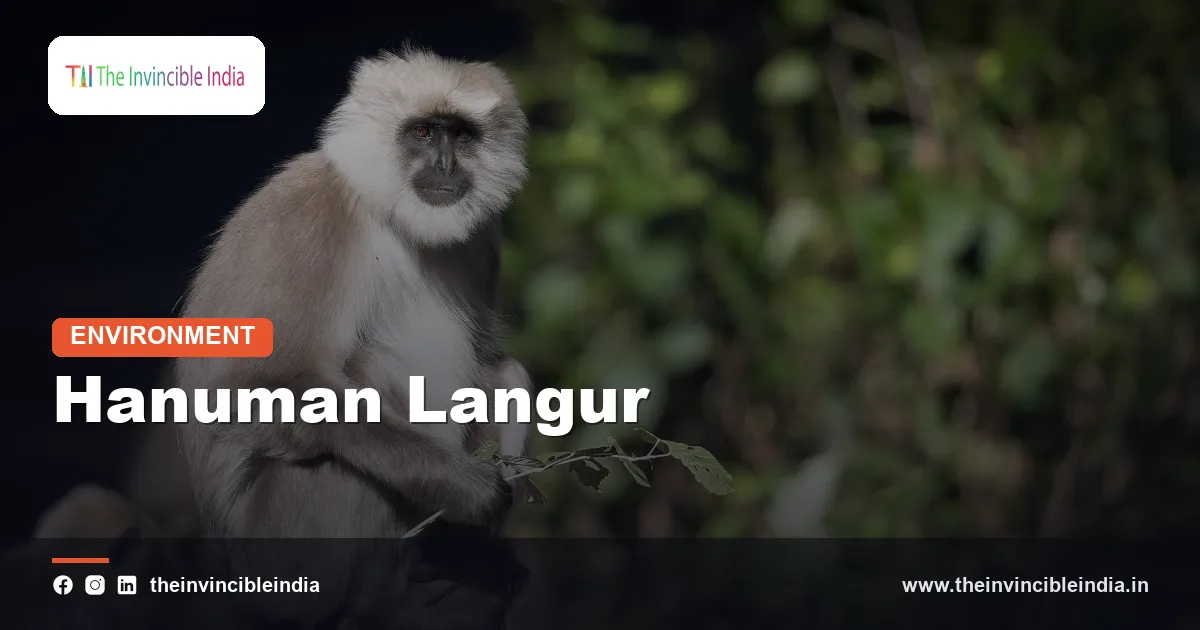
The Hanuman langur is a grey, long-tailed, black-faced leaf monkey of the genus Semnopithecus, found across much of the Indian subcontinent, and it is revered in India because of its association with the Hindu deity Hanuman. The Hanuman langur, also called the grey langur, lives in troops, eats mainly leaves, and is one of the few wild primates that share space with people in temple towns, villages and cities.
This explainer covers how to identify the Hanuman langur, which species the name covers, where it lives, what it eats, how troops are organised, how it leaps, and why it is respected across India. Information was last reviewed on 23 October 2026.
| Quick Fact | Detail |
|---|---|
| Common names | Hanuman langur, grey langur, common langur |
| Scientific genus | Semnopithecus (the grey or Hanuman langurs); the northern plains grey langur is Semnopithecus entellus |
| Family | Cercopithecidae, subfamily Colobinae (leaf-eating monkeys) |
| Size | Head and body roughly 50 to 80 cm, with a tail that is longer than the body; adult males commonly weigh around 15 to 20 kg, females less |
| Key features | Grey to buff fur, black face, hands and feet, and a long tail that arches forward over the back |
| Range | Much of India, Nepal, Bangladesh, Pakistan, Bhutan and Sri Lanka, from semi-desert to the Himalayan foothills and higher valleys |
| Diet | Mostly leaves, plus fruit, flowers, seeds, bark and gum |
| Social unit | Troops of roughly 10 to 40 or more, with one or more adult males |
| Cultural link | Associated with Hanuman, the devoted vanara of the Ramayana |
Key Takeaways
- The Hanuman langur is a grey, black-faced leaf monkey of the genus Semnopithecus that lives across India and neighbouring countries.
- The Hanuman langur eats mostly leaves and uses a multi-chambered stomach to ferment tough plant material, which sets it apart from macaques.
- Hanuman langur troops are organised around related females, with one or several adult males, and young males often form separate bachelor bands.
- The Hanuman langur is revered in India because of its association with Hanuman, and troops are often tolerated or fed at temples.
- The Hanuman langur is an agile climber and leaper that can cover several metres between trees, and it holds its long tail curved forward over its back.
- The Hanuman langur is protected under India’s Wildlife (Protection) Act, 1972, and it is generally classified as Least Concern, although some regional species are of greater concern.
What Is the Hanuman Langur?
The Hanuman langur is a large, mostly leaf-eating Old World monkey belonging to the genus Semnopithecus in the subfamily Colobinae, and it is the best-known monkey of the Indian plains after the rhesus macaque. Its common name honours Hanuman, the monkey-devotee of Lord Rama in the Ramayana.
Langurs differ from macaques in body shape and behaviour. They have slim bodies, long limbs and long tails, and they spend more time in trees. Macaques are stockier, have shorter tails and eat a more varied diet.
The term “Hanuman langur” is used loosely for several closely related forms. For many years, all Indian grey langurs were treated as one species, Semnopithecus entellus. Later studies, particularly those from the early 2000s, split them into several species, though the exact number and boundaries are still debated.
Which Species Are Called the Hanuman Langur?
The name Hanuman langur is applied to the grey langurs of the genus Semnopithecus, which many authorities now divide into around seven species, including the northern plains grey langur (Semnopithecus entellus), the southern plains grey langur (Semnopithecus dussumieri), the Tarai grey langur (Semnopithecus hector), the Nepal grey langur (Semnopithecus schistaceus), the Kashmir grey langur (Semnopithecus ajax) and the black-footed grey langur (Semnopithecus hypoleucos).
Not all authorities accept the same list, and classification is still being refined with genetic data. For general readers, the practical point is that “Hanuman langur” describes a group of similar grey monkeys with black faces that replace one another across regions.
| Species or form | General region | Notes |
|---|---|---|
| Northern plains grey langur (S. entellus) | Northern and central India plains | The form most people mean by “Hanuman langur” |
| Southern plains grey langur (S. dussumieri) | Western and southern India | Often seen near towns and temples |
| Black-footed grey langur (S. hypoleucos) | South-western India (Western Ghats region) | Darker feet and a more forest-bound habit |
| Tarai grey langur (S. hector) | Foothills of the Himalayas | Tarai and lower hill forests |
| Nepal grey langur (S. schistaceus) | Himalayan belt | Occurs at high elevations |
| Kashmir grey langur (S. ajax) | Western Himalaya | One of the more threatened forms |
How Do You Identify a Hanuman Langur?
A Hanuman langur is identified by its silvery-grey or buff body, black face with a prominent brow, black hands and feet, and a very long tail that is carried arched forward over the back. Adults are larger and more slender than rhesus macaques, and their movement is smooth and graceful.
Field marks and behaviour
- Face: black and hairless, framed by pale fur and a tuft of hair above the brow.
- Tail: longer than the body, usually carried in a curve forward, and it trails when the animal is on the ground.
- Infants: born with dark fur and lighter skin, they turn grey as they mature.
- Voice: a deep, loud “whoop” call, especially from males, and softer grunts within the troop.
Adult males are larger than females, and they have thicker shoulders and stronger canines. Females often care for and handle infants other than their own, a behaviour known as allomothering.
Where Does the Hanuman Langur Live?
The Hanuman langur lives across much of the Indian subcontinent, in habitats ranging from semi-arid scrub and dry deciduous forest to moist forest and the Himalayan foothills, and some forms reach high-altitude valleys. It is also found in Nepal, Bangladesh, Bhutan, Pakistan and Sri Lanka.
The species is highly adaptable. In Rajasthan, troops occupy dry thorn forest and rocky hills; in the Gangetic plains, they live on village trees and temple compounds; in the Himalayan foothills, they use oak and pine forest. The monkey is generally absent from very dense rainforest, where other primates are better adapted.
Because langur species are scattered over a large area, local populations are described with caution. Surveys vary in method, so reported numbers should be read as estimates, not as exact counts.
What Does the Hanuman Langur Eat?
The Hanuman langur eats mostly leaves, supplemented by fruit, flowers, seeds, buds, bark and gum, and it relies on a specialised stomach to digest tough plant material. Mature leaves, young shoots and flowers from trees such as neem, peepal, banyan, tamarind and acacia are common foods.
The stomach of the Hanuman langur has several chambers, where bacteria ferment cellulose in a way that resembles the digestion of cattle. This system lets it extract nutrients from leaves that would be nearly useless to a macaque, and it allows the langur to survive in seasonally dry habitats.
The digestive process is slow, so langurs spend much of the day resting after meals. In farmland and towns, they also eat crops, garden produce, and food offered at temples, which can lead to conflict with people.
In many forests, langurs feed alongside chital deer. The langurs drop leaves and fruit, which the deer eat, and the deer’s alarm calls warn langurs of predators; this is a well-known example of cooperation between species in Indian forests.
How Are Hanuman Langur Troops Organised?
Hanuman langur troops are organised around groups of related females and their young, with one or several resident adult males, and young males typically leave and join all-male bands. Troop sizes vary widely, often between about 10 and 40 or more animals, depending on habitat and food.
Females form the stable core of the group, and they remain in the troop where they were born. Males compete for the right to be the resident male, and a takeover by outside males can trigger conflict.
Infanticide and male takeovers
Researchers studying Hanuman langurs at Mount Abu in Rajasthan in the 1970s documented infanticide by new males following takeovers, and the observations became influential in the study of primate behaviour. Interpretations of this behaviour have been debated, and scientists continue to study how it relates to breeding success.
Daily life
- Morning: feeding in trees, moving to sunny perches to warm up.
- Midday: resting in shade, grooming and play among juveniles.
- Afternoon: more feeding, sometimes on the ground, followed by travel to sleeping trees.
- Night: sleeping in tall trees or on cliffs, away from ground predators such as leopards and dogs.
How Agile Is the Hanuman Langur?
The Hanuman langur is highly agile, capable of leaping several metres between branches and running quickly along the ground on all fours, and its long limbs and tail give it excellent balance. It is both an arboreal and a terrestrial primate, and it often feeds on the ground in open habitats.
When alarmed by predators such as leopards, tigers, dholes or dogs, a troop may scatter into the canopy, give loud alarm calls and leap from tree to tree. Males often make loud whooping calls that carry over long distances and help other troop members locate each other.
The tail works like a counterweight. While the animal moves along a branch or leaps between supports, it adjusts the tail to keep its balance. Anecdotal reports of very long leaps exist, but specific distances vary with the terrain and the animal.
Why Is the Hanuman Langur Revered in India?
The Hanuman langur is revered in India because it is associated with Hanuman, the monkey-devotee of Lord Rama in the Ramayana, and many people regard it as sacred. In popular belief, the langur’s black face and hands are linked to the fire of Lanka that Hanuman is said to have started.
The vanaras of the Ramayana are monkey-like beings, and which actual animal they represent is a matter of tradition rather than natural history. Many communities associate the langur with Hanuman, while others link the rhesus macaque to him. Both species are respected in different regions, and temples such as those in Vrindavan, Jaipur and other pilgrimage towns have resident monkeys.
Because of this reverence, troops of langurs are often fed at temples and are rarely harmed. The respect for Hanuman has therefore helped conserve langurs in some regions, though it can also lead to overfeeding and dependence on human food.
How Do Hanuman Langurs Live With People?
Hanuman langurs live alongside people in many Indian towns and villages by feeding on trees, crops and offerings, and by sleeping on rooftops or in tall trees. They are generally less aggressive than rhesus macaques and are often tolerated, although conflict does occur when they raid fields and gardens.
In some cities, langurs have been used to scare away rhesus macaques from public buildings, because macaques are afraid of the larger langur. This practice has raised animal welfare and legal questions, since the Wildlife (Protection) Act, 1972 restricts capturing and keeping wild langurs.
- Do not feed wild langurs processed food, which harms their health and encourages dependence.
- Keep food out of reach, since troops quickly learn to open windows and bags.
- Avoid direct eye contact and sudden movement near large males.
- Report injured or electrocuted animals to forest or wildlife authorities.
Electrocution on power lines, road accidents and attacks by dogs are major risks for urban troops. Better planning, insulated cables and canopy bridges on busy roads can reduce these threats.
Is the Hanuman Langur Endangered?
The Hanuman langur is not considered endangered as a group, and the best-known forms are generally listed as Least Concern, although some regional species and populations, such as the Kashmir grey langur, are of greater concern. Habitat loss, hunting in some regions, electrocution and conflict with farmers are the main pressures.
Conservation status differs between species, and assessments are updated periodically, so readers should check current listings for any particular form. In India, langurs are protected by law, and their capture or keeping is regulated.
Bottom Line
The Hanuman langur is a grey, black-faced leaf monkey that shapes both forests and towns across India through its troop life, its digestive specialisation and its religious significance. Respect for the animal, combined with careful feeding practices and safe infrastructure, helps langurs and people share space.
Frequently Asked Questions
What is a Hanuman langur?
A Hanuman langur is a grey, black-faced leaf monkey of the genus Semnopithecus that lives across India and neighbouring countries. It has a long tail and slender limbs, and it eats mostly leaves. It is named after Hanuman, the monkey-devotee of Lord Rama in the Ramayana.
Why is the Hanuman langur considered sacred in India?
The Hanuman langur is considered sacred because it is associated with the deity Hanuman in Hindu tradition. Popular belief links its black face and hands to the fire of Lanka in the Ramayana. As a result, troops are often tolerated and fed at temples.
What is the difference between a langur and a macaque?
A langur is a slender, long-tailed leaf-eating monkey, while a macaque is a stockier, shorter-tailed monkey with a more varied diet. Hanuman langurs have black faces and grey fur, and rhesus macaques have pinkish faces and brownish fur. Langurs spend more time in trees and have a specialised multi-chambered stomach.
What does the Hanuman langur eat?
The Hanuman langur eats mostly leaves, supplemented by fruit, flowers, seeds, buds, bark and gum. Its multi-chambered stomach ferments tough plant material. In towns and farmland, it also eats crops and food offered by people.
How big are Hanuman langur troops?
Hanuman langur troops usually have about 10 to 40 or more animals, depending on habitat and food. They are built around related females and their young, with one or several adult males. Young males often leave and form all-male bands.
Is the Hanuman langur protected by law in India?
The Hanuman langur is protected under India’s Wildlife (Protection) Act, 1972, which restricts hunting, capture and keeping of wild animals. Most Hanuman langurs are classified as Least Concern globally, but some regional species face more pressure. Readers should check current schedules and assessments for specific species.
{“@context”:”https://schema.org”,”@graph”:[{“@type”:”FAQPage”,”mainEntity”:[{“@type”:”Question”,”name”:”What is a Hanuman langur?”,”acceptedAnswer”:{“@type”:”Answer”,”text”:”A Hanuman langur is a grey, black-faced leaf monkey of the genus Semnopithecus that lives across India and neighbouring countries. It has a long tail and slender limbs, and it eats mostly leaves. It is named after Hanuman, the monkey-devotee of Lord Rama in the Ramayana.”}},{“@type”:”Question”,”name”:”Why is the Hanuman langur considered sacred in India?”,”acceptedAnswer”:{“@type”:”Answer”,”text”:”The Hanuman langur is considered sacred because it is associated with the deity Hanuman in Hindu tradition. Popular belief links its black face and hands to the fire of Lanka in the Ramayana. As a result, troops are often tolerated and fed at temples.”}},{“@type”:”Question”,”name”:”What is the difference between a langur and a macaque?”,”acceptedAnswer”:{“@type”:”Answer”,”text”:”A langur is a slender, long-tailed leaf-eating monkey, while a macaque is a stockier, shorter-tailed monkey with a more varied diet. Hanuman langurs have black faces and grey fur, and rhesus macaques have pinkish faces and brownish fur. Langurs spend more time in trees and have a specialised multi-chambered stomach.”}},{“@type”:”Question”,”name”:”What does the Hanuman langur eat?”,”acceptedAnswer”:{“@type”:”Answer”,”text”:”The Hanuman langur eats mostly leaves, supplemented by fruit, flowers, seeds, buds, bark and gum. Its multi-chambered stomach ferments tough plant material. In towns and farmland, it also eats crops and food offered by people.”}},{“@type”:”Question”,”name”:”How big are Hanuman langur troops?”,”acceptedAnswer”:{“@type”:”Answer”,”text”:”Hanuman langur troops usually have about 10 to 40 or more animals, depending on habitat and food. They are built around related females and their young, with one or several adult males. Young males often leave and form all-male bands.”}},{“@type”:”Question”,”name”:”Is the Hanuman langur protected by law in India?”,”acceptedAnswer”:{“@type”:”Answer”,”text”:”The Hanuman langur is protected under India’s Wildlife (Protection) Act, 1972, which restricts hunting, capture and keeping of wild animals. Most Hanuman langurs are classified as Least Concern globally, but some regional species face more pressure. Readers should check current schedules and assessments for specific species.”}}]}]}


