

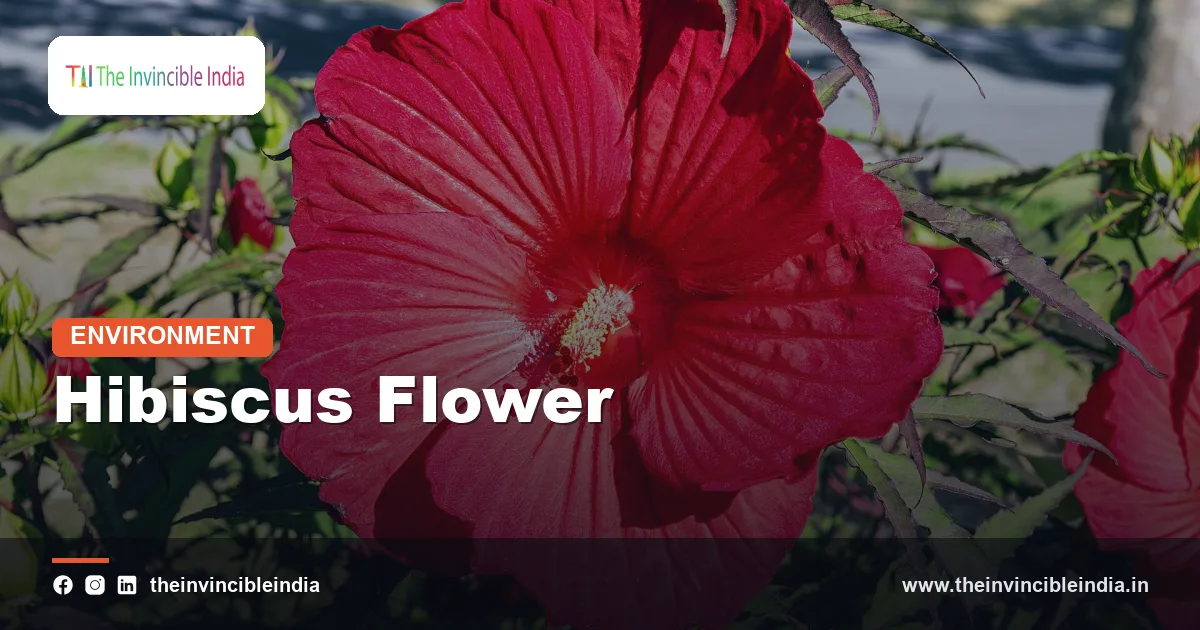
The hibiscus (Hibiscus rosa-sinensis) is a large, showy, five-petalled flowering shrub of the mallow family, grown across India in gardens, temples and hedgerows and popularly called the shoe flower or gudhal. The classic hibiscus bears trumpet-like blooms in red, though cultivated forms come in pink, orange, yellow, peach and white, and a single flower usually opens in the morning and fades within a day.
Few garden plants are as familiar in Indian life. The hibiscus is planted outside homes, offered in worship, used in traditional hair care and admired for its long flowering season. This explainer covers what the hibiscus is, why it is called the shoe flower, where and how it grows, how to look after it, and what it means in Indian culture.
Hibiscus Quick Facts
| Scientific name | Hibiscus rosa-sinensis |
|---|---|
| Common Indian names | Gudhal (Hindi), joba or japa (Bengali), jaswand (Marathi), sembaruthi (Tamil), chemparathi (Malayalam) |
| Plant family | Malvaceae, the mallow family that also includes cotton and okra |
| Origin | Believed to have originated in East Asia; now grown throughout the tropics and subtropics |
| Where grown in India | Gardens, hedges and temple compounds in nearly every state, thriving best in warm, frost-free regions |
| Plant type | Evergreen shrub, usually two to four metres tall, with glossy toothed leaves |
| Flowering season | Nearly year-round in warm climates, with heavy flushes in the warm and rainy months |
| Part used | Flowers and leaves, for worship, hair care, dye and traditional remedies |
| Notable fact | Each flower lasts only about a day, but a healthy plant produces new blooms continuously |
Key Takeaways
- The hibiscus (Hibiscus rosa-sinensis) is an evergreen flowering shrub of the mallow family with large five-petalled flowers, known in Hindi as gudhal.
- Hibiscus is called the shoe flower because crushed petals were traditionally used to polish and darken shoes.
- A single hibiscus flower generally lasts only one day, but a well-grown plant keeps producing fresh blooms for most of the year in warm climates.
- Red hibiscus is a customary offering to Goddess Kali and Durga in Bengal and to Lord Ganesha in many other parts of India.
- Named garden hibiscus varieties are multiplied by cuttings or grafting, because most hybrids do not grow true from seed.
- The sour red hibiscus tea often sold commercially is made from roselle (Hibiscus sabdariffa), a different species from the garden shoe flower.
What is the hibiscus flower?
The hibiscus flower is the large, funnel-shaped bloom of Hibiscus rosa-sinensis, an evergreen shrub that belongs to the mallow family, Malvaceae. The plant is the most familiar of the many Hibiscus species and is grown for ornament in warm regions worldwide. In India, the hibiscus is one of the commonest garden shrubs, often seen growing against boundary walls, along fences and in the courtyards of homes and temples.
The shrub has a woody, branching habit and dark glossy leaves with toothed edges. Its flowers are borne singly at the ends of branches and may measure up to about ten to fifteen centimetres across, depending on the cultivar. The plant is the national flower of Malaysia, where it is called bunga raya, but in India it has no such official status, even though it is one of the most widely recognised flowers in the country.
Why is the hibiscus called the shoe flower?
The hibiscus is called the shoe flower because its petals were traditionally rubbed on shoes to polish and blacken them. The deep colour in the petals comes from natural pigments called anthocyanins, which stain when crushed and rubbed. The nickname is used widely in English-speaking countries, including India, and is sometimes applied to the whole group of garden hibiscus plants.
The same staining quality explains why the petals have been used as a natural dye and as a simple chemistry-class indicator. Anthocyanin pigments change colour with acidity, so a hibiscus petal extract turns pinker in acid and greener or bluer in alkali. Teachers in some schools use the extract to demonstrate how indicators work.
What does a hibiscus flower look like?
A hibiscus flower has five broad overlapping petals arranged in a wide trumpet, with a long central column projecting from the middle. This column, called the staminal column, is formed by the male parts (stamens) fused around the style, the female structure, and it is tipped with pollen-bearing anthers and a fivefold, sticky stigma. The unmistakable column makes the hibiscus easy to recognise even among other mallow-family flowers.
Colour and form
Wild-type and traditional hibiscus flowers are bright red, but garden breeding has produced flowers in almost every warm colour, including yellow, orange, pink, peach, white and multicoloured blends. Some cultivars have a darker eye or throat at the centre of the bloom. Others have double or semi-double flowers with many layers of petals, in which the staminal column may be hidden.
Leaves and growth habit
The leaves are simple, oval to oblong, glossy and dark green, with a pointed tip and toothed margin. The shrub can be pruned into a bushy hedge, trained as a small standard tree or kept compact in a large pot. Left alone in a frost-free climate, the plant can reach several metres and form a rounded, spreading canopy.
Where does hibiscus grow in India?
Hibiscus grows throughout most of India, from the coast to the plains and lower hills, wherever winters are mild and frost is absent. It does best in warm, humid regions such as Kerala, Tamil Nadu, Karnataka, Maharashtra, West Bengal, Assam and Odisha, but it is also common in the gardens of the northern plains, where it is protected from the coldest nights.
Because the shrub is sensitive to frost, in places with hard winters it is usually grown in pots that can be moved indoors. In hill stations above a certain elevation, hibiscus survives only in sheltered spots. The plant is not a commercial field crop in the way that marigold or rose are, but it is sold by nurseries in huge numbers, and flowers are collected in volume near temples and for traditional hair-care and herbal products.
How is hibiscus grown and cared for?
Hibiscus is grown from stem cuttings or grafts in a sunny position with well-drained soil, regular watering and periodic feeding. It is a forgiving plant that tolerates heat well, but it flowers best with plenty of direct sunlight, usually at least five to six hours each day.
Propagation
Most named garden hibiscus cultivars are hybrids and do not come true from seed, so growers multiply them from semi-hardwood stem cuttings or by grafting onto a vigorous rootstock. Cuttings of about fifteen to twenty centimetres, taken from healthy branches, root readily in a moist, loose mix, especially in warm weather. Grafting is used for rare or delicate varieties.
Soil, water and feeding
- Soil: fertile, loose and well-drained, with a slightly acidic to neutral reaction.
- Water: regular watering in summer, because the plant wilts quickly in dry heat; the roots should not stand in water.
- Feeding: a balanced fertiliser with a good share of potash encourages bloom, while excess nitrogen yields leaves at the cost of flowers.
- Position: full sun to light shade; too little light reduces flowering.
Pruning
Gardeners prune hibiscus at the end of the cool season or before the monsoon, cutting back long, leggy branches to encourage fresh, flower-bearing growth. Hibiscus blooms on new wood, so timely pruning leads to more flowers. Regular removal of spent blooms and dead twigs keeps the plant tidy.
What pests and problems affect hibiscus?
Hibiscus is mainly troubled by sap-sucking insects such as aphids, mealybugs, whiteflies and thrips, as well as by bud drop when the plant is stressed. These insects gather on soft shoots and flower buds, weakening growth and leaving a sticky residue that can attract a black sooty mould.
Bud drop, in which flower buds yellow and fall before opening, is often caused by sudden changes in water supply, insufficient light, or heavy infestation. Gardeners usually deal with pests by washing the plant with a strong spray of water, applying neem-based sprays and removing badly infested shoots. Maintaining even moisture and proper sunlight reduces most problems.
Can hibiscus be grown in pots and on balconies?
Yes, hibiscus grows well in large pots and is a popular balcony and terrace plant in Indian cities, provided it receives enough sun and water. A container at least thirty to forty centimetres wide, with drainage holes and a loose, fertile potting mix, gives the roots enough room. Potted plants dry out faster than those in the ground, so they usually need watering every day or every second day in summer.
Potted hibiscus benefits from a light feed every few weeks during the growing season and from repotting into fresh soil every year or two. In regions with cold winters, the pot can be moved to a sheltered spot or indoors near a bright window. Compact cultivars are best suited to containers, whereas tall, vigorous types are better planted in the ground as hedges or specimens.
What is the role of hibiscus in Indian worship and culture?
Hibiscus has a prominent place in Indian worship, where the red flower is offered to deities, especially Goddess Kali and Durga in eastern India and Lord Ganesha in many other regions. In Bengal, the red joba flower is closely associated with the worship of Kali, and garlands or single blooms are laid at her shrines. In Hindu households across the country, a hibiscus is often among the flowers picked each morning for the home altar.
The flower also appears in poetry, folk songs and art as a symbol of vivid colour and fleeting beauty, partly because each bloom lasts only a day. Its Sanskrit name, japa kusuma, is used in classical texts and devotional verse.
Beyond religion, hibiscus is part of everyday domestic life. Girls and women in some regions still tuck the flower into their hair, and children learn to press its petals or use them for play. The plant is a common sight in school gardens, because it is hardy and flowers abundantly.
How is hibiscus used for hair, health and dye?
Hibiscus petals and leaves are traditionally used in Indian homes for hair care, particularly by being boiled in coconut oil or ground into a paste. The leaves and flowers release a mucilaginous, slippery substance, which is why they are used as a natural conditioner. In southern India, crushed hibiscus leaves have long been used as a shampoo substitute, producing a mild lather.
- Hair oil: petals and leaves are simmered in coconut or sesame oil, which is then applied to the scalp.
- Hair rinse and pack: a paste of leaves and flowers is mixed with water or curd and used as a conditioning pack.
- Natural dye: the red-purple pigment has been used to colour foods, cosmetics and sometimes fabric.
- Traditional remedies: petals feature in folk preparations, though scientific evidence for most claims is limited.
Hibiscus tea and roselle
The tart red drink commonly called hibiscus tea is usually made from the fleshy calyces of roselle, Hibiscus sabdariffa, not from the garden shoe flower. In India, roselle is known as gongura in Andhra Pradesh and Telangana, where its sour leaves are cooked in chutneys and curries, and as ambadi or similar names in other regions. Readers should not assume that all hibiscus plants are interchangeable in food or medicine, and anyone using a plant for health reasons should seek qualified advice.
What other kinds of hibiscus are found in India?
India has several other hibiscus species besides the garden shoe flower, ranging from colour-changing garden shrubs to coastal trees and useful fibre or food plants. The table below lists a few of the better known ones.
| Plant | Scientific name | Notable feature |
|---|---|---|
| Garden hibiscus, shoe flower | Hibiscus rosa-sinensis | Large showy blooms in many colours; the common garden and temple flower |
| Cotton rose, sthalpadma | Hibiscus mutabilis | Flowers open white or pale pink in the morning and deepen to red by evening |
| Roselle | Hibiscus sabdariffa | Sour leaves and red calyces eaten and used for drinks |
| Sea hibiscus | Hibiscus tiliaceus | Coastal tree with yellow flowers that turn orange-red |
| Kenaf or mesta | Hibiscus cannabinus | Grown for plant fibre |
The mallow family connection also explains why the hibiscus resembles the flowers of okra and cotton, which share the same overall floral structure.
Bottom Line
The hibiscus, or gudhal, is among India’s most recognisable garden and temple flowers, a hardy evergreen shrub with large five-petalled blooms that last a single day. It is easy to grow from cuttings in sun and warmth, and it carries religious, domestic and traditional-care uses. The sour hibiscus tea sold commercially comes from a related plant, roselle, not from the garden shoe flower.
Frequently Asked Questions
What is a hibiscus flower?
A hibiscus flower is the large, five-petalled, trumpet-shaped bloom of the shrub Hibiscus rosa-sinensis, a member of the mallow family. It is usually red but also occurs in pink, yellow, orange, peach and white. In India it is commonly called gudhal and is grown in gardens and temples.
Why is hibiscus called the shoe flower?
Hibiscus is called the shoe flower because its crushed petals were traditionally rubbed on shoes to polish and darken them. The petals contain strong anthocyanin pigments that stain surfaces. The name is now used for the garden hibiscus in general.
How long does a hibiscus flower last?
A single hibiscus flower usually lasts only about one day. It opens in the morning and fades by evening or the next day. A healthy plant keeps producing new buds, so it appears to flower continuously in warm weather.
How do you grow hibiscus in India?
Hibiscus is grown from stem cuttings or grafts in a sunny spot with well-drained soil, regular watering and occasional feeding. It needs at least five to six hours of direct sunlight to flower well. Pruning before the monsoon or at the end of winter encourages fresh flowering growth.
Is hibiscus tea made from the shoe flower?
No, the sour red hibiscus tea sold commercially is usually made from roselle (Hibiscus sabdariffa), not from the garden shoe flower. Roselle is a different species that is grown for its fleshy red calyces and leaves. In Andhra Pradesh and Telangana its leaves are cooked as gongura.
Why is hibiscus offered to Kali and Ganesha?
Red hibiscus is offered to Kali and Ganesha because the bright red flower is a traditional favourite in their worship. In Bengal, the joba flower is closely linked to Kali and Durga. Many Hindu households also offer a red hibiscus to Ganesha as part of daily puja.
{“@context”:”https://schema.org”,”@graph”:[{“@type”:”FAQPage”,”mainEntity”:[{“@type”:”Question”,”name”:”What is a hibiscus flower?”,”acceptedAnswer”:{“@type”:”Answer”,”text”:”A hibiscus flower is the large, five-petalled, trumpet-shaped bloom of the shrub Hibiscus rosa-sinensis, a member of the mallow family. It is usually red but also occurs in pink, yellow, orange, peach and white. In India it is commonly called gudhal and is grown in gardens and temples.”}},{“@type”:”Question”,”name”:”Why is hibiscus called the shoe flower?”,”acceptedAnswer”:{“@type”:”Answer”,”text”:”Hibiscus is called the shoe flower because its crushed petals were traditionally rubbed on shoes to polish and darken them. The petals contain strong anthocyanin pigments that stain surfaces. The name is now used for the garden hibiscus in general.”}},{“@type”:”Question”,”name”:”How long does a hibiscus flower last?”,”acceptedAnswer”:{“@type”:”Answer”,”text”:”A single hibiscus flower usually lasts only about one day. It opens in the morning and fades by evening or the next day. A healthy plant keeps producing new buds, so it appears to flower continuously in warm weather.”}},{“@type”:”Question”,”name”:”How do you grow hibiscus in India?”,”acceptedAnswer”:{“@type”:”Answer”,”text”:”Hibiscus is grown from stem cuttings or grafts in a sunny spot with well-drained soil, regular watering and occasional feeding. It needs at least five to six hours of direct sunlight to flower well. Pruning before the monsoon or at the end of winter encourages fresh flowering growth.”}},{“@type”:”Question”,”name”:”Is hibiscus tea made from the shoe flower?”,”acceptedAnswer”:{“@type”:”Answer”,”text”:”No, the sour red hibiscus tea sold commercially is usually made from roselle (Hibiscus sabdariffa), not from the garden shoe flower. Roselle is a different species that is grown for its fleshy red calyces and leaves. In Andhra Pradesh and Telangana its leaves are cooked as gongura.”}},{“@type”:”Question”,”name”:”Why is hibiscus offered to Kali and Ganesha?”,”acceptedAnswer”:{“@type”:”Answer”,”text”:”Red hibiscus is offered to Kali and Ganesha because the bright red flower is a traditional favourite in their worship. In Bengal, the joba flower is closely linked to Kali and Durga. Many Hindu households also offer a red hibiscus to Ganesha as part of daily puja.”}}]}]}


