

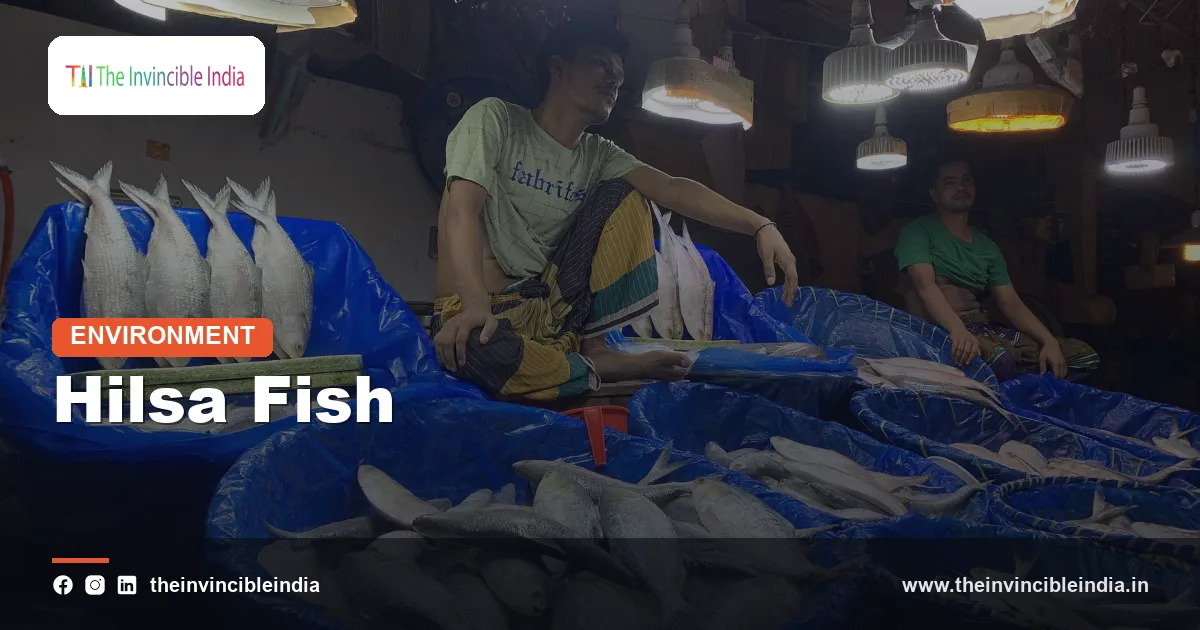
The hilsa is a prized anadromous migratory fish (Tenualosa ilisha) that lives in the sea and enters large rivers to breed, and in Bengal it is known simply as the ilish. Hilsa is a silvery, oily, bone-rich member of the herring family (Clupeidae) and is one of the most valued food fishes of the Bay of Bengal region, central to the cuisine and festivals of West Bengal, Odisha, Bangladesh and parts of Andhra Pradesh.
In India the hilsa fishery has been shaped by the Ganga-Hooghly river system, the Brahmaputra, the Mahanadi and the Godavari, and by dams and barrages that interrupted its migration. This explainer covers the biology, the cultural importance, the decline in catches, the rules on juvenile fish known as jatka, and the science of conservation and ranching.
| Scientific name | Tenualosa ilisha |
|---|---|
| Family | Clupeidae (herring family) |
| Common names | Hilsa, hilsa shad, ilish (Bengali), ilisha, palla (Sindhi and Gujarati usage), pulasa (Godavari delta usage) |
| Life history | Anadromous: adults migrate from the sea into rivers to spawn |
| Main Indian rivers | Ganga-Hooghly, Brahmaputra, Mahanadi, Godavari, Narmada (historically stronger runs) |
| Key Indian states | West Bengal, Odisha, Andhra Pradesh, Assam, Bihar, Uttar Pradesh, Gujarat |
| Nutritional profile | Oily fish, known for omega-3 fatty acids, with many fine intermuscular bones |
| Conservation status | Assessed by the IUCN as Least Concern at the global level, though local stocks and catches have fluctuated sharply |
| Lead research body | ICAR-Central Inland Fisheries Research Institute (CIFRI), Barrackpore, West Bengal |
Key Takeaways
- The hilsa (Tenualosa ilisha) is an anadromous fish that spends most of its adult life in the sea and swims up rivers such as the Ganga, Hooghly and Padma to spawn.
- Hilsa is known as the ilish in Bengal, and dishes such as shorshe ilish, ilish bhapa and ilish paturi are central to Bengali cooking and festivals.
- The Farakka Barrage on the Ganga, commissioned in 1975, is widely cited as a major barrier that reduced upstream hilsa migration and changed the fishery in the middle Ganga.
- Jatka are juvenile hilsa below a legal size limit, and protecting them from netting is one of the most important conservation rules for the species.
- Overfishing, fine-mesh nets, pollution, siltation and river regulation are the main pressures cited for declining hilsa catches in Indian rivers.
- Indian scientists at ICAR-CIFRI have worked on captive breeding and river ranching of hilsa as ways to support wild stocks, though large-scale recovery has not been established.
What is the hilsa fish?
The hilsa is a medium-sized, silver-bodied shad that belongs to the herring family and is scientifically named Tenualosa ilisha. Adults commonly reach roughly 40 to 50 centimetres in length, although larger fish are occasionally recorded, and they are laterally compressed with a deep body and a distinct notch in the upper jaw.
The flesh of the hilsa is rich in oil, which gives the fish its strong flavour and is the reason it is prized by cooks in eastern India. It is also full of fine, forked intermuscular bones, so eating hilsa is a skill that many Bengali households teach from childhood.
The fish feeds mostly on plankton, algae and small organisms, which it filters using fine gill rakers. Because it feeds low in the food chain, its condition reflects the productivity of estuaries and rivers.
How is hilsa different from other river fish?
Hilsa differs from carps and catfish because it is a marine and estuarine fish that enters fresh water only to breed. Most Indian freshwater fishes complete their entire life cycle in rivers and lakes, whereas the hilsa depends on both the sea and the river, which is why changes at either end affect it.
Where is hilsa found in India?
Hilsa in India is found in the estuaries and lower stretches of the Ganga-Hooghly system, the Brahmaputra, the Mahanadi, the Godavari and other east-coast rivers, with smaller populations on the west coast, including the Narmada and Tapti. The fish also occurs along the coasts and rivers of Bangladesh, Myanmar, and parts of the Persian Gulf region.
The Hooghly estuary and the Sundarbans delta in West Bengal are traditional fishing grounds, as are the Chilika lagoon and the Mahanadi estuary in Odisha. In Andhra Pradesh, the Godavari delta is known for a local form called pulasa, which is sold at very high prices during the monsoon.
- West Bengal: The Hooghly, Matla and Raimangal estuaries support the main commercial catch.
- Odisha: The Mahanadi system and coastal waters near Paradip and Chilika are significant sources.
- Andhra Pradesh: The Godavari estuary supplies pulasa, a fish with a loyal consumer base in the Konaseema region.
- Gujarat: The Narmada estuary historically supported a hilsa fishery known locally as palla, though catches have been reduced over time.
How does the hilsa migrate?
The hilsa migrates by moving from coastal waters into estuaries and then upstream into rivers when the monsoon swells the flow, spawning in fresh water before the adults and later the young return toward the sea. The timing is tied to monsoon rains, river discharge, salinity and water temperature, and runs are strongest when the river carries plenty of water.
Historically, hilsa were reported to travel hundreds of kilometres up the Ganga, reaching stretches near Prayagraj (Allahabad) and beyond, and some runs entered tributaries such as the Yamuna and the Gomti. Today the migration in the main Ganga is far more restricted, and most of the fishery is concentrated in the lower river and estuary.
Young hilsa spend several months in the river and estuary, growing quickly before heading out to sea. Scientists generally recognise more than one spawning season, with a major peak after the monsoon begins and another at a different time of year, depending on region.
What triggers the upstream run?
The upstream run of hilsa is triggered mainly by rising river flow and falling salinity at the estuary, which signal that fresh water is available for spawning. Without sufficient flow, the migration becomes weaker and fish may spawn closer to the sea or not at all.
Why is hilsa so important in Bengali culture?
Hilsa is important in Bengali culture because the ilish is associated with the monsoon, with festivals and with family occasions, and it is often described as the symbolic fish of Bengal. The arrival of the fish in the market in the rainy season is treated as a seasonal event, and prices are widely discussed.
Ilish appears in ceremonies and customs such as Jamai Sasthi, when sons-in-law are fed lavishly, in the rituals of Durga Puja, and in the traditional Bengali new year feast. In some households, a pair of ilish is offered during certain rituals, and the fish features in proverbs, poems and films.
The fish also carries a regional rivalry. Families from West Bengal and from Bangladesh both claim the better ilish, and the debate over the Padma ilish versus the Ganga ilish is a long-running theme in Bengali conversation. Bangladesh, where the hilsa is the national fish, obtained a Geographical Indication (GI) tag for it in 2017.
Which dishes are made from ilish?
The best-known ilish dishes are shorshe ilish (hilsa in mustard gravy), ilish bhapa (steamed hilsa), ilish paturi (hilsa wrapped in banana leaf), ilish macher jhol (a light curry) and fried hilsa. Pulasa from the Godavari delta is cooked in a spicy tamarind-based pulusu in coastal Andhra, and in Odisha the fish is cooked as ilisi jhola or ilisi besara.
How does hilsa support livelihoods and the economy?
Hilsa supports livelihoods by providing income to thousands of fishing families, traders, boat owners, ice suppliers and transporters across the delta and estuary regions of eastern India. In West Bengal, hilsa is among the most valuable fish in the market, and a good season can significantly affect household earnings in districts such as South 24 Parganas, North 24 Parganas, Purba Medinipur and Howrah.
The fishery is largely small-scale and seasonal. Fishers use gillnets from small boats, and the price per kilogram can vary widely depending on the size of the fish, the place of capture and the season. Fish from certain estuarine stretches are said to command a premium because of their fat content.
Trade between India and Bangladesh has added a diplomatic layer. Bangladesh has at times permitted limited exports of hilsa to India around the Durga Puja season, often described in the press as hilsa diplomacy, though the quotas and policies have changed from year to year.
Why have hilsa catches declined in India?
Hilsa catches have declined in several Indian rivers because of overfishing, the capture of juveniles, river regulation by dams and barrages, pollution, siltation and the loss of spawning and nursery habitat. No single factor explains the decline, and the impact varies between the Ganga, the Hooghly and other rivers.
- Barrages and dams: Structures such as the Farakka Barrage, commissioned in 1975, interrupt the upstream run and have been linked to a fall in hilsa catches in the middle and upper Ganga, such as at Prayagraj and Patna.
- Overfishing: Heavy fishing pressure during the peak migration season reduces the number of fish that reach spawning grounds.
- Juvenile catch: Netting of jatka, which are young fish yet to breed, removes future spawners from the stock.
- Fine-mesh nets: Small-mesh nets such as current jal, a very fine monofilament net, catch fish of all sizes and are widely restricted.
- Pollution and siltation: Industrial and urban waste and sediment deposition degrade nursery habitats and estuarine water quality.
- Climate and flow changes: Variable monsoons and changing river discharge affect when and whether migrations occur.
Some stretches have seen the opposite trend in recent years. Researchers have reported improved hilsa catches in the Hooghly and nearby estuary in certain seasons, which indicates that annual landings depend heavily on rainfall and river conditions as well as on fishing pressure.
What role did the Farakka Barrage play?
The Farakka Barrage, built across the Ganga in Murshidabad district of West Bengal and commissioned in 1975, is widely cited as a major influence on hilsa movement because it blocks the direct upstream route toward Bihar and Uttar Pradesh. The barrage was built to divert water into the Bhagirathi-Hooghly channel to help maintain navigation at Kolkata port.
Before the barrage, hilsa were reported far upstream. After it, fish catches at upstream stations fell sharply, and the migration largely stopped at the barrage. A navigation lock and a fish pass have been used or proposed to allow the fish to cross, but how effective these are has been debated, and scientists have studied the issue repeatedly.
The barrage has also changed freshwater flow in the Hooghly estuary, which affects salinity and, in turn, the conditions that hilsa encounter on entering the river. This is why hilsa management is closely linked to water management.
What are jatka and why are they protected?
Jatka are juvenile hilsa, typically fish below a minimum legal size, and they are protected because catching them before they have spawned reduces the future breeding stock. The term is used in Bengal and Bangladesh for young hilsa, and rules prohibiting their capture, sale and transport have been introduced in both countries.
In Bangladesh, the size limit for jatka is commonly cited as 25 centimetres, and the country enforces seasonal bans on jatka fishing along with a ban on fishing during the peak breeding period around the October full moon. In India, West Bengal has also issued orders restricting the capture of undersized hilsa and the use of fine-mesh nets, although the exact size limits and ban periods have been revised over time and should be checked against current notifications.
What other fishing rules apply?
Typical rules for hilsa include a minimum net mesh size, a ban on current jal, closed seasons during the peak breeding run and prohibitions on the sale of undersized fish. Fishing communities have sometimes been given compensation or alternative support during bans, but implementation and enforcement vary.
| Measure | Purpose | Notes |
|---|---|---|
| Jatka protection | Allow young fish to grow and breed | Size limits set by state or national rules and revised from time to time |
| Closed season | Protect breeding adults during peak spawning | Well established in Bangladesh; Indian measures vary by state |
| Net-mesh regulation | Reduce capture of small fish | Fine-mesh nets such as current jal are widely restricted |
| Sanctuaries | Safeguard nursery and spawning stretches | Used extensively in Bangladesh; limited and debated elsewhere |
| Fish passes | Restore upstream movement past barriers | Effectiveness at large barrages remains debated |
| Captive breeding and ranching | Support wild stocks with hatchery-raised seed | Research stage in India led by ICAR-CIFRI |
Can hilsa be bred in captivity or ranched?
Hilsa can be bred in captivity only with considerable difficulty, and Indian research on captive breeding and ranching has progressed but has not yet produced a widely adopted farming system. The fish is delicate, easily stressed by handling and highly migratory, which makes it hard to hold in ponds.
ICAR-CIFRI in Barrackpore has been the principal Indian institution working on hilsa, and its scientists have reported success in breeding hilsa in fresh water and rearing early life stages in ponds. The longer-term goal is ranching: raising seed or juveniles in a hatchery and releasing them into rivers to support the wild population, rather than rearing the fish to market size in ponds.
Ranching of this kind has risks. Introducing hatchery fish without maintaining river flow and habitat will not restore a stock, and the genetic effects of releasing hatchery fish into wild populations need careful monitoring. Scientists therefore emphasise that hatchery work should supplement, not replace, habitat protection and fishing regulation.
What is the future of the hilsa in India?
The future of the hilsa in India depends on keeping rivers connected, maintaining adequate freshwater flow, controlling juvenile and fine-mesh fishing, and cooperating with Bangladesh, since the fish crosses national boundaries. The Bay of Bengal stock is shared, and measures taken in one country affect the other.
Several steps are commonly recommended by researchers and fisheries managers:
- Enforce size limits and mesh rules consistently through community-based monitoring.
- Protect identified spawning and nursery grounds in estuaries and lower rivers.
- Improve fish passage at barrages, with design and monitoring backed by evidence.
- Reduce pollution and silt loads that degrade estuarine habitats.
- Provide alternative income or support to fishing families during closed seasons.
- Continue scientific stock assessment, genetics and migration studies, including tagging.
Hilsa is not currently listed among the highly threatened species at the global level, yet its decline in some stretches and its heavy dependence on a handful of rivers mean that managers regard it as a stock needing careful attention. Policy decisions on river flow, such as barrage operation and water sharing, will matter as much as fisheries rules.
Bottom Line
The hilsa is both an ecological indicator and a cultural icon: its health reflects the condition of the rivers and estuaries of the Bay of Bengal region. Protecting jatka, maintaining river flow and supporting ranching research are the main routes to a stable fishery, while the Farakka Barrage remains the clearest example of how infrastructure can change the migration of a river fish.
Frequently Asked Questions
What is hilsa fish called in India?
Hilsa is called ilish or ilisha in Bengali and Odia, pulasa in the Godavari region of Andhra Pradesh, and palla in Gujarat and Sindh. All these names refer to the same species, Tenualosa ilisha, although local forms and fishing grounds may be distinguished by name. The fish is also commonly called the hilsa shad in English.
Why is hilsa so expensive?
Hilsa is expensive because demand is strong, supply is seasonal and unpredictable, and the fish is difficult to farm. Larger fish from certain estuaries command the highest prices, and prices rise sharply around festivals such as Durga Puja and the Bengali new year. Reduced catches in several rivers have further pushed up the cost.
What is the difference between hilsa and jatka?
Jatka are juvenile hilsa that have not yet reached the minimum legal size or the age of first breeding. Adult hilsa are mature fish that spawn in rivers during the migration season. Catching jatka is restricted in Bangladesh and in West Bengal because it removes fish before they can reproduce.
Why did the Farakka Barrage affect hilsa?
The Farakka Barrage affected hilsa because it blocks the Ganga, which prevents most fish from swimming upstream to their traditional spawning areas. Catches at upstream sites such as Prayagraj and Patna declined after the barrage began operating in 1975. Fish passes and navigation locks have been tried, but their effectiveness is still debated.
Is hilsa an endangered fish?
Hilsa is not classified as endangered at the global level, and the IUCN has assessed it as Least Concern. However, catches have declined in many Indian rivers, and local stocks are under pressure from overfishing, juvenile capture and habitat change. Conservation rules and research aim to prevent a deeper decline.
Can hilsa be farmed in ponds?
Hilsa is not yet farmed commercially in ponds on a large scale. Researchers at ICAR-CIFRI have reported progress in breeding and rearing hilsa in captivity, but the species is sensitive and migratory, which makes it hard to culture. The more realistic near-term use of hatchery work is river ranching to support wild stocks.
{“@context”:”https://schema.org”,”@graph”:[{“@type”:”FAQPage”,”mainEntity”:[{“@type”:”Question”,”name”:”What is hilsa fish called in India?”,”acceptedAnswer”:{“@type”:”Answer”,”text”:”Hilsa is called ilish or ilisha in Bengali and Odia, pulasa in the Godavari region of Andhra Pradesh, and palla in Gujarat and Sindh. All these names refer to the same species, Tenualosa ilisha, although local forms and fishing grounds may be distinguished by name. The fish is also commonly called the hilsa shad in English.”}},{“@type”:”Question”,”name”:”Why is hilsa so expensive?”,”acceptedAnswer”:{“@type”:”Answer”,”text”:”Hilsa is expensive because demand is strong, supply is seasonal and unpredictable, and the fish is difficult to farm. Larger fish from certain estuaries command the highest prices, and prices rise sharply around festivals such as Durga Puja and the Bengali new year. Reduced catches in several rivers have further pushed up the cost.”}},{“@type”:”Question”,”name”:”What is the difference between hilsa and jatka?”,”acceptedAnswer”:{“@type”:”Answer”,”text”:”Jatka are juvenile hilsa that have not yet reached the minimum legal size or the age of first breeding. Adult hilsa are mature fish that spawn in rivers during the migration season. Catching jatka is restricted in Bangladesh and in West Bengal because it removes fish before they can reproduce.”}},{“@type”:”Question”,”name”:”Why did the Farakka Barrage affect hilsa?”,”acceptedAnswer”:{“@type”:”Answer”,”text”:”The Farakka Barrage affected hilsa because it blocks the Ganga, which prevents most fish from swimming upstream to their traditional spawning areas. Catches at upstream sites such as Prayagraj and Patna declined after the barrage began operating in 1975. Fish passes and navigation locks have been tried, but their effectiveness is still debated.”}},{“@type”:”Question”,”name”:”Is hilsa an endangered fish?”,”acceptedAnswer”:{“@type”:”Answer”,”text”:”Hilsa is not classified as endangered at the global level, and the IUCN has assessed it as Least Concern. However, catches have declined in many Indian rivers, and local stocks are under pressure from overfishing, juvenile capture and habitat change. Conservation rules and research aim to prevent a deeper decline.”}},{“@type”:”Question”,”name”:”Can hilsa be farmed in ponds?”,”acceptedAnswer”:{“@type”:”Answer”,”text”:”Hilsa is not yet farmed commercially in ponds on a large scale. Researchers at ICAR-CIFRI have reported progress in breeding and rearing hilsa in captivity, but the species is sensitive and migratory, which makes it hard to culture. The more realistic near-term use of hatchery work is river ranching to support wild stocks.”}}]}]}


