

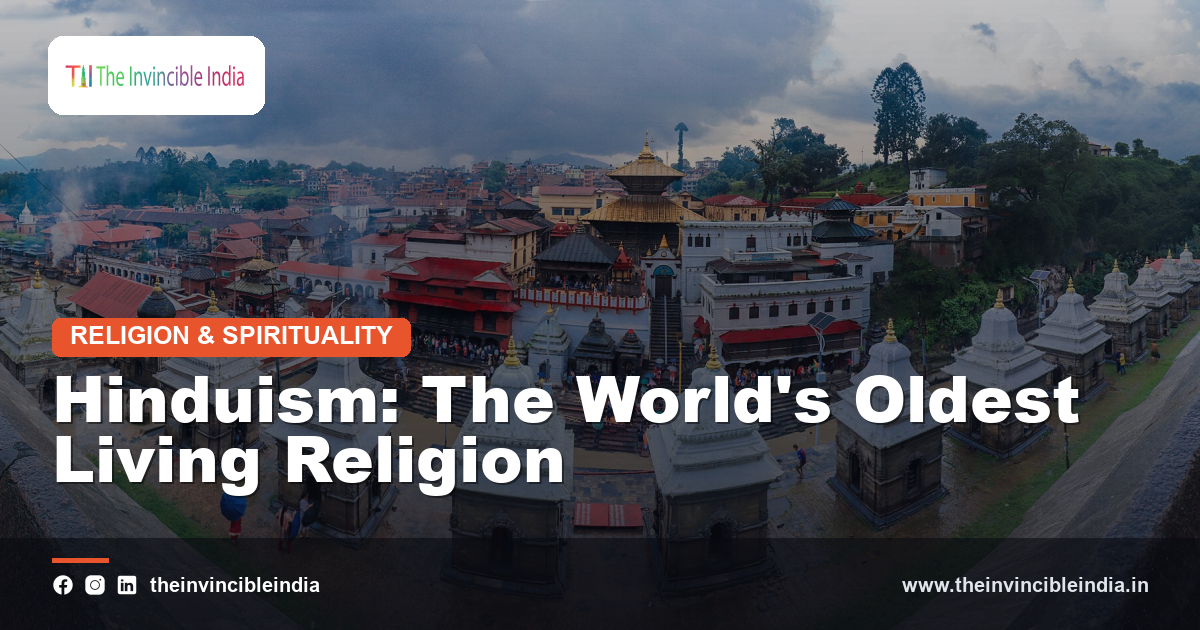
Hinduism is the world’s oldest living religion and one of its largest, a vast, ancient and profoundly diverse tradition that has shaped the spiritual, cultural and social life of India for thousands of years. Unlike many religions, it has no single founder, no single scripture and no single authority, but embraces an extraordinary variety of beliefs, practices, philosophies and ways of worship, united by shared concepts and a common heritage. Often called Sanatana Dharma, the eternal way, it offers many paths to the divine and encompasses everything from profound philosophy to colourful festival and devotion. This guide explores the beliefs, scriptures, deities, core concepts, major traditions and living practice of Hinduism, the ancient faith at the heart of Indian spiritual life.
Quick Facts
| Detail | Information |
|---|---|
| Type | The world’s oldest living major religion |
| Also called | Sanatana Dharma, the eternal way |
| Founder | No single founder; developed over thousands of years |
| Key concepts | Karma, dharma, samsara and moksha |
| Scriptures | The Vedas, Upanishads, Gita, epics and Puranas |
| Character | Vastly diverse, with many paths and traditions |
The Oldest Living Religion
Hinduism is widely regarded as the oldest living religion in the world, a tradition whose roots reach back thousands of years into the ancient past of the Indian subcontinent. Unlike religions that began at a definite time with a definite founder, Hinduism grew gradually over the ages, absorbing and developing a vast heritage of belief, practice and philosophy. This immense antiquity gives Hinduism a depth and richness matched by few other traditions, and a profound sense of continuity with the distant past. As the ancient and continuous faith of the majority of the people of India, and one of the great religions of the world, Hinduism holds a place of unique importance in the spiritual heritage of humanity.
A Religion Without a Founder
One of the most distinctive features of Hinduism is that it has no single founder, no one person who established it at a particular moment in history. Instead, it developed organically over thousands of years, growing from ancient roots and absorbing the contributions of countless sages, saints, philosophers and traditions across the ages. This absence of a single founder reflects the nature of Hinduism as an accumulated heritage rather than a religion founded on a single revelation or teacher. It is one reason for the extraordinary diversity of the tradition, which was never confined to the teaching of one person, but grew as a vast and evolving family of beliefs and practices over the long history of India.
Sanatana Dharma
Hindus often refer to their tradition not as Hinduism, a term of more recent and external origin, but as Sanatana Dharma, meaning the eternal way or eternal law. This name expresses the belief that the tradition embodies timeless, universal truths and principles of righteous living that are eternal and beyond any single founder or age. The concept of dharma, of righteousness, duty and the right way of living, is central to the tradition, and the idea of an eternal dharma captures the Hindu sense of a timeless spiritual order. Understanding the tradition as Sanatana Dharma illuminates its self-understanding as an eternal and universal way rather than a founded religion.
A Vastly Diverse Tradition
Hinduism is extraordinarily diverse, embracing a vast range of beliefs, practices, philosophies and forms of worship, so much so that it is sometimes described not as a single religion but as a family of related traditions. Within Hinduism there are many schools of philosophy, many deities and ways of worship, many scriptures, and many paths to the divine, ranging from the highly philosophical to the intensely devotional, from elaborate ritual to simple faith. This diversity is not a weakness but a defining characteristic, reflecting the tradition’s openness, its long development and its acceptance of many approaches to truth. The vast diversity of Hinduism, united by shared concepts and heritage, is one of its most remarkable features.
The Concept of Brahman
At the philosophical heart of Hinduism lies the concept of Brahman, the ultimate reality, the supreme, infinite and eternal spirit that underlies and pervades all existence. Brahman is the source and ground of everything, beyond all forms and names, the one reality behind the changing world. The great philosophical texts, especially the Upanishads, explore the nature of Brahman and its relationship to the individual self. The many gods and forms worshipped in Hinduism are, in this profound understanding, expressions or aspects of the one Brahman. This concept of a single ultimate reality, underlying the diversity of the world and the gods, is a central and unifying idea in the philosophy of Hinduism.
Atman and the Self
Closely connected to the concept of Brahman is the idea of the atman, the true self or soul, the innermost essence of the individual, which is eternal and beyond the changing body and mind. A profound teaching of Hindu philosophy, especially of the Upanishads, is that the individual self, the atman, is in its deepest nature one with the universal reality, Brahman, so that the divine dwells within every being. The realisation of this truth, the knowledge of the true self and its unity with the ultimate reality, is held to be the highest spiritual attainment. This teaching about the eternal self and its relationship to the divine is one of the deepest and most influential ideas in Hindu thought.
Karma and Rebirth
Central to Hindu belief are the concepts of karma and rebirth. Karma is the law of moral cause and effect, the principle that a person’s actions have consequences that shape their future, in this life and in lives to come. Bound up with karma is the belief in samsara, the cycle of birth, death and rebirth, in which the soul passes through many lives, its circumstances shaped by its past actions. The ultimate spiritual goal is to attain liberation from this cycle. These concepts of karma and rebirth are among the most important and characteristic beliefs of Hinduism, shaping its ethics and its vision of human life as part of a vast spiritual journey across many lifetimes.
Moksha: Liberation
The highest goal of Hindu spiritual life is moksha, liberation, the release of the soul from the cycle of birth, death and rebirth and its union with or realisation of the ultimate reality. Moksha represents the end of the soul’s long journey through many lives and the attainment of eternal freedom, peace and fulfilment beyond all suffering. Different traditions within Hinduism understand and describe moksha in different ways, but the attainment of this ultimate liberation is the supreme aim towards which the spiritual paths are directed. The concept of moksha as the final goal of life gives Hindu spirituality its ultimate orientation and expresses its vision of the highest destiny of the human soul.
The Many Deities
Hinduism is famous for its many gods and goddesses, a rich and colourful array of divine forms worshipped across the tradition. Yet this is not simple polytheism, for in the deeper understanding these many deities are seen as forms, aspects or expressions of the one ultimate reality, Brahman, which can be approached and worshipped in countless ways. Great deities such as Vishnu, Shiva and the Goddess, along with many others, are worshipped with deep devotion, each with rich mythology and forms. This combination of the worship of many divine forms with an underlying belief in one ultimate reality is characteristic of Hinduism, offering devotees many ways to approach and love the divine.
The Sacred Scriptures
Hinduism has a vast body of sacred scriptures, among the richest of any religion, accumulated over thousands of years. The most ancient and authoritative are the Vedas, the foundational scriptures, culminating in the philosophical Upanishads. Beyond these are the great epics, the Ramayana and the Mahabharata, the latter containing the beloved Bhagavad Gita, and the Puranas, the treasury of myth and devotion, along with many other texts of philosophy, law, ritual and devotion. This immense scriptural heritage, ranging from ancient hymn to profound philosophy to beloved story, is a foundation of the tradition and a source of its teachings, and it reflects the depth and diversity of Hinduism.
The Paths to the Divine
Hinduism teaches that there are many paths to the divine, suited to different temperaments and ways of life, and this openness is one of its great features. The tradition speaks of paths such as the way of selfless action, the way of loving devotion, and the way of knowledge and wisdom, along with the disciplines of meditation and yoga, each offering a route towards the spiritual goal. Rather than insisting on a single way, Hinduism offers a variety of approaches, allowing each seeker to follow the path best suited to their nature. This teaching of many paths to the one goal is a distinctive and cherished aspect of Hindu spirituality and reflects its inclusive and accommodating spirit.
The Major Traditions
Within the vast whole of Hinduism there are several major traditions, distinguished chiefly by the supreme deity they worship, though sharing much in common. Among the most important are the traditions devoted to Vishnu and his forms, those devoted to Shiva, and those devoted to the Goddess in her many forms, along with traditions that honour the great deities together. Each of these has its own theology, practices, saints and scriptures, and its own rich heritage of devotion and philosophy. These major traditions represent the main streams within the diversity of Hinduism, and understanding them helps to make sense of the tradition’s variety, showing how its many forms of worship are organised into great devotional families.
Worship and Devotion
Devotion and worship are central to the lived religion of most Hindus, expressed in a rich variety of ways. Worship, or puja, is performed in temples and in the home, offering prayers, flowers, food and light to the deities, and devotion is expressed through prayer, song, pilgrimage, fasting and the observance of festivals. Loving devotion to a personal deity, in the spirit of the Bhakti tradition, is a central feature of Hindu religious life, offering a warm and personal relationship with the divine. This rich and colourful world of worship and devotion, from grand temple ritual to simple household prayer, is the everyday face of Hinduism and the heart of its living practice for millions.
Festivals and Pilgrimage
The religious life of Hinduism is marked by a rich cycle of festivals and by the practice of pilgrimage to sacred places. Great festivals such as Diwali, Holi, Navaratri and many others are celebrated across the year with worship, joy and community, marking sacred occasions and the changing seasons. Pilgrimage to holy sites, sacred rivers, mountains, temples and cities, is a cherished practice, undertaken for blessing, purification and devotion. These festivals and pilgrimages are among the most vivid and joyful expressions of Hinduism, woven into the rhythm of life and drawing communities together in worship and celebration. They are a central and beloved part of the living religion.
A Way of Life
For many, Hinduism is not merely a set of beliefs but a whole way of life, woven into the fabric of daily existence, culture and society. Its concepts, values, rituals and festivals pervade the life of its adherents from birth to death, shaping their sense of duty, their relationships, their view of the world and their daily practices. The tradition offers guidance on every aspect of life and a framework of meaning within which to live. This character of Hinduism as an all-embracing way of life, rather than a religion confined to worship alone, is one of its defining features and reflects the depth to which it is woven into the culture and life of India.
Hinduism Today
Today Hinduism remains a vibrant, living religion, the faith of the great majority of the people of India and of communities around the world, and one of the largest religions on earth. Ancient yet ever alive, it continues to be practised in all its rich diversity, from profound philosophy to colourful festival, from temple ritual to personal devotion, and it continues to shape the culture and life of India. Its teachings on the divine, the self, karma and liberation, and its many paths to the truth, continue to guide and inspire millions. As the world’s oldest living religion, vast, diverse and eternally renewing, Hinduism endures as one of the great spiritual traditions of humanity.
Sources & Further Reading
- Ministry of Culture, Government of India, on the religious traditions of India (indiaculture.gov.in).
- The Vedas, Upanishads, Bhagavad Gita and Puranas, the foundational scriptures of Hinduism.
Frequently Asked Questions
What is Hinduism?
Hinduism is the world’s oldest living religion, a vast and diverse tradition with no single founder or scripture, often called Sanatana Dharma, the eternal way. It embraces many beliefs, deities, philosophies and paths to the divine, united by shared concepts such as karma, dharma and moksha.
Does Hinduism have a founder?
No. Hinduism has no single founder. Unlike religions established by one person at a particular time, it developed gradually over thousands of years, absorbing the contributions of countless sages, saints and traditions, which is one reason for its great diversity.
What are the core concepts of Hinduism?
Core concepts of Hinduism include Brahman, the ultimate reality; atman, the eternal self; karma, the law of moral cause and effect; samsara, the cycle of rebirth; dharma, righteousness and duty; and moksha, liberation, the highest spiritual goal.
Why does Hinduism have many gods?
Hinduism worships many deities, but in its deeper understanding these are seen as forms, aspects or expressions of the one ultimate reality, Brahman, which can be approached in countless ways. This offers devotees many paths to love and approach the divine.
What are the sacred texts of Hinduism?
Hinduism has a vast scriptural heritage, including the ancient Vedas and their philosophical Upanishads, the great epics the Ramayana and Mahabharata, the Bhagavad Gita, the Puranas, and many other texts of philosophy, ritual and devotion.


