

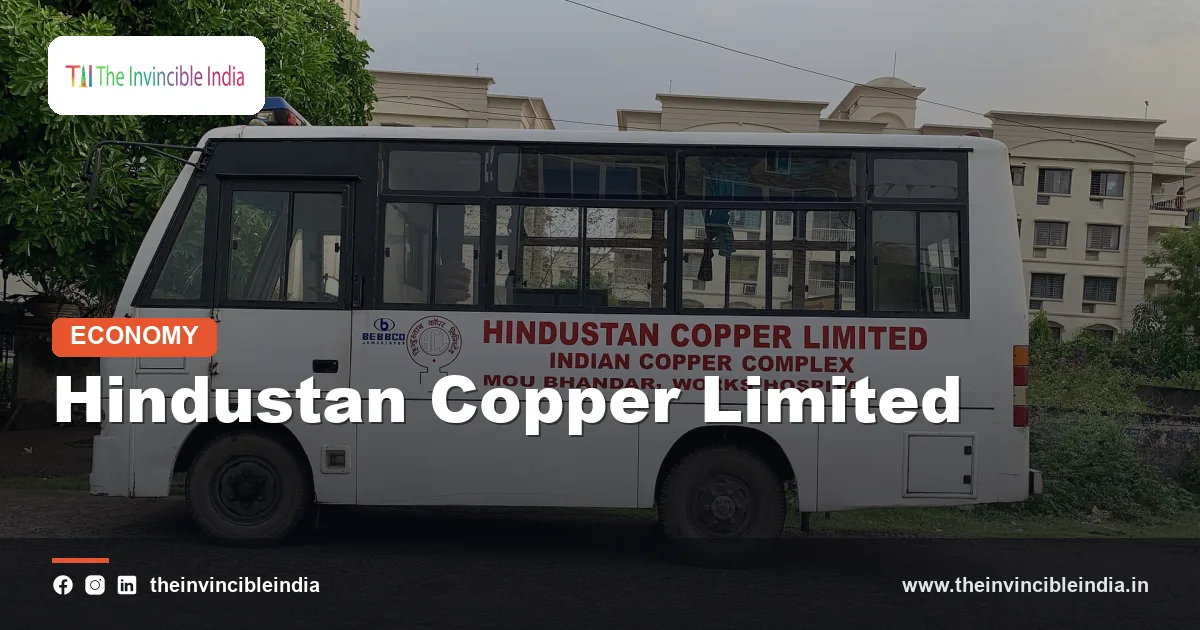
Hindustan Copper Limited (HCL) is a public sector undertaking under the Ministry of Mines, Government of India, and is generally described as the country’s only vertically integrated copper producer and its only company mining copper ore on a commercial scale. Incorporated in 1967 and headquartered in Kolkata, Hindustan Copper Limited runs mines and processing plants in Rajasthan, Madhya Pradesh and Jharkhand.
This explainer covers how Hindustan Copper Limited was formed, where its units are located, what “vertically integrated” means in the copper business, why India still imports much of its copper, and what mine-expansion plans the company has announced. Figures are given as approximate or dated, because production, reserves and plans change from year to year. Last updated: 20 October 2026.
| Attribute | Detail |
|---|---|
| Full name | Hindustan Copper Limited (HCL) |
| Incorporated | 1967, as a Government of India company |
| Administrative ministry | Ministry of Mines, Government of India |
| Type | Central public sector undertaking (PSU), listed on the stock exchanges |
| Headquarters | Kolkata, West Bengal |
| Main operating units | Khetri Copper Complex (Rajasthan), Malanjkhand Copper Project (Madhya Pradesh), Indian Copper Complex at Ghatsila (Jharkhand) |
| Other facilities | Taloja Copper Project (Maharashtra) and a past project in Gujarat |
| Principal product | Copper ore and copper concentrate, with a history of cathodes and wire rods |
| Notable position | Only vertically integrated copper producer and sole domestic copper-ore miner of significance |
Key Takeaways
- Hindustan Copper Limited was set up in 1967 and is a Government of India public sector undertaking under the Ministry of Mines.
- Hindustan Copper Limited is the only company in India that mines copper ore at a commercial scale, which makes it central to the country’s domestic copper supply.
- The principal Hindustan Copper Limited units are the Khetri Copper Complex in Rajasthan, the Malanjkhand Copper Project in Madhya Pradesh and the Indian Copper Complex in Ghatsila, Jharkhand.
- Indian copper ores are typically low in metal content, usually around or below one per cent copper, which raises the cost of mining and processing.
- India relies substantially on imported copper concentrate and refined copper, so domestic mine expansion is a stated national priority.
- Copper has been included in India’s list of critical minerals, which strengthens the policy case for expanding Hindustan Copper Limited’s mining capacity.
What is Hindustan Copper Limited and what does it do?
Hindustan Copper Limited is a Government of India company that mines copper ore, processes it into copper concentrate and sells it onward, and it is the only Indian entity operating copper mines on a significant commercial scale. The company works under the administrative control of the Ministry of Mines and is commonly abbreviated as HCL.
In practical terms, HCL’s work begins underground or in open pits, where copper-bearing rock is blasted and hauled to the surface. The ore then goes to a concentrator plant, where crushing, grinding and a process called froth flotation separate the copper minerals from waste rock. The resulting copper concentrate, which contains a much higher percentage of copper than the raw ore, is the main product HCL sells today. Smelters and refineries, including private-sector ones, use that concentrate to make refined copper.
HCL also holds the mining leases for the country’s best-known copper belts, which means that decisions the company takes on exploration and new shafts have an outsized effect on how much copper India can produce from its own soil.
When and why was Hindustan Copper Limited formed?
Hindustan Copper Limited was formed in 1967 so that India could consolidate its scattered public-sector copper activities under one organisation and reduce dependence on foreign copper. At the time, the Khetri copper project in Rajasthan had been developed under the National Mineral Development Corporation (NMDC), and the government wished to run copper as a distinct industry.
In the early 1970s the company also took over the private-sector Indian Copper Corporation, whose mines and plants at Ghatsila in the Singhbhum region of present-day Jharkhand had operated since the early twentieth century. This brought India’s oldest organised copper operation into HCL. Later, in the early 1980s, the Malanjkhand open-pit mine in Madhya Pradesh began production and became the company’s largest source of ore for several decades.
The creation of HCL reflected a wider policy of the period in which the state took the lead in strategic minerals such as copper, coal, iron ore and aluminium. Copper was considered strategic because of its use in power transmission, telecommunications, defence equipment and industrial machinery.
Where are the Hindustan Copper Limited mines and plants?
Hindustan Copper Limited operates in three main states: Rajasthan, Madhya Pradesh and Jharkhand, with a wire-rod facility in Maharashtra. The units are organised as separate complexes and projects, each with its own mines and concentrator.
| Unit | State and location | Brief description |
|---|---|---|
| Khetri Copper Complex (KCC) | Khetri Nagar, Jhunjhunu district, Rajasthan | Underground mines in the Khetri copper belt of the Aravalli region, including the Khetri and Kolihan mines, with a concentrator plant |
| Malanjkhand Copper Project (MCP) | Malanjkhand, Balaghat district, Madhya Pradesh | One of India’s largest copper deposits, mined first as an open pit and now being taken deeper through underground mining |
| Indian Copper Complex (ICC) | Ghatsila, East Singhbhum district, Jharkhand | Historic units in the Singhbhum copper belt, with several mines and a concentrator, some of which were reopened or revived in recent years |
| Taloja Copper Project (TCP) | Taloja, Raigad district, Maharashtra | Facility associated with continuous-cast copper wire rod production |
The Khetri and Singhbhum belts are among the oldest known copper-mining regions in the country, and evidence of ancient copper working has been reported in both areas. The Malanjkhand deposit was identified by geological survey work in the twentieth century and became the backbone of the company’s output after production began.
Why is Hindustan Copper Limited called India’s only vertically integrated copper producer?
Hindustan Copper Limited is called vertically integrated because, over its history, the company handled every stage of the copper chain: mining, beneficiation, smelting, refining and casting of finished products. Few producers worldwide control all these stages under a single management, and in India HCL has been the only one to have done so with domestic ore.
The description needs a short qualification. The smelting and refining stages once run at Ghatsila and Khetri were closed over time because of ageing plants, environmental norms and economics, and HCL now concentrates mainly on mining and producing concentrate for sale to other smelters. The phrase “vertically integrated” therefore describes the company’s institutional design and its history more than the current operations, and readers should check the company’s latest annual report for the present product mix.
The stages of the copper value chain
- Mining: extracting copper-bearing ore from underground or open-pit mines.
- Beneficiation: crushing, grinding and froth flotation to make copper concentrate.
- Smelting: heating concentrate in a furnace to produce an intermediate product called matte or blister copper.
- Refining: electrolytic refining to produce high-purity copper cathodes.
- Fabrication: casting cathodes into wire rods, tubes, sheets and other semi-finished goods.
How does copper mining work at Hindustan Copper Limited?
Copper mining at Hindustan Copper Limited is mostly underground, because the ore bodies at Khetri and Ghatsila lie in narrow, steeply dipping zones, and Malanjkhand is shifting from an open pit to underground methods as the pit deepens. Underground mining involves sinking shafts or declines, drilling and blasting the ore, and hauling it to the surface for processing.
The ore is low in grade, which means that a tonne of rock yields only a small amount of copper. A mine therefore needs to move very large volumes of rock to produce a modest quantity of metal. This is why mine mechanisation, deeper shafts, better ventilation and larger concentrator capacity matter so much to HCL’s economics.
At the concentrator, the ore is crushed and ground to a fine powder, mixed with water and chemicals, and agitated in flotation cells. Copper minerals stick to air bubbles and rise as a froth, while waste rock sinks. The froth is dried to form concentrate. The leftover waste, known as tailings, is stored in engineered dams that must meet environmental norms.
Why does India depend on imports for copper?
India depends on imports for a large share of its copper because domestic ore is limited in quantity and lean in grade, while demand from construction, power, electronics and vehicles has grown steadily. The country’s own mines supply only a small fraction of the copper concentrate its smelters need.
Several factors explain the gap:
- Geology: Indian deposits are mostly low-grade, and high-grade discoveries have been rare compared with those in Chile, Peru or the Democratic Republic of the Congo.
- Smelter capacity: private smelting and refining capacity, including that of Hindalco and others, relies partly on imported concentrate.
- Demand growth: expansion of the power grid, housing, appliances and electric mobility has increased consumption.
- Closures: the shutdown of a major private smelter in Tamil Nadu in 2018 changed India’s trade position in refined copper, and India has been reported to import more refined copper since then.
Because of this import reliance, copper has featured in policy discussions on supply security. Copper appears in India’s official list of critical minerals, and the National Critical Mineral Mission announced in 2025 covers efforts to expand domestic exploration, mining and processing of such minerals.
What are the mine-expansion plans of Hindustan Copper Limited?
Hindustan Copper Limited has announced plans to raise its ore production capacity several-fold over the coming years, with a target often cited as around 12 million tonnes of ore per annum by about 2030, compared with roughly 4 million tonnes in recent years. These figures are company or government statements of intent, and actual timelines can slip.
The plan rests on several strands of work:
- Deepening existing mines: developing the underground Malanjkhand mine and extending the Khetri and Kolihan mines to greater depths.
- Reopening mines: reviving older Singhbhum mines at Ghatsila that were shut because of low prices or technical limits.
- New exploration: expanding exploration within and beyond current leases, including blocks allotted or won in competitive auctions.
- Mechanisation and new concentrators: upgrading equipment and increasing plant capacity so more ore can be treated.
- Overseas interest: exploring partnerships or acquisitions in other copper-rich countries, in line with wider critical-mineral policy.
Mining a deep, low-grade deposit needs heavy capital spending and years of development before output rises, so analysts generally treat such targets as multi-year goals rather than immediate changes.
Why does copper matter for India’s economy and energy transition?
Copper matters because it is one of the best conductors of electricity and heat, which makes it essential for power cables, motors, transformers, electronics and many clean-energy technologies. Hindustan Copper Limited’s output feeds a metal that sits at the centre of electrification.
The main uses of copper in India include:
- Power and wiring: transmission lines, building wires, cables and transformers.
- Electronics and telecom: circuit boards, connectors and network equipment.
- Transport: electric vehicles use considerably more copper than conventional vehicles, as do charging stations.
- Renewable energy: solar plants and wind turbines require copper in wiring, generators and grid connections.
- Industry and defence: heat exchangers, alloys such as brass and bronze, and ammunition and equipment components.
As India expands renewable capacity and electric mobility, copper demand is widely expected to rise, which is why domestic supply capacity is a recurring subject in mining policy.
Who owns and governs Hindustan Copper Limited?
Hindustan Copper Limited is majority-owned by the Government of India, acting through the President of India, and a minority of shares is held by public and institutional investors because the company is listed on the National Stock Exchange and the BSE. The Ministry of Mines is the administrative ministry.
The company is run by a Board of Directors headed by a Chairman and Managing Director, along with functional directors and independent directors, as is standard for central PSUs. Like other PSUs, HCL is subject to audit by the Comptroller and Auditor General of India (CAG), parliamentary oversight and the rules of the Department of Public Enterprises. Mining operations are also regulated under the Mines and Minerals (Development and Regulation) Act, 1957, and by safety rules enforced through the Directorate General of Mines Safety.
What challenges does Hindustan Copper Limited face?
Hindustan Copper Limited faces challenges of low ore grade, rising mining depth, high capital needs and environmental compliance. Each of these affects how fast the company can expand and how profitable its operations are.
- Low grade: a larger volume of ore has to be processed for each tonne of copper, so operating costs are sensitive to international copper prices.
- Depth: as mines go deeper, ventilation, rock stability, cooling and hoisting systems become more complex and costly.
- Price cycles: copper prices on global exchanges swing sharply, and weak periods have in the past forced HCL to suspend or scale down some mines.
- Environment and land: new leases need environmental and forest clearances, and tailings management is closely watched.
- Technology and skills: modern mechanised mining requires investment in equipment and training.
Bottom Line
Hindustan Copper Limited is India’s principal domestic copper miner, with mines in Rajasthan, Madhya Pradesh and Jharkhand and a history of covering every step from ore to wire rod. Its expansion plans matter because India’s copper demand is rising while domestic supply remains small, but the plans depend on heavy investment, deeper mining and global price conditions.
Frequently Asked Questions
What is Hindustan Copper Limited?
Hindustan Copper Limited is a central public sector undertaking under the Ministry of Mines that mines copper ore and produces copper concentrate in India. It was incorporated in 1967 and is headquartered in Kolkata. It is generally described as India’s only vertically integrated copper producer and the only company mining copper ore on a commercial scale.
Where are the mines of Hindustan Copper Limited located?
The mines of Hindustan Copper Limited are located in Rajasthan, Madhya Pradesh and Jharkhand. The Khetri Copper Complex is in Jhunjhunu district, Rajasthan, the Malanjkhand Copper Project is in Balaghat district, Madhya Pradesh, and the Indian Copper Complex is at Ghatsila in East Singhbhum district, Jharkhand. A wire-rod facility has also operated at Taloja in Maharashtra.
Why is Hindustan Copper Limited called vertically integrated?
Hindustan Copper Limited is called vertically integrated because it has historically handled mining, beneficiation, smelting, refining and casting of copper under one management. Its older smelting and refining plants have since been closed, so the company today mainly sells copper concentrate. The label therefore reflects its design and history more than its present product mix.
Does India produce enough copper for its own needs?
No, India does not produce enough copper from its own mines to meet its needs. Domestic ore is limited and typically low-grade, so smelters rely heavily on imported copper concentrate, and India also imports refined copper. This import dependence is a major reason for expansion plans at Hindustan Copper Limited.
What are the expansion plans of Hindustan Copper Limited?
Hindustan Copper Limited plans to increase its ore production capacity several-fold, with a figure of around 12 million tonnes a year by about 2030 often cited, against roughly 4 million tonnes in recent years. The plan includes deepening mines at Malanjkhand and Khetri, reopening older mines at Ghatsila, new exploration and more mechanisation. These are targets that depend on investment and clearances, and timelines may change.
Is copper a critical mineral for India?
Yes, copper is included in India’s list of critical minerals. This reflects its importance for power grids, electronics, electric vehicles and renewable energy, along with the country’s reliance on imports. The listing supports policy efforts to expand domestic exploration, mining and processing.
{“@context”:”https://schema.org”,”@graph”:[{“@type”:”FAQPage”,”mainEntity”:[{“@type”:”Question”,”name”:”What is Hindustan Copper Limited?”,”acceptedAnswer”:{“@type”:”Answer”,”text”:”Hindustan Copper Limited is a central public sector undertaking under the Ministry of Mines that mines copper ore and produces copper concentrate in India. It was incorporated in 1967 and is headquartered in Kolkata. It is generally described as India’s only vertically integrated copper producer and the only company mining copper ore on a commercial scale.”}},{“@type”:”Question”,”name”:”Where are the mines of Hindustan Copper Limited located?”,”acceptedAnswer”:{“@type”:”Answer”,”text”:”The mines of Hindustan Copper Limited are located in Rajasthan, Madhya Pradesh and Jharkhand. The Khetri Copper Complex is in Jhunjhunu district, Rajasthan, the Malanjkhand Copper Project is in Balaghat district, Madhya Pradesh, and the Indian Copper Complex is at Ghatsila in East Singhbhum district, Jharkhand. A wire-rod facility has also operated at Taloja in Maharashtra.”}},{“@type”:”Question”,”name”:”Why is Hindustan Copper Limited called vertically integrated?”,”acceptedAnswer”:{“@type”:”Answer”,”text”:”Hindustan Copper Limited is called vertically integrated because it has historically handled mining, beneficiation, smelting, refining and casting of copper under one management. Its older smelting and refining plants have since been closed, so the company today mainly sells copper concentrate. The label therefore reflects its design and history more than its present product mix.”}},{“@type”:”Question”,”name”:”Does India produce enough copper for its own needs?”,”acceptedAnswer”:{“@type”:”Answer”,”text”:”No, India does not produce enough copper from its own mines to meet its needs. Domestic ore is limited and typically low-grade, so smelters rely heavily on imported copper concentrate, and India also imports refined copper. This import dependence is a major reason for expansion plans at Hindustan Copper Limited.”}},{“@type”:”Question”,”name”:”What are the expansion plans of Hindustan Copper Limited?”,”acceptedAnswer”:{“@type”:”Answer”,”text”:”Hindustan Copper Limited plans to increase its ore production capacity several-fold, with a figure of around 12 million tonnes a year by about 2030 often cited, against roughly 4 million tonnes in recent years. The plan includes deepening mines at Malanjkhand and Khetri, reopening older mines at Ghatsila, new exploration and more mechanisation. These are targets that depend on investment and clearances, and timelines may change.”}},{“@type”:”Question”,”name”:”Is copper a critical mineral for India?”,”acceptedAnswer”:{“@type”:”Answer”,”text”:”Yes, copper is included in India’s list of critical minerals. This reflects its importance for power grids, electronics, electric vehicles and renewable energy, along with the country’s reliance on imports. The listing supports policy efforts to expand domestic exploration, mining and processing.”}}]}]}


