

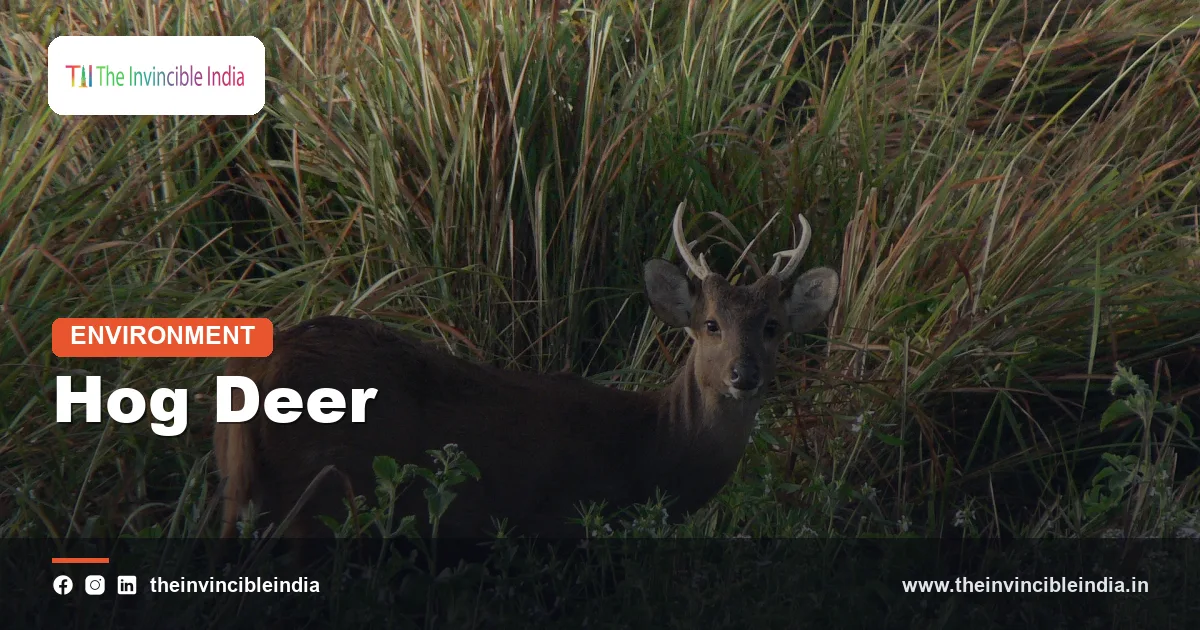
The hog deer (Axis porcinus) is a small, stocky deer of the grasslands and floodplains of South and Southeast Asia, named for the head-low, pig-like way it runs through tall grass, and hog deer conservation in India is the effort to protect this threatened species and the fragile terai and Brahmaputra floodplain grasslands on which it depends. India holds the largest share of the species’ remaining wild population, mainly in protected areas such as Kaziranga, Manas and Jaldapara.
Although it is far less famous than the tiger or the one-horned rhinoceros that share its habitat, the hog deer is an important prey animal and an indicator of grassland health. It is classified as Endangered on the IUCN Red List, mostly because of habitat loss across its wider range. This explainer covers its biology, habitat, threats and protection.
| Quick Facts: Hog Deer | |
|---|---|
| Scientific name | Axis porcinus (also placed by some authors in the genus Hyelaphus) |
| Family | Cervidae (deer family) |
| Common names | Hog deer; “para” in Hindi and several other Indian languages |
| Size | About 60 to 70 cm at the shoulder; roughly 30 to 50 kg, with males larger than females (approximate values) |
| Antlers | Three-tined antlers on males, shed and regrown annually |
| Habitat | Tall, moist grasslands and floodplains: the terai, Brahmaputra valley and the Gangetic and Indus plains |
| Key Indian strongholds | Kaziranga, Manas, Orang (Assam), Jaldapara and Gorumara (West Bengal), Dudhwa and Corbett region (north India) |
| Global status | Endangered on the IUCN Red List; the Indochinese subspecies is especially threatened |
| Main threats | Grassland conversion, floods, poaching, predation pressure in small reserves, vehicle strikes |
| Legal protection in India | Listed under the Wildlife (Protection) Act, 1972 among protected schedule species (check current schedule notification) |
Key Takeaways
- The hog deer (Axis porcinus) is a small, short-legged, stocky deer of tall grasslands that takes its name from its head-low, hog-like running gait.
- India’s terai and Brahmaputra floodplain grasslands, including Kaziranga National Park, hold the largest remaining wild hog deer populations.
- The species is assessed as Endangered on the IUCN Red List because wild populations have declined sharply across South and Southeast Asia.
- Hog deer are mostly solitary and crepuscular, gathering loosely to feed on fresh grass shoots after grassland burning or flooding.
- The main threats are loss and degradation of floodplain grassland, seasonal floods, poaching and road accidents on roads near protected areas.
- Hog deer are an important prey species for tigers, leopards and other large carnivores, so their protection supports the wider grassland ecosystem.
What is a hog deer?
A hog deer is a small deer of the genus Axis, belonging to the family Cervidae, found in tall, moist grasslands from Pakistan and northern India through Nepal, Bangladesh and Myanmar into mainland Southeast Asia. It has a low, compact body, a relatively short neck and legs, and a coat that is brown to yellowish-brown in colour, darker in winter, with little or no spotting in adults.
The animal stands about 60 to 70 centimetres at the shoulder, so it is considerably smaller than the chital (spotted deer) with which it often shares habitat. Males carry three-tined antlers, which are shed and regrown yearly, while females lack antlers. Fawns are born with faint spots that fade as they mature. The body shape is well suited to moving through dense grass, where a more upright deer would be slowed.
Two subspecies are generally recognised: the typical Axis porcinus porcinus of the Indian subcontinent and the Indochinese hog deer, Axis porcinus annamiticus, of mainland Southeast Asia. The latter is far rarer, and some authorities regard it as a separate species. Readers should not confuse the hog deer with the pygmy hog (Porcula salvania), a tiny wild pig also found in Assam grasslands.
Why is it called a hog deer?
The hog deer is called a hog deer because of its distinctive way of moving: instead of bounding away with its head held high like many deer, it runs with its head lowered and its body hunched, a gait reminiscent of a pig. The low posture helps the deer slip beneath tall grass and avoid the broad leaves and stems that would catch upright antlers.
When alarmed, a hog deer commonly freezes, lowers itself into cover and relies on camouflage. If flushed, it will dash a short distance with a rolling gait and may duck under obstacles rather than jump them. This behaviour makes it easier to pursue by predators in open areas but safer in thick grass, which explains why the species is so closely tied to tall vegetation.
Where is the hog deer found in India?
The hog deer is found in India mainly in the terai and the Brahmaputra and Ganga floodplains, with strongholds in Assam, West Bengal, Arunachal Pradesh, Uttar Pradesh, Uttarakhand and Punjab, although populations are patchy. The species lives along the foothills of the Himalaya in a belt of alluvial grassland known as the terai.
| Region | Important sites | Habitat note |
|---|---|---|
| Assam | Kaziranga National Park, Manas National Park, Orang National Park, Pobitora | Brahmaputra floodplain tall grass, flood-prone |
| West Bengal | Jaldapara National Park, Gorumara National Park | Duars grasslands and riverine forest |
| Uttar Pradesh and Uttarakhand | Dudhwa National Park, Jim Corbett National Park region | Terai grassland and swamps |
| Arunachal Pradesh | Foothill grasslands and lowland protected areas | Smaller and more scattered populations |
| Punjab and Haryana area | Small remnant or reintroduced groups in wetlands and sanctuaries | Highly fragmented and localised |
Kaziranga National Park in Assam is widely regarded as holding the greatest concentration of hog deer in India, with populations that run into the thousands in some survey years, although estimates vary. Manas National Park, a UNESCO World Heritage Site and tiger reserve on the Bhutan border, also supports a substantial population. Outside India, the species survives in Nepal’s Chitwan and Bardia, in Bangladesh, in Myanmar, and in small relict groups in Pakistan, Thailand, Cambodia and Vietnam. Introduced populations exist in Sri Lanka, Australia and the United States.
What habitat does the hog deer need?
The hog deer needs tall, moist alluvial grassland, often interspersed with wetlands, riverine forest and shorter grazing swards, and it depends on the periodic renewal of grass caused by floods and fire. It is a specialist of the floodplain grassland biome, one of the most threatened habitat types in Asia.
These grasslands are shaped by natural disturbance. Annual monsoon floods deposit silt and refresh vegetation, and seasonal burning, whether natural or managed, removes old growth so that tender green shoots appear. Hog deer favour these fresh shoots and are frequently seen grazing in recently burnt patches. Managers in Kaziranga and other reserves therefore conduct controlled burning of grassland in the dry months to maintain the mosaic of habitats required by deer, rhinos, buffalo and swamp deer.
The species also needs cover for resting and hiding fawns. Tall elephant grass, species such as Saccharum and Phragmites, provide shelter from heat and predators. Where grasslands are replaced by agriculture, tea gardens or plantations, hog deer disappear.
How does the hog deer live and behave?
The hog deer is a mostly solitary or loosely grouped, crepuscular herbivore that feeds on grasses, herbs and young shoots in the early morning and late afternoon, resting in dense cover during the heat of the day. Unlike chital, hog deer seldom form large, stable herds, although several animals may gather where food is plentiful.
Diet
The diet consists chiefly of fresh grasses, with additional herbs, fallen fruit and aquatic vegetation, depending on season. After the monsoon, hog deer follow the retreat of floodwaters to graze on new growth.
Breeding
Breeding is seasonal. Mating, or the rut, generally takes place from late summer to autumn, and males compete by sparring with their antlers. After a gestation period of about seven to eight months, a female usually gives birth to a single fawn in spring, though twins occasionally occur. The fawn hides in the grass during its first weeks. Lifespan in the wild is thought to be about ten to fifteen years, though data are limited.
Predators
Hog deer are preyed upon by tigers, leopards, dholes (Asian wild dogs), pythons and, for fawns, jackals and large birds of prey. In reserves with healthy tiger populations, hog deer make up an important portion of the carnivore’s diet alongside chital, swamp deer and sambar.
Why is the hog deer threatened?
The hog deer is threatened mainly by the conversion and degradation of floodplain grasslands, along with seasonal flooding, poaching and road traffic. Over the last century, large tracts of tall grassland across the Indo-Gangetic and Brahmaputra plains have been turned into farmland, settlements, embankments and plantations.
The principal threats include:
- Grassland loss: Agricultural expansion, human settlement, grazing by livestock and infrastructure development fragment and shrink habitat.
- Floods: Severe monsoon floods, particularly in the Brahmaputra valley, can drown many deer, and climate change may increase the frequency of extreme events.
- Vehicle collisions: When floodwater forces animals to move uphill, they cross highways such as the road near Kaziranga, where speeding vehicles kill deer and other wildlife. Seasonal speed limits and animal corridors have been introduced.
- Poaching: Hog deer are hunted for meat in some areas, and snares and illegal hunting remain concerns near unprotected habitat.
- Invasive plants: Weeds such as Mikania and water hyacinth, or the spread of woody vegetation, can degrade grassland quality.
- Small populations: Isolated groups face inbreeding and local extinction risk.
In Southeast Asia, the Indochinese subspecies has declined dramatically from hunting and habitat loss, and it is now extremely rare in parts of its former range. In Pakistan and India’s northwestern plains, once-common hog deer have shrunk to small remnant groups.
How is the hog deer protected in India?
The hog deer is protected in India through the Wildlife (Protection) Act, 1972, which prohibits hunting and trade of listed species, and through national parks, sanctuaries and tiger reserves that conserve its habitat. The exact schedule placement of the species has been revised through amendments, so current schedule notifications should be consulted for the latest legal status.
Protected areas form the core of conservation. Kaziranga, Manas and Orang in Assam are managed under Project Tiger and related programmes, which protect grassland and prey as well as big cats. State forest departments conduct anti-poaching patrols, manage grassland through controlled burning, remove invasive plants and build highland refuges and artificial platforms for wildlife during floods. Kaziranga also has designated animal corridors along National Highway 715 (formerly NH-37), with seasonal speed restrictions to limit vehicle strikes.
Internationally, the species is covered by listing on the IUCN Red List as Endangered and by the Convention on International Trade in Endangered Species (CITES), under which the Indochinese subspecies is listed in the strictest category. India has also taken part in reintroduction or translocation efforts for hog deer within suitable grassland reserves, though success depends on habitat quality and security.
Why does the hog deer matter to the ecosystem?
The hog deer matters to the ecosystem because it is a grazer and a prey species that links grassland plants to top predators, so its presence helps sustain tigers, leopards and other carnivores, and its health reflects the condition of floodplain grasslands. Healthy hog deer populations indicate that tall grass, water and cover remain intact.
Grazing by hog deer, along with that of swamp deer, wild buffalo and rhinoceros, keeps grass growth varied and encourages regrowth. Their dung returns nutrients to the soil. In landscapes where larger and more charismatic species draw attention, the hog deer’s decline can go unnoticed, yet it is often an early warning that grassland habitat is shrinking.
Grassland conservation in general has historically received less attention than forest conservation in India. Protecting the hog deer therefore benefits a suite of grassland specialists, including the Bengal florican, the hispid hare, the pygmy hog, the swamp francolin and the one-horned rhinoceros.
How does the hog deer compare with other Indian deer?
The hog deer differs from other Indian deer in its small size, low build, plain coat and head-low running style, as well as its specialisation in tall, wet grassland. Comparing it to better-known species helps clarify its niche.
| Species | Approximate size | Coat and antlers | Typical habitat |
|---|---|---|---|
| Hog deer (Axis porcinus) | Small, about 60 to 70 cm at shoulder | Plain brown; three-tined antlers | Tall wet grassland, floodplains |
| Chital or spotted deer (Axis axis) | Medium, about 90 cm | Spotted coat; three-tined antlers | Open forest and grassland |
| Sambar (Rusa unicolor) | Large, over 120 cm | Dark brown; three-tined antlers | Forests and hills |
| Barasingha or swamp deer (Rucervus duvaucelii) | Large, about 120 cm | Brown; many-tined antlers | Marshy grassland |
| Barking deer or muntjac (Muntiacus muntjak) | Small, about 50 to 60 cm | Reddish; short antlers on skin-covered pedicles | Forests |
The hog deer’s relationship to the barasingha is notable because the two share floodplain grasslands in places such as Kaziranga, Dudhwa and Manas, and both rely on the same fragile habitat. Conservation planning often considers them together.
What is the future of hog deer conservation in India?
The future of hog deer conservation in India depends on safeguarding grassland habitat, managing floods and highways around protected areas, improving monitoring and creating secure additional populations. India’s protected-area network provides a strong base, but isolated reserves and climate-related risks remain concerns.
Priorities identified by wildlife biologists include regular censuses using standardised methods, since reliable population estimates remain limited; scientific management of grassland through burning and invasive-species control; wildlife corridors and underpasses on key roads; and community participation in conservation. Restoration of degraded floodplain grassland outside parks, along with careful planning of embankments and development, could offer extra space for the species.
Research on the genetic diversity of isolated populations, the effect of climate change on flood patterns and the carrying capacity of reserves would also guide management. Public awareness is equally important, because grasslands are often perceived as wasteland rather than as vital ecosystems.
Bottom Line
The hog deer is a small, head-low-running deer whose survival depends on the tall floodplain grasslands of the terai and the Brahmaputra valley. India’s protected areas hold the species’ main stronghold, and long-term success will rest on safeguarding grassland, managing floods and roads, and monitoring populations carefully.
Frequently Asked Questions
Why is the hog deer called a hog deer?
The hog deer is called a hog deer because it runs with its head held low and its body hunched, like a pig, instead of bounding with a raised head. This posture helps it slip through tall grass. The behaviour is one of the most recognisable features of the species.
Is the hog deer endangered?
Yes, the hog deer is assessed as Endangered on the IUCN Red List, mainly because of habitat loss and hunting across its range. Populations in India are comparatively better protected, particularly in Kaziranga and Manas, while the Indochinese subspecies is much rarer. Conservation status can change when assessments are updated.
Where can I see hog deer in India?
Hog deer can be seen in grassland reserves such as Kaziranga, Manas and Orang in Assam, Jaldapara and Gorumara in West Bengal, and Dudhwa in Uttar Pradesh. Early morning and late afternoon are the best times. They are often found grazing near the edges of tall grass.
How big is a hog deer?
A hog deer stands about 60 to 70 centimetres at the shoulder and weighs roughly 30 to 50 kilograms, with males larger than females. It is smaller than the chital and has a stocky, short-legged build. Exact measurements vary between individuals and regions.
What do hog deer eat?
Hog deer eat mainly fresh grasses and young shoots, supplemented by herbs, fallen fruit and aquatic plants. They often graze on new growth after grassland burning or floodwater retreat. Feeding peaks in the early morning and late afternoon.
What threatens hog deer in India?
The main threats to hog deer in India are the loss of floodplain grassland, severe floods, poaching and road accidents near protected areas. Invasive plants and small, isolated populations add further risk. Protected areas, controlled burning, speed limits and anti-poaching patrols are the principal responses.
{“@context”:”https://schema.org”,”@graph”:[{“@type”:”FAQPage”,”mainEntity”:[{“@type”:”Question”,”name”:”Why is the hog deer called a hog deer?”,”acceptedAnswer”:{“@type”:”Answer”,”text”:”The hog deer is called a hog deer because it runs with its head held low and its body hunched, like a pig, instead of bounding with a raised head. This posture helps it slip through tall grass. The behaviour is one of the most recognisable features of the species.”}},{“@type”:”Question”,”name”:”Is the hog deer endangered?”,”acceptedAnswer”:{“@type”:”Answer”,”text”:”Yes, the hog deer is assessed as Endangered on the IUCN Red List, mainly because of habitat loss and hunting across its range. Populations in India are comparatively better protected, particularly in Kaziranga and Manas, while the Indochinese subspecies is much rarer. Conservation status can change when assessments are updated.”}},{“@type”:”Question”,”name”:”Where can I see hog deer in India?”,”acceptedAnswer”:{“@type”:”Answer”,”text”:”Hog deer can be seen in grassland reserves such as Kaziranga, Manas and Orang in Assam, Jaldapara and Gorumara in West Bengal, and Dudhwa in Uttar Pradesh. Early morning and late afternoon are the best times. They are often found grazing near the edges of tall grass.”}},{“@type”:”Question”,”name”:”How big is a hog deer?”,”acceptedAnswer”:{“@type”:”Answer”,”text”:”A hog deer stands about 60 to 70 centimetres at the shoulder and weighs roughly 30 to 50 kilograms, with males larger than females. It is smaller than the chital and has a stocky, short-legged build. Exact measurements vary between individuals and regions.”}},{“@type”:”Question”,”name”:”What do hog deer eat?”,”acceptedAnswer”:{“@type”:”Answer”,”text”:”Hog deer eat mainly fresh grasses and young shoots, supplemented by herbs, fallen fruit and aquatic plants. They often graze on new growth after grassland burning or floodwater retreat. Feeding peaks in the early morning and late afternoon.”}},{“@type”:”Question”,”name”:”What threatens hog deer in India?”,”acceptedAnswer”:{“@type”:”Answer”,”text”:”The main threats to hog deer in India are the loss of floodplain grassland, severe floods, poaching and road accidents near protected areas. Invasive plants and small, isolated populations add further risk. Protected areas, controlled burning, speed limits and anti-poaching patrols are the principal responses.”}}]}]}


