

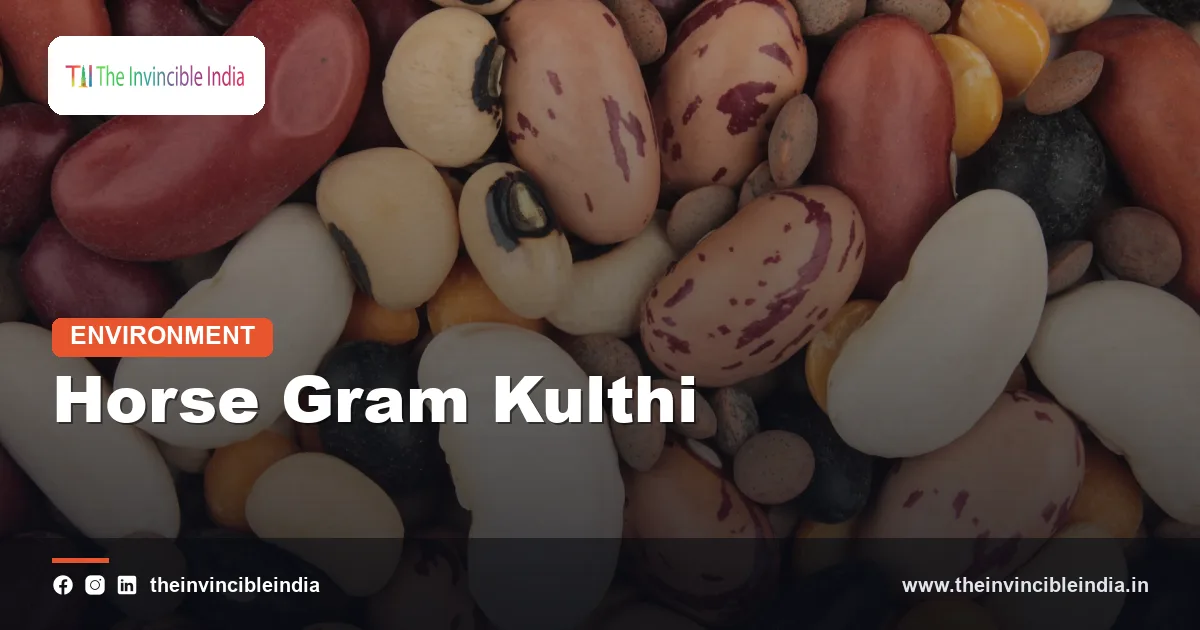
Kulthi, called horse gram in English, is a hardy, drought-tolerant pulse crop (Macrotyloma uniflorum) of the legume family, grown on poor, dry soils across India for its small flat seeds that are cooked as dal, soup and chutney powder. The plant is a low, creeping or twining annual that can produce a crop with very little rain, which has made it a dependable food of dryland farmers for thousands of years.
Horse gram is known as kollu in Tamil, ulavalu in Telugu, hurali in Kannada, muthira in Malayalam and gahat in the Kumaon hills of Uttarakhand. This explainer describes what the plant is, where and how it is grown, how it is eaten and used in traditional medicine, and why researchers now call it a valuable underutilised crop.
| Attribute | Detail |
|---|---|
| Common names | Horse gram, kulthi, Madras gram (Tamil: kollu; Telugu: ulavalu; Kannada: hurali; Malayalam: muthira; Uttarakhand: gahat) |
| Scientific name | Macrotyloma uniflorum (Lam.) Verdc. |
| Plant family | Fabaceae (the legume or pea family) |
| Where grown in India | Karnataka, Andhra Pradesh, Telangana, Tamil Nadu, Odisha, Maharashtra, Chhattisgarh, Jharkhand and the Uttarakhand hills |
| Growing season | Mostly a rainfed late-kharif or rabi crop; sown from August to October in the south and with the monsoon in the hills |
| Crop duration | Roughly 90 to 120 days, depending on variety and sowing date |
| Part used | Dry seeds (whole, sprouted or ground); haulm and seeds as cattle and horse feed |
| Main products and uses | Soup or rasam, dal, chutney powder, dosa, sprouts, flour, animal feed and folk medicine |
| Importance | Drought-tolerant food and fodder legume of dryland India; a recognised underutilised crop |
Key Takeaways
- Horse gram (Macrotyloma uniflorum), known as kulthi in Hindi, is a drought-tolerant pulse that is native to the Indian subcontinent and has been cultivated here since prehistoric times.
- Horse gram thrives on shallow, infertile, rainfed soils where most other crops fail, and it is mostly grown by small and marginal farmers in dryland regions of southern and central India.
- Horse gram seeds contain roughly 20 to 25 per cent protein and are traditionally eaten as soup, dal, sprouts and roasted chutney powder.
- The horse gram plant is a nitrogen-fixing legume whose dense, creeping growth covers the ground and protects thin soils from erosion.
- Horse gram is called an orphan or underutilised crop because its nutritional and climate-resilience value is high but its research and market attention has been limited.
- Raw horse gram contains anti-nutritional factors and a hard seed coat, so the seed must be soaked and cooked thoroughly before it is eaten.
What Is Horse Gram?
Horse gram is a pulse, meaning the dry edible seed of a leguminous plant, and it is the seed of Macrotyloma uniflorum, a close relative of the cowpea and the green and black grams. Unlike common dals, horse gram seeds are small, flat and glossy, ranging in colour from light brown to reddish-brown, grey or nearly black, often with mottled markings.
The English name comes from the old practice of feeding the seeds to horses and cattle, although in India the crop is eaten by people as well. In many southern households, the seeds are an everyday winter food, and in the hills of Uttarakhand, gahat dal is a traditional dish prepared during cold months.
Where did horse gram originate?
Horse gram is considered native to the Indian subcontinent, and archaeological finds of the seeds at ancient sites in southern and central India suggest that people have used it for several thousand years. It is among the earliest pulses cultivated in peninsular India, and it later spread to Sri Lanka, Myanmar, Africa and the Caribbean.
Ancient Indian texts refer to a pulse called kulattha, which is generally identified with horse gram, and the plant features in traditional Ayurvedic writing. This long history reflects how well suited the crop is to the dry regions of the country.
What Does the Horse Gram Plant Look Like?
The horse gram plant is a slender, hairy annual herb that is either erect or spreading and sometimes twining, usually reaching 30 to 60 centimetres in height or length. Its trailing habit and fine hairs help it cover the ground and conserve moisture in dry soils.
- Roots: a deep, strong taproot that searches for water far below the surface and carries small nitrogen-fixing nodules.
- Leaves: trifoliate, with three oval leaflets that are covered in soft hairs.
- Flowers: small, pale yellow or greenish flowers borne in small clusters at the leaf joints.
- Pods: slightly curved, flat and narrow, 3 to 6 centimetres long, ending in a short beak and holding five to eight seeds.
- Seeds: small, flat and lens-shaped, with a hard coat that makes them slow to absorb water.
The plant is often photoperiod-sensitive, and its flowering and ripening depend on the date of sowing. Farmers therefore choose varieties suited to their region and sow them at the recommended time.
Where Is Horse Gram Grown in India?
Horse gram is grown mainly in the drier parts of southern and central India, with Karnataka, Andhra Pradesh, Telangana and Tamil Nadu among the key states, along with Odisha, Maharashtra, Chhattisgarh and Jharkhand. In the Himalayan region, the crop is raised on terraced slopes in Uttarakhand, where it is known as gahat.
Production is concentrated in these areas for several reasons.
- Rainfall pattern: the crop suits regions with low or erratic rain and a short wet season.
- Soil type: it grows on red, gravelly, shallow and light soils that are poor in nutrients.
- Cropping role: it is sown as a late-season crop after the main kharif harvest or as a sole rainfed crop on marginal land.
Horse gram occupies a modest share of India’s total pulse area and is mostly a subsistence and local-market crop. Official figures vary by year and source, so any statistics should be checked against the reference year.
Why Is Horse Gram So Drought-Tolerant?
Horse gram is so drought-tolerant because of its deep taproot, its small, hairy leaves that lose little water and its short life cycle, which allows the plant to complete its growth before moisture runs out. These traits let the crop produce seed on residual soil moisture and in seasons when rainfall is poor.
Researchers studying horse gram have found genes and traits related to water-use efficiency and heat tolerance, and they see the crop as a possible source of climate-resilience traits for other legumes. With rainfall becoming less predictable in many dryland districts, horse gram has attracted fresh attention from agricultural scientists.
| Trait | How It Helps in Dry Conditions |
|---|---|
| Deep taproot | Reaches moisture in deeper soil layers |
| Hairy, small leaves | Reduces water loss through the leaf surface |
| Creeping habit | Shades the soil and reduces evaporation |
| Short duration | Escapes the late-season drought |
| Low input need | Gives a harvest without irrigation or heavy fertiliser |
What Conditions Does Horse Gram Need?
Horse gram needs warm weather with temperatures of about 20 to 30 degrees Celsius and well-drained soil, and it can survive on far less rainfall than most pulses. It does badly on waterlogged ground and in heavy clay soils, and it is sensitive to frost.
- Rainfall: modest; the crop commonly grows in areas with 400 to 800 millimetres per year.
- Soil: red loams, gravelly and sandy soils with low fertility and good drainage.
- Sowing time: usually late August to October in southern India; the monsoon months in the hills.
- Seed rate: often around 20 to 25 kilograms per hectare for sole crops.
- Management: minimal fertiliser, with a light dose of phosphorus helpful in poor soils.
How Is Horse Gram Cultivated?
Horse gram is cultivated with very little effort by sowing seed by broadcast or in rows on lightly prepared land and allowing it to grow on the available rain. Because it is often grown on marginal land, farmers invest less in this crop than in cereals or cash crops.
Sowing and care
Seeds are sown after one or two ploughings, either scattered by hand or placed in rows 30 centimetres apart. Seed treatment with Rhizobium culture and a fungicide can improve establishment, and one weeding in the first month is usually enough.
Mixed and intercropping
In many places, horse gram is grown with millets such as finger millet (ragi) or with sorghum, or sown as a relay crop after a short-duration kharif crop. These systems use leftover soil moisture and add a pulse to the household’s food supply.
Harvest and threshing
The crop is harvested when most pods turn yellow-brown and dry, and the plants are cut and sun-dried before threshing. The leftover haulm makes valuable fodder and is fed to cattle, buffalo and horses.
How Is Horse Gram Eaten?
Horse gram is eaten after soaking and boiling or pressure-cooking until the hard seeds turn soft, and it is then served as soup, dal, curry, sprouts or ground chutney powder. The earthy, slightly strong flavour distinguishes it from milder pulses such as moong.
| Dish | Region | Description |
|---|---|---|
| Kollu rasam or ulava charu | Tamil Nadu and Andhra Pradesh | A thin, spiced soup made from boiled seeds and their broth |
| Hurali saaru and hurali chutney pudi | Karnataka | Spiced gravy and dry roasted seed powder eaten with rice or ragi balls |
| Kollu paruppu | Tamil Nadu | Cooked horse gram dal with tempering |
| Gahat ki dal and phanu | Uttarakhand | Warming dal and a thick preparation of ground pulses eaten in winter |
| Horse gram dosa and sprouts | Southern India | Ground batter pancakes and boiled or stir-fried sprouted seeds |
Because the seed coat is hard, soaking for several hours or overnight is common practice, and sprouting also softens the seed. Cooked horse gram is dark and strongly flavoured, and many cooks pair it with garlic, tamarind, chillies and cumin.
Is Horse Gram Nutritious and Is It Used as Medicine?
Horse gram is nutritious because it contains protein, dietary fibre, iron, calcium and phenolic compounds, with a protein level of about 20 to 25 per cent of dry weight. It is also low in fat and is traditionally regarded as a warming food that suits cold weather.
Horse gram has a long place in Indian folk medicine and Ayurveda, where the cooked seed broth is traditionally used for kidney stones, coughs and weight management. These uses rest on tradition, and while laboratory studies have examined its antioxidant and blood-sugar-related properties, they are not a substitute for medical treatment.
Raw seeds contain trypsin inhibitors, tannins and other anti-nutritional factors that interfere with digestion, so they are never eaten uncooked. Proper soaking, sprouting and thorough boiling reduce these compounds, and people with medical conditions such as kidney disease should seek professional advice before making horse gram a regular dietary feature.
What Is the Role of Horse Gram in Farming and Animal Feed?
Horse gram plays a dual role in farming as a food crop for people and a fodder and feed crop for animals, especially in dry regions where green fodder is scarce. The seeds are boiled and fed to horses, cattle and buffaloes as a high-energy feed, and the dry haulm is used as protein-rich fodder.
As a legume, horse gram also improves soil, and farmers value several of its characteristics.
- It fixes atmospheric nitrogen through root nodules.
- It covers the ground quickly and reduces soil erosion on slopes.
- It produces a seed crop with almost no purchased inputs.
- It can be grown as a green manure or cover crop in some systems.
Pests and diseases on horse gram are fewer than on most pulses, but the crop can suffer from yellow mosaic virus, powdery mildew, leaf spots and pod borers, and stored seeds can be attacked by bruchid beetles.
Why Is Horse Gram Called an Underutilised Crop?
Horse gram is called an underutilised crop because its yield and market value have remained low even though it is nutritious and climate-resilient, and because little breeding work and commercial promotion have been devoted to it. Scientists group it with other neglected crops such as small millets, which have also been rediscovered in recent years.
Several factors have limited the spread of horse gram.
- Yields are modest, usually well below those of chickpea or pigeon pea.
- The crop is grown mostly on marginal land by farmers with little market access.
- The hard seed coat and longer cooking time reduce its appeal in urban kitchens.
- Pulse procurement and policy support have focused on other crops.
In recent years, interest in millets, traditional foods and climate-smart agriculture has encouraged research institutes and farmer groups to improve horse gram varieties and to promote value-added products such as flour, ready-to-cook mixes and snacks.
Bottom Line
Horse gram is a rugged legume that turns dry, thin soils into food and fodder. Its drought tolerance, soil-protecting growth and long place in regional cooking make kulthi a crop of renewed interest as farmers and scientists look for resilient options in a changing climate.
Frequently Asked Questions
Is horse gram the same as kulthi?
Yes, horse gram and kulthi are the same crop, Macrotyloma uniflorum. It is also known as kollu in Tamil, ulavalu in Telugu, hurali in Kannada, muthira in Malayalam and gahat in Uttarakhand.
Why is it called horse gram?
It is called horse gram because the seeds have traditionally been fed to horses and other working animals as a nourishing feed. In India the pulse is also eaten by people, especially in southern and hill regions.
Which states grow horse gram in India?
Karnataka, Andhra Pradesh, Telangana, Tamil Nadu, Odisha, Maharashtra, Chhattisgarh, Jharkhand and the hills of Uttarakhand are the main horse gram growing regions. It is mostly grown under rainfed conditions on poor, dry soils.
Why is horse gram good for dry farming?
Horse gram suits dry farming because it has a deep taproot, small hairy leaves and a short life cycle that let it produce seed on very little rain. It also needs few inputs and grows on shallow, infertile soils where other pulses struggle.
Can horse gram be eaten raw?
No, horse gram should not be eaten raw, because the seeds contain anti-nutritional compounds and have a hard coat. Soaking, sprouting and thorough boiling or pressure-cooking make the seeds safe, soft and easier to digest.
Is horse gram good for kidney stones?
Horse gram soup is traditionally used in Indian folk medicine for kidney stones, but this use is based on tradition and is not a proven treatment. Anyone with kidney stones or kidney disease should consult a doctor before relying on it.
{“@context”:”https://schema.org”,”@graph”:[{“@type”:”FAQPage”,”mainEntity”:[{“@type”:”Question”,”name”:”Is horse gram the same as kulthi?”,”acceptedAnswer”:{“@type”:”Answer”,”text”:”Yes, horse gram and kulthi are the same crop, Macrotyloma uniflorum. It is also known as kollu in Tamil, ulavalu in Telugu, hurali in Kannada, muthira in Malayalam and gahat in Uttarakhand.”}},{“@type”:”Question”,”name”:”Why is it called horse gram?”,”acceptedAnswer”:{“@type”:”Answer”,”text”:”It is called horse gram because the seeds have traditionally been fed to horses and other working animals as a nourishing feed. In India the pulse is also eaten by people, especially in southern and hill regions.”}},{“@type”:”Question”,”name”:”Which states grow horse gram in India?”,”acceptedAnswer”:{“@type”:”Answer”,”text”:”Karnataka, Andhra Pradesh, Telangana, Tamil Nadu, Odisha, Maharashtra, Chhattisgarh, Jharkhand and the hills of Uttarakhand are the main horse gram growing regions. It is mostly grown under rainfed conditions on poor, dry soils.”}},{“@type”:”Question”,”name”:”Why is horse gram good for dry farming?”,”acceptedAnswer”:{“@type”:”Answer”,”text”:”Horse gram suits dry farming because it has a deep taproot, small hairy leaves and a short life cycle that let it produce seed on very little rain. It also needs few inputs and grows on shallow, infertile soils where other pulses struggle.”}},{“@type”:”Question”,”name”:”Can horse gram be eaten raw?”,”acceptedAnswer”:{“@type”:”Answer”,”text”:”No, horse gram should not be eaten raw, because the seeds contain anti-nutritional compounds and have a hard coat. Soaking, sprouting and thorough boiling or pressure-cooking make the seeds safe, soft and easier to digest.”}},{“@type”:”Question”,”name”:”Is horse gram good for kidney stones?”,”acceptedAnswer”:{“@type”:”Answer”,”text”:”Horse gram soup is traditionally used in Indian folk medicine for kidney stones, but this use is based on tradition and is not a proven treatment. Anyone with kidney stones or kidney disease should consult a doctor before relying on it.”}}]}]}


