

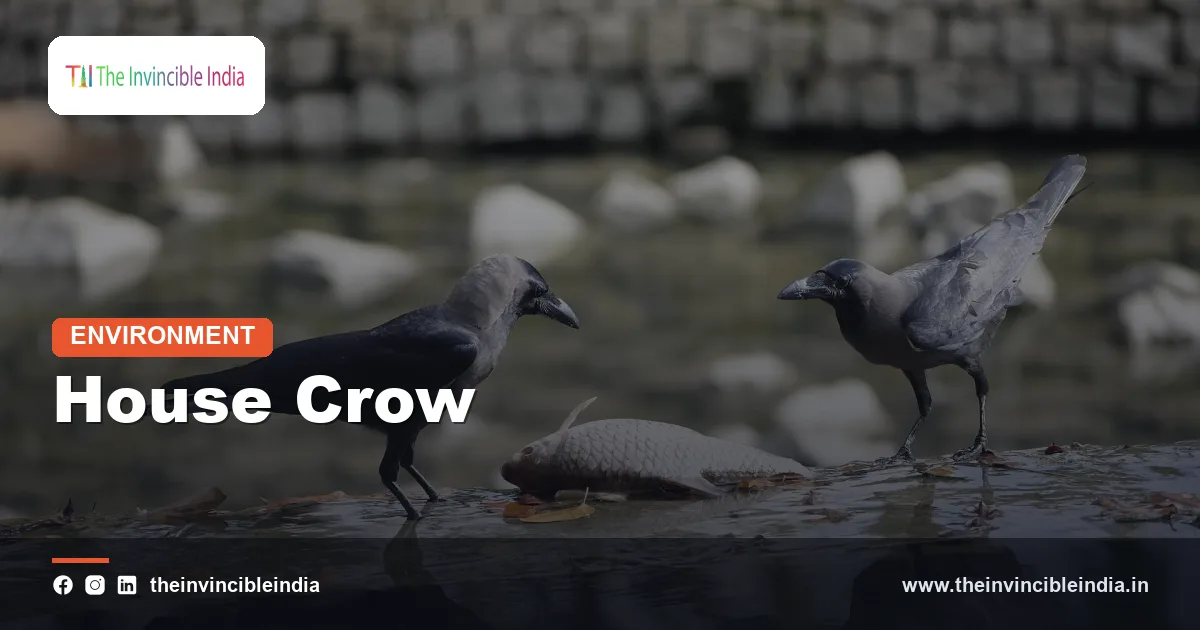
The house crow (Corvus splendens) is a medium-sized, glossy black crow with a pale grey neck and breast, native to South Asia and found in almost every Indian town, where it lives alongside people, scavenges food waste and shows remarkable intelligence. The house crow is also an invasive species in many countries outside its native range, having spread by ship and by deliberate introduction to parts of Africa, the Middle East and South-East Asia.
In India the house crow is one of the most familiar birds, perched on rooftops, wires and market stalls, and it holds a place in folklore, ritual and everyday speech. This explainer sets out how to identify the house crow, how it behaves and thinks, what role it plays in city sanitation, and why it has become a pest overseas, using stable and widely documented facts.
| Attribute | Detail |
|---|---|
| Common name | House crow (also Indian house crow; Hindi: kauwa) |
| Scientific name | Corvus splendens |
| Family | Corvidae (crows, ravens, jays and magpies) |
| Length | Roughly 40 centimetres |
| Distinguishing marks | Black forehead, throat, wings and tail with a paler grey-brown collar on the neck and upper breast |
| Native range | The Indian subcontinent and parts of neighbouring South and South-East Asia |
| Diet | Omnivorous: scraps, insects, grain, fruit, eggs, carrion and small animals |
| Breeding | Stick nests in trees, often on city trees and structures; pairs raise a brood each year |
| Introduced range | East Africa, South Africa, the Middle East, Singapore, Malaysia and other regions |
Key Takeaways
- The house crow is a grey-necked, glossy black crow of the family Corvidae, native to South Asia and abundant in Indian towns and cities.
- House crows are omnivorous scavengers that clear food waste, carrion and insects, giving them a practical role in urban sanitation.
- Crows in general, including the house crow, are considered among the most intelligent birds because they solve problems, learn quickly and cooperate.
- House crows mob predators and intruders in large noisy groups, a behaviour that protects nests and roosts.
- The house crow has become an invasive species in many countries outside South Asia, where it harms native birds and creates urban nuisance.
- In Hindu tradition, crows are linked with ancestors, which explains why food is offered to them during certain rituals.
What is the house crow?
The house crow is a medium-sized, omnivorous, highly social member of the crow family, Corvidae, found across South Asia and closely tied to human settlements. It is smaller and slimmer than the jungle crow and is easily recognised by its grey collar.
The scientific name Corvus splendens means roughly “shining crow”, a reference to the glossy plumage. The house crow is among the few birds that depend almost entirely on human habitation, to the extent that in parts of its range it is rarely seen far from villages or towns. Across India it is a resident species, staying put through the year, though flocks move locally to follow food and roosts.
It is often confused with the large-billed or jungle crow (Corvus macrorhynchos), which is bigger, entirely black, heavier-billed and more common in forests and the countryside.
How do you identify a house crow?
A house crow can be identified by its black head, throat, wings and tail contrasting with a pale grey or grey-brown collar that wraps around the neck and upper chest. The bill is black and strong, and the legs are black.
Useful field marks include the following.
- Grey collar: The paler neck and breast give the bird a “hooded” look. The shade of grey can vary between regions, and it is paler in some eastern populations.
- Slim build: The body is lighter and the bill thinner than in the jungle crow.
- Voice: The familiar flat, harsh “kaa” call is higher pitched than the deep croak of the jungle crow.
- Behaviour: House crows gather in flocks near buildings and food sources, while jungle crows are often more solitary.
- Sexes: Males and females look alike.
Juveniles are duller, with a less distinct collar, and a wing-flapping begging posture when they are fed by their parents.
Where does the house crow live in India?
The house crow lives in towns, cities, villages, ports and markets across India, and it is most concentrated wherever people produce food waste. It rarely settles in dense forest or remote country.
Its distribution closely follows human activity. Typical habitats include the following.
- Urban neighbourhoods, markets and food stalls
- Rubbish dumps, slaughter areas and fish markets
- Railway stations, temples and bus stands
- Coastal ports, harbours and fishing villages
- Tall trees, telephone towers and buildings used for roosting
At dusk, house crows gather in large communal roosts that can number in the hundreds or thousands, and individuals radiate out at dawn to feed. The size and exact locations of roosts shift over time, and no precise national population figure exists, though the species is widely considered abundant and not threatened.
How intelligent is the house crow?
The house crow is highly intelligent, as are most members of the crow family, showing quick learning, flexible problem-solving and memory for people and places. Corvids as a group have relatively large brains for their body size and are often compared with some primates in cognitive tests.
Research on corvids around the world, including crows and ravens, has documented behaviours such as using tools, remembering human faces, planning ahead and passing information to others. Studies of other crow species have drawn the most attention, and not every ability has been tested in the house crow specifically, so scientists are careful to separate what has been shown from what is likely. Nevertheless, everyday observation of house crows in Indian cities shows several clever habits.
- Opening containers: House crows pull at bags, lids and wrappers to reach food.
- Learning routines: They learn when meals are put out, when bins are emptied and when vehicles stop at particular places.
- Stealing: They snatch food from other animals or from people’s hands with quick coordinated moves, sometimes with one bird distracting while another grabs.
- Caching: Many corvids store spare food for later, and house crows have been seen hiding scraps.
- Social learning: A discovery by one crow is soon copied by others in the flock.
These capacities are linked to the bird’s success. A species that can quickly understand a changing human environment is at an advantage in a city.
What does the house crow eat?
The house crow eats almost anything it can find, including kitchen scraps, grain, fruit, insects, eggs, nestlings, small animals and carrion. It is a generalist scavenger and opportunist, which makes it extremely adaptable.
In towns, a large part of its diet consists of food waste from households, markets and street stalls. In rural areas, crows also take grain, fruit and insects. They sometimes raid the nests of other birds, eating eggs and chicks, and they may attack weak or injured animals. This broad diet is the main reason for the species’ abundance, because it allows the bird to live wherever people discard food.
What role does the house crow play in city sanitation?
The house crow plays a role as a natural scavenger, removing food waste, dead animals and discarded scraps that would otherwise rot and attract pests. Together with kites, dogs and rats, crows form part of the informal clean-up crew of Indian towns.
This contribution is real but has limits. Crows tear open waste bags and scatter litter, and they can spread rubbish more widely when they search for food. They may also carry microbes on their feet and bills, so the net effect on public health depends on how well municipal waste is managed. Cities with covered bins and regular collection offer fewer opportunities for crows to forage, which usually reduces both the mess and the crow population around those areas.
How does the house crow behave in groups?
The house crow behaves as a highly social bird that roosts, feeds and defends itself in groups, and its most famous behaviour is mobbing, in which many crows converge, call loudly and dive at a predator or intruder. Mobbing is directed at birds of prey, owls, cats, snakes and sometimes people near nests.
Common social behaviours include the following.
- Alarm calling: A crow that spots danger gives a harsh call that draws other crows quickly.
- Communal roosting: Birds gather in evening roosts, possibly to share information about food and to gain safety in numbers.
- Cooperative nest defence: Neighbouring pairs often help drive off a threat.
- Reacting to death: A crowd of crows often gathers around a dead crow, calling loudly, a behaviour that observers have long noted.
House crows are also well known as hosts of the Asian koel (Eudynamys scolopaceus), a cuckoo that lays its eggs in crow nests so that the crows raise the koel chicks. Crows frequently chase koels, particularly during the breeding season.
How does the house crow breed?
The house crow breeds by building a platform of sticks in a tree or on a structure, where the female lays a clutch of pale blue-green eggs with brown speckles, and both parents feed the young. The nest is often untidy and may include wire and other human debris.
Clutch size is commonly in the range of three to six eggs, but numbers vary by region. In much of India the breeding season falls roughly in the warmer months before and during the monsoon, though it differs between locations. Young crows remain dependent on their parents for some time after leaving the nest and are fed by them while they learn to forage. As with many corvids, family groups can stay together for a while.
Why is the house crow an invasive species abroad?
The house crow is an invasive species abroad because it spread beyond South Asia, often by travelling on ships, and then thrived in port cities where it competed with native birds, preyed on their nests and became a nuisance. Several countries now treat it as a pest and run control programmes.
The bird was carried by ship to many ports over the last century and a half, and it also established itself in some places through deliberate introduction. The table below lists some of the better-known examples.
| Region | How it arrived | Reported impact |
|---|---|---|
| East Africa (Zanzibar, Kenya and nearby coasts) | Introduced in the late nineteenth century, partly to clear waste | Competes with native birds; nuisance in towns |
| South Africa (Durban and Cape Town area) | Arrived by ship; established in port towns | Preys on native birds’ nests; targeted by control efforts |
| Singapore and Malaysia | Spread through ports and trade | Noise, droppings and nest predation; subject to culling programmes |
| Middle East and Gulf region | Ship-assisted spread to port cities | Established in some coastal towns |
| Other sites (Europe, Australia and elsewhere) | Occasional ship-assisted arrivals | Small populations, usually targeted for eradication |
The house crow’s mix of intelligence, appetite and association with ports makes it a very effective colonist. The costs reported include harm to small birds and their eggs, damage to crops, noise and fouling in towns. Control programmes in places such as Singapore have used trapping and other measures, and they remain a topic of debate among wildlife managers, since eradicating a clever and abundant bird is very difficult.
What does the crow mean in Indian culture?
The crow holds a place in Indian culture as a messenger and a symbol linked to ancestors, and during Pitru Paksha, the fortnight of ancestor rites in Hindu tradition, food is offered to crows. In Hindu mythology the crow is also associated with Shani, the deity linked to Saturn, as a vehicle.
The bird features in proverbs and folk tales, and a crow cawing at the window is traditionally seen as a sign that a guest is coming. The bird is also a subject of well-known fables in which its cleverness is celebrated. These cultural associations show how long the crow has lived alongside Indian society.
Bottom Line
The house crow is an intelligent, adaptable scavenger that has shaped, and been shaped by, Indian town life. At home it plays a useful clean-up role and has deep cultural meaning, while abroad it stands as a reminder of how a successful species can become a problem when moved to a new place.
Frequently Asked Questions
What is a house crow?
A house crow is a medium-sized, glossy black crow with a pale grey neck and breast, native to South Asia. It lives close to people in towns and villages across India. The species is a social, omnivorous scavenger.
How can I tell a house crow from a jungle crow?
The house crow has a grey collar on the neck and chest and a slimmer build, while the jungle crow is larger, wholly black and heavier-billed. The house crow is also higher pitched in voice and more tied to towns. The grey collar is the simplest clue.
Are house crows intelligent?
Yes, house crows are considered intelligent because crows in general show quick learning, problem-solving and social learning. Not every ability has been tested in the house crow itself, but its behaviour in cities, such as opening bags and learning routines, shows clear flexibility. Corvids as a group rank among the most intelligent birds.
Why are house crows called an invasive species?
House crows are called invasive because, outside South Asia, they have spread through ports and towns, preyed on native birds’ nests and caused nuisance. Countries such as Singapore and South Africa have run control programmes. In India, where the bird is native, it is part of the natural fauna.
Do house crows help keep cities clean?
Yes, house crows help by eating food waste, carrion and insects, so they act as scavengers in towns. However, they can also scatter rubbish when they tear open bags. Good waste management reduces both the mess and the number of crows.
Why do Indians feed crows during Pitru Paksha?
Indians feed crows during Pitru Paksha because, in Hindu tradition, crows are believed to carry offerings to ancestors. Families place food out for the birds as part of ancestor rites. The practice reflects the bird’s long cultural link with remembrance and the departed.
{“@context”:”https://schema.org”,”@graph”:[{“@type”:”FAQPage”,”mainEntity”:[{“@type”:”Question”,”name”:”What is a house crow?”,”acceptedAnswer”:{“@type”:”Answer”,”text”:”A house crow is a medium-sized, glossy black crow with a pale grey neck and breast, native to South Asia. It lives close to people in towns and villages across India. The species is a social, omnivorous scavenger.”}},{“@type”:”Question”,”name”:”How can I tell a house crow from a jungle crow?”,”acceptedAnswer”:{“@type”:”Answer”,”text”:”The house crow has a grey collar on the neck and chest and a slimmer build, while the jungle crow is larger, wholly black and heavier-billed. The house crow is also higher pitched in voice and more tied to towns. The grey collar is the simplest clue.”}},{“@type”:”Question”,”name”:”Are house crows intelligent?”,”acceptedAnswer”:{“@type”:”Answer”,”text”:”Yes, house crows are considered intelligent because crows in general show quick learning, problem-solving and social learning. Not every ability has been tested in the house crow itself, but its behaviour in cities, such as opening bags and learning routines, shows clear flexibility. Corvids as a group rank among the most intelligent birds.”}},{“@type”:”Question”,”name”:”Why are house crows called an invasive species?”,”acceptedAnswer”:{“@type”:”Answer”,”text”:”House crows are called invasive because, outside South Asia, they have spread through ports and towns, preyed on native birds’ nests and caused nuisance. Countries such as Singapore and South Africa have run control programmes. In India, where the bird is native, it is part of the natural fauna.”}},{“@type”:”Question”,”name”:”Do house crows help keep cities clean?”,”acceptedAnswer”:{“@type”:”Answer”,”text”:”Yes, house crows help by eating food waste, carrion and insects, so they act as scavengers in towns. However, they can also scatter rubbish when they tear open bags. Good waste management reduces both the mess and the number of crows.”}},{“@type”:”Question”,”name”:”Why do Indians feed crows during Pitru Paksha?”,”acceptedAnswer”:{“@type”:”Answer”,”text”:”Indians feed crows during Pitru Paksha because, in Hindu tradition, crows are believed to carry offerings to ancestors. Families place food out for the birds as part of ancestor rites. The practice reflects the bird’s long cultural link with remembrance and the departed.”}}]}]}


