

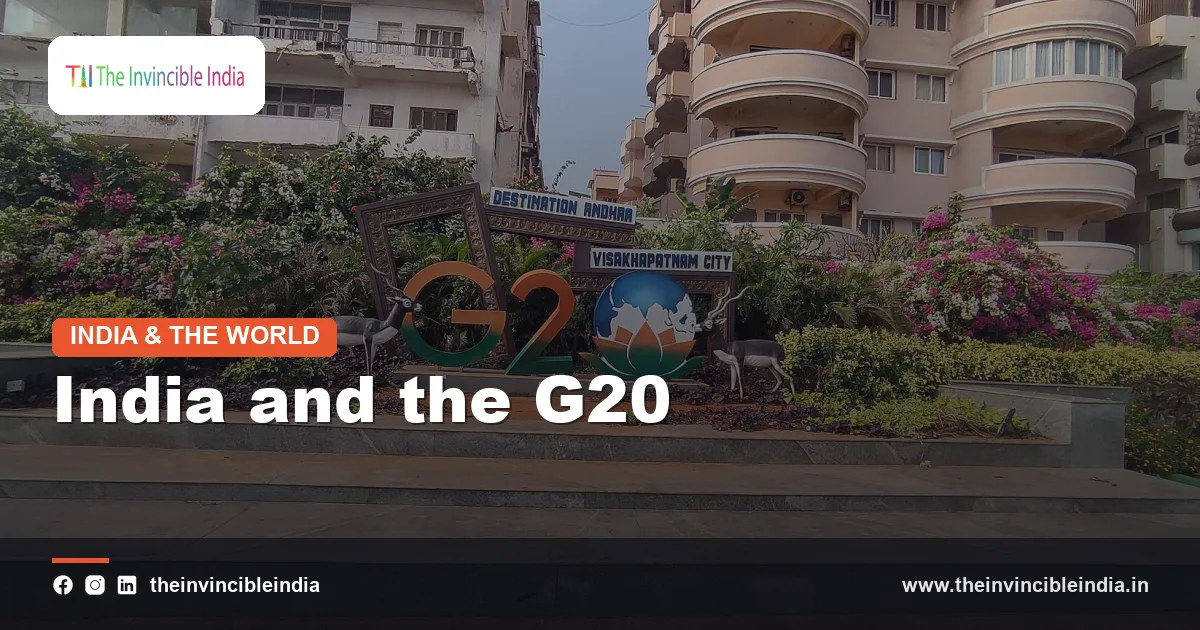
The G20, or Group of Twenty, is the world’s premier forum for international economic cooperation. It brings the leaders, finance ministers and central bank governors of the largest developed and emerging economies around one table to discuss growth, trade, finance, climate, health and development. Together, its members account for roughly 85 per cent of global GDP, about 75 per cent of world trade and close to two-thirds of the world’s population, which is why decisions taken here ripple far beyond the member countries.
India has been part of the group since its very beginning, but its stint as president in 2022-23 placed it firmly in the spotlight. Under the theme “One Earth, One Family, One Future”, India took G20 meetings to cities and towns across the country, spoke up for the Global South, and secured a consensus declaration in New Delhi along with a historic expansion of the group. This overview explains what the G20 is, how it works and what India’s presidency achieved. Figures given here are approximate and meant for general understanding.
Quick Facts
| Full name | Group of Twenty (G20) |
|---|---|
| Founded | 1999, as a forum of finance ministers and central bank governors |
| Leaders’ summits begin | 2008 (Washington, during the global financial crisis) |
| Membership | 19 countries, the European Union and (since 2023) the African Union |
| Share of the world | About 85% of global GDP, 75% of trade and two-thirds of population (approximate) |
| Secretariat | None; a rotating presidency coordinates the work |
| India’s presidency | 1 December 2022 to 30 November 2023 |
| India’s theme | Vasudhaiva Kutumbakam: One Earth, One Family, One Future |
| New Delhi Summit | 9-10 September 2023, Bharat Mandapam, Pragati Maidan |
What Is the G20?
The G20 is an informal intergovernmental forum. It is not a treaty-based organisation like the United Nations or the World Trade Organization, and its decisions are not legally binding. Its strength lies in political weight: when the leaders of the world’s largest economies agree on a direction, international institutions, national governments and markets pay attention.
The forum was designed to be flexible. It has no charter, no headquarters and no permanent staff. Each year a member country takes the chair, sets priorities, hosts the meetings and builds consensus on a joint outcome document, usually called a leaders’ declaration or communique.
Why the G20 matters
- It combines advanced economies and large emerging economies, giving it wider legitimacy than clubs of rich nations alone.
- It acts as a crisis-management platform, as it did in 2008-09, when coordinated stimulus and banking reforms helped stabilise the world economy.
- It sets the agenda on issues such as international taxation, debt relief, climate finance and the reform of global financial institutions.
- It gives developing countries a voice in shaping rules that affect them, even though it is not a formal rule-making body.
Origins: From the Asian Financial Crisis to Leaders’ Summits
The G20 was born out of the financial turbulence of the late 1990s. The Asian financial crisis of 1997-98 showed how quickly instability in one region could spread through globalised markets, and it exposed the limits of forums like the G7, which did not include major emerging economies. In response, finance ministers and central bank governors of the leading economies agreed to create a wider group, and the G20 was formally established in 1999, with its first meeting held in Berlin that December.
For nearly a decade the G20 remained a finance-level forum. That changed with the global financial crisis of 2008, which began in the United States housing and banking sector and soon engulfed the world economy. Leaders realised that ministers alone could not coordinate the scale of response required. The first G20 Leaders’ Summit was held in Washington, D.C. in November 2008, followed by London and Pittsburgh in 2009. At Pittsburgh, leaders designated the G20 as the premier forum for international economic cooperation.
Milestones at a glance
- 1997-98: Asian financial crisis highlights the need for a broader dialogue.
- 1999: G20 created at finance minister and central bank governor level.
- 2008: First Leaders’ Summit in Washington amid the global financial crisis.
- 2009: Pittsburgh summit names the G20 the premier forum for economic cooperation.
- 2022-23: India holds the presidency for the first time.
- 2023: African Union joins as a permanent member at the New Delhi Summit.
Who Are the Members of the G20?
The G20 has 19 member countries, plus the European Union. Since the New Delhi Summit of 2023, the African Union is also a full member. Despite the name “Group of Twenty”, the membership has therefore grown beyond the original count.
The 19 countries are Argentina, Australia, Brazil, Canada, China, France, Germany, India, Indonesia, Italy, Japan, Mexico, Russia, Saudi Arabia, South Africa, South Korea, Turkiye, the United Kingdom and the United States. The mix spans several continents, but Africa was long represented only by South Africa, an imbalance that India’s presidency set out to correct.
The African Union’s entry
The inclusion of the African Union, a bloc of 55 member states, as a permanent member was one of the most celebrated outcomes of the 2023 summit. India had championed the idea in the months before the summit, with the Prime Minister writing to fellow leaders to propose it. The decision was announced at the start of the summit, and the AU’s chair took a seat at the table as a full member. The move gave a continent that is home to over a billion people a direct voice in the forum, placing the AU on an equal footing with the European Union.
Guests and international organisations
Each presidency also invites guest countries and international organisations such as the United Nations, the International Monetary Fund, the World Bank, the World Trade Organization and the OECD. During India’s presidency, invited guests included countries such as Bangladesh, Egypt, Mauritius, the Netherlands, Nigeria, Oman, Singapore, Spain and the United Arab Emirates.
How the G20 Works
With no permanent secretariat, the G20 depends on the country holding the presidency, which runs the process for a year from 1 December to 30 November. The presidency decides the theme, schedules the meetings and shapes the agenda, while drawing on the members for ideas and consensus.
The rotating presidency and the troika
The presidency rotates among members, which are grouped into regional clusters so that every region gets a turn. To maintain continuity, the outgoing, current and incoming presidencies work together as the “troika”. During India’s term, the troika consisted of Indonesia (the previous president), India, and Brazil (the next president). The sequence continued with Brazil in 2024, South Africa in 2025 and the United States in 2026.
The two main tracks
- Finance Track: Led by finance ministers and central bank governors, it deals with the global economy, international financial architecture, taxation, infrastructure, sustainable finance and financial regulation.
- Sherpa Track: Led by the leaders’ personal representatives, known as sherpas, it covers wider issues such as agriculture, anti-corruption, climate, culture, digital economy, education, employment, energy, health, tourism and trade. The name comes from the mountain guides who help climbers reach the summit.
Both tracks feed into the Leaders’ Summit, where heads of state and government finalise the outcome document. Sherpas negotiate the text for months, and the real difficulty lies in finding wording acceptable to every member.
Engagement groups: beyond governments
The G20 also listens to societies and industries through engagement groups, which bring non-governmental stakeholders into the process and submit recommendations to the leaders. Each group is run by organisations from the host country.
- B20 (Business 20): The voice of the global business community.
- C20 (Civil 20): Civil society organisations.
- L20 (Labour 20): Trade unions and workers.
- Y20 (Youth 20): Young people from G20 countries.
- W20 (Women 20): Advocates for gender equality and women’s economic empowerment.
- T20 (Think 20): Think tanks and policy researchers.
- S20 (Science 20): Scientific academies and researchers.
- U20 (Urban 20): Cities and local governments.
- P20 (Parliament 20): Legislators from member countries.
India added further engagement groups during its presidency, including a Startup20 forum, to bring entrepreneurs and innovators into the discussion.
India and the G20: A Founding Member
India has been part of the G20 since its formation in 1999 and has used the forum to represent the interests of developing economies. Over the years, Indian leaders have used G20 summits to push for fairer global trade rules, greater financing for development, action against tax evasion and fugitive economic offenders, and better representation of emerging economies in global institutions such as the IMF and World Bank.
India’s economy is among the largest in the world and one of the fastest growing, and the country is home to the world’s largest population. This combination of size, growth and a developing-country perspective makes India a natural bridge between advanced and emerging economies, a position that proved valuable when it took over the chair.
Before 2023, India had never hosted a G20 Leaders’ Summit. Holding the presidency was therefore a first for the country, and it came as India was also marking 75 years of independence, adding a layer of national significance to the occasion.
India’s G20 Presidency, 2022-23
India took over the G20 presidency from Indonesia on 1 December 2022, following the Bali summit, and held it until 30 November 2023. The presidency’s logo featured a lotus, and its theme was drawn from the ancient Sanskrit phrase Vasudhaiva Kutumbakam, meaning “the world is one family”. Rendered in English as “One Earth, One Family, One Future”, it reflected the idea that global challenges require collective, human-centric solutions.
A presidency taken to the people
Unlike hosts who concentrate meetings in a single capital, India spread the G20 calendar across the country. Over 200 meetings were held in more than 50 cities, from Srinagar, Leh and Amritsar to Kochi, Hampi, Konark, Khajuraho and Kutch. Delegates were introduced to India’s heritage, cuisine and handicrafts, and the presidency was often described as a “People’s G20” because citizens, schools and universities took part in outreach events. Tourism and local infrastructure received a boost in the host cities.
Presidency highlights
| Aspect | Highlight |
|---|---|
| Theme | One Earth, One Family, One Future (Vasudhaiva Kutumbakam) |
| Duration | 1 December 2022 to 30 November 2023 |
| Reach | Meetings across dozens of cities in many states and Union Territories |
| Leaders’ Summit | New Delhi, 9-10 September 2023 |
| Outcome document | New Delhi Leaders’ Declaration, adopted by consensus |
| Membership | African Union admitted as a permanent member |
| Voice of the Global South | Summits hosted in 2023 to gather developing countries’ views |
| Sidelines | Launch of the India-Middle East-Europe Economic Corridor and the Global Biofuels Alliance |
India’s Priorities as President
India framed its agenda around inclusive, ambitious, decisive and action-oriented outcomes. Six broad priority areas stood out.
The voice of the Global South
Before the G20 summit, India hosted the Voice of Global South Summit, a virtual meeting with leaders of developing countries, to collect their concerns on food, fuel, fertiliser, debt and climate. The ideas were then carried into the G20 deliberations, so that the agenda did not remain set only by the richest economies. A second edition was held later in 2023.
Digital public infrastructure
India promoted the idea that open, interoperable digital systems for identity, payments and data exchange can accelerate inclusion. Drawing on its own experience with Aadhaar and the Unified Payments Interface (UPI), India pushed G20 members to endorse a framework for digital public infrastructure and to support its adoption in other developing countries.
Climate finance and green development
Another focus was linking climate action with development, including mobilising adequate finance and technology for developing countries, and encouraging lifestyle changes through the idea of LiFE, or Lifestyle for Environment. Members also reaffirmed efforts to promote renewable energy and energy transitions.
Reforming multilateral development banks
India supported efforts to make institutions such as the World Bank and regional development banks larger, better and more responsive, so that they can lend more for development and climate goals.
Women-led development
Moving beyond women’s development to women-led development, India encouraged policies to raise women’s workforce participation, access to technology and leadership in decision-making.
Inclusive and sustainable growth
The presidency also paid attention to health, education, food security, tourism, and the Sustainable Development Goals, whose progress had slowed in many regions.
The New Delhi Leaders’ Declaration
The summit’s central achievement was the New Delhi Leaders’ Declaration, adopted by consensus. At a time of sharp geopolitical divisions, particularly over the war in Ukraine, many observers expected the group to fail to agree on a joint text, as had happened with some ministerial meetings earlier in the year. The declaration was agreed on the first day of the summit, which was widely seen as a diplomatic success for the Indian presidency and its negotiators.
The text covered a wide range of topics, including strong, sustainable, balanced and inclusive growth, accelerated progress on the Sustainable Development Goals, green development pacts, reform of multilateral institutions, and a commitment to work on debt vulnerabilities of low-income countries. It also reaffirmed the principle that states should refrain from the threat or use of force against territorial integrity, while stressing that the G20 is primarily a forum for economic cooperation rather than a body for resolving security disputes. The summit was held at the newly built Bharat Mandapam in Pragati Maidan, New Delhi.
Key Outcomes and Announcements
- African Union as a permanent member: Perhaps the most lasting result, it broadened the group’s representation.
- India-Middle East-Europe Economic Corridor (IMEC): On the summit’s sidelines, India, the United States, Saudi Arabia, the United Arab Emirates, the European Union, France, Germany and Italy announced an understanding to develop a corridor of railways, ports, energy and digital links connecting India, the Gulf and Europe.
- Global Biofuels Alliance: Launched by India with partner countries to promote the adoption and trade of sustainable biofuels as part of the energy transition.
- Digital public infrastructure: Support for a framework on digital public infrastructure and for related initiatives such as a global repository of digital solutions.
- Green Development Pact: A commitment to sustainable development combined with climate action and the mobilisation of finance.
- Women’s empowerment: Creation of a working group on the empowerment of women, to continue the work in future presidencies.
Why It Matters for India’s Global Standing
The presidency strengthened India’s profile in several ways. It showcased the country’s organisational capacity, from hosting hundreds of meetings to managing a large summit. It demonstrated diplomatic skill by building consensus in a divided world, and it helped India project itself as a bridge between the developed world and the Global South.
It also allowed India to place its own policy experiences, such as digital public infrastructure, on the global stage. By championing the African Union and developing-country concerns, India reinforced ties with Africa and the wider Global South, and gained goodwill in the process. Domestically, the presidency raised public awareness of international affairs and promoted tourism in lesser-known destinations.
Importantly, the G20 does not end with a single presidency. India’s term was followed by Brazil, then South Africa, both developing economies, which gave continuity to the Global South agenda that India had pushed to the centre of G20 discussions.
G20 vs G7 vs BRICS
The G20 is often compared with other groupings, and understanding the differences clarifies its role.
| Grouping | Nature | Composition | Focus |
|---|---|---|---|
| G7 | Informal club of advanced democracies | Canada, France, Germany, Italy, Japan, the UK and the US (with the EU attending) | Economic and political coordination among wealthy economies |
| G20 | Informal forum of major economies | 19 countries, the EU and the African Union | Global economic cooperation and financial stability |
| BRICS | Grouping of emerging economies | Originally Brazil, Russia, India, China and South Africa, since expanded | Cooperation among emerging markets and reform of global governance |
The G7 is smaller and more homogeneous, and its members are all in the G20. BRICS is a separate grouping of emerging economies, several of which are also G20 members. India participates in both the G20 and BRICS, and this allows it to engage with different groups of countries without being tied to any single bloc. Of the three, the G20 is the broadest, because it brings advanced and emerging economies into one room.
Conclusion
From a finance ministers’ meeting born out of the Asian financial crisis, the G20 has grown into the central forum for global economic diplomacy. India’s presidency in 2022-23 showed how a developing country can lead that forum: it widened the group by welcoming the African Union, delivered a consensus declaration despite geopolitical strains, and put the concerns of the Global South firmly on the agenda. As the presidency now passes from one member to another, the work begun in New Delhi on digital public infrastructure, climate finance, development banks and inclusive growth continues to shape the conversation.
Frequently Asked Questions
What does G20 stand for?
G20 stands for the Group of Twenty, a forum of major developed and emerging economies. It includes 19 countries, the European Union and, since 2023, the African Union. It was set up in 1999 to coordinate on international economic and financial issues.
When did India hold the G20 presidency?
India held the G20 presidency from 1 December 2022 to 30 November 2023, taking over from Indonesia. The Leaders’ Summit was held in New Delhi on 9-10 September 2023. It was the first time India hosted the G20 Leaders’ Summit.
What was the theme of India’s G20 presidency?
The theme was “One Earth, One Family, One Future”, drawn from the Sanskrit phrase Vasudhaiva Kutumbakam, which means the world is one family. It emphasised collective, human-centric solutions to global challenges.
Why was the African Union’s inclusion important?
The African Union became a permanent G20 member at the 2023 New Delhi Summit, giving the 55-member bloc a direct voice in the forum. Until then, South Africa was the only African country in the group. India had strongly championed this expansion, and it is regarded as a major outcome of its presidency.
How is the G20 different from the G7?
The G7 is a smaller club of advanced economies, while the G20 also includes large emerging economies such as India, China, Brazil and Indonesia. The G20 therefore represents a much larger share of the world’s population and economy, and it deals with a wider set of issues beyond the concerns of wealthy nations.
Does the G20 have a permanent headquarters or secretariat?
No. The G20 has no permanent secretariat or headquarters. The country holding the rotating presidency coordinates the agenda and meetings for a year, supported by the troika of the previous, current and next presidencies.


