

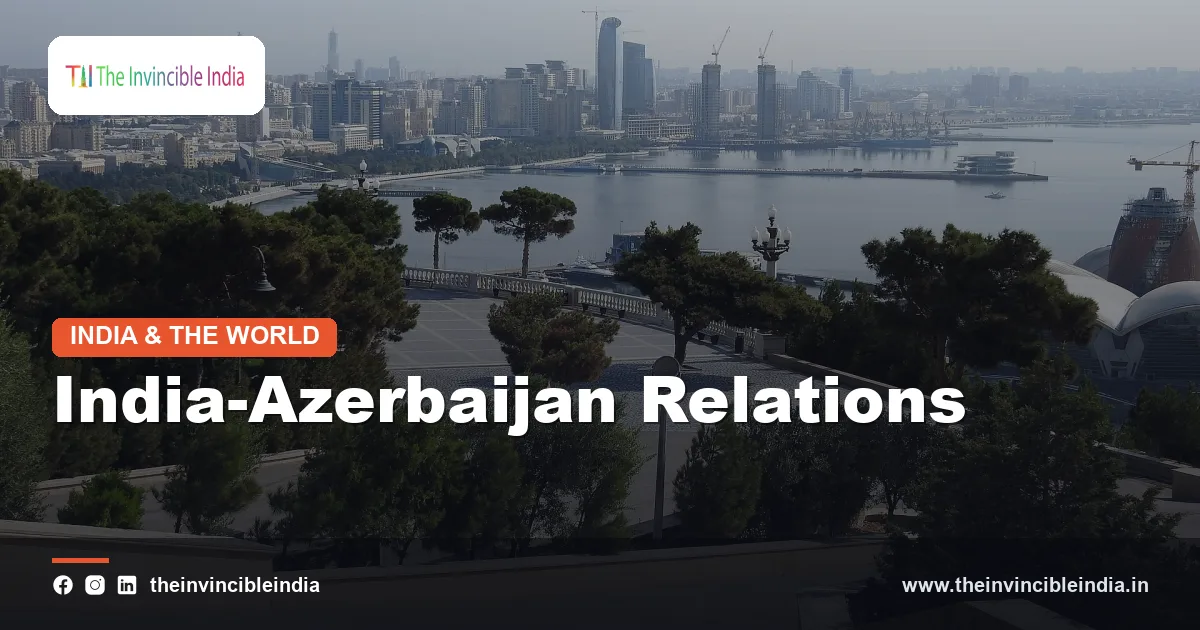
India-Azerbaijan relations are the bilateral ties between the Republic of India and the Republic of Azerbaijan, a Caucasus-Caspian partnership centred on energy, trade and the International North-South Transport Corridor (INSTC), and shaped by a delicate regional balance. Azerbaijan became independent from the Soviet Union in 1991, and India recognised the new state soon afterwards, with embassies opening in Baku and New Delhi in the late 1990s.
India-Azerbaijan relations have two distinct layers. One is economic and practical: Indian state-owned ONGC Videsh holds a stake in Azerbaijan’s offshore oil fields, and Azerbaijan sits on a key trade route to Russia and Europe. The other is political: Azerbaijan’s close alignment with Pakistan and Turkey, and India’s own partnership with Armenia, impose limits that both capitals manage carefully.
| Attribute | Details |
|---|---|
| Countries | Republic of India and Republic of Azerbaijan |
| Azerbaijan’s independence | 1991 (dissolution of the Soviet Union) |
| Diplomatic ties | Recognition in the early 1990s; resident embassies in Baku and New Delhi from the late 1990s |
| Energy link | ONGC Videsh minority stake in the Azeri-Chirag-Gunashli (ACG) offshore fields and related Baku-Tbilisi-Ceyhan pipeline interests |
| Connectivity | International North-South Transport Corridor (INSTC), agreed in 2000 by India, Iran and Russia; Azerbaijan joined subsequently |
| Trade pattern | India imports mainly crude oil; India exports pharmaceuticals, machinery, tea, rice and other goods |
| Historic link | The Ateshgah fire temple near Baku, associated with Indian merchants of the seventeenth and eighteenth centuries |
| Sensitive factors | Azerbaijan-Pakistan-Turkey closeness; India-Armenia defence relationship |
Key Takeaways
- India-Azerbaijan relations began after Azerbaijan’s independence in 1991 and are driven mainly by energy cooperation and trade.
- ONGC Videsh, the overseas arm of India’s Oil and Natural Gas Corporation (ONGC), holds a minority stake in the Azeri-Chirag-Gunashli offshore oil fields in the Caspian Sea.
- Azerbaijan is part of the International North-South Transport Corridor, a multimodal route intended to shorten transport time between India, Iran, the Caucasus and Russia.
- Indian merchants traded in Baku centuries ago, and the Ateshgah temple near Baku is often cited as a symbol of the historical link.
- Azerbaijan’s closeness to Pakistan and Turkey, and India’s growing partnership with Armenia, are the main political sensitivities in the relationship.
- Bilateral trade is modest compared with India’s major partners and has been volatile because it depends on crude oil purchases.
What is the history of India-Azerbaijan relations?
The history of India-Azerbaijan relations stretches back centuries through merchants and pilgrims on the Silk Road, and its modern phase began when Azerbaijan became independent in 1991. Indian traders, including those from Multan and Sindh, were known to live in Baku in the seventeenth and eighteenth centuries, where Baku’s natural gas flames drew Hindu and Zoroastrian worshippers.
The Ateshgah of Baku, a temple complex at Surakhani near the city, is associated with these merchants and attracts Indian visitors even today. It is now a museum and heritage site.
Modern milestones
- 1991: Azerbaijan declares independence; India recognises the new state.
- 1990s: Diplomatic relations are formalised and presidential-level contacts begin.
- Late 1990s: India and Azerbaijan open embassies in each other’s capitals.
- 2000-2002: The INSTC agreement is signed, and Azerbaijan later joins the framework.
- 2013: ONGC Videsh acquires a stake in the ACG offshore oil fields in the Caspian.
Why is energy the core of India-Azerbaijan relations?
Energy is the core of India-Azerbaijan relations because Azerbaijan is a Caspian oil and gas producer, India is one of the world’s largest oil importers, and an Indian state company has a direct equity stake in Azerbaijani production. Baku became one of the world’s earliest oil-producing centres in the nineteenth century, and its offshore resources remain central to the national economy.
India’s interest is both commercial and strategic. Access to equity oil and diversified supply sources supports Indian energy security, and Azerbaijan’s light, low-sulphur Azeri crude is attractive to many refiners. Azerbaijan, in turn, sees India as a large, growing energy market and a potential investor in downstream and technology sectors.
What is ONGC Videsh’s role in Azerbaijan?
ONGC Videsh Limited (OVL), the overseas investment arm of ONGC, holds a minority participating interest in the Azeri-Chirag-Gunashli (ACG) oil fields in the Azerbaijani sector of the Caspian Sea, as well as a stake in the Baku-Tbilisi-Ceyhan (BTC) oil pipeline linked to the project. OVL acquired its ACG stake in 2013 from another international partner, in a deal widely reported at around one billion US dollars.
The investment gave India a foothold in one of the world’s major offshore developments, which is operated by BP and shared with several international partners and Azerbaijan’s State Oil Company (SOCAR). The share is small, roughly in the low single digits, and its contribution to India’s overall crude supply is limited. Even so, the project is symbolic as an instance of Indian public-sector energy investment in the Caspian region. Production from ACG has matured in recent years, so output and returns change over time.
How does the INSTC connect India and Azerbaijan?
The International North-South Transport Corridor (INSTC) connects India and Azerbaijan by offering a multimodal route in which cargo from Indian ports travels by sea to Iran, then by rail and road through Iran and Azerbaijan towards Russia, the Caucasus and northern Europe. India, Iran and Russia signed the original INSTC agreement in 2000, and Azerbaijan acceded afterwards as a transit state.
The corridor is designed to reduce transit time and cost compared with the traditional sea route via the Suez Canal. Estimates commonly cited by planners suggest savings of about 30 per cent in cost and up to 40 per cent in time on certain consignments, although actual results depend on route and cargo.
Main route options
- Western route: Mumbai to Bandar Abbas (Iran) by sea, then via Iranian rail and road to Astara on the Azerbaijan border, and onward through Azerbaijan to Russia.
- Central route: Across the Caspian Sea from Iranian ports to Russian ports.
- Eastern route: Through Central Asia towards Russia.
The missing rail link between Rasht and Astara in Iran has long been seen as the key bottleneck on the western route. Progress has depended on financing, regional politics and sanctions affecting Iran, so the corridor operates below its potential.
What is the state of trade between India and Azerbaijan?
Trade between India and Azerbaijan is modest, generally in the range of one to two billion US dollars in recent years, and is dominated by Indian purchases of crude oil. The figure has fluctuated widely because it depends on oil volumes and prices, and it is small compared with India’s trade with larger partners.
India exports pharmaceuticals, machinery, electrical equipment, tea, rice, cotton, textiles and some vehicles and spare parts to Azerbaijan. Indian pharmaceutical companies are active in the Azerbaijani market, and Indian students, especially in medicine, attend universities in Baku.
| Area | Description | Status |
|---|---|---|
| Crude oil | Indian refiners buy Azerbaijani crude; OVL holds an equity stake in the ACG fields | Main driver of trade value; volumes vary |
| Pharmaceuticals and healthcare | Indian generics supplied to Azerbaijan; medical education links | Steady |
| Connectivity | INSTC and Caspian shipping | Operational in part; limited by gaps in Iranian rail links |
| IT and services | Cooperation in information technology and training | Early stage |
| Tourism and education | Indian visitors and students in Baku | Affected by shifts in public sentiment in recent years |
Why do Azerbaijan’s ties with Pakistan and Turkey matter to India?
Azerbaijan’s ties with Pakistan and Turkey matter to India because Baku has aligned with Islamabad and Ankara on several regional questions, including the Kashmir dispute, and this limits the political depth of India-Azerbaijan relations. Azerbaijan, Pakistan and Turkey have developed a close defence, political and cultural partnership, sometimes described as a trilateral friendship.
Azerbaijan has at times expressed positions favourable to Pakistan on Kashmir in international forums, and Azerbaijan and Pakistan have cooperated on defence matters. India’s position is that Kashmir is an internal matter and that Jammu and Kashmir is an integral part of India. India has sought to prevent the disagreement from blocking cooperation on energy and connectivity, while keeping its public rhetoric measured. Baku, for its part, describes its policy as based on territorial integrity and sovereignty, the same principle it invokes on its own conflicts.
Following India-Pakistan tensions in 2025, public sentiment in India toward Azerbaijan and Turkey cooled, and several Indian travel operators reduced promotion of the destinations. Official channels remained open.
How does the Armenia dispute affect India-Azerbaijan relations?
The Armenia dispute affects India-Azerbaijan relations because India has built a defence and diplomatic partnership with Armenia, while Azerbaijan and Armenia have been in conflict over Nagorno-Karabakh since the 1980s and 1990s. India has sold Armenia military equipment in recent years, and Armenia has supported India’s positions on several issues.
India has publicly supported the territorial integrity of states and a peaceful negotiated settlement, and it did not take sides in the 2020 war or in Azerbaijan’s 2023 military operation that brought the territory under Azerbaijani control. A peace framework between Azerbaijan and Armenia was announced in Washington in 2025, and India welcomed efforts at reconciliation. If peace holds, it could improve regional connectivity, which would also be relevant to the INSTC and to other proposed transport routes across the South Caucasus.
India’s approach is best described as hedged neutrality: preserving defence ties with Armenia while maintaining energy and trade ties with Azerbaijan.
How do India and Azerbaijan cooperate in multilateral forums?
India and Azerbaijan cooperate in multilateral forums such as the United Nations, the Non-Aligned Movement and Eurasian groupings, although their positions do not always match. Azerbaijan chaired the Non-Aligned Movement from 2019 to 2023, a period in which India, a founding member of the movement, remained an active participant.
Azerbaijan has also been associated with the Shanghai Cooperation Organisation as a dialogue partner and has shown interest in broader Eurasian and global groupings, while India is a full SCO member. Both countries support multilateral trade, climate action and energy dialogue. Differences appear on the most sensitive South Asian and Caucasus questions, which are generally kept out of joint statements.
What cultural and people-to-people links exist?
The cultural and people-to-people links between India and Azerbaijan include the Ateshgah temple, Bollywood’s popularity in Baku, yoga, medical education and a small Indian diaspora. Indian films have long had audiences in the former Soviet space, and Indian cuisine and festivals have been showcased in Baku through cultural centres.
Indian students, many of them studying medicine, form one of the larger Indian groups in Azerbaijan. Azerbaijani visitors to India include business delegations, students and tourists. The Indian Council for Cultural Relations (ICCR) and Azerbaijani institutions have organised occasional exchanges, and Azerbaijani studies exist at a few Indian universities.
What is the future of India-Azerbaijan relations?
The future of India-Azerbaijan relations is likely to remain pragmatic, with energy, connectivity and trade continuing while political divergence on Pakistan and Armenia sets a ceiling. Neither country has an interest in a public rupture, and both gain from practical exchanges in energy, pharmaceuticals and transport.
The most important variables are the stability of Azerbaijan-Armenia peace, the progress of the INSTC (especially the Iranian rail link), and the trajectory of India-Pakistan and Azerbaijan-Pakistan relations. Observers also note that Azerbaijan pursues a multi-vector foreign policy, balancing Russia, Turkey, Europe, China and the Gulf, which means India is one among several partners rather than a central one.
Bottom Line
India-Azerbaijan relations are functional rather than close: energy equity, the INSTC corridor and modest trade provide a stable base, while Azerbaijan’s closeness to Pakistan and Turkey and India’s partnership with Armenia restrain political warmth. Both governments have so far managed the differences without allowing them to disrupt practical cooperation.
Frequently Asked Questions
When did India recognise Azerbaijan?
India recognised Azerbaijan after it became independent from the Soviet Union in 1991. Diplomatic relations were established in the early 1990s. Embassies opened in Baku and New Delhi in the late 1990s.
What is ONGC Videsh’s stake in Azerbaijan?
ONGC Videsh holds a minority interest in the Azeri-Chirag-Gunashli offshore oil fields in the Caspian Sea, acquired in 2013, along with a share in the related Baku-Tbilisi-Ceyhan pipeline. The stake is small, in the low single digits by percentage. The project is operated by BP together with international partners and SOCAR.
How is Azerbaijan connected to the INSTC?
Azerbaijan is a transit state on the western route of the International North-South Transport Corridor, which links India to Russia and Europe via Iran. Cargo moves from Indian ports to Iran, then by rail and road to Astara and onward through Azerbaijan. The corridor still depends on completing a rail link in Iran.
Does Azerbaijan support Pakistan against India?
Azerbaijan has been close to Pakistan and has sometimes taken positions on Kashmir that India does not accept. India treats Kashmir as an internal matter. Both India and Azerbaijan have kept channels open despite the disagreement.
How does India balance its ties with Armenia and Azerbaijan?
India balances its ties by supporting territorial integrity and peaceful settlement, avoiding taking sides in the Armenia-Azerbaijan conflict, and continuing separate cooperation with each country. India has defence and diplomatic ties with Armenia and energy and trade ties with Azerbaijan. The approach is often described as hedged neutrality.
What is the Ateshgah of Baku?
The Ateshgah of Baku is a historic temple complex at Surakhani near Baku, linked to Indian merchants of the seventeenth and eighteenth centuries. It was a site of fire worship associated with Hindu and Zoroastrian traditions because of natural gas flames. It is now a museum and a symbol of the historical India-Azerbaijan connection.
{“@context”:”https://schema.org”,”@graph”:[{“@type”:”FAQPage”,”mainEntity”:[{“@type”:”Question”,”name”:”When did India recognise Azerbaijan?”,”acceptedAnswer”:{“@type”:”Answer”,”text”:”India recognised Azerbaijan after it became independent from the Soviet Union in 1991. Diplomatic relations were established in the early 1990s. Embassies opened in Baku and New Delhi in the late 1990s.”}},{“@type”:”Question”,”name”:”What is ONGC Videsh’s stake in Azerbaijan?”,”acceptedAnswer”:{“@type”:”Answer”,”text”:”ONGC Videsh holds a minority interest in the Azeri-Chirag-Gunashli offshore oil fields in the Caspian Sea, acquired in 2013, along with a share in the related Baku-Tbilisi-Ceyhan pipeline. The stake is small, in the low single digits by percentage. The project is operated by BP together with international partners and SOCAR.”}},{“@type”:”Question”,”name”:”How is Azerbaijan connected to the INSTC?”,”acceptedAnswer”:{“@type”:”Answer”,”text”:”Azerbaijan is a transit state on the western route of the International North-South Transport Corridor, which links India to Russia and Europe via Iran. Cargo moves from Indian ports to Iran, then by rail and road to Astara and onward through Azerbaijan. The corridor still depends on completing a rail link in Iran.”}},{“@type”:”Question”,”name”:”Does Azerbaijan support Pakistan against India?”,”acceptedAnswer”:{“@type”:”Answer”,”text”:”Azerbaijan has been close to Pakistan and has sometimes taken positions on Kashmir that India does not accept. India treats Kashmir as an internal matter. Both India and Azerbaijan have kept channels open despite the disagreement.”}},{“@type”:”Question”,”name”:”How does India balance its ties with Armenia and Azerbaijan?”,”acceptedAnswer”:{“@type”:”Answer”,”text”:”India balances its ties by supporting territorial integrity and peaceful settlement, avoiding taking sides in the Armenia-Azerbaijan conflict, and continuing separate cooperation with each country. India has defence and diplomatic ties with Armenia and energy and trade ties with Azerbaijan. The approach is often described as hedged neutrality.”}},{“@type”:”Question”,”name”:”What is the Ateshgah of Baku?”,”acceptedAnswer”:{“@type”:”Answer”,”text”:”The Ateshgah of Baku is a historic temple complex at Surakhani near Baku, linked to Indian merchants of the seventeenth and eighteenth centuries. It was a site of fire worship associated with Hindu and Zoroastrian traditions because of natural gas flames. It is now a museum and a symbol of the historical India-Azerbaijan connection.”}}]}]}


