

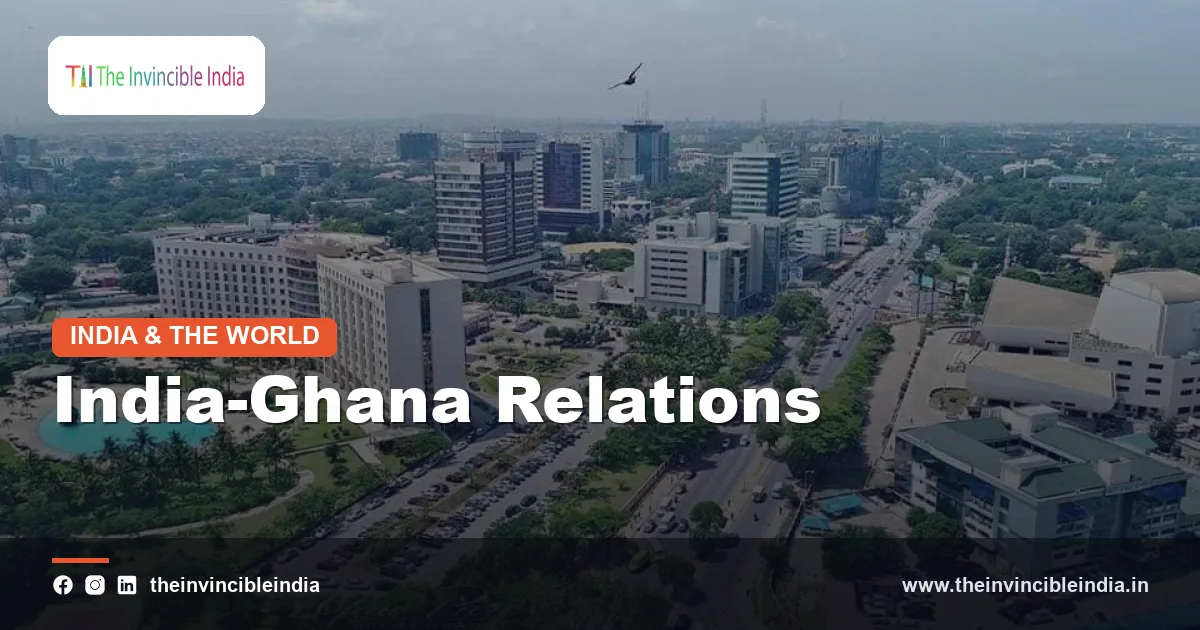
India-Ghana relations are the bilateral ties between the Republic of India and the Republic of Ghana, a partnership rooted in the shared anti-colonial struggle, the Non-Aligned Movement and a long Indian commercial presence on the West African coast. Ghana became independent from Britain on 6 March 1957, and the two Commonwealth democracies have maintained warm, largely uncomplicated relations since then, built on development cooperation, trade in gold and pharmaceuticals, and people-to-people links.
Today India-Ghana relations combine a historic political bond with a practical economic agenda. India is one of Ghana’s leading trading partners, Indian lines of credit and training programmes support Ghana’s development, and a small but long-established Indian-origin community acts as a social bridge between the two countries.
| Attribute | Details |
|---|---|
| Countries | Republic of India and Republic of Ghana |
| Ghana’s independence | 6 March 1957, from British colonial rule |
| Diplomatic ties | Established around Ghana’s independence in 1957; resident missions in Accra and New Delhi |
| Founding political link | Friendship between Jawaharlal Nehru and Kwame Nkrumah; both were early champions of the Non-Aligned Movement (NAM) |
| Main trade items | India imports gold, cashew nuts, cocoa, timber and other commodities; India exports pharmaceuticals, vehicles, machinery, rice and textiles |
| Development partnership | Exim Bank lines of credit, ITEC training, scholarships, Pan-African e-Network and the India-Ghana Kofi Annan Centre of Excellence in ICT |
| Shared forums | United Nations, Commonwealth, NAM, International Solar Alliance |
| Recent milestone | State visit by Prime Minister Narendra Modi to Ghana in July 2025, reported to have raised ties to a comprehensive partnership |
Key Takeaways
- India-Ghana relations date to Ghana’s independence in 1957, when the Nehru-Nkrumah friendship tied the two countries together through the Non-Aligned Movement.
- India has been among Ghana’s largest trading partners, with Ghanaian gold forming a major share of India’s imports from the country.
- Indian pharmaceuticals, vehicles and machinery are among the most visible Indian exports to Ghana.
- Development cooperation, including Exim Bank lines of credit and ITEC capacity-building courses, is a central pillar of India-Ghana relations.
- The Indian-origin community in Ghana, long engaged in trade and professions, gives India-Ghana relations a human dimension beyond government-to-government contact.
- Bilateral trade values change from year to year with gold prices and commodity cycles, so published totals should be treated as approximate.
What is the history of India-Ghana relations?
The history of India-Ghana relations begins with the common experience of British colonial rule and the independence movements that followed. India gained independence in 1947 and Ghana, then the Gold Coast, in 1957, becoming the first sub-Saharan African country to shed colonial control.
Indian leaders had followed the Gold Coast’s political awakening with sympathy, and India was among the countries that quickly established relations with the new state. Indian traders and professionals were already present in the coastal towns before independence, which gave the diplomatic relationship an existing social foundation.
Early milestones
- 1947: India becomes independent and begins to champion decolonisation in Africa and Asia at the United Nations.
- 1957: Ghana becomes independent under Kwame Nkrumah and establishes diplomatic ties with India.
- 1958: Nkrumah visits India, strengthening political understanding with Prime Minister Jawaharlal Nehru.
- 1961: Both countries take part in the Belgrade conference that formally launched the Non-Aligned Movement.
Why was the Nehru-Nkrumah friendship important?
The Nehru-Nkrumah friendship was important because it gave India-Ghana relations a shared ideological framework of non-alignment, anti-colonialism and South-South solidarity. Jawaharlal Nehru and Kwame Nkrumah regarded each other as fellow architects of a post-colonial order in which newly independent states would not be forced to choose between rival Cold War blocs.
Ghana became a prominent voice for African unity, while India supported the cause of African liberation in international forums. This convergence shaped voting patterns at the United Nations and encouraged early cooperation in education, training and technical assistance. Ghana’s role in the formation of the Organisation of African Unity in 1963 was widely noted in India as part of the same broader movement.
How do India and Ghana cooperate politically today?
India and Ghana cooperate politically through regular high-level visits, a joint commission mechanism, foreign-office consultations and close coordination in multilateral bodies. Both countries are members of the United Nations, the Commonwealth and the Non-Aligned Movement, and both have generally supported reform of global institutions to give developing regions a stronger voice.
India has often voiced support for African representation in the United Nations Security Council, a position that resonates in Accra. Ghana, for its part, is a stable multi-party democracy, and its commitment to democratic governance is one of the values frequently cited by both sides as common ground.
A notable recent step was Prime Minister Narendra Modi’s state visit to Ghana in July 2025. It was reported to be the first visit to Ghana by an Indian prime minister in roughly three decades, and the visit was accompanied by announcements of closer cooperation in trade, energy, health, digital public infrastructure and defence-related training.
What is the trade relationship between India and Ghana?
The trade relationship between India and Ghana is one of India’s more substantial commercial links in West Africa, characterised by large Indian imports of Ghanaian gold and a diverse basket of Indian exports. Annual two-way trade has generally been counted in the low billions of US dollars, though the figure swings considerably with gold prices and import volumes.
What does India import from Ghana?
India imports gold, cashew nuts, cocoa products, timber, and, in some years, crude oil and other commodities from Ghana. Gold is the dominant item by value. Ghana is one of Africa’s leading gold producers, and Indian demand for the metal, driven by jewellery and investment buying, makes India a significant buyer.
What does India export to Ghana?
India exports pharmaceuticals, motor vehicles and two-wheelers, machinery, electrical equipment, rice, sugar, plastics and textiles to Ghana. Indian generic medicines are widely used in Ghanaian pharmacies and hospitals because they are affordable and meet recognised quality standards. Indian-made commercial vehicles, motorcycles and agricultural equipment are also familiar on Ghanaian roads and farms.
Why do trade figures vary so much?
Trade figures between India and Ghana vary because gold, which is priced in global markets, accounts for a large share of the total. A change in the international gold price or in Indian import duties can move the headline number by hundreds of millions of dollars, even if physical volumes are similar.
| Direction | Typical goods | Notes |
|---|---|---|
| India to Ghana | Pharmaceuticals, vehicles, two-wheelers, machinery, rice, textiles, plastics | Affordable, widely distributed Indian products with an established service network |
| Ghana to India | Gold, cashew nuts, cocoa products, timber, crude oil (in some years) | Gold dominates the value of Indian imports |
| Services and investment | IT services, banking, education, consulting, small manufacturing | Indian companies operate in sectors such as pharmaceuticals, plastics and food processing |
How does India support Ghana’s development?
India supports Ghana’s development through concessional lines of credit, training courses, scholarships and technology transfer rather than through large grant programmes alone. The model is often described as demand-driven South-South cooperation, in which Ghana identifies its priorities and India provides finance, expertise or equipment.
Lines of credit
The Export-Import Bank of India (Exim Bank) has extended lines of credit to Ghana on behalf of the Government of India. These have financed projects in areas such as agriculture, rural electrification, power transmission and water supply. The specific project list and amounts have changed over time, so readers should consult official Exim Bank and Ministry of External Affairs updates for current commitments.
Capacity-building and technical cooperation
The Indian Technical and Economic Cooperation (ITEC) programme offers Ghanaian officials and professionals short and long-term training in India in fields including public administration, information technology, agriculture and small business. The Indian Council for Cultural Relations (ICCR) provides scholarships for Ghanaian students at Indian universities.
Digital and educational projects
The India-Ghana Kofi Annan Centre of Excellence in Information and Communication Technology in Accra, set up with Indian assistance in the early 2000s, was a flagship capacity-building project. India also connected African institutions with Indian universities and hospitals through the Pan-African e-Network project for tele-education and tele-medicine, although the network was later succeeded by other digital initiatives.
Who are the Indian-origin community in Ghana?
The Indian-origin community in Ghana consists of Indian nationals and persons of Indian descent, mainly traders, entrepreneurs, teachers, doctors and professionals, who have lived in Ghana for several decades. Estimates put the community in the range of several thousand to about ten thousand, and many families trace their presence to the early twentieth century, with Sindhi and Gujarati merchants prominent among them.
The community runs businesses in retail, trading, manufacturing, pharmaceuticals, plastics and education. Indian teachers and lecturers have long worked in Ghanaian schools and universities, and Indian festivals such as Diwali are celebrated in Accra and other cities. The India-Ghana social bond is reinforced by cultural associations, the High Commission of India in Accra and Indian cultural events, including yoga and classical dance programmes.
Which sectors offer the most potential for cooperation?
The sectors with the greatest potential for India-Ghana cooperation are agriculture and agro-processing, pharmaceuticals and healthcare, renewable energy, digital services and mining-related technology. Both governments have identified these areas in joint discussions, and each matches an Indian strength to a Ghanaian need.
- Agriculture and food processing: Indian expertise in mechanisation, irrigation and value addition for crops such as cashew, cassava and cocoa.
- Pharmaceuticals and healthcare: Indian generics, medical devices, hospital partnerships and medical tourism links.
- Energy: Solar power cooperation, supported by both countries’ membership in the International Solar Alliance.
- Digital public infrastructure: Indian experience with digital identity, payment systems and e-governance, which interest many African governments.
- Education and skills: Scholarships, vocational training and university linkages.
How do India and Ghana cooperate on defence and security?
India and Ghana cooperate on defence and security mainly through training, exchanges and shared concerns about maritime safety, terrorism and regional stability rather than through large arms transfers. Ghanaian military and police personnel attend courses at Indian defence institutions, and the two countries have discussed cooperation on maritime security in the Gulf of Guinea.
Both countries are significant contributors to United Nations peacekeeping, which gives their armed forces a shared operational experience. Piracy and illegal fishing in the Gulf of Guinea are concerns for West African states and for Indian shipping, which is why maritime domain awareness is a recurring topic of discussion.
What challenges affect India-Ghana relations?
The main challenges affecting India-Ghana relations are the concentration of trade in a few commodities, the distance and logistics costs between the two markets, and competition from other partners such as China, the European Union, Turkey and Gulf states. The relationship is not affected by any significant political dispute.
- Trade concentration: A large share of trade value depends on gold, which makes totals volatile.
- Connectivity: Direct shipping and flight links are limited, which raises costs for smaller exporters.
- Project delivery: Lines of credit depend on timely implementation, and delays on either side can slow completion.
- Competition: Ghana has several external partners offering finance and infrastructure, so India competes mainly on affordability, training and long-standing goodwill.
- Awareness: Many Indian small and medium businesses remain unfamiliar with Ghanaian market opportunities.
Why does Ghana matter to India’s Africa policy?
Ghana matters to India’s Africa policy because it is a stable democracy, a gateway to the West African market and a long-standing political friend with historical significance in the decolonisation story. India has expanded its diplomatic presence across Africa in recent decades, and the India-Africa Forum Summit process has provided a structure for engagement with all African Union members.
Ghana also hosts the secretariat of the African Continental Free Trade Area (AfCFTA) in Accra, which makes it relevant for Indian companies that want to approach African markets as a bloc rather than country by country. For Ghana, India offers affordable technology, a large market for commodities and a development partner without a colonial legacy in West Africa.
Bottom Line
India-Ghana relations rest on a durable foundation of shared history, non-alignment, trade and development cooperation. The partnership is stable and positive, and its future growth depends on diversifying trade beyond gold, delivering development projects on schedule and deepening links in pharmaceuticals, agriculture, energy and digital services.
Frequently Asked Questions
When did India and Ghana establish diplomatic relations?
India and Ghana established diplomatic relations around Ghana’s independence in 1957. The relationship grew quickly through the friendship of Jawaharlal Nehru and Kwame Nkrumah. Both countries now maintain resident diplomatic missions in each other’s capitals.
What does India import from Ghana?
India imports mainly gold from Ghana, along with cashew nuts, cocoa products, timber and, in some years, crude oil. Gold usually accounts for the largest share of the value. The totals vary with global gold prices.
What does India export to Ghana?
India exports pharmaceuticals, vehicles, two-wheelers, machinery, rice, sugar, plastics and textiles to Ghana. Indian generic medicines are especially widespread because they are affordable and widely approved. Agricultural equipment and electrical goods are other common categories.
How does India help Ghana’s development?
India helps Ghana’s development through Exim Bank lines of credit, ITEC training programmes, ICCR scholarships and technology projects. The India-Ghana Kofi Annan Centre of Excellence in ICT in Accra is a well-known example. Cooperation focuses on sectors such as agriculture, power, health and digital skills.
Is there an Indian community in Ghana?
Yes, a well-established Indian-origin community lives in Ghana, estimated at several thousand people and sometimes cited as around ten thousand. Many are traders, entrepreneurs, teachers and professionals, and some families have been in Ghana for several generations. The community supports commercial and cultural ties between the two countries.
Did Prime Minister Modi visit Ghana?
Yes, Prime Minister Narendra Modi made a state visit to Ghana in July 2025. It was reported to be the first visit by an Indian prime minister to Ghana in about three decades. The visit focused on trade, energy, health, digital cooperation and strengthening the overall partnership.
{“@context”:”https://schema.org”,”@graph”:[{“@type”:”FAQPage”,”mainEntity”:[{“@type”:”Question”,”name”:”When did India and Ghana establish diplomatic relations?”,”acceptedAnswer”:{“@type”:”Answer”,”text”:”India and Ghana established diplomatic relations around Ghana’s independence in 1957. The relationship grew quickly through the friendship of Jawaharlal Nehru and Kwame Nkrumah. Both countries now maintain resident diplomatic missions in each other’s capitals.”}},{“@type”:”Question”,”name”:”What does India import from Ghana?”,”acceptedAnswer”:{“@type”:”Answer”,”text”:”India imports mainly gold from Ghana, along with cashew nuts, cocoa products, timber and, in some years, crude oil. Gold usually accounts for the largest share of the value. The totals vary with global gold prices.”}},{“@type”:”Question”,”name”:”What does India export to Ghana?”,”acceptedAnswer”:{“@type”:”Answer”,”text”:”India exports pharmaceuticals, vehicles, two-wheelers, machinery, rice, sugar, plastics and textiles to Ghana. Indian generic medicines are especially widespread because they are affordable and widely approved. Agricultural equipment and electrical goods are other common categories.”}},{“@type”:”Question”,”name”:”How does India help Ghana’s development?”,”acceptedAnswer”:{“@type”:”Answer”,”text”:”India helps Ghana’s development through Exim Bank lines of credit, ITEC training programmes, ICCR scholarships and technology projects. The India-Ghana Kofi Annan Centre of Excellence in ICT in Accra is a well-known example. Cooperation focuses on sectors such as agriculture, power, health and digital skills.”}},{“@type”:”Question”,”name”:”Is there an Indian community in Ghana?”,”acceptedAnswer”:{“@type”:”Answer”,”text”:”Yes, a well-established Indian-origin community lives in Ghana, estimated at several thousand people and sometimes cited as around ten thousand. Many are traders, entrepreneurs, teachers and professionals, and some families have been in Ghana for several generations. The community supports commercial and cultural ties between the two countries.”}},{“@type”:”Question”,”name”:”Did Prime Minister Modi visit Ghana?”,”acceptedAnswer”:{“@type”:”Answer”,”text”:”Yes, Prime Minister Narendra Modi made a state visit to Ghana in July 2025. It was reported to be the first visit by an Indian prime minister to Ghana in about three decades. The visit focused on trade, energy, health, digital cooperation and strengthening the overall partnership.”}}]}]}


