

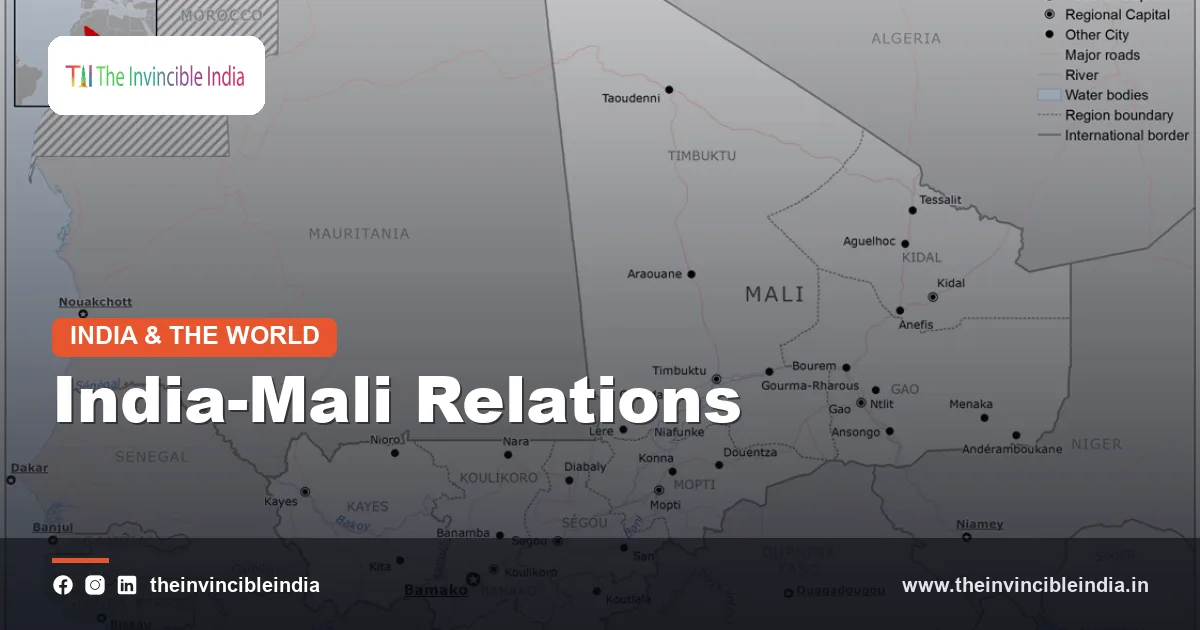
India-Mali relations are the bilateral partnership between the Republic of India and the Republic of Mali, a landlocked West African Sahel country, built since Mali’s independence in 1960 on development cooperation, concessional lines of credit for power and rural electrification, training under the Indian Technical and Economic Cooperation (ITEC) programme, and a small but diverse trade in pharmaceuticals, machinery, food items and agricultural goods. The relationship is friendly, low-profile and focused on practical projects rather than strategic alliances.
Mali sits at the crossroads of West Africa and the Sahel, and its political situation has changed considerably since 2012, which affects how every outside partner operates there. This explainer describes how India-Mali relations began, what India offers, what the two countries trade, how Mali’s political turbulence has shaped cooperation, and what the outlook is. It was last reviewed on 20 October 2026.
| India-Mali Relations: Quick Facts | |
|---|---|
| Countries | Republic of India and Republic of Mali |
| Mali’s capital and region | Bamako; landlocked West Africa, in the Sahel belt, along the Niger River |
| Mali’s independence | 22 September 1960, from France |
| Diplomatic relations | Established in the decades after Mali’s independence; India maintains an embassy in Bamako |
| Main Indian tools | Lines of credit through EXIM Bank, ITEC training, Indian Council for Cultural Relations (ICCR) scholarships, humanitarian and health support |
| Priority sectors | Power transmission, rural electrification and solar energy, agriculture, health and capacity-building |
| Typical trade | Indian exports of pharmaceuticals, vehicles, machinery, rice and textiles; Indian imports of agricultural and natural-resource products in small volumes |
| Regional groupings | Mali belongs to the Alliance of Sahel States, announced its exit from ECOWAS in 2024, and has had its African Union participation suspended since the 2020-21 military takeovers |
Key Takeaways
- India-Mali relations began after Mali’s independence from France in 1960 and have been consistently cordial, centred on development cooperation rather than defence or political alliances.
- India has offered Mali concessional lines of credit through the Export-Import Bank of India (EXIM Bank), with power transmission, rural electrification and solar energy among the sectors discussed.
- The Indian Technical and Economic Cooperation (ITEC) programme, started in 1964, trains Malian civil servants, engineers and other professionals in India on Indian government funding.
- Trade between India and Mali is small compared with India’s trade with larger African economies, and it is dominated by Indian exports of medicines, vehicles, machinery and food products.
- India has followed a policy of non-interference during Mali’s political changes since 2012, continuing working-level engagement while advising its nationals about security risks.
- Mali’s landlocked geography, security conditions and limited transport links remain the main practical constraints on expanding India-Mali relations.
What is the history of India-Mali relations?
India-Mali relations date from Mali’s independence in 1960, when India, a founder of the Non-Aligned Movement, welcomed the new state and developed friendly contacts based on shared anti-colonial and non-aligned values. Mali’s first president, Modibo Keita, was himself associated with the non-aligned and pan-African currents of the period, which created natural political sympathy with India.
In the following decades the relationship stayed modest. Indian engagement in Africa in the 1970s and 1980s was concentrated in countries with large Indian-origin populations and Commonwealth ties, such as Kenya, Tanzania, Zambia and Mauritius. Francophone West Africa received less attention, and exchanges with Mali consisted of occasional ministerial contacts, cultural scholarships and technical training.
The relationship became more structured from the 2000s. India’s economy was growing quickly, its exporters were looking for new markets, and its government launched a broader Africa policy. The India-Africa Forum Summits of 2008, 2011 and 2015 brought leaders from across the continent, including Mali, into one format. The third summit, held in New Delhi in 2015, invited all 54 African countries, and it announced fresh concessional credit, scholarships and capacity-building places that applied to Mali among others.
Visits by Malian ministers to India, and by Indian officials to Bamako, have continued at a low-to-moderate frequency, and the two governments have signed agreements on matters such as cultural exchange and technical cooperation.
Why does Mali matter to India?
Mali matters to India because it is a United Nations voting partner in the Global South and a founding member of the Organisation of African Unity, the African Union’s predecessor, because it offers a modest market for Indian goods, and because it lies in the Sahel, a region whose stability affects migration, terrorism and trade across West Africa. Mali is not a major economic partner, but it is part of India’s larger effort to build a presence in all African sub-regions.
Mali is a large country, with an area of roughly 1.24 million square kilometres and a population that is commonly given as over 20 million, most of whom live in the south along the Niger and Senegal river valleys. Its economy depends on gold mining, cotton, livestock and subsistence agriculture, and it has long been among the lower-income countries on the United Nations Human Development Index.
India’s interests in Mali can be grouped as follows:
- Diplomatic support: India values African votes and goodwill in international bodies, including on the reform of the United Nations Security Council.
- Market access: Indian pharmaceuticals, vehicles, agricultural equipment and consumer goods find buyers in West Africa.
- Development partnership: Cooperation in solar power, rural electrification and agriculture supports India’s positioning as a development partner on terms different from traditional donors.
- Regional stability: India has an interest in the Sahel remaining open to trade and free from large-scale extremism that could spread across borders.
What lines of credit has India extended to Mali?
India has offered Mali concessional lines of credit (LoCs) administered by the Export-Import Bank of India (EXIM Bank) for development projects, with power, rural electrification, solar energy and agriculture among the sectors most often mentioned. A line of credit is a government-backed loan on softer terms than commercial finance, which the borrowing country uses to buy Indian goods, equipment and services for agreed projects.
The model works in several steps. The African government identifies a project and asks India for support, EXIM Bank and the Ministry of External Affairs (MEA) review it, and an LoC agreement is signed with a repayment schedule and interest rate that are below market levels. Indian contractors, selected under competitive procedures, then execute the work, and the loan is disbursed against progress.
For Mali, the focus on energy is understandable. Electricity access is limited, particularly in rural areas, and the Sahel has abundant sunshine that makes solar power attractive. Indian companies are experienced in building transmission lines, substations and solar installations, and cooperation in this area also fits India’s wider promotion of the International Solar Alliance, an initiative co-launched by India and France in 2015.
As in other African countries, lines of credit to Mali have faced practical challenges. Project preparation can be slow, security conditions affect site access, and public financing is constrained. Actual disbursed amounts are therefore normally smaller than the headline amounts offered, and individual project statuses should be checked against official EXIM Bank and MEA sources.
How do ITEC and capacity-building work in Mali?
ITEC and related capacity-building work in Mali by giving Malian professionals fully funded places on short and medium-term training courses in India, and by offering scholarships for longer study. ITEC, launched in 1964, is India’s flagship technical cooperation scheme and is open to many developing countries in Africa, Asia, Latin America and the Pacific.
Courses cover subjects such as public administration, rural development, information technology, renewable energy, banking, agricultural mechanisation, small-business development, and parliamentary practice. Participants receive tuition, accommodation and a living allowance, and many return to civil service or university posts in Mali. Alumni networks are used by the Indian embassy to maintain contact.
Other forms of capacity-building include:
- ICCR scholarships: The Indian Council for Cultural Relations funds degree study at Indian universities for students from partner countries.
- Defence training: India offers training slots at military institutions to many African armed forces, usually described in general terms rather than by country.
- Virtual and e-learning: India has promoted tele-education and tele-medicine, and Africa has been a main target of these offers.
- Cultural diplomacy: Yoga events, Bollywood film screenings and exhibitions are common soft-power tools in Bamako, as elsewhere in Africa.
Language is a continuing hurdle, because Mali’s official language is French, while Indian courses are mostly in English. Preparatory language support is sometimes required.
What do India and Mali trade?
India and Mali trade a small but varied set of goods, with Indian exports of pharmaceuticals, vehicles, machinery, rice and textiles flowing to Mali, and a modest range of agricultural and natural-resource products moving in the other direction. The total is small by Indian standards and is typically described as ranging from tens to a few hundred millions of US dollars in a year, though it varies with prices and shipments.
| Direction | Product group | Comment |
|---|---|---|
| India to Mali | Pharmaceuticals and medical supplies | Indian generics are widely used in West African health systems |
| India to Mali | Motorcycles, vehicles, spare parts | Two- and three-wheelers are popular for transport and small business |
| India to Mali | Machinery, pumps, agricultural equipment | Linked to irrigation, farming and electrification needs |
| India to Mali | Rice, sugar and processed food | Mali imports food even though it grows rice along the Niger |
| Mali to India | Cotton and agricultural goods | Mali is one of Africa’s larger cotton producers |
| Mali to India | Other natural-resource products | Small and irregular; gold exports from Mali mainly go to other markets |
Landlocked status raises costs: goods destined for Mali usually arrive through the ports of Dakar in Senegal, Abidjan in Cote d’Ivoire or other coastal cities, then travel overland. Both governments have talked about trade promotion, buyer-seller meetings and chambers of commerce contacts, but results depend largely on private business interest.
How has Mali’s political situation affected India-Mali relations?
Mali’s political situation has affected India-Mali relations by narrowing the space for large projects and increasing security caution, while India has maintained a policy of continuing diplomatic contact with the authorities in power and not commenting on internal affairs. The country experienced a rebellion and a coup in 2012, followed by military takeovers in August 2020 and May 2021.
These events led to major shifts in regional politics. Mali, Burkina Faso and Niger, all governed by military-led authorities, formed the Alliance of Sahel States (AES) in 2023. The three countries announced their withdrawal from the Economic Community of West African States (ECOWAS) in 2024. The United Nations peacekeeping mission in Mali, known as MINUSMA and in place since 2013, ended in 2023 at the request of the Malian authorities. Violence by armed groups, including groups linked to al-Qaeda and the Islamic State, has continued in parts of the north and centre and increasingly in other areas.
India’s approach is consistent with its long-standing principle that governments, not outside powers, decide their own political arrangements. Indian officials have emphasised development cooperation and humanitarian concern for the Malian people, and have supported African-led and United Nations-led approaches to peace. At the same time, India has issued periodic travel advisories asking Indian nationals to exercise great caution in Mali, and the security situation has made it difficult for Indian companies to execute projects in some areas. Such cautions reflect concern for the safety of citizens and should not be read as a political judgement.
It should also be noted that analysts differ in their assessments of Mali’s situation, including the effectiveness of different security partners and the prospects for political transition. This explainer therefore describes the facts that are widely reported and avoids taking a position on disputed questions.
How do India and Mali cooperate in multilateral forums and security?
India and Mali cooperate in multilateral forums mainly through the United Nations, the African Union-India dialogue and the India-Africa Forum Summit process, and India has contributed to United Nations peacekeeping in Africa over many years. India is one of the largest contributors of uniformed personnel to UN peacekeeping missions worldwide, with deployments in several African countries.
In Mali, India’s role in the UN mission was limited relative to its large contingents in other missions, and it consisted of small numbers of specialised or staff personnel according to public reports. After the mission ended in 2023, direct Indian military presence in Mali was minimal. Defence cooperation is therefore principally through training offers and occasional dialogue rather than operational deployment.
On global issues, India and Mali share many broad positions as developing countries. Both favour a more representative United Nations Security Council, greater climate finance for vulnerable regions, and fairer terms of trade. India also supported the African Union’s admission as a permanent member of the G20 during its 2023 presidency, an outcome welcomed across Africa. Voting alignment on individual resolutions varies and should be checked case by case.
What is the Indian presence and community in Mali?
The Indian presence in Mali is small and consists of diplomats, a limited number of businesspeople, engineers and project staff, and professionals working with international organisations or private firms. The Indian community is far smaller than those in Eastern and Southern Africa, and estimates in public sources are generally in the low hundreds.
The embassy in Bamako is responsible for consular services, trade promotion and coordination of cooperation projects. Because of security conditions, travel within Mali is restricted for many foreign missions, and the embassy has issued advisories from time to time. Indian nationals are encouraged to register with the embassy.
Malian students in India and Indian-trained Malian officials form another kind of connection. Many Malian ITEC and ICCR alumni have, over the years, returned home with experience of Indian institutions, and they act as informal links between the two societies.
What are the challenges in India-Mali relations?
The main challenges in India-Mali relations are security conditions, landlocked logistics, limited private-sector contact, competition from other partners and slow project delivery. These factors limit the scale of cooperation even though there is no political dispute between the two governments.
- Security: Armed-group activity, kidnappings and instability reduce the ability of Indian companies and officials to travel and to monitor projects.
- Logistics and cost: Mali has no seaport, so goods must pass through neighbouring countries, which adds time and expense.
- Financing constraints: Mali faces tight public finances and, periods of regional and international financial restrictions, making new borrowing complex.
- Competition: France, China, Turkey, Russia, the Gulf states and multilateral lenders all engage with Mali in different ways.
- Information gaps: Indian small and medium enterprises know relatively little about the Francophone West African market.
What is the outlook for India-Mali relations?
The outlook for India-Mali relations is for continued, modest cooperation concentrated in development, health, energy and training, with the pace depending mainly on Mali’s security and political stabilisation. India’s general approach is to remain engaged, patient and non-judgemental, which positions it to expand cooperation when conditions improve.
Areas with the most potential include:
- Solar and rural electrification: Both countries have an interest in decentralised power and mini-grids.
- Agriculture: Indian tractors, irrigation equipment, seeds and food-processing know-how fit Mali’s farming sector.
- Health: Affordable Indian medicines, diagnostics and telemedicine can complement Mali’s public health system.
- Digital public goods: India shares its digital identity and payments experience with partner countries, and Mali could take part if it wished.
- Skills and education: Training places and scholarships will likely continue.
Realistically, India-Mali relations will stay small in economic terms, but they illustrate how India engages with African states regardless of size.
Bottom Line
India-Mali relations are cordial, development-focused and modest in scale, resting on lines of credit, ITEC training and a limited trade in medicines, machinery and food. Mali’s political turbulence and landlocked geography constrain faster growth, but India has maintained steady, non-interfering engagement that keeps the door open for wider cooperation.
Frequently Asked Questions
What are India-Mali relations based on?
India-Mali relations are based on development cooperation, shared non-aligned and anti-colonial history, and a small trade in goods. India provides lines of credit, training under the ITEC programme and scholarships, while Mali offers a market for Indian medicines, vehicles and machinery. The relationship is friendly but modest in scale.
What development projects has India supported in Mali?
India has offered Mali concessional lines of credit through EXIM Bank, with power transmission, rural electrification, solar energy and agriculture among the sectors discussed. Indian contractors normally carry out the work under these credits. Project status should be checked in official sources because delivery has been affected by security and financing constraints.
Does India have an embassy in Mali?
Yes, India maintains an embassy in Bamako, the capital of Mali. The embassy handles consular services, trade promotion and development cooperation, and it also issues advisories to Indian nationals about local conditions.
What does India trade with Mali?
India mainly exports pharmaceuticals, vehicles, machinery, rice and textiles to Mali, and imports small volumes of agricultural and natural-resource products. Total trade is modest, usually described as tens to a few hundred millions of US dollars a year. Mali’s landlocked position raises shipping costs.
How has India responded to political changes in Mali?
India has followed a policy of non-interference and has kept up working-level contact with the authorities in Bamako. It has emphasised development cooperation and humanitarian concern for the Malian people. India has also advised its citizens to take great care because of security risks.
What is ITEC and how does it help Mali?
ITEC stands for Indian Technical and Economic Cooperation, a programme launched in 1964 that funds training in India for professionals from developing countries. Malian officials and engineers can attend courses in areas such as public administration, renewable energy and agriculture. The training is paid for by the Indian government and aims to build skills in Mali.
{“@context”:”https://schema.org”,”@graph”:[{“@type”:”FAQPage”,”mainEntity”:[{“@type”:”Question”,”name”:”What are India-Mali relations based on?”,”acceptedAnswer”:{“@type”:”Answer”,”text”:”India-Mali relations are based on development cooperation, shared non-aligned and anti-colonial history, and a small trade in goods. India provides lines of credit, training under the ITEC programme and scholarships, while Mali offers a market for Indian medicines, vehicles and machinery. The relationship is friendly but modest in scale.”}},{“@type”:”Question”,”name”:”What development projects has India supported in Mali?”,”acceptedAnswer”:{“@type”:”Answer”,”text”:”India has offered Mali concessional lines of credit through EXIM Bank, with power transmission, rural electrification, solar energy and agriculture among the sectors discussed. Indian contractors normally carry out the work under these credits. Project status should be checked in official sources because delivery has been affected by security and financing constraints.”}},{“@type”:”Question”,”name”:”Does India have an embassy in Mali?”,”acceptedAnswer”:{“@type”:”Answer”,”text”:”Yes, India maintains an embassy in Bamako, the capital of Mali. The embassy handles consular services, trade promotion and development cooperation, and it also issues advisories to Indian nationals about local conditions.”}},{“@type”:”Question”,”name”:”What does India trade with Mali?”,”acceptedAnswer”:{“@type”:”Answer”,”text”:”India mainly exports pharmaceuticals, vehicles, machinery, rice and textiles to Mali, and imports small volumes of agricultural and natural-resource products. Total trade is modest, usually described as tens to a few hundred millions of US dollars a year. Mali’s landlocked position raises shipping costs.”}},{“@type”:”Question”,”name”:”How has India responded to political changes in Mali?”,”acceptedAnswer”:{“@type”:”Answer”,”text”:”India has followed a policy of non-interference and has kept up working-level contact with the authorities in Bamako. It has emphasised development cooperation and humanitarian concern for the Malian people. India has also advised its citizens to take great care because of security risks.”}},{“@type”:”Question”,”name”:”What is ITEC and how does it help Mali?”,”acceptedAnswer”:{“@type”:”Answer”,”text”:”ITEC stands for Indian Technical and Economic Cooperation, a programme launched in 1964 that funds training in India for professionals from developing countries. Malian officials and engineers can attend courses in areas such as public administration, renewable energy and agriculture. The training is paid for by the Indian government and aims to build skills in Mali.”}}]}]}


