

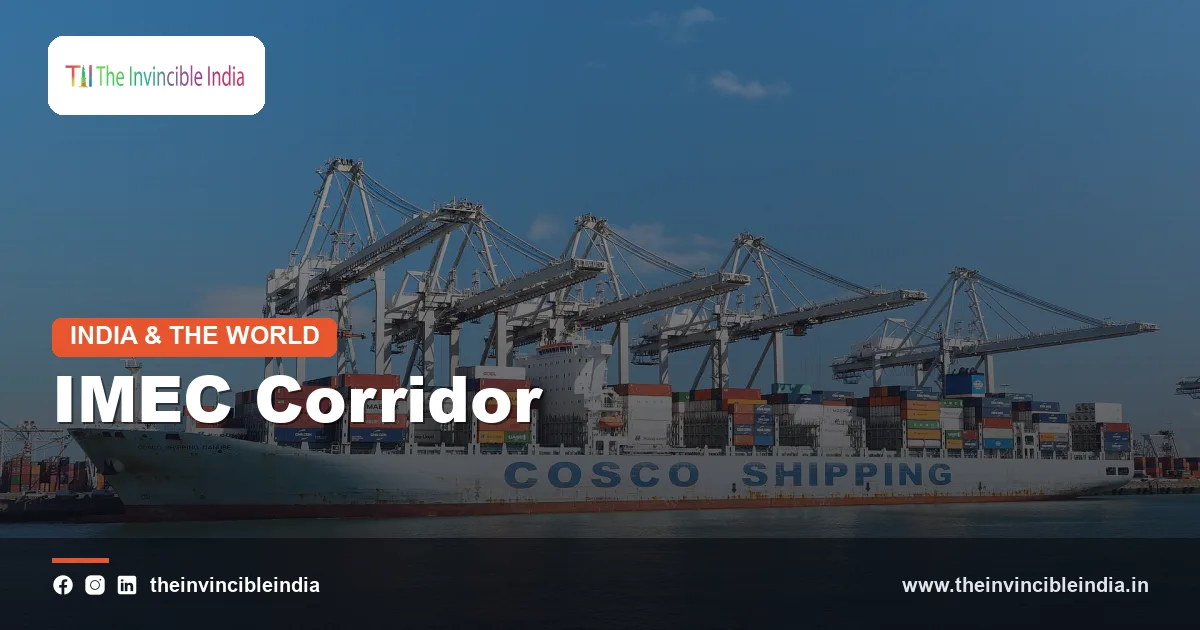
The India-Middle East-Europe Economic Corridor (IMEC) is a proposed multimodal connectivity corridor that links India to the Arabian Gulf by sea and the Gulf to Europe by rail and sea, backed by a Memorandum of Understanding announced at the G20 Summit in New Delhi in September 2023. The corridor combines ports, railways, electricity grid links, hydrogen pipelines and high-speed data cables so that goods, energy and digital traffic can move between South Asia, West Asia and Europe more efficiently than along the traditional sea route through the Suez Canal.
IMEC is best understood as a framework of cooperating countries and planned infrastructure rather than a single completed project. It brings together India, the United Arab Emirates, Saudi Arabia, the European Union, the United States, France, Germany and Italy, and it depends on transit states such as Jordan and Israel. This explainer sets out what IMEC is, how its two corridors are meant to work, why India values it, and what obstacles stand in the way.
| Quick Facts: India-Middle East-Europe Economic Corridor (IMEC) | |
|---|---|
| Announced | 9 September 2023, on the sidelines of the G20 Summit in New Delhi |
| Instrument | Memorandum of Understanding (non-binding political and economic framework) |
| Signatories | India, United Arab Emirates, Saudi Arabia, European Union, United States, France, Germany, Italy |
| Type | Multimodal corridor combining shipping, railways, energy and digital links |
| Structure | Eastern corridor (India to the Gulf) and Northern corridor (Gulf to Europe) |
| Key Indian ports | Mundra, Kandla (Deendayal) and Jawaharlal Nehru Port (Nhava Sheva) |
| Key European ports | Piraeus (Greece), Messina (Italy) and Marseille (France) |
| Linked initiative | Partnership for Global Infrastructure and Investment (PGII) |
| Principal challenge | Financing, cross-border agreements and regional security along the rail route |
Key Takeaways
- The India-Middle East-Europe Economic Corridor was announced through an MoU at the G20 Summit in New Delhi on 9 September 2023.
- IMEC has two parts: an eastern corridor linking India with the Arabian Gulf and a northern corridor linking the Gulf with Europe.
- The corridor is designed to carry more than containers, because it also envisages electricity cables, hydrogen pipelines and high-speed data cables.
- The IMEC MoU is a non-binding framework, so each rail line, port upgrade and cable still needs separate agreements and financing.
- India expects IMEC to cut transit time and logistics cost on trade with Europe and to deepen its economic ties with the Gulf.
- Regional security in West Asia, the rail gap across Saudi Arabia, Jordan and Israel, and the absence of a single funding mechanism are the main hurdles for IMEC.
What is the India-Middle East-Europe Economic Corridor?
The India-Middle East-Europe Economic Corridor is a planned trade and infrastructure route that connects Indian ports to Gulf ports by sea, links Gulf states to the Israeli port of Haifa by rail across the Arabian Peninsula, and then reaches Europe through Mediterranean shipping. The idea is to create a faster, more predictable land-sea chain between Asia and Europe that supplements the maritime route through the Red Sea and the Suez Canal.
IMEC was presented as a “green and digital bridge” rather than only a trade route. The MoU text speaks of enhancing efficiency, reducing costs, increasing economic unity, generating employment and lowering greenhouse gas emissions. It also refers to connecting and expanding electricity and digital networks and pipelines for clean hydrogen export.
The corridor was unveiled at a time when several governments were looking for alternatives to supply chains that depended heavily on a few chokepoints and on a single dominant infrastructure provider. IMEC is often described as complementary to existing routes, and it is not meant to replace sea trade through the Suez Canal.
Which countries are part of IMEC?
Eight signatories are part of the IMEC MoU: India, the United Arab Emirates, Saudi Arabia, the European Union, the United States, France, Germany and Italy. The three European states signed alongside the European Union because they have separate national ports, shipping lines and investment interests along the Mediterranean.
Several other countries are essential to the route even though they did not sign the original MoU. Jordan and Israel lie on the proposed rail path between Saudi Arabia and the Mediterranean coast, and Greece is a leading European landing point because of the container terminal at Piraeus. Oman, Egypt and other states have sometimes been discussed as possible participants or competitors, depending on how the corridor evolves.
| Participant | Principal role in IMEC |
|---|---|
| India | Eastern corridor origin; port, rail and shipping links to the Gulf; large market and manufacturing base |
| United Arab Emirates | Gulf logistics hub; ports at Jebel Ali, Fujairah and Abu Dhabi; Etihad Rail network |
| Saudi Arabia | Land bridge across the Arabian Peninsula; planned rail extension toward Jordan |
| European Union, France, Germany, Italy | Northern corridor destination; Mediterranean ports, markets and investment |
| United States | Political sponsor; investment mobilisation through the Partnership for Global Infrastructure and Investment |
| Jordan and Israel (transit states) | Rail transit toward the Mediterranean; Haifa port as the likely landing point |
How is the IMEC corridor structured?
The IMEC corridor is structured in two parts, an eastern corridor that connects India with the Arabian Gulf and a northern corridor that connects the Gulf with Europe. Together they form a chain in which cargo moves by ship, then by rail, and then by ship again.
The eastern corridor: India to the Gulf
The eastern corridor is a maritime link between Indian ports on the west coast and Gulf ports, mainly in the United Arab Emirates. Containers from Mundra, Kandla and Jawaharlal Nehru Port are expected to cross the Arabian Sea to ports such as Fujairah, Jebel Ali and Abu Dhabi. Because this stretch is entirely over water and already served by established shipping lines, it is the part of IMEC that is closest to being operational in practice.
The northern corridor: the Gulf to Europe
The northern corridor is a rail-and-sea link that carries cargo from the Gulf across Saudi Arabia and Jordan to the Israeli port of Haifa, and from there by ship to European ports. Piraeus in Greece, Messina in Italy and Marseille in France have been named as possible destinations. The rail stretch is the least developed part of IMEC, because a continuous line across the Arabian Peninsula to the Mediterranean does not yet exist.
What infrastructure does IMEC include beyond ports and railways?
IMEC includes electricity grid interconnections, pipelines for clean hydrogen export and high-speed data cables laid along the route, in addition to ports and railways. The MoU describes the corridor as an infrastructure platform whose physical, energy and digital layers reinforce one another.
- Rail and road links: a railway intended to run through the Gulf region toward the Mediterranean, with road connections that feed freight to the main lines.
- Ports and logistics hubs: berths, container terminals, customs systems and warehousing at the Indian, Gulf and European ports on the route.
- Electricity interconnections: grid links that allow cross-border power trade, which supports the integration of renewable energy.
- Hydrogen pipelines: corridors for exporting clean hydrogen produced in the Gulf and in India to European consumers.
- Telecommunication cables: high-speed undersea and terrestrial data cables to expand digital capacity and reliability.
This layered design is what separates IMEC from a purely commercial shipping arrangement. A single right-of-way can, in principle, host rail, power and data infrastructure, which lowers per-unit costs once the first stretch is built.
How would cargo move along IMEC?
Cargo would move along IMEC by ship from an Indian port to a Gulf port, by rail across the Arabian Peninsula to Haifa, and by ship across the Mediterranean to a European port. The chain involves at least two transhipment points, at the Gulf port and at Haifa, so smooth handling and customs coordination are essential.
Supporters argue that the route can cut total transit time compared with an all-sea voyage around the Arabian Peninsula and through the Red Sea. Indian officials have often cited an expected saving of roughly a third to two-fifths of the time, but such estimates depend on assumptions about rail speed, port efficiency and customs clearance. The actual figure will become clear only after the line is complete and operating at scale.
Digital trade facilitation is a design priority. Interoperable electronic documents, harmonised customs procedures and single-window clearance would reduce the dwell time at each hand-over, which is as important as the speed of the trains themselves.
Why does IMEC matter for India?
IMEC matters for India because it offers a faster and more diversified path to European markets, strengthens economic ties with the Gulf, and gives India a leading role in shaping a new connectivity route. India’s exports to Europe currently travel through the Red Sea and the Suez Canal, so disruptions in that waterway directly affect Indian shippers.
Economic benefits for India
- Lower logistics cost: Indian exporters of textiles, engineering goods, pharmaceuticals and agricultural products could gain a quicker route to Europe.
- Gulf economic integration: India already has large trade, investment and energy links with the UAE and Saudi Arabia, and IMEC extends these into infrastructure.
- Energy security: shared electricity and hydrogen links could add to India’s long-term energy options.
- Port and shipping development: demand from the corridor supports upgrades at Indian west-coast ports.
Strategic benefits for India
India gains a connectivity partnership with the United States and the European Union while also deepening its bilateral ties with Gulf states. IMEC also complements India’s other connectivity efforts, including the International North-South Transport Corridor and the Chabahar port, by giving Indian trade more than one option to reach Europe.
What is the strategic significance of IMEC for the Gulf, Europe and the United States?
IMEC is strategically significant because it ties Gulf economies into long-term infrastructure partnerships, gives Europe a diversified route to Asian markets, and gives the United States a constructive economic initiative in West Asia. Each partner approaches the corridor with different priorities.
- Gulf states: the UAE and Saudi Arabia want to become global logistics and clean-energy hubs, and IMEC positions them as the central link between Asia and Europe.
- European Union: Europe seeks resilient supply chains, access to clean hydrogen and a stronger infrastructure presence beyond its neighbourhood, in line with its Global Gateway strategy.
- United States: Washington presents IMEC as part of the Partnership for Global Infrastructure and Investment, a G7-backed effort to mobilise public and private capital for infrastructure in developing and middle-income economies.
Observers frequently view IMEC as an alternative or counterweight to China’s Belt and Road Initiative. Official statements describe it instead as an inclusive and transparent framework open to additional participants, and the participating governments have generally avoided framing it as directed against any country.
How does IMEC compare with other major routes?
IMEC differs from the Suez Canal route, the International North-South Transport Corridor and China’s Belt and Road routes in its geography, financing model and partners. The comparison below summarises the main differences.
| Route | Path | Main character |
|---|---|---|
| IMEC | India to Gulf by sea, Gulf to Haifa by rail, Haifa to Europe by sea | Planned multimodal corridor with energy and data links; political framework with multiple partners |
| Suez Canal sea route | Arabian Sea, Red Sea, Suez Canal, Mediterranean | Established all-sea route; very high volumes; exposed to chokepoint disruption |
| International North-South Transport Corridor | India to Iran by sea, then rail and road through Iran and the Caspian region to Russia | Operating in parts since 2000; limited by sanctions and missing rail links |
| Belt and Road Initiative land routes | China through Central Asia to Europe | Large, China-led programme financed mainly through Chinese institutions |
IMEC and the Suez route are best seen as complements. The Suez Canal will remain the dominant artery for bulk container traffic because of its scale, and IMEC aims to offer a reliable alternative for time-sensitive goods and for energy and data flows.
What are the main challenges facing IMEC?
The main challenges facing IMEC are the lack of binding commitments and dedicated financing, the missing rail links across the Arabian Peninsula, regional security risks and the complexity of coordinating many countries’ customs and regulatory systems. These hurdles explain why IMEC has progressed through working groups and bilateral agreements rather than through large-scale construction.
Financing and legal framework
The IMEC MoU does not create a joint fund, and each project must raise money from its own sponsors, development banks or private investors. Bilateral and multilateral agreements on transit rights, tariffs, customs and dispute settlement are also required before a continuous service can operate.
Physical gaps and technical standards
A continuous railway from the Gulf to the Mediterranean does not yet exist, and portions of the route would have to be built across difficult terrain. Differences in rail gauges, signalling systems and port technologies add further cost and delay.
Security and geopolitics
The route crosses a region subject to political tension and conflict. The war in Gaza that began in October 2023 and wider instability around the Red Sea disrupted the diplomatic momentum behind the proposal, even as shipping disruptions underlined why alternatives are attractive. Some regional states, including Turkey and Egypt, have expressed reservations or promoted competing corridors, and IMEC’s success depends on a stable political environment among the transit countries.
What is the current status of IMEC?
IMEC is currently at the framework and early-preparation stage, with working groups, feasibility studies and bilateral agreements advancing while major construction remains pending. After the 2023 announcement, participating governments pledged to develop an action plan within a short period and to hold regular consultations.
The strongest progress has come in parts of the Gulf, where rail networks such as Etihad Rail in the UAE are expanding and could eventually link with Saudi Arabia. India and the UAE have also signed an intergovernmental framework to support IMEC cooperation. Overall, the timeline for a fully functioning end-to-end corridor remains uncertain and depends on regional stability and the arrival of financing.
What is the timeline of IMEC?
The timeline of IMEC begins with the G20 announcement in September 2023 and continues through a series of consultations and bilateral frameworks. The table below lists the principal milestones in a simplified form.
| Stage | Development |
|---|---|
| September 2023 | MoU announced at the G20 Summit in New Delhi by the eight signatories |
| Late 2023 | Regional conflict in West Asia disrupts the early diplomatic momentum |
| 2024 onward | Bilateral frameworks, including between India and the UAE, and continuing working-group discussions |
| Future phases | Feasibility studies, financing arrangements, rail construction and operational pilot services |
Bottom Line
The India-Middle East-Europe Economic Corridor is an ambitious plan to connect Indian ports, Gulf rail networks and European markets through a single multimodal chain that also carries power, hydrogen and data. Its value to India is clear, but delivery depends on financing, binding agreements and stability in West Asia. IMEC should therefore be viewed as a long-term strategic project that complements existing routes.
Frequently Asked Questions
What does IMEC stand for?
IMEC stands for the India-Middle East-Europe Economic Corridor. It is a proposed network of ports, railways, energy links and data cables that connects India with the Gulf and Europe. The framework was announced in September 2023 at the G20 Summit in New Delhi.
Which countries signed the IMEC agreement?
India, the United Arab Emirates, Saudi Arabia, the European Union, the United States, France, Germany and Italy signed the IMEC Memorandum of Understanding. Jordan and Israel are not signatories but lie on the proposed rail route. Other countries may join later.
How is IMEC different from the Suez Canal route?
IMEC combines sea and rail transport and adds energy and data links, whereas the Suez Canal route is an all-sea passage. IMEC is meant to offer a faster and more diversified option for some cargo, while the Suez Canal remains the main route for large container volumes. The two are expected to coexist.
Is IMEC an alternative to China’s Belt and Road Initiative?
IMEC is widely seen as a different model of connectivity, but the participating governments describe it as an open, transparent and cooperative framework rather than a rival to any country. It relies on multiple partners and financing sources, in contrast with the largely China-financed structure of the Belt and Road Initiative.
Why is IMEC important for India?
IMEC is important for India because it can shorten and diversify trade routes to Europe, strengthen economic ties with the Gulf and add energy and digital links. It also gives India a leadership role in a major connectivity initiative with Western and Gulf partners.
Has IMEC been completed?
IMEC has not been completed and remains at an early stage of planning and preparation. The MoU is non-binding, a continuous rail link across the Arabian Peninsula still has to be built, and regional security and financing questions remain open. Progress depends on bilateral agreements and sustained political commitment.
{“@context”:”https://schema.org”,”@graph”:[{“@type”:”FAQPage”,”mainEntity”:[{“@type”:”Question”,”name”:”What does IMEC stand for?”,”acceptedAnswer”:{“@type”:”Answer”,”text”:”IMEC stands for the India-Middle East-Europe Economic Corridor. It is a proposed network of ports, railways, energy links and data cables that connects India with the Gulf and Europe. The framework was announced in September 2023 at the G20 Summit in New Delhi.”}},{“@type”:”Question”,”name”:”Which countries signed the IMEC agreement?”,”acceptedAnswer”:{“@type”:”Answer”,”text”:”India, the United Arab Emirates, Saudi Arabia, the European Union, the United States, France, Germany and Italy signed the IMEC Memorandum of Understanding. Jordan and Israel are not signatories but lie on the proposed rail route. Other countries may join later.”}},{“@type”:”Question”,”name”:”How is IMEC different from the Suez Canal route?”,”acceptedAnswer”:{“@type”:”Answer”,”text”:”IMEC combines sea and rail transport and adds energy and data links, whereas the Suez Canal route is an all-sea passage. IMEC is meant to offer a faster and more diversified option for some cargo, while the Suez Canal remains the main route for large container volumes. The two are expected to coexist.”}},{“@type”:”Question”,”name”:”Is IMEC an alternative to China’s Belt and Road Initiative?”,”acceptedAnswer”:{“@type”:”Answer”,”text”:”IMEC is widely seen as a different model of connectivity, but the participating governments describe it as an open, transparent and cooperative framework rather than a rival to any country. It relies on multiple partners and financing sources, in contrast with the largely China-financed structure of the Belt and Road Initiative.”}},{“@type”:”Question”,”name”:”Why is IMEC important for India?”,”acceptedAnswer”:{“@type”:”Answer”,”text”:”IMEC is important for India because it can shorten and diversify trade routes to Europe, strengthen economic ties with the Gulf and add energy and digital links. It also gives India a leadership role in a major connectivity initiative with Western and Gulf partners.”}},{“@type”:”Question”,”name”:”Has IMEC been completed?”,”acceptedAnswer”:{“@type”:”Answer”,”text”:”IMEC has not been completed and remains at an early stage of planning and preparation. The MoU is non-binding, a continuous rail link across the Arabian Peninsula still has to be built, and regional security and financing questions remain open. Progress depends on bilateral agreements and sustained political commitment.”}}]}]}


