

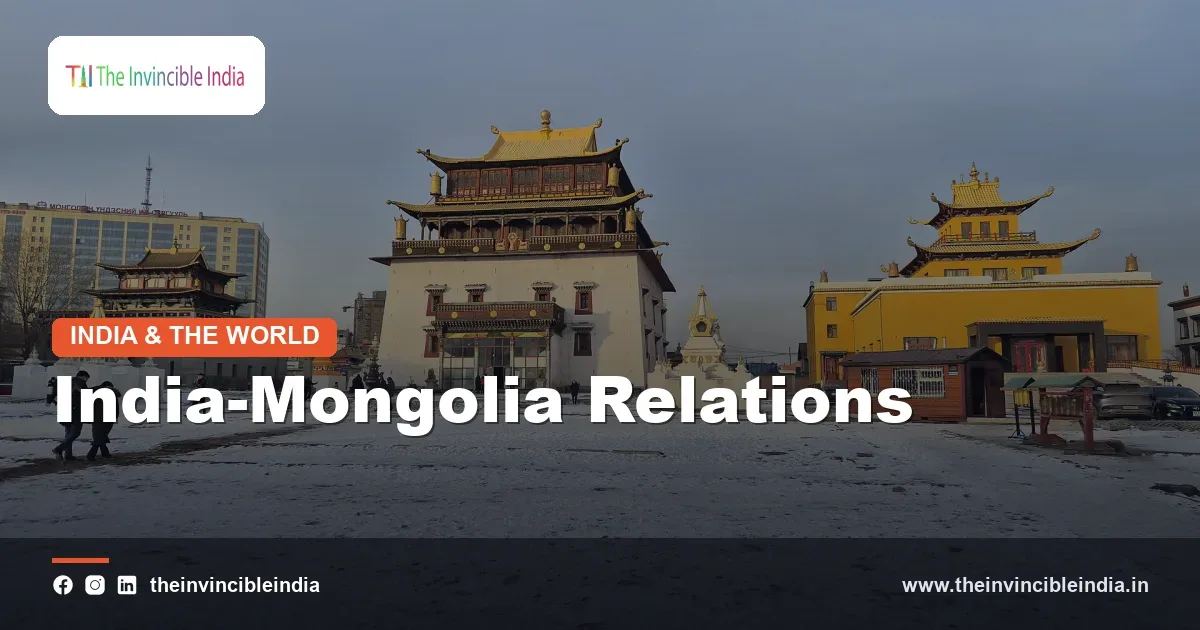
India-Mongolia relations are the bilateral partnership between the Republic of India and Mongolia, two Asian democracies joined by a shared Buddhist heritage, formal diplomatic ties since 1955 and a “strategic partnership” declared in 2015. India often describes Mongolia as a “spiritual neighbour”, even though the two countries share no border and are separated by thousands of kilometres of mountains, steppe and desert.
Today India-Mongolia relations rest on cultural and religious links, development finance, defence cooperation, education and a growing interest in minerals and energy. India’s US$1 billion line of credit for the Mongol Refinery, the annual Nomadic Elephant military exercise and Mongolia’s “third neighbour” foreign policy are the three best-known features. This explainer covers how the relationship developed, what it includes and what shapes it.
| Attribute | Details |
|---|---|
| Countries | Republic of India and Mongolia (capital: Ulaanbaatar) |
| Diplomatic relations established | 24 December 1955 |
| Relationship level | Comprehensive Partnership (2009), upgraded to Strategic Partnership (2015) |
| Common description | “Spiritual neighbours”, because Buddhism travelled from India to Mongolia |
| Major project | Mongol Refinery at Sainshand, financed by a US$1 billion Indian line of credit |
| Military exercise | Nomadic Elephant, held alternately in India and Mongolia |
| Capacity-building | Indian Technical and Economic Cooperation (ITEC) courses; ICCR scholarships |
| Mongolian policy angle | “Third neighbour” policy to balance its two large neighbours, Russia and China |
| Resource angle | Mongolia holds large coal, copper and other mineral deposits; India seeks diversified supplies of critical minerals and energy |
Key Takeaways
- India and Mongolia established diplomatic relations on 24 December 1955, and the relationship was upgraded to a strategic partnership in 2015.
- India describes Mongolia as a “spiritual neighbour” because Buddhism spread from India to Mongolia through Tibet, and Tibetan Buddhism remains the main religious tradition in Mongolia.
- India announced a US$1 billion line of credit in 2015 to help Mongolia build the Mongol Refinery at Sainshand, the largest Indian credit commitment to Mongolia.
- The Nomadic Elephant exercise is an annual joint military exercise between the Indian Army and the Mongolian Armed Forces, held alternately in each country.
- Mongolia’s “third neighbour” policy seeks partnerships with countries beyond its two giant neighbours, Russia and China, and India is one of the partners it values.
- Bilateral trade between India and Mongolia is modest in volume, so the relationship depends more on culture, credit, defence and long-term resource cooperation than on commerce.
Why are India and Mongolia called spiritual neighbours?
India and Mongolia are called spiritual neighbours because Buddhism, which originated in India, reached Mongolia through Tibet and became the dominant faith of the Mongolian people. The phrase became prominent when Prime Minister Narendra Modi visited Ulaanbaatar in 2015 and used it to describe a bond that rests on religion and culture rather than on geography.
Mongolian Buddhism belongs to the Tibetan tradition, particularly the Gelug school, which draws on Indian philosophers and texts such as the works of Nagarjuna, Dharmakirti and other scholars of Nalanda. The large Buddhist canons known as the Kanjur and Tanjur were translated into Mongolian, and the texts that Mongolian monks study trace their roots to Indian originals in Sanskrit. For many Mongolians, India is therefore the sacred land of the Buddha, and a pilgrimage to Bodh Gaya or Sarnath carries deep meaning.
What is the historical background of India-Mongolia relations?
The historical background of India-Mongolia relations runs from the spread of Buddhism and the medieval Mongol world to the Cold War and the post-1990 era. Contacts through religion and scholarship existed for centuries, and the Mughal dynasty that ruled much of India from 1526 took its name from “Mongol”, since its founder Babur claimed descent from both Timur and Genghis Khan.
India was among the early non-communist countries to recognise Mongolia and to open ties with it after Indian independence. Formal diplomatic relations began on 24 December 1955, and during the Cold War the two countries kept friendly contact while pursuing different alignments. Mongolia’s transition to democracy and a market economy after 1990 opened more space for new partnerships.
A notable figure in this story was the 19th Kushok Bakula Rinpoche, a Buddhist leader from Ladakh and a Member of Parliament, who served as India’s ambassador to Mongolia from 1990 to 2000. His tenure helped revive Buddhist institutions in Mongolia after decades of suppression under the communist-era state, and he is still remembered affectionately there.
How did the relationship become a strategic partnership?
The relationship became a strategic partnership in two steps: a “Comprehensive Partnership” in 2009 and an upgrade to “Strategic Partnership” during Prime Minister Modi’s visit to Mongolia in May 2015, the first by an Indian prime minister. The 2015 visit produced a joint statement that listed cooperation in defence, cyber security, trade, culture, education, energy and minerals as priorities.
The strategic partnership gave the relationship a more institutional shape, including regular political consultations, defence dialogue, joint committees and a clear framework for development assistance. It also signalled India’s interest in engaging central and north-east Asia as part of its wider Act East outlook, and Mongolia’s interest in deepening partnerships with democracies across Asia.
Mongolian leaders have visited India several times since the early 2000s, and high-level exchanges have continued in recent years. Each visit has typically added agreements on culture, health, training, defence or energy to the existing framework.
What is the Mongol Refinery and why does it matter?
The Mongol Refinery is a planned oil refinery at Sainshand in Dornogovi province in south-eastern Mongolia, intended to process crude oil into petrol, diesel and other products, and it is the flagship project of India-Mongolia economic cooperation. India announced a line of credit of US$1 billion for the project in 2015, and the Export-Import Bank of India extended the facility. Engineers India Limited, a public-sector engineering consultancy, has been associated with project management and execution.
The refinery matters because Mongolia imports almost all of its refined fuel from a single neighbour, which exposes it to price changes and supply interruptions. A domestic refinery with a capacity of around 1.5 million tonnes a year is meant to reduce that dependence, improve energy security and create skilled jobs. For India, the project is a showcase for its development cooperation model and for the capabilities of Indian engineering firms abroad.
Large infrastructure projects of this kind involve land, financing, technical and procurement challenges, and timelines have been extended more than once. Even so, the project remains central to how both governments describe the relationship.
Is the Mongol Refinery India’s largest credit line in the region?
The US$1 billion credit line for the Mongol Refinery is the largest single Indian financial commitment to Mongolia, and it is among the notable Indian credit lines in East and Central Asia. It was announced as a special concessional facility, reflecting both the size of the project and the political weight attached to the partnership.
What defence cooperation exists between India and Mongolia?
Defence cooperation between India and Mongolia includes the annual Nomadic Elephant joint military exercise, training exchanges, staff talks and cooperation under defence agreements. Nomadic Elephant began in 2006 and takes place alternately in India and Mongolia, with the Indian Army and the Mongolian Armed Forces training together in counter-insurgency, peacekeeping and mountain or steppe operations.
Mongolia has a strong record in United Nations peacekeeping, and India is one of the largest historic contributors of troops, so both armies share experience in that field. India also invites Mongolian officers to attend courses at its military training institutions under the ITEC defence stream, and India has taken part in the multinational Khaan Quest exercise hosted by Mongolia.
Cooperation also extends to cyber security. India has offered to share experience with Mongolia in this area, and the 2015 joint statement identified cyber security as a growing field of cooperation. These activities strengthen defence ties without creating any alliance, which suits Mongolia’s policy of neutrality and balanced relations.
What are Mongolia’s “third neighbour” ties and how does India fit in?
Mongolia’s “third neighbour” policy is its approach of building political, economic and security relationships with countries other than Russia and China, which lie on its northern and southern borders. The phrase describes a diverse group of partners, including Japan, South Korea, the United States, the European Union, Turkey, Germany and India.
India fits into this policy as a large, democratic, non-threatening partner with historical and religious links to Mongolia. India is not a neighbour by geography, but it offers credit, training, technology and diplomatic support, and it shares a commitment to a rules-based international order. Mongolia values this type of partner because it offers options without the risk of dependence on any one country.
For India, engagement with Mongolia fits its wider efforts to build ties across Asia and to secure access to resources, markets and diplomatic support beyond its immediate region. Neither side presents the partnership as directed against any third country, and both stress that the relationship is based on mutual interest.
How do culture, education and Buddhism connect India and Mongolia?
Culture, education and Buddhism connect India and Mongolia through religious exchanges, scholarships, language teaching, scholarly cooperation and cultural centres. Indian Buddhist leaders and scholars visit Mongolian monasteries such as Gandan Monastery in Ulaanbaatar, and Mongolian monks and pilgrims travel to Buddhist sites in India and to Tibetan monastic universities in India.
India has supported scholarly work on Mongolian Buddhist literature, including the Mongolian Kanjur, and has sent sacred Buddhist relics for exhibition in Mongolia on several occasions. In 2015, a sapling of the Bodhi tree from Bodh Gaya was presented as a gift to Mongolia, which has symbolic importance.
Education links include Indian Council for Cultural Relations (ICCR) scholarships, ITEC training slots, Hindi and Sanskrit teaching in Mongolian institutions and an Indian-assisted information technology centre in Ulaanbaatar named after Atal Bihari Vajpayee. Yoga and Indian cinema are also popular among young Mongolians.
| Year | Milestone |
|---|---|
| 1955 | India and Mongolia establish diplomatic relations on 24 December |
| 1990 to 2000 | Kushok Bakula Rinpoche serves as India’s ambassador to Mongolia |
| 2006 | First Nomadic Elephant joint military exercise |
| 2009 | Relationship upgraded to a Comprehensive Partnership |
| 2015 | Modi’s visit to Mongolia; Strategic Partnership declared; US$1 billion line of credit announced |
| Late 2010s onwards | Mongol Refinery project agreements and ground-level progress at Sainshand |
| Recent years | Continued exercises, Buddhist relic exhibitions, scholarship and training exchanges |
What is the economic and mineral cooperation between India and Mongolia?
Economic cooperation between India and Mongolia is modest in trade volume but strategically significant in the areas of minerals, energy and development finance. India exports pharmaceuticals, machinery, vehicles, textiles and other manufactured goods to Mongolia, while Mongolia sells smaller quantities of commodities such as cashmere, raw materials and some mineral products to India.
Mongolia holds large reserves of coal, copper, gold, fluorspar, uranium and other minerals, including potential rare earth resources, and India seeks diversified and reliable supplies of critical minerals for its manufacturing and clean-energy transition. The two countries have signed agreements on geology and mineral resources, and a bilateral agreement on cooperation in the peaceful uses of nuclear energy was signed in 2009.
Actual large-scale mineral trade has been limited by distance, the absence of direct transport links and the fact that Mongolia is landlocked, with its trade routes passing through its two neighbours. Direct air connectivity, simplified visas and better logistics would help raise commercial exchanges.
What are the challenges in India-Mongolia relations?
The main challenges in India-Mongolia relations are geography, limited trade, long project timelines and the careful balancing that Mongolia must maintain between its two large neighbours. The countries are far apart, there are few direct flights, and the business communities know each other less well than they might. Trade has remained small compared with Mongolia’s trade with China and Russia.
Project delivery is another issue. Large infrastructure projects such as the refinery take time to finance, design and build, and delays can weaken public support. Mongolia must also consider how its decisions affect relations with Beijing and Moscow, which control its main trade routes. India, for its part, has to weigh its own priorities in a wide range of regions.
What could strengthen the relationship further?
- Direct air links and easier visas to promote tourism, pilgrimage and business travel.
- Steady delivery of the Mongol Refinery and other Indian-assisted projects.
- Expanded cooperation in critical minerals, renewable energy and digital technology.
- More scholarships, language programmes and cultural centres.
- Regular defence dialogue and continued joint exercises, including peacekeeping training.
Bottom Line
India-Mongolia relations are built on a rare combination of spiritual kinship and practical cooperation, supported by diplomatic ties since 1955 and a strategic partnership since 2015. The relationship is not large in trade terms, but projects such as the Mongol Refinery and exercises such as Nomadic Elephant give it substance and make it a useful part of both countries’ wider Asian diplomacy.
Frequently Asked Questions
When did India and Mongolia establish diplomatic relations?
India and Mongolia established diplomatic relations on 24 December 1955. Contacts through Buddhism and trade existed much earlier, but the formal relationship began in the mid-1950s. It was upgraded to a Comprehensive Partnership in 2009 and a Strategic Partnership in 2015.
Why does India call Mongolia a spiritual neighbour?
India calls Mongolia a spiritual neighbour because Buddhism, which began in India, spread to Mongolia and became its main religion. Mongolian Buddhism follows the Tibetan tradition and draws on Indian texts and philosophers. The phrase highlights a bond based on faith and culture rather than a shared border.
What is the Mongol Refinery project?
The Mongol Refinery is a planned oil refinery at Sainshand in south-eastern Mongolia, financed through a US$1 billion Indian line of credit announced in 2015. It is designed to process crude oil into fuels for domestic use and reduce Mongolia’s dependence on imported refined products. Engineers India Limited has been involved as a project consultant.
What is the Nomadic Elephant exercise?
Nomadic Elephant is an annual joint military exercise between the Indian Army and the Mongolian Armed Forces, held alternately in India and Mongolia since 2006. It focuses on counter-insurgency, peacekeeping and interoperability. The exercise is one of the most visible parts of bilateral defence cooperation.
What is Mongolia’s third neighbour policy?
Mongolia’s third neighbour policy is its strategy of developing close ties with countries other than Russia and China, its two immediate neighbours. Partners include Japan, South Korea, the United States, the European Union and India. The policy gives Mongolia more diplomatic and economic options and supports its independence.
How much do India and Mongolia trade?
Trade between India and Mongolia is modest compared with Mongolia’s trade with China and Russia. India mainly exports pharmaceuticals, machinery, vehicles and textiles, while Mongolia sells smaller amounts of commodities and raw materials. The relationship relies more on development credit, culture, defence and long-term mineral cooperation than on trade volumes.
{“@context”:”https://schema.org”,”@graph”:[{“@type”:”FAQPage”,”mainEntity”:[{“@type”:”Question”,”name”:”When did India and Mongolia establish diplomatic relations?”,”acceptedAnswer”:{“@type”:”Answer”,”text”:”India and Mongolia established diplomatic relations on 24 December 1955. Contacts through Buddhism and trade existed much earlier, but the formal relationship began in the mid-1950s. It was upgraded to a Comprehensive Partnership in 2009 and a Strategic Partnership in 2015.”}},{“@type”:”Question”,”name”:”Why does India call Mongolia a spiritual neighbour?”,”acceptedAnswer”:{“@type”:”Answer”,”text”:”India calls Mongolia a spiritual neighbour because Buddhism, which began in India, spread to Mongolia and became its main religion. Mongolian Buddhism follows the Tibetan tradition and draws on Indian texts and philosophers. The phrase highlights a bond based on faith and culture rather than a shared border.”}},{“@type”:”Question”,”name”:”What is the Mongol Refinery project?”,”acceptedAnswer”:{“@type”:”Answer”,”text”:”The Mongol Refinery is a planned oil refinery at Sainshand in south-eastern Mongolia, financed through a US$1 billion Indian line of credit announced in 2015. It is designed to process crude oil into fuels for domestic use and reduce Mongolia’s dependence on imported refined products. Engineers India Limited has been involved as a project consultant.”}},{“@type”:”Question”,”name”:”What is the Nomadic Elephant exercise?”,”acceptedAnswer”:{“@type”:”Answer”,”text”:”Nomadic Elephant is an annual joint military exercise between the Indian Army and the Mongolian Armed Forces, held alternately in India and Mongolia since 2006. It focuses on counter-insurgency, peacekeeping and interoperability. The exercise is one of the most visible parts of bilateral defence cooperation.”}},{“@type”:”Question”,”name”:”What is Mongolia’s third neighbour policy?”,”acceptedAnswer”:{“@type”:”Answer”,”text”:”Mongolia’s third neighbour policy is its strategy of developing close ties with countries other than Russia and China, its two immediate neighbours. Partners include Japan, South Korea, the United States, the European Union and India. The policy gives Mongolia more diplomatic and economic options and supports its independence.”}},{“@type”:”Question”,”name”:”How much do India and Mongolia trade?”,”acceptedAnswer”:{“@type”:”Answer”,”text”:”Trade between India and Mongolia is modest compared with Mongolia’s trade with China and Russia. India mainly exports pharmaceuticals, machinery, vehicles and textiles, while Mongolia sells smaller amounts of commodities and raw materials. The relationship relies more on development credit, culture, defence and long-term mineral cooperation than on trade volumes.”}}]}]}


