

Few bilateral ties in the world are as intimate as the one between two Himalayan neighbours who share a faith, a script, a river system and a border that people cross without a passport. India-Nepal relations are often described as unique because they rest less on diplomacy than on everyday life: families linked by marriage, pilgrims moving between shrines, labourers heading south for work and soldiers serving in the same Gorkha regiments.
That closeness, however, has never meant the absence of friction. Nepal is a sovereign nation proud of its independence, and India is a much larger neighbour with security and economic interests in the Himalayas. This article explains the foundations of the partnership, the treaties and institutions that frame it, the trade, hydropower and connectivity links that bind the two countries, and the irritants that make the relationship deep yet occasionally prickly.
Quick Facts
| Aspect | Details |
|---|---|
| Formal diplomatic relations | Established in 1947, the year of Indian independence |
| Foundational pact | Treaty of Peace and Friendship, signed 31 July 1950 in Kathmandu |
| Length of shared border | Roughly 1,750 km, largely open |
| Indian states along the border | Uttarakhand, Uttar Pradesh, Bihar, West Bengal and Sikkim |
| Historic boundary treaty | Treaty of Sugauli, 1816, which fixed the Kali (Mahakali) river as the western limit |
| Currency link | Nepali rupee pegged to the Indian rupee since 1993 |
| Landmark relief effort | Operation Maitri after the 25 April 2015 earthquake |
| Key cooperation areas | Trade and transit, hydropower, connectivity, defence, culture and education |
Shared Civilisation: Roots of the Relationship
The story begins long before modern states. The Himalayan foothills and the Gangetic plain have formed one cultural zone for millennia. The Ramayana tradition links the two countries directly: Janakpur in Nepal’s Terai is revered as the birthplace of Sita, and the Janaki Mandir there draws pilgrims from across India, especially during Vivaha Panchami, which commemorates the marriage of Sita and Rama. Ancient Mithila, which spans parts of Bihar and the Nepali plains, is a single cultural region with a shared language family, folk art and cuisine.
Language, script and customs
Nepali is written in the Devanagari script, as are Hindi and Sanskrit, and large parts of the vocabulary are common. Maithili, Bhojpuri and Awadhi are spoken on both sides of the border. Festivals such as Dashain, Tihar (which closely parallels Dussehra and Diwali), Holi and Chhath are celebrated across the frontier with only small variations.
Why it matters
This inherited familiarity explains why the relationship is described in terms of kinship rather than strategy. Even when governments disagree, ordinary citizens on both sides tend to see the other as relatives, a sentiment that politicians in both capitals have learned to respect.
Religion and Pilgrimage: Hindu and Buddhist Links
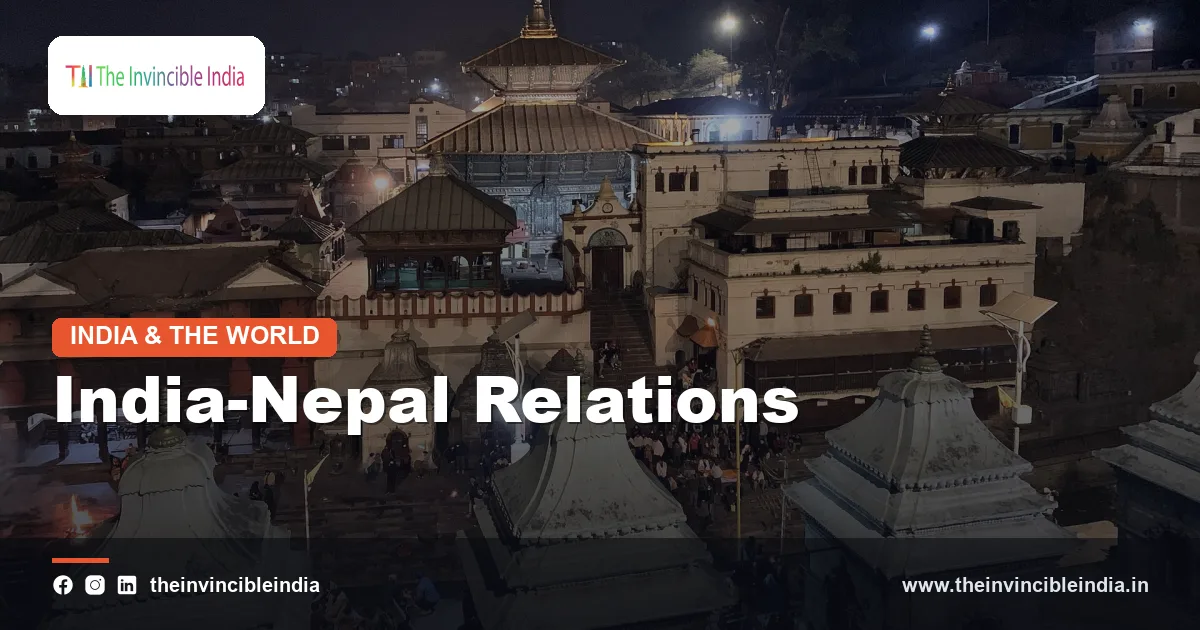
Religion is perhaps the strongest cultural thread. Nepal is home to Pashupatinath, the great Shiva temple on the Bagmati river in Kathmandu, which is a UNESCO World Heritage Site and one of the most important Shaivite shrines in South Asia. Tradition has long linked its worship with priests from India, and the temple draws large numbers of Indian devotees, especially on Maha Shivaratri. Muktinath in the Mustang region is sacred to both Hindus and Buddhists, and Indian pilgrims also travel to Janakpur, Gosaikunda and the Kailash-Manasarovar routes that pass through the region.
The Buddhist connection is equally profound. Lumbini, in southern Nepal, is the birthplace of Siddhartha Gautama, the Buddha. It is marked by the Maya Devi temple and an inscribed pillar of the Mauryan emperor Ashoka, and it was inscribed as a UNESCO World Heritage Site in 1997. Kushinagar, where the Buddha attained mahaparinirvana, along with Bodh Gaya and Sarnath, lies in India, so the Buddhist circuit naturally runs across both countries.
- Pashupatinath and Muktinath tie Nepal into the wider Hindu pilgrim network.
- Lumbini and the Indian Buddhist sites form a shared Buddhist circuit.
- Both governments promote cross-border religious tourism and have developed Ramayana and Buddhist circuits.
The Open Border and Roti-Beti Ties
The India-Nepal border is one of the few open frontiers of its kind in Asia. Citizens of both countries can cross without a visa or passport, and Nepali nationals have long been able to live and work in India without a work permit, with similar freedom for Indians in Nepal. The frontier runs along or near the Indian states of Uttarakhand, Uttar Pradesh, Bihar, West Bengal and Sikkim, and towns on either side function almost as twin settlements, with daily commuters, shoppers and traders.
What roti-beti means
The phrase “roti-beti ka rishta” captures the heart of the relationship. Roti stands for shared livelihood and food, and beti for marriage ties. Across the Terai and the adjoining districts of Bihar and Uttar Pradesh, families routinely marry their daughters across the border, creating dense networks of in-laws, cousins and friends. Weddings, funerals and festivals bring families together irrespective of nationality.
Practical realities
- Large numbers of Nepali citizens have traditionally worked in India in sectors such as hospitality, security and agriculture, and remittances are important to many Nepali households.
- Indian nationals in Nepal include traders, professionals, students and long-settled families.
- The open border also creates challenges, including smuggling, trafficking and difficulties in policing, which both countries address through border management cooperation.
The 1950 Treaty of Peace and Friendship
The legal backbone of the modern relationship is the Treaty of Peace and Friendship, signed in Kathmandu on 31 July 1950. It followed India’s independence and the geopolitical changes in the region, and it set out principles that continue to shape bilateral life. Its provisions are generally summarised as follows.
- Peace and friendship: both governments acknowledged each other’s complete sovereignty, territorial integrity and independence.
- National treatment: citizens of each country receive treatment on par with nationals of the other in matters such as residence, ownership of property, participation in trade and commerce, and movement.
- Open border: the free movement of people across the frontier is the practical result.
- Security consultation: the two countries agreed to consult each other on threats to either’s security and to inform each other of any serious friction with a neighbouring state.
The treaty was accompanied by letters of exchange on defence matters, and a separate Treaty of Trade and Commerce followed in 1950 as well. Over the decades, successive trade and transit treaties have been renewed and revised, but the 1950 treaty remains the reference point for the open border and the special status of each country’s citizens.
Calls to Revise the Treaty and the Eminent Persons Group
The 1950 treaty is valued by many people on both sides for what it enables, yet it has also been criticised, especially in Nepal. Critics argue that it was signed at a time of unequal bargaining positions and that some clauses, particularly those related to security and defence, restrict Nepal’s freedom of action in foreign policy. For some Nepali political groups and commentators, revising the treaty has become a symbol of equal sovereignty, while others caution that the open border benefits ordinary Nepalis and that changes could disrupt livelihoods.
To address this, the two governments agreed to set up an Eminent Persons Group (EPG), with members from both countries, to review bilateral arrangements and suggest ways to update them. The group was formed in 2016 and worked on a comprehensive set of recommendations over the following years. Its report has been a subject of discussion in both capitals, and the question of whether and how the treaty should be updated remains an open one. For readers of Indian foreign policy, the EPG is a useful example of how close neighbours attempt to modernise old agreements through dialogue rather than confrontation.
The Gorkha Connection
Few institutions symbolise the relationship better than the Gorkha regiments. Soldiers recruited from the hill communities of Nepal have a long record of military service, dating back to the era of the East India Company after the Anglo-Nepalese war that ended with the Treaty of Sugauli in 1816. At the time of Indian independence, a Tripartite Agreement in 1947 among India, Nepal and the United Kingdom divided the Gorkha regiments, with several remaining in the Indian Army and others joining the British Army.
Service, pensions and families
The Indian Army’s Gorkha Rifles continue to recruit both Indian Gorkhas (domiciled in India, for example in Uttarakhand, Himachal Pradesh, Darjeeling and the North East) and Nepali citizens. Retired soldiers living in Nepal receive Indian pensions, and India supports the welfare of its ex-servicemen there through pension and medical facilities. The money flowing into hill districts has long been an important part of local economies. The two countries also traditionally confer honorary army ranks on each other’s army chiefs, a gesture that reflects the military bond.
Agnipath and recruitment
The introduction of the Agnipath short-service scheme in 2022 complicated matters. Nepal indicated that the new model did not align neatly with the 1947 tripartite arrangements and the established pattern of long-term service and pensions, and Gorkha recruitment rallies from Nepal were put on hold while the two sides discussed the issue. The matter shows how a shift in India’s internal defence policy can have ripple effects in Nepal’s hill communities.
Economic Ties: Trade, Transit and Aid
India is Nepal’s largest trading partner and the main source of its imports, ranging from petroleum products and vehicles to machinery, cereals and construction materials. A very large share of Nepal’s external trade passes through India. Nepal’s exports to India include items such as agricultural products, textiles, edible oils, and increasingly electricity. The Nepali rupee has been pegged to the Indian rupee since 1993, which makes trade settlements simple but also ties Nepal’s monetary conditions to India’s.
Transit for a landlocked country
Nepal is landlocked, and its access to the sea has traditionally run through Indian territory. Goods bound for Nepal move through the ports of Kolkata and Haldia, and later through Visakhapatnam, then by road or rail to inland container depots and border points. A Treaty of Transit governs this arrangement, and bilateral trade and transit agreements have been updated over the years to simplify procedures and allow the use of additional routes and waterways.
Development assistance
India has funded and executed many development projects in Nepal, from roads and bridges in the Terai to hospitals, schools, drinking water, border-area infrastructure and post-earthquake housing. India also provides scholarships to Nepali students, a long-standing channel for people-to-people contact and capacity-building.
Hydropower Cooperation
Nepal’s fast-flowing Himalayan rivers, the Koshi, Gandak (Narayani) and Karnali, which join the Ganga system in India, give the country enormous hydropower potential. Estimates of its theoretical capacity run to many tens of thousands of megawatts, a large portion of it considered technically and economically feasible. Because the same rivers feed Indian floodplains, water and power cooperation has been a recurring theme since the 1950s.
- Koshi and Gandak agreements (1954, 1959): early barrage projects on the Nepal-India border that provided irrigation and flood control, and also drew criticism in Nepal over sharing of benefits.
- Mahakali Treaty (1996): an agreement covering the Mahakali river, which envisages the integrated Pancheshwar multipurpose project. Despite its great potential, Pancheshwar has been slow to take shape because of questions about design, costs and benefit sharing.
- Joint ventures: Indian companies have participated in several hydropower projects in Nepal, designed to export surplus power to India.
Power trade
The more recent story is one of growing power trade. Cross-border transmission lines, such as the Dhalkebar-Muzaffarpur line, enabled Nepal to sell surplus electricity to India, particularly in the monsoon months when river flows are strong. Nepal has also begun exporting power to Bangladesh through Indian territory, an arrangement made possible by Indian transmission networks and a trilateral understanding. This shows how Nepal’s hydro potential can create regional energy links beyond a purely bilateral frame.
Connectivity: Roads, Rail and Pipelines
Improving physical links has been a stated priority of both governments. The aim is to reduce transit time and costs, making trade more efficient and reducing Nepal’s perceived dependence on a small number of routes.
| Link | What it does |
|---|---|
| Raxaul-Amlekhgunj petroleum pipeline | Inaugurated in 2019, it is South Asia’s first cross-border petroleum products pipeline and lowers fuel transport costs |
| Jaynagar-Janakpur (Kurtha) railway | A broad-gauge rail link that connects the Bihar border to the sacred town of Janakpur |
| Integrated Check Posts | Modern border facilities at places such as Birgunj-Raxaul, Biratnagar-Jogbani, Bhairahawa-Sunauli and Nepalgunj, to speed customs and immigration |
| Cross-border transmission lines | Allow two-way electricity trade, including Dhalkebar-Muzaffarpur |
| Road projects in the Terai | Highways and bridges that improve links to the East-West Highway and to hill districts |
Further rail proposals, including links to Birgunj, Biratnagar and Bhairahawa and eventually connections toward Kathmandu, have been discussed and are at different stages of planning. Waterways, inland container depots and improved air connectivity are also part of the broader agenda.
Irritants: The Boundary Dispute
The principal territorial disagreement concerns Kalapani, Lipulekh and Limpiyadhura, an area at the tri-junction with Tibet in the Kumaon Himalaya, in what India administers as part of Uttarakhand. The dispute hinges on the interpretation of the Treaty of Sugauli, which designated the Kali (Mahakali) river as the western boundary. The two sides differ on which stream constitutes the true source of the Kali river and therefore on where the line falls.
Why it flared up
Lipulekh is a strategic pass used for the Kailash Mansarovar Yatra and for trade with Tibet. In 2019 India published a new political map after the reorganisation of Jammu and Kashmir, and in 2020 the inauguration of a road to Lipulekh drew protests in Nepal. Nepal responded by issuing a new official map in May 2020 that included the disputed areas, and its Parliament amended the Constitution in June 2020 to update the map on its national emblem. India called the move unilateral and not based on historical fact or evidence.
Both sides have said the matter should be addressed through dialogue and have talked about using existing diplomatic mechanisms, including boundary working groups. The dispute continues to be politically sensitive in both countries, and no final settlement has been reached.
The 2015 Blockade and China’s Growing Role
Nepal promulgated its new Constitution on 20 September 2015 after years of political transition. Some groups in the southern plains, notably Madhesi and Tharu communities, felt their concerns about representation and federal boundaries were not adequately addressed, and protests followed. Soon after, supplies of fuel, medicines and other goods through major border crossings fell sharply and a period of acute shortages began in Nepal, lasting into early 2016.
Nepal and many commentators described the disruption as an unofficial blockade by India. India denied imposing one and said the disruption was due to security conditions and protests at the border. Regardless of the dispute over causes, the episode left a lasting impression in Nepal and strengthened the argument for diversifying trade and transit routes.
The China factor
In the aftermath, Nepal signed a transit and transport agreement with China in 2016 and joined China’s Belt and Road Initiative framework in 2017. China has since expanded its engagement in infrastructure, trade and aid. For India, this is a matter of strategic attention because of the sensitivity of its northern frontier. In practice, Nepal seeks balanced relations with both neighbours, while geography, the cost of trade across the Himalayas and long-standing links keep India’s position in Nepal’s economy strong.
Humanitarian Support: Earthquake Relief and Operation Maitri
A powerful earthquake struck Nepal on 25 April 2015, killing thousands of people and damaging heritage sites, homes and infrastructure. India launched Operation Maitri within hours, sending National Disaster Response Force teams, Indian Air Force aircraft, army medical units and relief material, and later assisted with rescue and reconstruction. It was one of the largest disaster relief operations India had undertaken abroad at that point.
India subsequently announced a major reconstruction assistance package, including support for housing in affected districts, and funded school and heritage projects. At a time when political relations were beginning to be strained, the episode demonstrated the humanitarian dimension of the relationship, though it was followed within months by the controversy surrounding the border disruption.
Timeline of Key Moments
| Year | Event |
|---|---|
| 1816 | Treaty of Sugauli fixes the Kali river as the western boundary |
| 1947 | Diplomatic relations established; Tripartite Agreement on the Gorkha regiments |
| 1950 | Treaty of Peace and Friendship signed on 31 July |
| 1954 and 1959 | Koshi and Gandak agreements on river projects |
| 1996 | Mahakali Treaty signed |
| 2015 | Earthquake on 25 April and Operation Maitri; new Constitution on 20 September; border supply crisis |
| 2016 | Eminent Persons Group constituted |
| 2019 | Raxaul-Amlekhgunj petroleum pipeline inaugurated |
| 2020 | Nepal issues new map including Kalapani, Lipulekh and Limpiyadhura |
| 2022 | Agnipath scheme introduced; Gorkha recruitment questions arise |
Nationalism, Sensitivity and the Road Ahead
Because of the size gap between the two countries, Nepal’s politics is often sensitive to perceptions of Indian influence, and Indian actions are scrutinised closely in the Nepali media. At the same time, Indian policymakers see Nepal as central to their “Neighbourhood First” approach and as a key part of Himalayan security. Both sides have stressed the importance of dealing with each other on the basis of sovereign equality, mutual respect and benefit.
The future of the partnership is likely to depend on a few practical areas: completing connectivity projects, expanding hydropower and power trade, resolving the boundary question through dialogue, updating old treaties in a way both nations accept, and maintaining the lively people-to-people ties that make the relationship unique.
Conclusion
The story of India-Nepal relations is a blend of intimacy and independence. A shared civilisation, an open border, Hindu and Buddhist pilgrim routes, the Gorkha tradition, trade and hydropower collaboration give the relationship a depth that few others can match. The boundary dispute, the memory of 2015 and the question of the 1950 treaty remind both countries that closeness needs constant care. As a landmark relationship in South Asia, it will continue to be shaped by how well both sides listen to each other.
Frequently Asked Questions
What is the 1950 Treaty of Peace and Friendship between India and Nepal?
It is a treaty signed in Kathmandu on 31 July 1950 that recognises each country’s sovereignty and provides for an open border and national treatment of each other’s citizens in matters such as residence, work and trade. It also provides for consultation on security matters. Some in Nepal want it revised, and an Eminent Persons Group was set up in 2016 to review it.
Is the India-Nepal border really open?
Yes, largely. Citizens of both countries can cross the roughly 1,750 km border without a visa or passport, and Nepali citizens can live and work in India without a work permit. Third-country nationals, however, are required to carry valid travel documents and follow immigration rules at designated crossings.
What is the Kalapani-Lipulekh dispute?
It is a boundary disagreement over areas in the Kumaon Himalaya near the tri-junction with Tibet. Nepal and India interpret the Treaty of Sugauli of 1816 differently on which stream forms the source of the Kali river. Nepal issued a new map in May 2020 including the area, and both countries say the matter should be resolved through dialogue.
Why are Gorkha soldiers important to India-Nepal ties?
Gorkha soldiers from Nepal have served in the Indian Army’s Gorkha Rifles since before independence, and a 1947 Tripartite Agreement shaped their service. Their pensions and the welfare of ex-servicemen provide an important income and human link between the two countries. The Agnipath scheme of 2022 complicated recruitment and led to a pause in Gorkha recruitment rallies in Nepal.
How does India help Nepal’s economy?
India is Nepal’s largest trading partner and provides transit access through its ports and territory, since Nepal is landlocked. It also provides development assistance for infrastructure, education and health, and buys surplus Nepali hydropower. Cooperation on rail links, check-posts and the Raxaul-Amlekhgunj petroleum pipeline has further strengthened economic ties.
What happened in 2015 that affected relations?
Two major events marked the year. India sent large-scale relief under Operation Maitri after the 25 April earthquake. After Nepal’s new Constitution was promulgated in September, protests in the plains disrupted border supplies, which many Nepalis described as an unofficial blockade, a charge India rejected. The episode led Nepal to strengthen transit options with China.


