

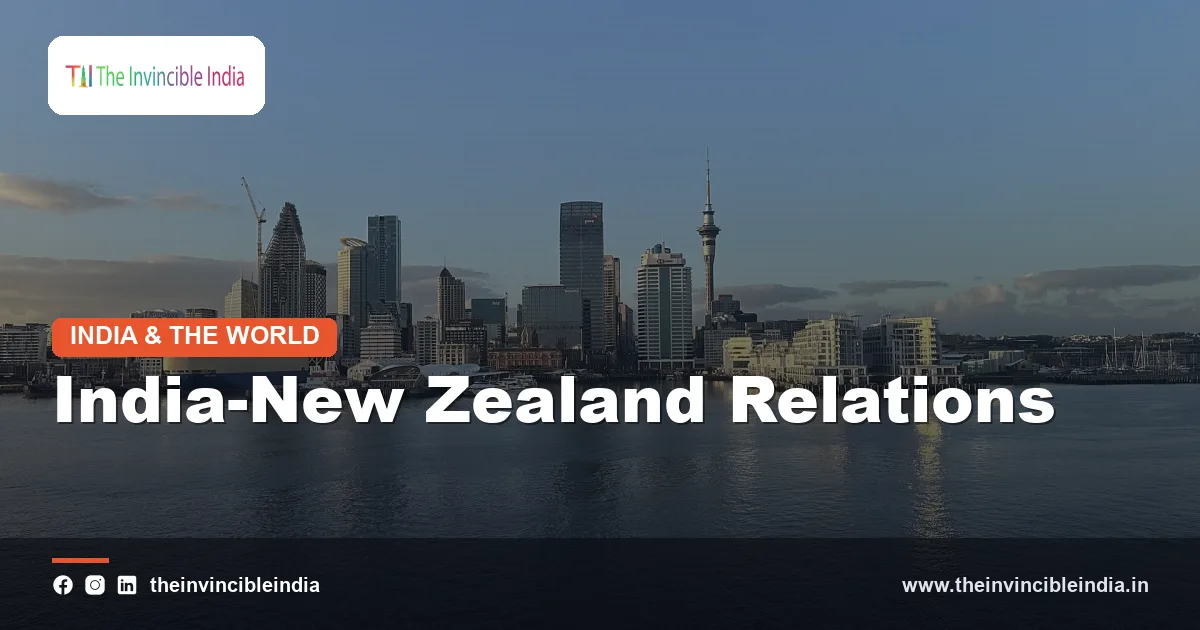
India-New Zealand relations are the long-standing, generally warm but economically modest bilateral ties between two Commonwealth democracies, built on shared parliamentary traditions, the English language, a deep love of cricket and a large Indian-origin community in New Zealand. Formal diplomatic ties date from the early 1950s, and the relationship has grown from a largely people-to-people bond into a broader partnership covering trade, education, agriculture, defence dialogue and Indo-Pacific cooperation.
The two countries are geographically distant and differ greatly in size, but they share a commitment to a rules-based international order. Trade between them remains small relative to each country’s major partners, and free-trade talks have historically been complicated by sensitivities in India’s dairy sector, which makes the relationship one of both promise and caution.
| Attribute | Detail |
|---|---|
| Relationship | Bilateral relations between India and New Zealand |
| Diplomatic ties | Established in the early 1950s; missions in Wellington and New Delhi |
| Shared memberships | Commonwealth, United Nations, World Trade Organization, East Asia Summit, Indo-Pacific Economic Framework (IPEF) |
| Political systems | Both parliamentary democracies with Westminster-style institutions |
| Indian community in New Zealand | Among the largest and fastest-growing ethnic communities, well over 200,000 people in recent censuses |
| Key sectors | Education, tourism, agriculture and horticulture, forestry, services, information technology |
| Trade negotiations | Free trade agreement talks begun in 2010, stalled, and relaunched in 2025 |
| Cultural bond | Cricket, Hindi cinema, Diwali celebrations, yoga |
Key Takeaways
- India and New Zealand are both Commonwealth members and parliamentary democracies that have maintained diplomatic relations since the early 1950s.
- People-to-people links are the strongest part of India-New Zealand relations, anchored by a large Indian-origin community and shared passion for cricket.
- Education and tourism are major drivers of the relationship, with India being one of the largest sources of international students for New Zealand.
- India and New Zealand began free-trade-agreement negotiations in 2010, and the talks were formally relaunched in March 2025, with dairy access remaining a historically sensitive issue.
- Both countries support a free, open and rules-based Indo-Pacific and cooperate through forums such as the East Asia Summit and the Indo-Pacific Economic Framework.
- Two-way trade between India and New Zealand is small compared with each country’s larger partners, which leaves considerable room for growth.
How did India-New Zealand relations begin?
India-New Zealand relations began in the colonial and early post-independence period through shared membership of the British Commonwealth and were formalised with diplomatic missions in the early 1950s. Contacts predate independence, since Indians had been arriving in New Zealand since the 19th century, and the two sides were linked by Commonwealth institutions, trade in goods such as wool and by sporting competition.
A famous early link is the 1953 ascent of Mount Everest by the New Zealander Sir Edmund Hillary and the Nepali-Indian mountaineer Tenzing Norgay. Hillary later became deeply involved in Himalayan communities and served as New Zealand’s High Commissioner to India from 1985 to 1988, which gave him a lasting place in the story of the two countries.
During the Cold War, ties were cordial but not close. New Zealand’s strong anti-nuclear stance and its criticism of nuclear testing created some friction after India’s tests in 1974 and 1998, but the relationship improved significantly once India’s civil nuclear arrangements were accepted internationally in 2008 and as both countries turned their attention to the Indo-Pacific.
Why are cricket and people-to-people ties so central?
Cricket and people-to-people ties are central to India-New Zealand relations because they provide a common cultural language and everyday contact that formal diplomacy often lacks. The two countries have played Test cricket against each other since the 1950s, and matches between them are followed keenly in both nations.
The rivalry has produced memorable moments in recent years. New Zealand defeated India in the semi-final of the 2019 Cricket World Cup and won the inaugural ICC World Test Championship final in 2021, while India beat New Zealand in the 2023 World Cup semi-final and in the final of the 2025 Champions Trophy. In 2024, New Zealand won a Test series in India for the first time, adding to a competitive and respectful rivalry.
Beyond cricket, Hindi films, Indian food, yoga and festivals such as Diwali are widely visible in New Zealand. Diwali celebrations are held in cities such as Auckland and Wellington and are often marked at the national level, which shows the integration of Indian culture into New Zealand life.
How large is the Indian community in New Zealand?
The Indian community in New Zealand is one of the country’s largest and fastest-growing ethnic communities, numbering well over two hundred thousand people according to recent censuses, or roughly one in twenty residents. The community includes people who came directly from India, the descendants of earlier migrants, and a significant number who arrived from Fiji, South Africa and other countries with historic Indian populations.
The Indian population has grown rapidly since the 1990s because of skilled migration, student pathways and family reunification. Auckland is home to the largest concentration, with other significant communities in Wellington, Hamilton and Christchurch. Gujarati, Punjabi, Tamil, Telugu, Malayalam and Hindi speakers all form part of this community, and Hindi and Punjabi are among the more widely spoken languages in the country.
The community plays a key role in the New Zealand economy, particularly in healthcare, information technology, hospitality, retail, dairy farming and construction. It also contributes to politics, with Indian-origin members serving in Parliament and local government.
What is the role of education and tourism?
Education and tourism are two of the most important practical links between India and New Zealand, because they bring large numbers of people to each other’s countries every year. India has long been among the largest sources of international students for New Zealand, drawn by quality universities, post-study work opportunities and relatively affordable fees.
New Zealand institutions have promoted collaboration with Indian universities through scholarships, research partnerships and exchange programmes. The Indian government has welcomed such cooperation, and Indian students in New Zealand are an important contributor to the education export sector.
Tourism flows in both directions. New Zealand attracts Indian visitors with its landscapes, adventure activities and the use of the country as a film location, and Indian tourism to New Zealand has grown over the past two decades. Visitors from New Zealand to India are fewer but include many members of the Indian diaspora visiting family.
What is the state of trade between India and New Zealand?
Trade between India and New Zealand is modest, amounting to a few billion US dollars a year in goods and services combined, and it is small compared with each country’s largest trade partners. The pattern reflects the complementary nature of the two economies.
| Direction | Typical products |
|---|---|
| New Zealand exports to India | Forestry products and logs, wool, fruit such as apples and kiwifruit, dairy and food ingredients, coal and some machinery |
| India exports to New Zealand | Pharmaceuticals, jewellery and gems, textiles and garments, machinery, vehicles and parts, spices and information technology services |
Services trade is led by education and tourism from the New Zealand side and by information technology and professional services from the Indian side. Both governments have said they want to increase trade and investment, and have encouraged business delegations and cooperation in sectors such as agri-tech, food processing, renewable energy and start-ups.
Why have free-trade negotiations been difficult?
Free-trade negotiations between India and New Zealand have been difficult mainly because of differences over agriculture, especially dairy, along with other market access and regulatory issues. The two countries began free trade agreement (FTA) negotiations in 2010 and held several rounds, but the talks lost momentum and did not conclude.
The central issue was dairy. New Zealand is one of the world’s largest dairy exporters and sought wider access to the Indian market, while India’s dairy sector is made up of tens of millions of small farmers, and the government has been cautious about opening it to imports because of livelihood concerns. India also wanted better terms for its services professionals and for exports such as textiles and pharmaceuticals, while New Zealand had interests in forestry and horticulture access.
The talks were formally relaunched in March 2025, when leaders of both countries announced a fresh effort to negotiate a deal. Developments after that date are best checked against official statements from India’s Ministry of Commerce and Industry and New Zealand’s Ministry of Foreign Affairs and Trade.
- New Zealand priorities: Dairy and agricultural access, forestry and horticulture, and education services.
- Indian priorities: Protection of sensitive farm sectors, access for textiles, pharmaceuticals and services, and easier movement of skilled professionals.
How do India and New Zealand cooperate on the Indo-Pacific?
India and New Zealand cooperate on the Indo-Pacific by sharing a stated preference for a free, open, stable and rules-based region, and by working together in regional bodies and dialogues. Both countries are members of the East Asia Summit and of the Indo-Pacific Economic Framework, and both take part in wider regional forums such as the ASEAN-centred dialogues.
New Zealand has a strong presence in the Pacific Islands through the Pacific Islands Forum, while India has been building ties with Pacific Island nations through the Forum for India-Pacific Islands Cooperation (FIPIC), launched in 2014. The two countries can therefore find common ground on development cooperation, climate resilience and maritime security in the Pacific.
Defence and security ties are growing but remain limited, and they include naval visits, dialogues and cooperation in areas such as maritime domain awareness, counter-terrorism and disaster relief. The two countries differ in some respects: New Zealand is a member of the Five Eyes intelligence partnership, while India follows a policy of strategic autonomy and is not part of any formal alliance.
What other areas of cooperation exist?
India and New Zealand also cooperate in agriculture, science and technology, climate action, renewable energy, sports and culture. These areas have grown steadily as both sides look beyond trade to build a broader partnership.
- Agriculture and horticulture: Cooperation on dairy technology, apple and kiwifruit cultivation, and food processing.
- Science and technology: Joint research projects and exchanges between universities and research bodies.
- Climate and energy: Shared interest in renewable energy, disaster resilience and climate adaptation, with both countries active in climate negotiations.
- Sports: Cricket, hockey and other sports contacts, and exchanges between coaches and athletes.
- Mobility: Visa arrangements for students, skilled workers and visitors, which are a recurring topic in discussions.
What does the future hold for India-New Zealand relations?
The future of India-New Zealand relations is likely to be shaped by the success of trade negotiations, deeper education and mobility links, and growing strategic convergence in the Indo-Pacific. The size and energy of the Indian community in New Zealand provide a solid base for this partnership.
The main challenges are practical and political. Sensitivity in the Indian dairy sector will continue to influence negotiations, and New Zealand must balance its ties with India against its significant economic relationships elsewhere in Asia. Distance, limited direct flight connectivity and a small business footprint also constrain how quickly the relationship can deepen.
Even so, both governments have signalled that they see value in a closer partnership, and the foundation of shared democratic values, language, sport and community links is strong.
Bottom Line
India-New Zealand relations rest on shared Commonwealth and democratic traditions, cricket and a large, successful Indian community, while economic ties remain small relative to their potential. The outcome of free-trade negotiations, with dairy as the most delicate issue, and cooperation on education and the Indo-Pacific will decide how far the relationship grows.
Frequently Asked Questions
When did India and New Zealand establish diplomatic relations?
India and New Zealand established diplomatic relations in the early 1950s, soon after India’s independence. Both countries now maintain high commissions in each other’s capitals, in New Delhi and Wellington.
How many Indians live in New Zealand?
Well over two hundred thousand people of Indian ethnicity live in New Zealand according to recent censuses, which is roughly one in twenty residents. The community is among the fastest-growing in the country and is concentrated in Auckland.
Is there a free trade agreement between India and New Zealand?
India and New Zealand began negotiating a free trade agreement in 2010, but the talks stalled and were formally relaunched in March 2025. The latest status should be checked with official government announcements.
Why is dairy a sensitive issue in India-New Zealand trade?
Dairy is sensitive because New Zealand is a leading dairy exporter that wants Indian market access, while India’s dairy sector supports millions of small farmers. India has therefore been cautious about reducing tariffs on dairy imports.
What is the role of cricket in India-New Zealand relations?
Cricket provides a shared passion and a friendly rivalry that supports people-to-people ties between the two countries. The teams have played each other since the 1950s, with memorable contests in recent World Cup and Test championship matches.
Do India and New Zealand cooperate on the Indo-Pacific?
Yes, both countries support a free, open and rules-based Indo-Pacific and work together in forums such as the East Asia Summit and the Indo-Pacific Economic Framework. Their cooperation includes development, climate resilience and maritime security.
{“@context”:”https://schema.org”,”@graph”:[{“@type”:”FAQPage”,”mainEntity”:[{“@type”:”Question”,”name”:”When did India and New Zealand establish diplomatic relations?”,”acceptedAnswer”:{“@type”:”Answer”,”text”:”India and New Zealand established diplomatic relations in the early 1950s, soon after India’s independence. Both countries now maintain high commissions in each other’s capitals, in New Delhi and Wellington.”}},{“@type”:”Question”,”name”:”How many Indians live in New Zealand?”,”acceptedAnswer”:{“@type”:”Answer”,”text”:”Well over two hundred thousand people of Indian ethnicity live in New Zealand according to recent censuses, which is roughly one in twenty residents. The community is among the fastest-growing in the country and is concentrated in Auckland.”}},{“@type”:”Question”,”name”:”Is there a free trade agreement between India and New Zealand?”,”acceptedAnswer”:{“@type”:”Answer”,”text”:”India and New Zealand began negotiating a free trade agreement in 2010, but the talks stalled and were formally relaunched in March 2025. The latest status should be checked with official government announcements.”}},{“@type”:”Question”,”name”:”Why is dairy a sensitive issue in India-New Zealand trade?”,”acceptedAnswer”:{“@type”:”Answer”,”text”:”Dairy is sensitive because New Zealand is a leading dairy exporter that wants Indian market access, while India’s dairy sector supports millions of small farmers. India has therefore been cautious about reducing tariffs on dairy imports.”}},{“@type”:”Question”,”name”:”What is the role of cricket in India-New Zealand relations?”,”acceptedAnswer”:{“@type”:”Answer”,”text”:”Cricket provides a shared passion and a friendly rivalry that supports people-to-people ties between the two countries. The teams have played each other since the 1950s, with memorable contests in recent World Cup and Test championship matches.”}},{“@type”:”Question”,”name”:”Do India and New Zealand cooperate on the Indo-Pacific?”,”acceptedAnswer”:{“@type”:”Answer”,”text”:”Yes, both countries support a free, open and rules-based Indo-Pacific and work together in forums such as the East Asia Summit and the Indo-Pacific Economic Framework. Their cooperation includes development, climate resilience and maritime security.”}}]}]}


