

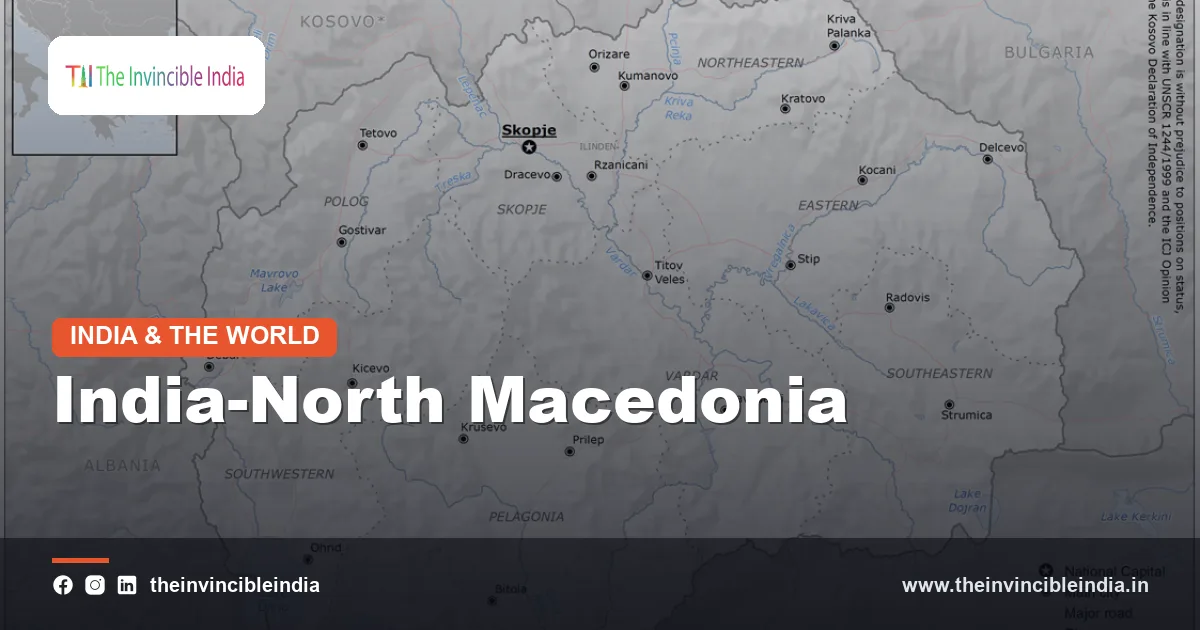
India-North Macedonia relations are the cordial, low-key bilateral ties between the Republic of India and the Republic of North Macedonia, a small landlocked Balkan country that became independent from Yugoslavia in 1991 and adopted its present name in 2019. The relationship has no major disputes and rests on a handful of durable threads: modest trade led by pharmaceuticals, the shared memory of Mother Teresa, who was born in Skopje, and steady cooperation on multilateral platforms such as the United Nations.
Because North Macedonia is a small economy that is still working its way towards European Union (EU) membership, the partnership with India is more about goodwill, education and selective commercial openings than about strategic competition. This explainer sets out how the ties developed, what they cover, where the limits lie and what may shape them next. Last reviewed: 21 October 2026.
| Item | Detail |
|---|---|
| Countries | India and the Republic of North Macedonia (capital: Skopje) |
| Nature of ties | Friendly, low-profile bilateral relationship with no outstanding disputes |
| North Macedonia’s independence | 1991, peacefully, from the Socialist Federal Republic of Yugoslavia |
| Name change | From “Republic of Macedonia” to “Republic of North Macedonia” under the Prespa Agreement, in force since February 2019 |
| Diplomatic ties | Established in the 1990s after independence; representation has largely been handled by non-resident or regional arrangements |
| Cultural anchor | Mother Teresa (born Anjezë Gonxhe Bojaxhiu in Skopje, 1910), who later worked in Kolkata |
| Main trade theme | Indian pharmaceuticals and other manufactured goods; trade volumes are small |
| Euro-Atlantic status of North Macedonia | NATO member since 2020; EU candidate country since 2005 |
| Cooperation channels | United Nations, Indian Technical and Economic Cooperation (ITEC) training, cultural and educational exchanges |
Key Takeaways
- India-North Macedonia relations are friendly and uncomplicated, but the economic and political scale of the partnership remains small.
- North Macedonia gained independence from Yugoslavia in 1991, and India’s contact with the country grew out of its earlier close relationship with Yugoslavia.
- Mother Teresa, born in Skopje in 1910 and canonised in 2016, is the most visible civilisational link between the people of India and North Macedonia.
- The 2018 Prespa Agreement, in force from February 2019, renamed the country North Macedonia and unlocked its NATO membership in 2020 and its EU accession talks.
- Pharmaceuticals are the commercial bright spot, because Indian generic medicines suit the price sensitivity of Balkan health systems.
- Future growth depends on better connectivity, more business contact, training slots and the pace of North Macedonia’s own reforms towards the EU.
What are India-North Macedonia relations based on?
India-North Macedonia relations are based on mutual goodwill, a shared preference for peaceful settlement of disputes, and a small but growing set of commercial, cultural and educational contacts. Neither side has a historical grievance against the other, and neither treats the relationship as a strategic priority, which gives the partnership a stable but understated character.
For India, North Macedonia is one of several small South-East European states with which it maintains cordial ties alongside its larger relationships in the region, such as those with Serbia, Greece, Bulgaria and Romania. For North Macedonia, India is a large Asian democracy and a fast-growing market that offers pharmaceuticals, information technology services and scholarships. Both countries are parliamentary democracies, and both value multilateral institutions as a way to amplify the voice of mid-sized and small states.
Official statements from both capitals typically stress three ideas: respect for sovereignty and territorial integrity, support for a rules-based international order, and a wish to widen trade and people-to-people contact. These are broad principles rather than a detailed programme, so the relationship is best understood as a framework within which specific projects can be added over time.
How did ties between India and North Macedonia begin?
Ties between India and North Macedonia began after 1991, when the former Yugoslav republic of Macedonia declared independence, although the deeper background is India’s relationship with Yugoslavia during the Cold War. India and Yugoslavia were founding pillars of the Non-Aligned Movement (NAM), and leaders such as Jawaharlal Nehru and Josip Broz Tito shaped a tradition of friendly contact that many successor states inherited in a diluted form.
When the Yugoslav federation broke apart in the early 1990s, India recognised the successor states one by one and built bilateral relations with each. North Macedonia was admitted to the United Nations in April 1993 under the provisional reference “the former Yugoslav Republic of Macedonia”, because of a naming dispute with Greece, and diplomatic relations with India followed in that decade. In the years that followed, the relationship developed slowly, mainly through visits by officials, ministerial meetings on the margins of UN sessions and cultural events.
Why the pace was gradual
Several factors kept the early years modest. North Macedonia was a young state with a small economy, it faced a prolonged dispute over its name, and its foreign policy was focused on neighbours, NATO and the EU. India, for its part, was undergoing economic liberalisation after 1991 and prioritised larger partners. The result was a relationship maintained mostly at the level of goodwill rather than programmes.
What is the Mother Teresa connection between India and North Macedonia?
The Mother Teresa connection is the most emotive link between India and North Macedonia, because the saint who spent most of her life serving the poor in Kolkata was born in Skopje, the present capital of North Macedonia, on 26 August 1910. She was baptised Anjezë Gonxhe Bojaxhiu, left for Ireland and then India as a young woman in 1928 to join the Sisters of Loreto, and founded the Missionaries of Charity in Kolkata in 1950.
She received the Nobel Peace Prize in 1979, India’s highest civilian honour, the Bharat Ratna, in 1980, and was canonised by the Catholic Church in September 2016. She died in Kolkata in 1997. Skopje preserves her memory through a memorial house and museum dedicated to her life,. Visiting Indian dignitaries and delegations often include these sites on their programmes.
The shared memory matters because it gives the two peoples a common reference point that needs no explanation. Her heritage is viewed through different lenses in the region, since she is claimed with pride by communities of Albanian and other backgrounds in the Balkans, and by many in India as a figure of compassion. A neutral way to describe her role is as a human bridge: a person of Balkan origin whose life’s work was carried out in India.
How have North Macedonia’s renaming and EU path shaped the relationship?
North Macedonia’s renaming and its European path have shaped the relationship mainly by changing how the country is addressed and by pointing its foreign policy towards Brussels. The Prespa Agreement, signed with Greece in June 2018 and in force from February 2019, ended a decades-long dispute by changing the country’s name from the Republic of Macedonia to the Republic of North Macedonia.
The agreement cleared the way for NATO membership, which North Macedonia obtained in March 2020 as the alliance’s 30th member. It also unblocked the EU track: the country has been an EU candidate since December 2005, the European Union agreed in 2020 to open accession negotiations in principle, and the first intergovernmental conference was held in 2022. Progress since then has depended on reform benchmarks and on bilateral issues with neighbouring EU members, so the timeline remains uncertain.
What this means for India
- India uses the official name, North Macedonia, in its communications, aligned with the UN and with most of the international community.
- A stable name and a settled neighbourhood make North Macedonia a more predictable partner for investors and for institutions that sign agreements with it.
- EU alignment means North Macedonia’s regulatory standards, including those for medicines and food, are gradually converging with EU rules, which is relevant for Indian exporters.
- North Macedonia’s political bandwidth is mostly taken up by EU and NATO commitments, so engagement with distant partners such as India must compete for attention.
What does trade and economic cooperation between India and North Macedonia look like?
Trade and economic cooperation between India and North Macedonia is modest in absolute terms, usually measured in tens of millions of US dollars annually, and it is led by Indian exports, especially pharmaceuticals. Exact annual figures vary from year to year and by data source, so any single number should be treated as approximate.
Indian exports to North Macedonia have typically included pharmaceutical formulations, machinery, auto components, textiles and chemicals, while imports from North Macedonia have been smaller and have included items such as metals, machinery parts and agricultural or processed goods. North Macedonia has a service-oriented and export-driven manufacturing base, with strong links to German and wider EU supply chains, so its demand for Indian goods is limited by its small size.
Why pharmaceuticals lead
India is often described as the “pharmacy of the developing world” because of its large generic-drug industry, and North Macedonia, like other Balkan states, needs affordable medicines. Indian generics fit that need, although regulatory registration, EU-style quality standards and local distribution partnerships all determine how much market share Indian firms can win. North Macedonia also has its own pharmaceutical manufacturer, which creates scope for licensing and supply partnerships rather than only direct imports.
Other sectors with potential
- Information technology and outsourcing, where North Macedonia has built a growing digital-services sector.
- Agriculture and food processing, including wine, vegetables and fruit.
- Tourism, where lakes such as Ohrid, a UNESCO World Heritage site, could attract more Indian visitors with better flight connections.
- Education, where Indian students and trainers can both give and receive exposure.
How do India and North Macedonia cooperate at the United Nations?
India and North Macedonia cooperate at the United Nations mainly through shared positions on peace, development and multilateralism, and through mutual courtesy in elections and consultations rather than through a formal bloc. Both countries are members of the UN General Assembly and routinely support resolutions on sustainable development, climate action and the peaceful settlement of disputes.
India has long been a leading contributor to UN peacekeeping, and North Macedonia, as a small state with its own experience of international mediation during the 2001 internal crisis, takes a keen interest in conflict prevention. India seeks support for reform of the UN Security Council and for its aspiration to a permanent seat. North Macedonia, like most countries, has supported reform of the Council in general terms, and the exact wording of any bilateral endorsement is a matter of the official joint statements issued from time to time.
The two countries also meet in wider settings such as the World Health Organization and the UN Educational, Scientific and Cultural Organization (UNESCO). These meetings give officials a regular chance to compare notes without requiring costly visits.
What role do education and capacity-building play?
Education and capacity-building play a growing but selective role in India-North Macedonia relations, because India offers training and scholarship opportunities to partner countries, including those in the Balkans. The best-known channel is the Indian Technical and Economic Cooperation (ITEC) programme, launched in 1964, which funds short- and medium-term courses in India for civil servants, diplomats and professionals from developing and middle-income countries.
Scholarships under schemes run by the Indian Council for Cultural Relations (ICCR) have also been offered to students from many countries, with a focus on Indian languages, arts, humanities and technology. Participation from small countries is usually measured in a handful of slots each year, but alumni of such programmes often become informal ambassadors for India in their own societies.
Yoga, Indian classical dance and Bollywood films offer another soft-power route. Cultural centres and local associations in the Balkans have held yoga sessions, especially around the International Day of Yoga on 21 June, an observance India proposed at the UN in 2014. These events are small, but they build familiarity at the grassroots level.
How are the two countries represented diplomatically?
The two countries maintain diplomatic relations through arrangements that rely partly on non-resident accreditation, a common practice for small bilateral partnerships. India has traditionally accredited its envoys in a neighbouring European capital to North Macedonia, while North Macedonia has used its own regional or multilateral missions to maintain contact. The details of resident missions have changed over the years, so readers needing current information should consult the Ministry of External Affairs (MEA) in New Delhi or the Ministry of Foreign Affairs in Skopje.
Non-resident accreditation is cheaper than a full embassy, and it works adequately when the agenda is light. It has drawbacks: envoys visit infrequently, local business contact is thinner, and consular help for Indian travellers must be arranged across borders. Honorary consuls and cultural associations sometimes fill part of that gap.
Travel and consular matters
Few Indian tourists visit North Macedonia compared with Western Europe, partly because there are no direct flights and partly because awareness is low. Indian nationals generally need a visa to enter, and holders of a valid Schengen or certain other visas may enjoy easier entry subject to the rules in force. Travellers should always check current requirements with official sources before departure.
What is the timeline of India-North Macedonia relations?
The timeline of India-North Macedonia relations runs from the Cold War friendship with Yugoslavia, through 1990s recognition and the long naming dispute, to the 2019 renaming and the country’s recent European integration steps. The table below summarises the main milestones.
| Year | Milestone |
|---|---|
| 1910 | Mother Teresa is born in Skopje, then part of the Ottoman Empire |
| 1950 | Mother Teresa founds the Missionaries of Charity in Kolkata |
| 1961 | India and Yugoslavia are founding participants of the Non-Aligned Movement in Belgrade |
| 1991 | Macedonia declares independence from Yugoslavia |
| 1993 | Admitted to the UN under the provisional reference “the former Yugoslav Republic of Macedonia” |
| 2005 | Granted EU candidate status |
| 2016 | Mother Teresa is canonised as Saint Teresa of Calcutta |
| 2018 | Prespa Agreement signed with Greece |
| 2019 | Country formally becomes North Macedonia |
| 2020 | Joins NATO as its 30th member |
| 2022 | First intergovernmental conference of EU accession negotiations |
What are the challenges and limits of the relationship?
The main challenges in India-North Macedonia relations are distance, scale and limited visibility, rather than any political friction. The two countries are separated by thousands of kilometres, share no direct air link and have little overlapping media coverage, so awareness of each other remains low among ordinary citizens and business owners.
- Small market size: North Macedonia has a population of roughly 1.8 million, which limits the scale of Indian investment and exports.
- Regulatory convergence: As the country adopts EU rules, Indian firms may need to meet stricter quality and documentation standards.
- Competing priorities: Both governments focus on larger partners, such as the EU and the United States for North Macedonia, and neighbours, the Gulf and major powers for India.
- Thin institutional framework: The number of formal agreements, joint commissions and business councils is limited compared with India’s ties with larger European states.
- Information gaps: Businesses on both sides often lack basic market intelligence and trusted intermediaries.
None of these obstacles is insurmountable, and similar small-country relationships have grown when governments added a few concrete mechanisms, such as business delegations, direct flight discussions or training exchanges.
What is the future outlook for India-North Macedonia relations?
The future outlook for India-North Macedonia relations is steady and incremental, with growth most likely in pharmaceuticals, digital services, education and tourism rather than in defence or high politics. Much will depend on how North Macedonia’s EU accession progresses, since EU membership would integrate the country into a much larger single market with which India already negotiates and trades.
India’s wider engagement with Europe, including its trade negotiations with the EU and its expanding partnerships in Central and South-East Europe, may create indirect benefits for smaller states. For North Macedonia, India represents diversification and a large, young consumer base. For India, the country is a friendly voice in a region where it seeks goodwill, and a possible production or services partner linked to EU supply chains.
Practical steps that could strengthen the partnership include regular foreign office consultations, expanded ITEC and scholarship slots, trade fairs, cultural weeks centred on Mother Teresa’s legacy and clearer visa facilitation for business visitors.
Bottom Line
India-North Macedonia relations are warm, stable and small, anchored by Mother Teresa’s Skopje roots, by modest pharmaceutical trade and by a shared commitment to the United Nations system. Their growth will be gradual, and will depend largely on North Macedonia’s European integration and on new people-to-people and commercial links.
Frequently Asked Questions
Are India and North Macedonia friendly countries?
Yes, India and North Macedonia have friendly and cordial relations with no major disputes. The ties are modest in scale and are supported by cultural links, mainly Mother Teresa’s birthplace in Skopje, as well as small-scale trade and cooperation at the United Nations.
Why is Mother Teresa important to India-North Macedonia relations?
Mother Teresa is important because she was born in Skopje, the capital of present-day North Macedonia, in 1910 and spent most of her life working in Kolkata, India. She is therefore a shared point of pride and remembrance for the two countries, and Skopje has a memorial house dedicated to her.
When did Macedonia become North Macedonia?
The country officially became North Macedonia in February 2019, when the Prespa Agreement with Greece entered into force. The agreement ended a long naming dispute and opened the way for the country to join NATO in 2020 and move forward with EU accession negotiations.
What does India export to North Macedonia?
India mainly exports pharmaceutical products to North Macedonia, along with machinery, auto components, textiles and chemicals. Trade volumes are small, usually in the tens of millions of US dollars a year, and the exact figures vary from year to year.
Does North Macedonia have an embassy in India?
The arrangements for diplomatic representation between the two countries have relied partly on non-resident accreditation and have changed over time. For the current position, readers should check the latest information from India’s Ministry of External Affairs or North Macedonia’s Ministry of Foreign Affairs.
Is North Macedonia a member of the European Union?
No, North Macedonia is not yet a member of the European Union, but it has been an EU candidate country since 2005. It joined NATO in 2020, and its accession negotiations with the EU formally began in 2022, with progress depending on reforms and on political agreements with neighbouring states.
{“@context”:”https://schema.org”,”@graph”:[{“@type”:”FAQPage”,”mainEntity”:[{“@type”:”Question”,”name”:”Are India and North Macedonia friendly countries?”,”acceptedAnswer”:{“@type”:”Answer”,”text”:”Yes, India and North Macedonia have friendly and cordial relations with no major disputes. The ties are modest in scale and are supported by cultural links, mainly Mother Teresa’s birthplace in Skopje, as well as small-scale trade and cooperation at the United Nations.”}},{“@type”:”Question”,”name”:”Why is Mother Teresa important to India-North Macedonia relations?”,”acceptedAnswer”:{“@type”:”Answer”,”text”:”Mother Teresa is important because she was born in Skopje, the capital of present-day North Macedonia, in 1910 and spent most of her life working in Kolkata, India. She is therefore a shared point of pride and remembrance for the two countries, and Skopje has a memorial house dedicated to her.”}},{“@type”:”Question”,”name”:”When did Macedonia become North Macedonia?”,”acceptedAnswer”:{“@type”:”Answer”,”text”:”The country officially became North Macedonia in February 2019, when the Prespa Agreement with Greece entered into force. The agreement ended a long naming dispute and opened the way for the country to join NATO in 2020 and move forward with EU accession negotiations.”}},{“@type”:”Question”,”name”:”What does India export to North Macedonia?”,”acceptedAnswer”:{“@type”:”Answer”,”text”:”India mainly exports pharmaceutical products to North Macedonia, along with machinery, auto components, textiles and chemicals. Trade volumes are small, usually in the tens of millions of US dollars a year, and the exact figures vary from year to year.”}},{“@type”:”Question”,”name”:”Does North Macedonia have an embassy in India?”,”acceptedAnswer”:{“@type”:”Answer”,”text”:”The arrangements for diplomatic representation between the two countries have relied partly on non-resident accreditation and have changed over time. For the current position, readers should check the latest information from India’s Ministry of External Affairs or North Macedonia’s Ministry of Foreign Affairs.”}},{“@type”:”Question”,”name”:”Is North Macedonia a member of the European Union?”,”acceptedAnswer”:{“@type”:”Answer”,”text”:”No, North Macedonia is not yet a member of the European Union, but it has been an EU candidate country since 2005. It joined NATO in 2020, and its accession negotiations with the EU formally began in 2022, with progress depending on reforms and on political agreements with neighbouring states.”}}]}]}


