

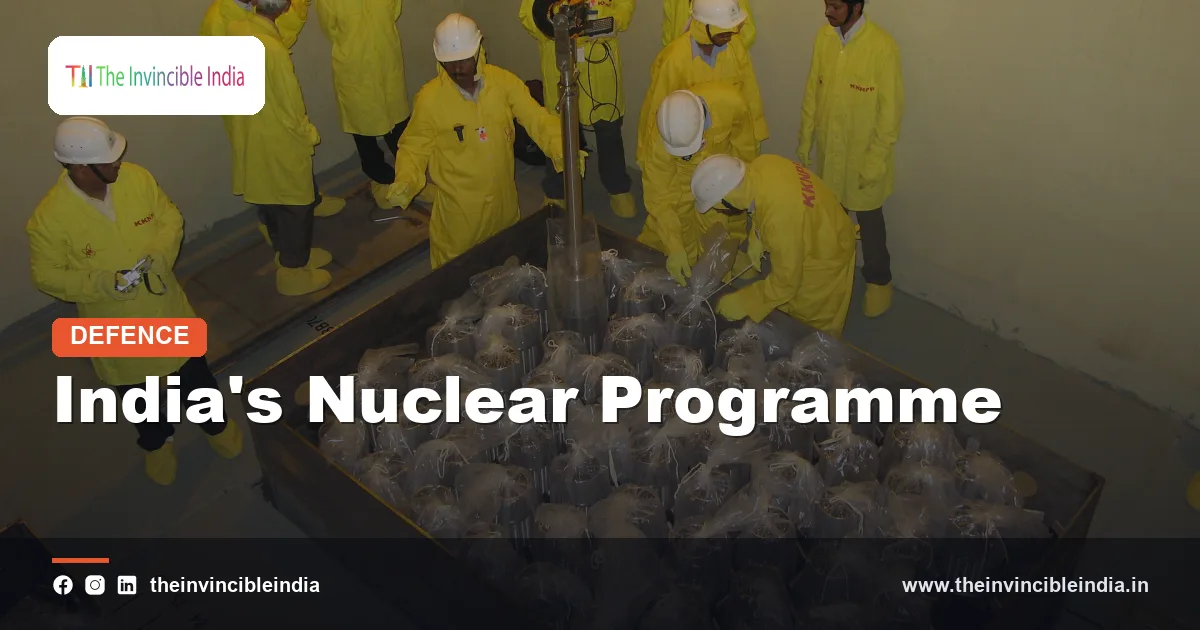
The India nuclear programme is one of the most closely studied technology and security projects of the modern world. It began in the 1940s as a scientific dream of building an independent atomic energy base for a newly free country, and it grew into a two-track enterprise: a civilian effort to generate electricity, produce isotopes and advance research, and a strategic effort that gave India a credible nuclear deterrent. Few other national programmes have combined these two strands under such a distinctive philosophy of self-reliance.
This explainer walks through the whole story in plain language. It covers the founding vision of Homi J. Bhabha, the three-stage power plan built around India’s thorium reserves, the tests of 1974 and 1998, the doctrine of credible minimum deterrence and No First Use, the nuclear triad, India’s position outside the NPT, and the 2008 civil nuclear agreement that ended decades of technological isolation. Last updated: 29 September 2026.
| Item | Detail |
|---|---|
| Founding architect | Homi Jehangir Bhabha, regarded as the father of India’s nuclear programme |
| Atomic Energy Commission | Set up in 1948 |
| Department of Atomic Energy | Created in 1954, reporting directly to the Prime Minister |
| First nuclear test | Pokhran-I (“Smiling Buddha”), 18 May 1974, described as a “peaceful nuclear explosion” |
| Second series of tests | Pokhran-II (Operation Shakti), 11 and 13 May 1998, five tests in all |
| Core doctrine | Credible minimum deterrence, No First Use, massive retaliation, civilian political control |
| Command structure | Nuclear Command Authority with a Political Council and an Executive Council; Strategic Forces Command |
| Civil nuclear breakthrough | India-US civil nuclear deal and the Nuclear Suppliers Group waiver of 2008 |
The Founding Vision: Homi J. Bhabha and Nuclear Self-Reliance
The story begins with Homi Jehangir Bhabha, a Cambridge-trained physicist who returned to India during the Second World War. In 1944 he wrote to the Sir Dorabji Tata Trust arguing that India would one day need nuclear energy and must build its own scientific capacity to use it. The result was the Tata Institute of Fundamental Research, founded in Bombay in 1945, which became the nursery of Indian atomic science.
Why atomic energy mattered to a young republic
Bhabha and Jawaharlal Nehru shared the belief that modern science was central to nation-building. Newly independent India was poor in industrial power capacity, and atomic energy promised electricity, medical isotopes, better agriculture and industrial gauges. Nehru repeatedly stressed that atomic energy should be used for peaceful development, yet he also declined to rule out a future strategic role should circumstances change.
Building the base
- Nuclear scientists were trained in India and abroad, and prospecting for atomic minerals began early.
- Thorium-rich beach sands, especially along the Kerala coast, and uranium deposits in eastern India were mapped.
- The Atomic Energy Establishment at Trombay, later renamed the Bhabha Atomic Research Centre (BARC) after Bhabha’s death in 1966, became the main research complex.
- Research reactors such as Apsara, which went critical in 1956, gave Indian scientists hands-on experience.
Institutions: The Atomic Energy Commission and the Department of Atomic Energy
Two institutional decisions shaped everything that followed. The Atomic Energy Act of 1948 led to the creation of the Atomic Energy Commission (AEC) in August 1948, with Bhabha as its first chairman. In 1954 the Department of Atomic Energy (DAE) was established, and it was placed directly under the Prime Minister, a structure that has continued. This gave the nuclear enterprise unusual autonomy, steady funding and top-level political attention.
The DAE family
Over the decades the DAE grew into a network of research centres, public sector undertakings and aided institutions. Its major arms include:
- Bhabha Atomic Research Centre (BARC): multidisciplinary research, reactor design and fuel cycle work.
- Indira Gandhi Centre for Atomic Research (IGCAR), Kalpakkam: fast reactor science and technology.
- Nuclear Power Corporation of India Limited (NPCIL): designs, builds and operates the country’s nuclear power plants.
- Atomic Minerals Directorate and other public sector units: exploration, mining and processing of uranium, thorium and rare earths.
- Atomic Energy Regulatory Board (AERB): the safety regulator for nuclear and radiation facilities.
The design principle behind all of them was an end-to-end fuel cycle, so that India would not depend on external suppliers at any stage.
The Three-Stage Nuclear Power Programme
India’s civilian strategy is unlike that of most countries because of a geological fact: the country has modest reserves of uranium but very large reserves of thorium. Bhabha therefore designed, in the 1950s, a three-stage programme that would use uranium first and then gradually shift to thorium as the long-term fuel.
Stage one: Pressurised Heavy Water Reactors
The first stage uses Pressurised Heavy Water Reactors (PHWRs) fuelled by natural uranium and moderated by heavy water. These reactors generate electricity and, as a by-product, produce plutonium in their spent fuel. This stage has been the workhorse of Indian nuclear power, and the country has built many indigenous PHWR units of standardised design.
Stage two: Fast Breeder Reactors
The second stage uses plutonium recovered by reprocessing the spent fuel of stage one. In Fast Breeder Reactors, plutonium is used as the fuel while a blanket of uranium-238 or thorium around the core is converted into more fissile material, so the reactor can “breed” more fuel than it burns. India’s Fast Breeder Test Reactor at Kalpakkam began operating in the 1980s, and a larger Prototype Fast Breeder Reactor has been developed there as the stepping stone to commercial breeders.
Stage three: thorium-based reactors
The third stage aims at a self-sustaining chain built on thorium and uranium-233. Thorium itself is not fissile, but it can be converted to uranium-233 inside a reactor. India has tested the concept in small research reactors such as Kamini at Kalpakkam and has designed an Advanced Heavy Water Reactor for thorium use. Because thorium reserves are large, this stage promises long-term energy security, although it remains the most technically demanding.
Pokhran-I: The “Smiling Buddha” of 1974
By the early 1960s the strategic setting around India had changed. The Sino-Indian conflict of 1962 was followed by China’s first nuclear test in October 1964, and the major powers were moving to freeze the nuclear club. Indian scientists had by then acquired the plutonium and engineering skills that could support a test.
On 18 May 1974, India conducted an underground nuclear explosion at the Pokhran test range in Rajasthan under Prime Minister Indira Gandhi. The device was code-named “Smiling Buddha”, and the government described it as a “peaceful nuclear explosion”, pointing to potential uses in mining and earth-moving. India did not declare itself a nuclear-weapon state at that time.
Consequences
- Several countries tightened nuclear export controls, and the Nuclear Suppliers Group (NSG) was formed in the mid-1970s partly in response.
- Foreign supply of nuclear fuel and technology to India was curtailed, pushing the country further towards indigenous solutions.
- India’s civilian programme continued, but it did so under a long period of technology denial.
Pokhran-II: Operation Shakti of 1998
For nearly a quarter of a century India kept its nuclear option in a state of ambiguity. That changed in May 1998. On 11 May, India carried out three underground tests at Pokhran, and on 13 May it conducted two more, for a total of five tests under the code name Operation Shakti. The tests took place when Atal Bihari Vajpayee was Prime Minister, and senior scientists from the DAE and the Defence Research and Development Organisation, including Dr A. P. J. Abdul Kalam and Dr R. Chidambaram, played prominent roles.
Declaration and moratorium
After the tests India announced that it was a nuclear-weapon state and declared a voluntary moratorium on further underground testing. Several countries imposed economic sanctions, but these were gradually eased over the following years as India explained its restraint and as strategic engagement deepened.
National Technology Day
The successful tests are commemorated every year on 11 May as National Technology Day, which honours India’s scientists, engineers and technological achievements more broadly, from space missions to indigenous defence systems.
India’s Nuclear Doctrine: Credible Minimum Deterrence and No First Use
A draft nuclear doctrine prepared by the National Security Advisory Board was released in August 1999. In January 2003 the Cabinet Committee on Security reviewed the operationalisation of the doctrine and released a public summary. Its main pillars are as follows.
- Credible minimum deterrence: India builds and maintains a nuclear force that is sufficient to deter an adversary, without engaging in an open-ended arms race.
- No First Use (NFU): nuclear weapons will be used only in retaliation against a nuclear attack on Indian territory or on Indian forces anywhere.
- Massive retaliation: a nuclear attack on India will be met with a response designed to inflict damage that the aggressor would find unacceptable.
- Non-use against non-nuclear-weapon states: India does not threaten nuclear use against states that do not possess such weapons.
- Chemical and biological attack: the 2003 statement reserved the option of a nuclear response if India or its forces were attacked with chemical or biological weapons causing major damage.
- Continued export controls and support for a fissile material cut-off treaty: the doctrine links deterrence with responsible behaviour on non-proliferation.
India has also maintained its voluntary moratorium on nuclear testing while remaining outside the Comprehensive Nuclear-Test-Ban Treaty.
Command and Control: The Nuclear Command Authority
Any decision to use nuclear weapons rests with civilian leadership. The Nuclear Command Authority (NCA), formally set up in January 2003, consists of two layers.
- Political Council: chaired by the Prime Minister. It is the only body that can authorise the use of nuclear weapons.
- Executive Council: chaired by the National Security Adviser. It provides inputs for decision-making by the Political Council and carries out its directives.
Strategic Forces Command
The Strategic Forces Command (SFC), also created in 2003, is a tri-service command that manages and administers the nuclear forces. It is headed by a Commander-in-Chief of the rank of a three-star officer, who reports to the Executive Council. The arrangement keeps custody and employment of the weapons under strict political control while allowing the armed forces to handle day-to-day operations. Such separation between civilian decision-making and military execution is a central feature of the Indian model.
The Nuclear Triad: Land, Air and Sea
A credible retaliatory capability requires that some part of the force survives a first strike. For this reason India has worked to build a triad, meaning delivery options from land, air and sea.
| Leg of the triad | Main platforms | Notes |
|---|---|---|
| Land | Prithvi and the Agni series of ballistic missiles | Developed indigenously by the DRDO; the Agni family ranges from medium-range to long-range systems |
| Air | Nuclear-capable fighter aircraft of the Indian Air Force | The earliest and most flexible delivery route, complemented by modern strike aircraft |
| Sea | Arihant-class nuclear-powered ballistic missile submarines (SSBNs) | INS Arihant was commissioned in 2016 and provides a survivable second-strike capability |
Why the sea leg matters
Submarines can remain hidden for long periods, which makes them the most survivable part of any deterrent. INS Arihant, built under the classified Advanced Technology Vessel project, was the first Indian submarine of this type, and follow-on boats of the class have since joined or are being built. Together with submarine-launched missiles, they reinforce the No First Use policy, because a nation that pledges not to strike first must be sure it can strike back.
Outside the NPT, Inside the Non-Proliferation Mainstream
The Treaty on the Non-Proliferation of Nuclear Weapons (NPT) was opened for signature in 1968 and came into force in 1970. It recognises as nuclear-weapon states only those that had tested a device before 1 January 1967. India has never signed it, arguing that it divides the world into permanent nuclear “haves” and “have-nots” and does not impose a genuine timetable for disarmament by the recognised powers.
India’s stated position
- India supports the goal of a nuclear-weapon-free world through a universal, non-discriminatory and verifiable framework.
- It declined to join the Comprehensive Nuclear-Test-Ban Treaty in the 1990s, but maintains its own voluntary moratorium.
- It has an unblemished record of not passing nuclear technology to other countries and has put in place strict domestic export control laws.
In later years India was admitted to other export-control regimes, such as the Missile Technology Control Regime, the Wassenaar Arrangement and the Australia Group, which recognised its non-proliferation conduct. Membership of the Nuclear Suppliers Group is still an ongoing diplomatic objective.
The 2008 India-US Civil Nuclear Deal and the NSG Waiver
After 1974 and again after 1998, India faced a regime of sanctions and restrictions. It could not easily import reactors or uranium, and its civil programme had to make do with domestic uranium of limited quality. This isolation was ended through a series of steps between 2005 and 2008.
Steps to the deal
- July 2005: a joint statement by Prime Minister Manmohan Singh and US President George W. Bush announced civil nuclear cooperation.
- 2006: India presented a plan to separate its civil and military nuclear facilities, and the US Congress passed the Henry J. Hyde Act.
- August 2008: the IAEA Board of Governors approved an India-specific safeguards agreement.
- 6 September 2008: the Nuclear Suppliers Group granted India a special waiver allowing civil nuclear trade.
- October 2008: the bilateral “123 Agreement” between India and the United States was signed.
What changed
The waiver let India buy reactors and fuel from several countries, and it recognised India as a responsible state with advanced nuclear technology, without requiring it to sign the NPT. In return, India placed its declared civilian facilities under IAEA safeguards. Agreements with other partners, including France, Russia and Canada, followed. Many analysts consider this the most significant shift in India’s global nuclear standing.
Civilian Nuclear Power: Tarapur, Kudankulam and Beyond
The civilian side of the story is easier to see on the map. India has a network of nuclear power stations spread across several states.
- Tarapur (Maharashtra): the site of India’s first commercial nuclear power station, which began operating in 1969 with boiling water reactors built with foreign help.
- Rawatbhata (Rajasthan): home to the early PHWR units based on a Canadian design, which India subsequently indigenised.
- Kalpakkam (Tamil Nadu): the Madras Atomic Power Station and the centre for fast reactor development.
- Narora (Uttar Pradesh), Kakrapar (Gujarat) and Kaiga (Karnataka): stations that use India’s standard PHWR designs.
- Kudankulam (Tamil Nadu): large light-water reactors built with Russian cooperation, made possible after the end of the isolation regime.
Regulation and liability
Safety is overseen by the Atomic Energy Regulatory Board, and India’s Civil Liability for Nuclear Damage Act of 2010 sets out the framework for compensation in the event of an accident. The law has been the subject of considerable discussion among suppliers and operators.
Nuclear Energy and India’s Clean Energy Goals
Nuclear power supplies a small single-digit share of India’s electricity today, but it is regarded as an important low-carbon, round-the-clock source. India announced at the COP26 climate conference in 2021 that it aims to reach net-zero emissions by 2070, and nuclear energy is expected to work alongside solar, wind, hydro and other renewable sources in meeting that goal.
Advantages and challenges
- Baseload supply: nuclear plants can operate steadily regardless of weather or time of day.
- Low carbon: they emit very little carbon dioxide during operation.
- Long-term fuel security: the thorium-based third stage could reduce reliance on imported uranium.
- Challenges: high capital costs, long construction timelines, land acquisition, public acceptance and waste management.
Beyond power, the DAE’s work has also produced radioisotopes for cancer care, radiation-based food preservation and crop varieties developed through mutation breeding.
Timeline of the Indian Nuclear Journey, 1948-2008
| Year | Milestone |
|---|---|
| 1945 | Tata Institute of Fundamental Research founded in Bombay under Homi J. Bhabha |
| 1948 | Atomic Energy Act passed and the Atomic Energy Commission established |
| 1954 | Department of Atomic Energy created; Trombay establishment set up |
| 1956 | Apsara, India’s first research reactor, goes critical |
| 1964 | China conducts its first nuclear test |
| 1966 | Death of Homi J. Bhabha |
| 1969 | Tarapur atomic power station begins operation |
| 1974 | Pokhran-I, “Smiling Buddha” (18 May) |
| 1985 | Fast Breeder Test Reactor begins operating at Kalpakkam |
| 1998 | Pokhran-II, Operation Shakti (11 and 13 May) |
| 1999 | Draft nuclear doctrine released |
| 2003 | Nuclear Command Authority and Strategic Forces Command formalised |
| 2008 | IAEA safeguards approval and the NSG waiver (September) for India |
Conclusion
The India nuclear programme grew out of a scientific and developmental idea and matured into a comprehensive national capability. Its civilian half, built on the three-stage plan, is aimed at long-term energy security through thorium. Its strategic half, defined by credible minimum deterrence and No First Use, is designed for restraint rather than aggression. The 2008 civil nuclear breakthrough allowed both halves to operate in the open, with international cooperation and safeguards, and today the programme stands as a case study in how a country can pursue technological self-reliance while trying to remain a responsible member of the global nuclear order.
Frequently Asked Questions
Who is called the father of India’s nuclear programme?
Homi Jehangir Bhabha is regarded as the father of India’s nuclear programme. He founded the Tata Institute of Fundamental Research, became the first chairman of the Atomic Energy Commission in 1948, and designed the three-stage nuclear power plan. The Bhabha Atomic Research Centre in Mumbai is named after him.
What is India’s nuclear doctrine?
India follows a doctrine of credible minimum deterrence based on No First Use. Nuclear weapons are meant to be used only in retaliation for a nuclear attack on Indian territory or on Indian forces, and the response would be massive. India also does not use or threaten to use nuclear weapons against states that do not have them, and all decisions rest with civilian political leadership.
What was the difference between Pokhran-I and Pokhran-II?
Pokhran-I, the “Smiling Buddha” test of 18 May 1974, was a single underground explosion described as a peaceful nuclear explosion. Pokhran-II, or Operation Shakti, consisted of five tests on 11 and 13 May 1998, after which India formally declared itself a nuclear-weapon state and announced a voluntary moratorium on further testing.
Why has India not signed the NPT?
India regards the Non-Proliferation Treaty as discriminatory because it permits only countries that tested before 1 January 1967 to be recognised as nuclear-weapon states and does not set a firm timetable for their disarmament. India instead supports universal, non-discriminatory disarmament and follows strict export controls of its own.
What is the three-stage nuclear power programme?
It is a long-term plan proposed by Homi Bhabha to use India’s limited uranium and large thorium reserves. Stage one uses Pressurised Heavy Water Reactors with natural uranium, stage two uses Fast Breeder Reactors fuelled with plutonium, and stage three uses thorium-based reactors that rely on uranium-233.
How did the 2008 India-US nuclear deal help India?
The deal, together with the Nuclear Suppliers Group waiver of September 2008, ended India’s nuclear isolation. It allowed India to import reactors and fuel for its civilian programme and to cooperate with other countries in return for placing its civilian facilities under IAEA safeguards, even though it remained outside the NPT.
{“@context”:”https://schema.org”,”@graph”:[{“@type”:”FAQPage”,”mainEntity”:[{“@type”:”Question”,”name”:”Who is called the father of India’s nuclear programme?”,”acceptedAnswer”:{“@type”:”Answer”,”text”:”Homi Jehangir Bhabha is regarded as the father of India’s nuclear programme. He founded the Tata Institute of Fundamental Research, became the first chairman of the Atomic Energy Commission in 1948, and designed the three-stage nuclear power plan. The Bhabha Atomic Research Centre in Mumbai is named after him.”}},{“@type”:”Question”,”name”:”What is India’s nuclear doctrine?”,”acceptedAnswer”:{“@type”:”Answer”,”text”:”India follows a doctrine of credible minimum deterrence based on No First Use. Nuclear weapons are meant to be used only in retaliation for a nuclear attack on Indian territory or on Indian forces, and the response would be massive. India also does not use or threaten to use nuclear weapons against states that do not have them, and all decisions rest with civilian political leadership.”}},{“@type”:”Question”,”name”:”What was the difference between Pokhran-I and Pokhran-II?”,”acceptedAnswer”:{“@type”:”Answer”,”text”:”Pokhran-I, the “Smiling Buddha” test of 18 May 1974, was a single underground explosion described as a peaceful nuclear explosion. Pokhran-II, or Operation Shakti, consisted of five tests on 11 and 13 May 1998, after which India formally declared itself a nuclear-weapon state and announced a voluntary moratorium on further testing.”}},{“@type”:”Question”,”name”:”Why has India not signed the NPT?”,”acceptedAnswer”:{“@type”:”Answer”,”text”:”India regards the Non-Proliferation Treaty as discriminatory because it permits only countries that tested before 1 January 1967 to be recognised as nuclear-weapon states and does not set a firm timetable for their disarmament. India instead supports universal, non-discriminatory disarmament and follows strict export controls of its own.”}},{“@type”:”Question”,”name”:”What is the three-stage nuclear power programme?”,”acceptedAnswer”:{“@type”:”Answer”,”text”:”It is a long-term plan proposed by Homi Bhabha to use India’s limited uranium and large thorium reserves. Stage one uses Pressurised Heavy Water Reactors with natural uranium, stage two uses Fast Breeder Reactors fuelled with plutonium, and stage three uses thorium-based reactors that rely on uranium-233.”}},{“@type”:”Question”,”name”:”How did the 2008 India-US nuclear deal help India?”,”acceptedAnswer”:{“@type”:”Answer”,”text”:”The deal, together with the Nuclear Suppliers Group waiver of September 2008, ended India’s nuclear isolation. It allowed India to import reactors and fuel for its civilian programme and to cooperate with other countries in return for placing its civilian facilities under IAEA safeguards, even though it remained outside the NPT.”}}]}]}


