

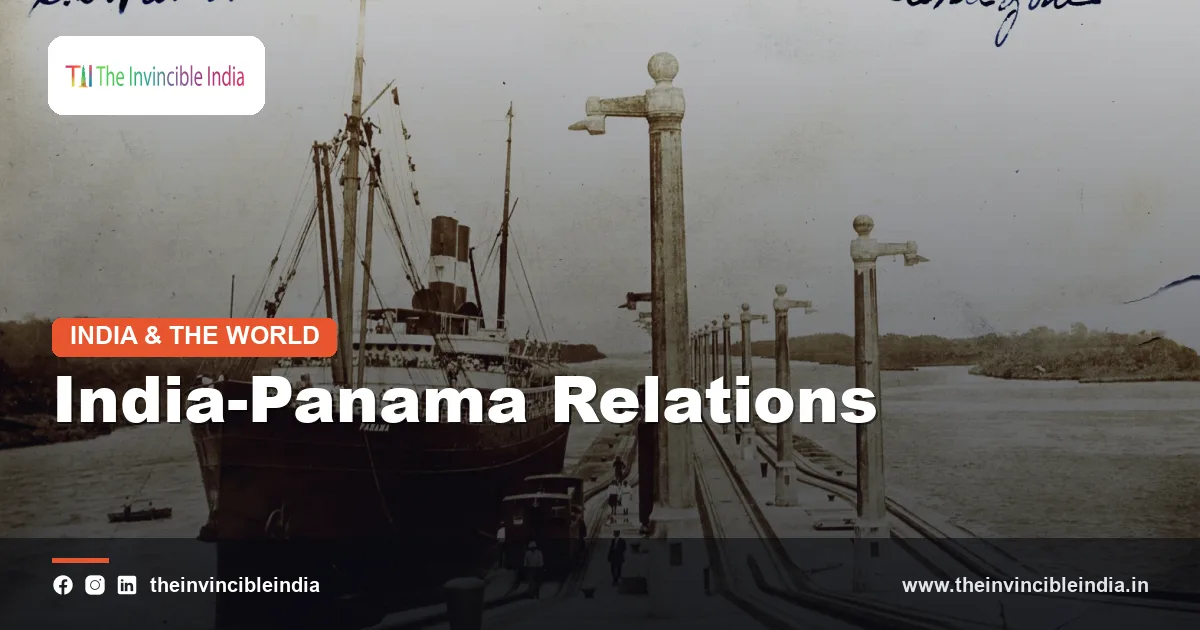
India-Panama relations are the bilateral ties between the Republic of India and the Republic of Panama, a partnership shaped by the Panama Canal, the Colón Free Zone, Panama’s status as the world’s largest ship registry, and a well-established Indian-origin business community. Diplomatic relations were established in the early 1970s, and Panama serves India as a commercial and logistics gateway to Central America, the Caribbean and the wider Americas.
Although the two countries are far apart and political contacts at the highest level are infrequent, their economic links are significant because of shipping, re-export trade and seafaring. This explainer sets out the history, the importance of the canal, trade, the diaspora and the prospects for the relationship. It was last reviewed on 17 October 2026.
| Attribute | Details |
|---|---|
| Diplomatic relations | Established in the early 1970s (commonly cited as 1971) |
| Indian mission | Embassy of India, Panama City |
| Panamanian mission | Embassy of Panama, New Delhi |
| Defining feature | Panama Canal, opened in 1914 and expanded with a third set of locks in 2016 |
| Trade hub | Colón Free Zone, one of the largest free trade zones in the world, with a notable Indian business presence |
| Maritime link | Panama operates the world’s largest ship registry, widely used by Indian and international owners |
| Indian-origin community | Estimated at roughly ten to fifteen thousand people, mostly traders and professionals |
| Main Indian exports | Pharmaceuticals, textiles, garments, vehicles, machinery, consumer goods |
Key Takeaways
- India and Panama have maintained diplomatic relations since the early 1970s, and the partnership is anchored in shipping, trade and the Indian-origin community rather than in political or security cooperation.
- The Panama Canal links the Atlantic and Pacific oceans across a roughly 80-kilometre isthmus and carries a few per cent of global maritime trade, making it important to Indian shippers and traders even without being on every Indian route.
- Panama’s ship registry is the largest in the world, and many Indian-owned or Indian-crewed vessels sail under the Panamanian flag.
- The Colón Free Zone, established in 1948, is a major re-export centre in which Indian traders play a visible role, particularly in textiles, electronics and consumer goods.
- The Indian community in Panama is long-established and active in business, and it provides a ready link between Indian exporters and Latin American buyers.
- Bilateral trade is modest in comparison with India’s trade with large Latin American economies, but Panama’s logistics role gives it strategic value in India’s outreach to the Americas.
What are India-Panama relations?
India-Panama relations are a cordial economic and diplomatic partnership in which Panama functions as a logistics, financial and trading gateway for Indian business in Central America and the Caribbean. Unlike India’s ties with some larger Latin American countries, the relationship does not rest on large defence or energy agreements, but on maritime services, commerce and community links.
India has an embassy in Panama City and Panama has an embassy in New Delhi. The two governments consult on trade, shipping, consular matters and international forums, and they have exchanged ministerial and parliamentary delegations from time to time. The relationship has remained free of disputes since it began.
Why does the Panama Canal matter to India?
The Panama Canal matters to India because it is one of the world’s key maritime shortcuts, affecting freight costs, shipping schedules and trade flows between the Atlantic and Pacific sides of the Americas and between Asia and the American east coast. The waterway opened in 1914, was managed by the United States until it was handed to Panama on 31 December 1999, and is now run by the Panama Canal Authority (ACP).
The canal is not on every Indian trade route. Many cargoes from Indian ports to the United States east coast and Europe travel through the Suez Canal or around the Cape of Good Hope, while Indian cargoes to the Pacific coast of the Americas can cross the Pacific. Even so, the canal’s performance affects India indirectly through global freight rates, container availability and energy shipping patterns. Whenever transits are slowed by drought or congestion, as occurred during the dry spell of 2023-2024, global shipping costs and schedules can change.
India also has a direct interest in the canal as a user of the Americas’ Atlantic and Pacific coasts. Indian exporters shipping to Central America, the Caribbean and the northern part of South America often use transshipment hubs near the canal, and Indian importers of American commodities occasionally rely on canal routings depending on the market.
- Expansion: The third set of locks opened in June 2016 and allowed larger “Neopanamax” vessels to transit.
- Water supply: The canal relies on freshwater from Gatun Lake, so rainfall patterns influence the number of daily transits.
- Governance: The ACP operates the canal as an autonomous agency under Panama’s constitution.
How did India-Panama relations develop?
India-Panama relations developed in the early 1970s when the two governments established diplomatic ties, and they deepened later as India widened its economic outreach to Latin America and the Caribbean. Indian merchants had arrived in Panama earlier, drawn by the opportunities of a country that was a crossroads of world trade, and their presence preceded formal government-to-government cooperation.
Indian policy towards the region gained structure with the Focus LAC programme, launched in the late 1990s to promote trade with Latin America and the Caribbean, and with later business missions, forums and lines of credit. India also increased its engagement with regional organisations of the Americas, including as an observer in some forums, and Panama welcomed this wider interest.
Senior Indian leaders, ministers and parliamentary delegations have visited Central America in recent years, and Panamanian ministers have travelled to India for business and diplomatic meetings. These contacts have helped to keep consular, trade and cultural issues on the agenda.
What is the Indian-origin community in Panama?
The Indian-origin community in Panama is a well-established group of roughly ten to fifteen thousand people, many of them descended from traders who arrived from Gujarat and Sindh in the twentieth century and settled in Panama City and Colón. The community has become influential in retail, wholesale, electronics, textiles and re-export businesses.
Indian businesses in the Colón Free Zone import goods from India, China and elsewhere and sell them to buyers from across Latin America and the Caribbean. The community has built temples, cultural associations and schools, and it maintains close contact with India through family, business and cultural ties. Annual events such as Diwali and the International Day of Yoga attract wide participation.
These community networks help Indian exporters because they offer trusted local partners, knowledge of customs and language, and access to distribution channels. The Indian embassy works with them on consular services and business promotion.
What is the Colón Free Zone and why is it important?
The Colón Free Zone (CFZ) is a large duty-free commercial area on Panama’s Caribbean coast, created in 1948, in which companies can import, store, process and re-export goods with limited customs formalities. It is among the largest free trade zones in the world by trade volume and is a major distribution centre for Latin America and the Caribbean.
Indian firms use the CFZ to hold stocks of pharmaceuticals, garments, fabrics, electronics, footwear and general merchandise close to customers across the region. Buyers from neighbouring countries can visit, choose goods and ship them quickly, which cuts delivery times compared with sending orders directly from Asia.
The CFZ is also exposed to regional conditions. Economic slowdowns in Venezuela, Colombia and other customer markets, changes in customs rules and concerns about financial transparency in Panama have affected volumes in different years. Panama has taken steps to improve its compliance with international financial standards, which is relevant to Indian companies concerned about reputation and banking.
Why is Panama important for Indian shipping and seafarers?
Panama is important for Indian shipping and seafarers because it operates the world’s largest ship registry, and a large share of the global merchant fleet, including vessels owned or managed by Indian companies, sails under its flag. India is also one of the largest suppliers of trained seafarers in the world, and thousands of Indian officers and ratings serve on Panama-flagged ships.
Ship owners choose flags of convenience for reasons that include registration costs, taxes, regulatory flexibility and speed of services. Panama’s registry is administered by the Panama Maritime Authority, which maintains offices in many countries and works with classification societies and port state control systems.
Cooperation between the two countries on maritime issues covers seafarer certification, safety standards, the welfare of crew, piracy and the recovery of stranded or abandoned seafarers. Indian authorities, including the Directorate General of Shipping, have a regular interest in the treatment of Indian crew on foreign-flagged ships, and Panama is among the registries with which this dialogue matters.
How much trade is there between India and Panama?
Trade between India and Panama is moderate, generally in the range of several hundred million to around a billion US dollars a year, and heavily weighted towards Indian exports. The figures change with global shipping, commodity prices and re-export patterns, and the free zone makes official numbers difficult to interpret precisely.
Indian exports to Panama include pharmaceuticals, textiles and garments, vehicles and auto parts, machinery, chemicals, rice, jewellery and consumer goods. Many of these are destined not for Panama’s own market, which is small, but for re-export through the CFZ or for transshipment through Panamanian ports. Imports from Panama to India are much smaller and include items such as metal scrap, fish products and some other commodities.
| Area | Indian role | Panamanian role |
|---|---|---|
| Goods trade | Exports of pharma, textiles, vehicles and machinery | Re-export hub and consumer market, with small exports to India |
| Shipping | Shipowners, managers and seafarers | Largest ship registry and canal operator |
| Free zone | Traders and exporters with warehouses and offices | Colón Free Zone infrastructure and regulation |
| Diaspora | Business networks and cultural associations | Host society and legal framework |
| Capacity building | ITEC training and scholarships | Participation of Panamanian officials and students |
How does Panama fit into India’s Latin America and Caribbean outreach?
Panama fits into India’s Latin America and Caribbean outreach as a hub through which Indian goods, services and diplomacy can reach Central America, the Caribbean and northern South America. India has been broadening its engagement with the region through trade promotion, lines of credit, pharmaceutical exports, digital cooperation and participation in multilateral forums.
Panama offers several advantages for this purpose. It has a dollarised economy, a modern financial and logistics sector, good air connections through Tocumen International Airport and Copa Airlines, and an open attitude to foreign investment. Indian companies have used it as a regional base for sales, procurement and distribution.
India also cooperates with Panama in global forums such as the United Nations, where both countries are members of the Group of 77, and on topics like climate change, maritime security and the reform of global institutions. The two sides generally find common ground on questions of multilateralism and the interests of developing countries.
What are the challenges and prospects for India-Panama relations?
The challenges for India-Panama relations include long distance, the absence of direct flights, a modest official trade volume and concerns over the transparency of some offshore financial activity, while the prospects centre on logistics, shipping, pharmaceuticals and digital cooperation. The two countries do not have a bilateral free trade agreement, which limits preferential market access.
Future cooperation may include simplified visa procedures, agreements on investment protection, joint work on port and logistics projects, expanded pharmaceutical registration and closer coordination between maritime authorities. The Indian community will probably continue to be an asset, particularly if younger members of the diaspora move into technology, tourism and professional services.
Climate and water constraints on the canal add another dimension. Droughts have shown how vulnerable canal operations are to rainfall, and Indian shipping and trade interests have a stake in how Panama manages water supply, investment in new reservoirs and capacity planning.
Bottom Line
India-Panama relations are a trade, shipping and community-based partnership whose importance exceeds the size of bilateral trade, because Panama controls a key global waterway, hosts a major re-export zone and registers a large share of the world’s ships. The partnership is steady and uncontroversial, and its growth will depend on logistics, business links and wider Indian engagement with the Americas.
Frequently Asked Questions
When did India and Panama establish diplomatic relations?
India and Panama established diplomatic relations in the early 1970s, with 1971 commonly cited. India has an embassy in Panama City and Panama has an embassy in New Delhi.
Why is the Panama Canal important to India?
The Panama Canal is important to India because it shapes global freight costs and trade flows between the Atlantic and Pacific and between Asia and the Americas. It is not on every Indian trade route, but disruptions to canal transits can affect shipping schedules and prices that Indian exporters and importers face.
How large is the Indian community in Panama?
The Indian community in Panama is estimated at roughly ten to fifteen thousand people. Many are traders of Gujarati and Sindhi origin who work in the Colón Free Zone and in wholesale and retail businesses in Panama City.
What is the Colón Free Zone and what is its connection with India?
The Colón Free Zone is a duty-free commercial area on Panama’s Caribbean coast, established in 1948, that serves as a re-export hub for Latin America and the Caribbean. Indian traders and exporters operate warehouses and offices there, selling goods such as textiles, pharmaceuticals and electronics to regional buyers.
What does India export to Panama?
India exports pharmaceuticals, textiles and garments, vehicles and auto parts, machinery, chemicals, rice and consumer goods to Panama. A large share of these goods is re-exported to other countries in the region through the Colón Free Zone.
Why do Indian ships and seafarers use the Panama flag?
Many Indian-owned or managed ships use the Panama flag because Panama runs the world’s largest ship registry and offers competitive registration and regulatory conditions. India is also a leading supplier of seafarers, so many Indian officers and crew serve on Panama-flagged vessels.
{“@context”:”https://schema.org”,”@graph”:[{“@type”:”FAQPage”,”mainEntity”:[{“@type”:”Question”,”name”:”When did India and Panama establish diplomatic relations?”,”acceptedAnswer”:{“@type”:”Answer”,”text”:”India and Panama established diplomatic relations in the early 1970s, with 1971 commonly cited. India has an embassy in Panama City and Panama has an embassy in New Delhi.”}},{“@type”:”Question”,”name”:”Why is the Panama Canal important to India?”,”acceptedAnswer”:{“@type”:”Answer”,”text”:”The Panama Canal is important to India because it shapes global freight costs and trade flows between the Atlantic and Pacific and between Asia and the Americas. It is not on every Indian trade route, but disruptions to canal transits can affect shipping schedules and prices that Indian exporters and importers face.”}},{“@type”:”Question”,”name”:”How large is the Indian community in Panama?”,”acceptedAnswer”:{“@type”:”Answer”,”text”:”The Indian community in Panama is estimated at roughly ten to fifteen thousand people. Many are traders of Gujarati and Sindhi origin who work in the Colu00f3n Free Zone and in wholesale and retail businesses in Panama City.”}},{“@type”:”Question”,”name”:”What is the Colu00f3n Free Zone and what is its connection with India?”,”acceptedAnswer”:{“@type”:”Answer”,”text”:”The Colu00f3n Free Zone is a duty-free commercial area on Panama’s Caribbean coast, established in 1948, that serves as a re-export hub for Latin America and the Caribbean. Indian traders and exporters operate warehouses and offices there, selling goods such as textiles, pharmaceuticals and electronics to regional buyers.”}},{“@type”:”Question”,”name”:”What does India export to Panama?”,”acceptedAnswer”:{“@type”:”Answer”,”text”:”India exports pharmaceuticals, textiles and garments, vehicles and auto parts, machinery, chemicals, rice and consumer goods to Panama. A large share of these goods is re-exported to other countries in the region through the Colu00f3n Free Zone.”}},{“@type”:”Question”,”name”:”Why do Indian ships and seafarers use the Panama flag?”,”acceptedAnswer”:{“@type”:”Answer”,”text”:”Many Indian-owned or managed ships use the Panama flag because Panama runs the world’s largest ship registry and offers competitive registration and regulatory conditions. India is also a leading supplier of seafarers, so many Indian officers and crew serve on Panama-flagged vessels.”}}]}]}


